
The famous temples in Karnataka represent one of the most architecturally magnificent, spiritually diverse, and historically resilient sacred landscapes in all of India. Karnataka is the extraordinary meeting point of four monumental traditions of Sanatana Dharma: the Vaishnava Bhakti devotion of Udupi and the Hoysala master-builders of Belur, the Shaiva pilgrimages of Hampi, Murudeshwar, and Gokarna, the royal Shakti worship of Chamundeshwari in Mysuru, and the pure Advaita Vedanta founded on the banks of the Tunga by Adi Shankaracharya at Sringeri.
While travellers often ask about Jyotirlingas in Karnataka, scriptural tradition holds that Karnataka preserves something equally supreme: the legendary Atma Linga of Lord Shiva at Gokarna (the eternal soul of Shiva's power), alongside the 123-foot coastal Shiva colossus at Murudeshwar, 1,400 years of unbroken living daily worship at Hampi's Virupaksha, and the UNESCO-crowned soapstone miracles of the Hoysalas. In this complete 2026-2027 pilgrimage guide, I provide verified darshan timings, free vs. special seva fees, authentic legends, temple dress codes, and five ready-to-use yatra circuits from Bengaluru and Mangaluru. Jai Kannadamba!
Top 10 Famous Temples in Karnataka (2026-2027) - Quick Reference
| # | Temple | City / District | Presiding Deity | Daily Timings | Entry Fee |
|---|---|---|---|---|---|
| 1 | Udupi Sri Krishna Temple | Udupi | Lord Krishna (Kadagolu Krishna) | 4:00 AM - 9:00 PM | Free | Anna Brahma Meals |
| 2 | Kukke Subramanya Temple | Sullia, Dakshina Kannada | Lord Subramanya & Vasuki | 5:30 AM - 8:30 PM | Free* (Paid Sevas) |
| 3 | Hampi Virupaksha UNESCO | Hampi, Vijayanagara | Lord Shiva (Virupaksha) | 6:00 AM - 6:00 PM | Free Darshan (ASI monuments ₹40) |
| 4 | Belur Chennakeshava UNESCO | Belur, Hassan | Lord Vishnu (Vijayanarayana) | 7:30 AM - 8:30 PM | FREE (Active Temple) |
| 5 | Halebidu Hoysaleswara UNESCO | Halebidu, Hassan | Lord Shiva (Twin Shrines) | 6:00 AM - 6:00 PM | FREE (ASI Monument) |
| 6 | Chamundeshwari Shakti Peeth | Chamundi Hill, Mysuru | Goddess Chamundeshwari | 7:30 AM - 9:00 PM | Free | Special ₹30-₹100 |
| 7 | Murudeshwar Temple | Bhatkal, Uttara Kannada | Lord Shiva (123-ft Colossus) | 6:00 AM - 8:30 PM | Free (Tower lift ₹10) |
| 8 | Dharmasthala Sri Manjunatha | Dharmasthala, D. Kannada | Lord Manjunatha (Shiva) | 6:30 AM - 8:30 PM | Free | Daily Annadana |
| 9 | Sringeri Sharada Peetham | Sringeri, Chikkamagaluru | Goddess Sharadamba & Shiva | 6:00 AM - 9:00 PM | Free | Annaprasada |
| 10 | Gokarna Mahabaleshwar | Gokarna, Uttara Kannada | Lord Shiva (Atma Linga) | 6:00 AM - 8:00 PM | Free (Dhoti required) |
* Free general darshan at all active shrines; optional paid sevas and special entry passes are available via official temple portals. Hampi Virupaksha is free for darshan, while separate ASI monuments (Vittala Temple, Zenana Enclosure) require an ASI monument ticket (₹40 Indians / ₹600 Foreigners).
1. Udupi Sri Krishna Temple - The Kanakana Kindi Window & Dvaita Vedanta Tradition
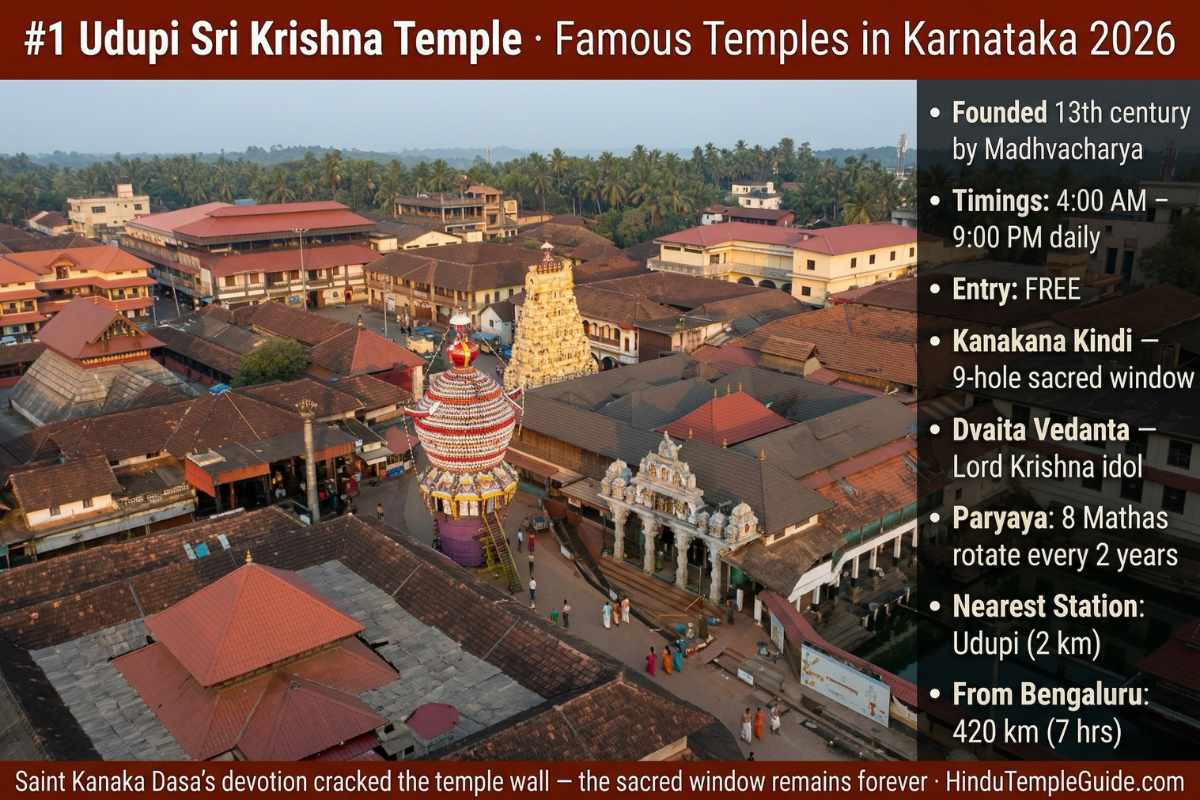
| Founded & Tradition | 13th century CE by Jagadguru Sri Madhvacharya, founder of the Dvaita (Dualistic) school of Vedanta |
| Presiding Deity | Kadagolu Krishna (Child Krishna holding a butter-churning rod in one hand and rope in the other) |
| Darshan Timings | 4:00 AM - 9:00 PM daily (Continuous darshan through 14 daily poojas and aartis) · 100% FREE |
| Kanakana Kindi | Unique 9-hole silver-plated sacred window through which all devotees view the Lord |
| Ashta Mathas & Paryaya | 8 monastic maths rotate temple administration every 2 years (Paryaya Mahotsava in January of even years) |
| Getting There | Udupi Railway Station (3 km) · Mangaluru International Airport (IXE - 58 km) · Bengaluru 405 km |
Unlike traditional Hindu temples where devotees enter directly through a main doorway to face the sanctum, Udupi Sri Krishna Matha is globally unique: no devotee-not even kings or prime ministers-enters through a front door. Instead, every single pilgrim views the radiant idol of Balakrishna through a carved silver-plated nine-hole window known as the Kanakana Kindi (Kanaka's Window).
The 500-year-old legend is one of the most powerful testaments to equality of devotion in the Bhakti movement. In the 16th century, the great saint, poet, and composer Kanaka Dasa was barred from entering the temple by orthodox priests because of his lower-caste birth. Unfazed, Kanaka Dasa stood at the western outer wall playing his tambura and singing heartfelt kirtans to Lord Krishna. His devotion was so absolute that the western stone wall cracked open and the idol of Lord Krishna miraculously turned around from east to west to face him through the fissure! Acharya Vadiraja Tirtha subsequently framed the crack with the ornate nine-hole screen that remains worshipped today.
2. Kukke Subramanya Temple - Most Powerful Sarpa Dosha Remedy in India
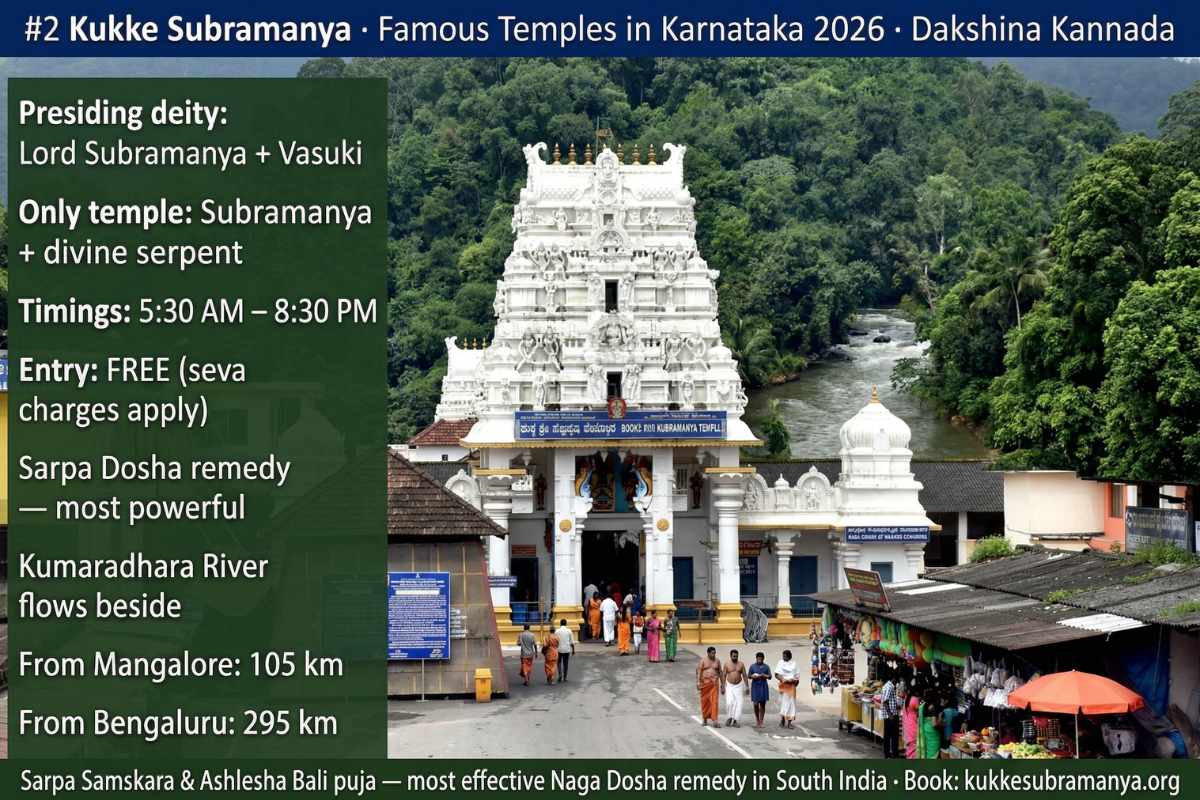
| Presiding Deity | Lord Subramanya (Kartikeya) worshipped alongside the sacred serpent king Vasuki |
| Darshan Timings | 5:30 AM - 8:30 PM daily (Maha Pooja: 12:30 PM & 7:30 PM) · Free general darshan |
| Key Nivarana Sevas | Sarpa Samskara (2-day ritual), Ashlesha Bali, and Naga Pratishta |
| Sacred Setting | Encircled by the lush Pushpagiri Wildlife Sanctuary with the sacred Kumaradhara River flowing alongside |
| Official Booking Portal | itms.kar.nic.in / kukkesubramanya.org · Subrahmanya Road Stn (12 km) · Mangaluru 105 km |
Sheltered in the pristine valleys of the Western Ghats under the towering shadow of Kumara Parvatha (Pushpagiri), Kukke Subramanya Temple in Dakshina Kannada is universally recognized as the foremost shrine in India for remedies against Sarpa Dosha (Naga Dosha), Kala Sarpa Dosha, delayed marriage, and ancestral obstacles. According to the Skanda Purana (Sanatkumara Samhita), when Garuda waged war against the serpent race, the divine serpent king Vasuki performed severe penance in the Biladwara cave here; Lord Subramanya appeared, blessed Vasuki with his eternal protection, and declared that he would forever reside here jointly with Vasuki.
3. Hampi Virupaksha Temple - UNESCO World Heritage & Living Temple Since 7th Century
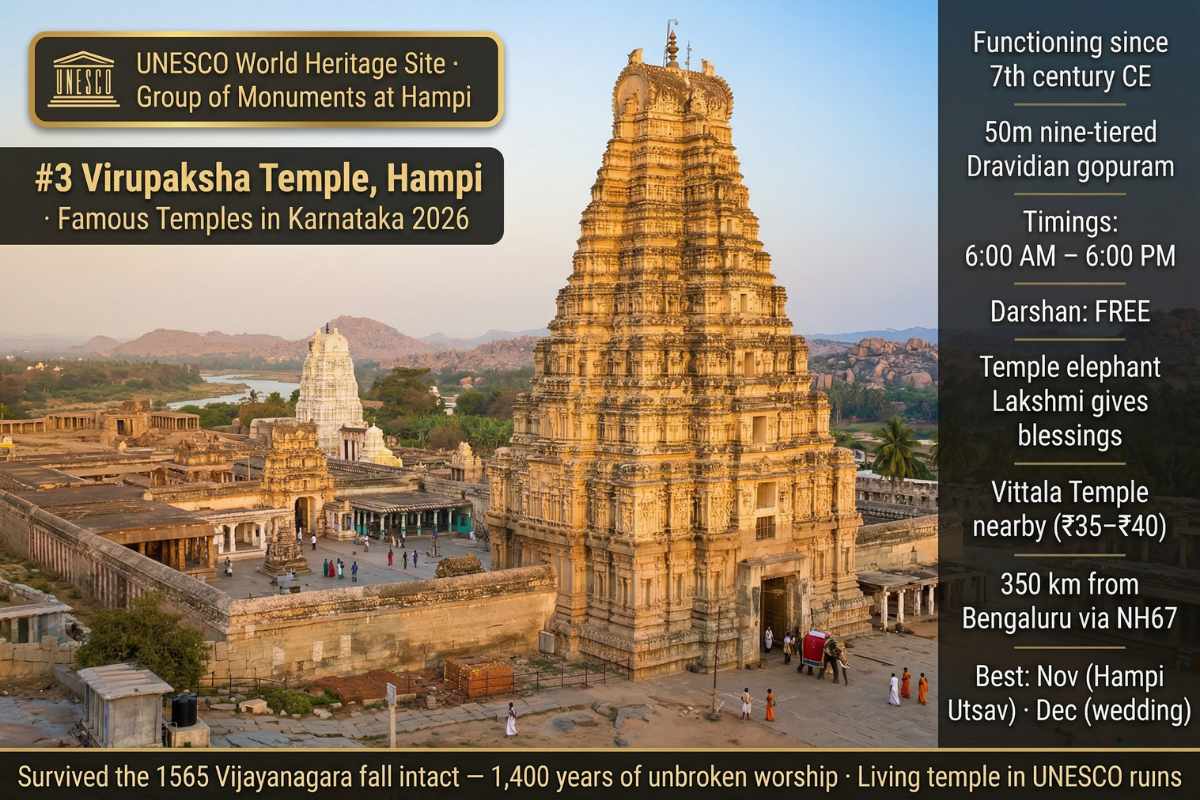
| UNESCO Status | Part of the 'Group of Monuments at Hampi' (UNESCO World Heritage Site since 1986) |
| Continuous Worship | Functioning since at least the 7th century CE - survived the 1565 battle of Talikota intact |
| Architectural Marvel | 50-metre (165 ft) 9-tiered Raja Gopuram + Inverted pinhole-camera shadow phenomenon on inner sanctum wall |
| Temple Resident & Fests | Temple elephant Lakshmi blesses devotees every morning · Virupaksha Chariot Festival (April) · Hampi Utsav (November) |
Hampi Virupaksha Temple holds a distinction that sets it apart from every other archaeological wonder on Earth: it is a living, breathing sanctuary of active daily prayer standing at the epicentre of a ruined imperial capital that was once the second-largest city in the medieval world. Dedicated to Lord Shiva as Virupaksha (the all-seeing Lord with oblique eyes) and his consort Pampa Devi (the daughter of Brahma who personified the Tungabhadra River), this kshetra was already ancient when the Vijayanagara Empire was founded in 1336 CE by Harihara and Bukka under the guidance of Sage Vidyaranya.
When the Deccan Sultanate confederacy sacked and burned Vijayanagara in 1565 CE, dismantling stone palaces and carving off temple colonnades over six continuous months, they left Virupaksha Temple unmolested out of divine awe. Walk through the soaring eastern gopuram commissioned by King Krishnadevaraya in 1510 CE to see the famous camera obscura (pinhole optical effect) in the rear hall, where natural sunlight passing through a tiny wall slit projects an inverted shadow of the 50-metre gopuram upside down on the interior wall!
4. Belur Chennakeshava Temple - Hoysala Masterpiece UNESCO Heritage (12th Century)
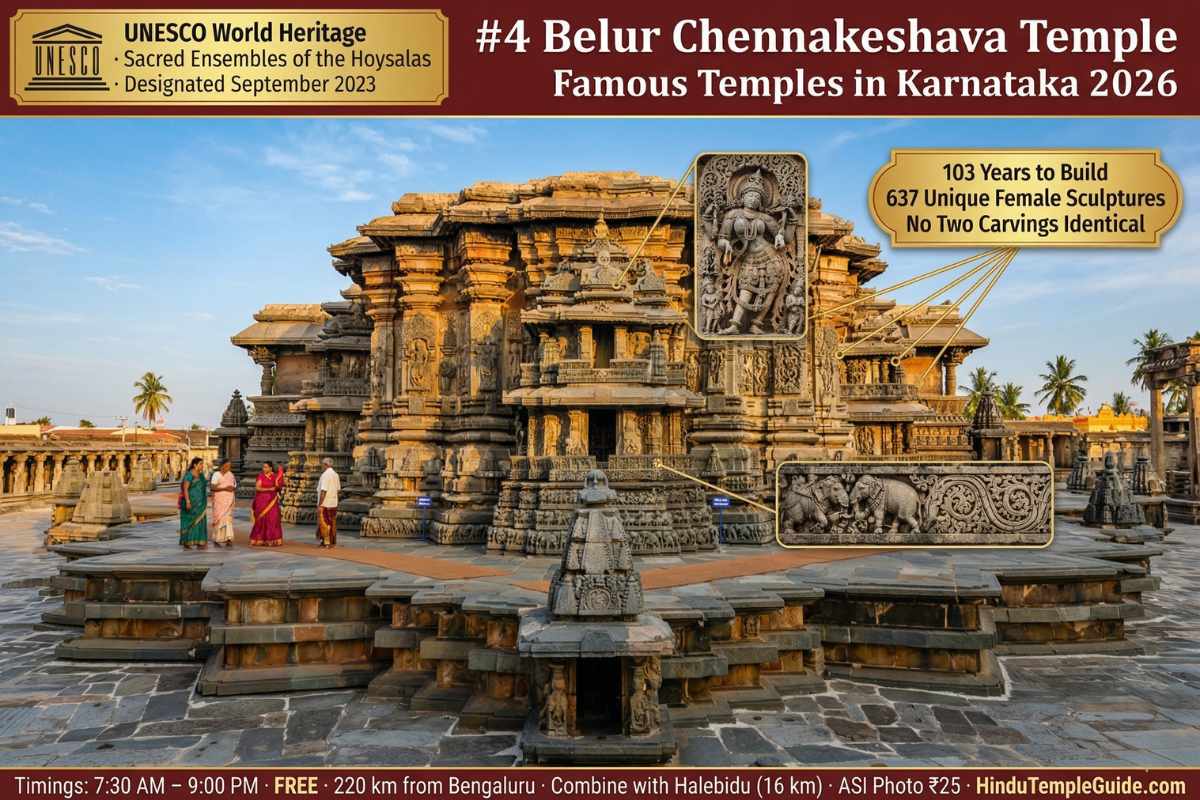
| UNESCO Status | Inscribed under the 'Sacred Ensembles of the Hoysalas' (UNESCO World Heritage, September 2023) |
| Built By & Era | Commissioned in 1117 CE by King Vishnuvardhana; took three generations (103 years, completed 1220 CE) |
| Presiding Deity | Lord Chennakeshava (Vijayanarayana / Handsome Vishnu) - standing with Shankha, Chakra, Gada, and Padma |
| Darshan Timings | 7:30 AM - 8:30 PM daily (Sanctum curtains pause 1:30-3:30 PM for Alankara) · Entry: FREE |
| Sculptural Wonders | 42 Darpana Sundari / Madanika bracket figures + 48 lathe-turned monolithic soapstone pillars + Gravity-defying Mohini Pillar |
Standing on the banks of the Yagachi River in Hassan district, Belur Chennakeshava Temple is the crown jewel of Hoysala architecture. Commissioned by King Vishnuvardhana following his conversion to Vaishnavism under the guidance of Sri Ramanujacharya and his military victory over the Cholas at Talakad in 1116 CE, this temple required 103 years of continuous craftsmanship across three generations of master sculptors (including the legendary Amarashilpi Jakanachari and his son Dankanachari).
Carved entirely out of fine-grained chloritic schist (soft green soapstone that hardens on exposure to air), the temple rests upon a raised star-shaped platform (Jagati). Around the exterior capitals sit 42 Madanikas (bracket damsels) depicted in classical dance poses, hunting, applying makeup, and playing flutes-with jewellery so intricately undercut that you can slide a thread behind the stone ornaments! Inside the Navaranga hall, marvel at the Narasimha Pillar (which once rotated on ball bearings) and the lathe-turned polished stone columns that reflect light like polished obsidian.
5. Halebidu Hoysaleswara Temple - UNESCO Hoysala with 80,000+ Stone Carvings
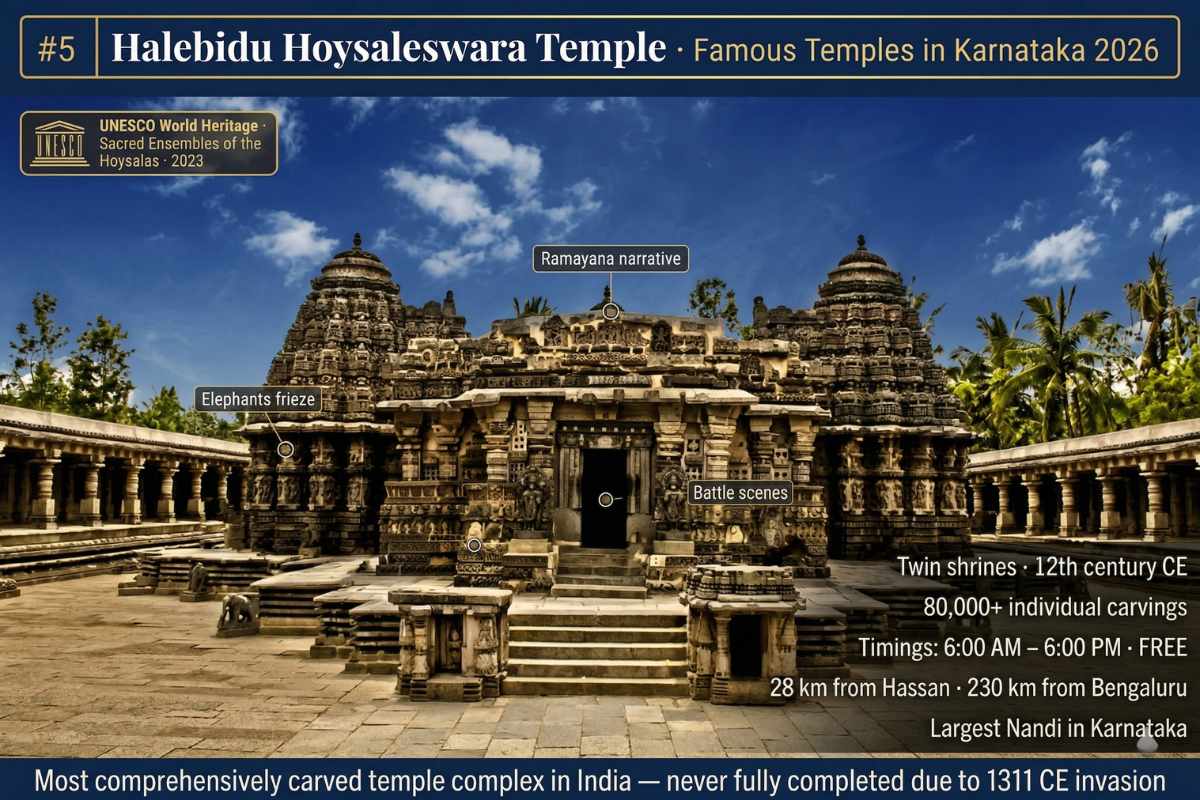
| UNESCO Designation | 'Sacred Ensembles of the Hoysalas' World Heritage (Sept 2023) alongside Belur & Somanathapura |
| Twin Sanctums | Dvikuta (Twin-Shivalinga plan): Hoysaleswara (King's shrine) and Shanthaleswara (Queen Shanthala Devi's shrine) |
| Sculptural Density | 80,000+ relief carvings across 8 horizontal baseline friezes running uninterrupted for 700 feet |
| Monolithic Nandis | Two massive, jewel-adorned monolithic Nandi bulls facing their respective Shiva shrines |
| Visiting Hours | 6:00 AM - 6:00 PM daily (ASI protected monument) · FREE Entry · Photography permitted |
Located just 16 km east of Belur in ancient Dorasamudra (Halebidu, meaning "the old capital"), Hoysaleswara Temple represents the pinnacle of sculptural ambition in Indian art history. Begun around 1121 CE by the wealthy merchant Ketamalla and decorated by chief sculptor Kedarojo, this twin Shiva temple features two identical star-shaped sanctums side-by-side, each fronted by an open Nandi pavilion housing a 16-foot monolithic bull carved with necklaces of bells, pearls, and floral tassels.
The exterior basement alone is a stone encyclopaedia: eight horizontal friezes run in continuous bands around the entire 700-foot perimeter. The bottom tier features over 1,200 elephants (symbolising strength, with no two elephants sharing the exact same stance), topped by lions (courage), horses (speed), floral tendrils (beauty), makaras (aquatic monsters), swans (spiritual discernment), and eye-level narrative relief panels depicting the entire Mahabharata, Ramayana, and Bhagavata Purana. The temple was never crowned with its intended superstructures because the invasion of Malik Kafur in 1311 CE sacked Dorasamudra-yet what stands today is among the greatest stone achievements of human hands.
6. Chamundeshwari Temple, Mysuru - Maha Shakti Peeth Atop Chamundi Hill
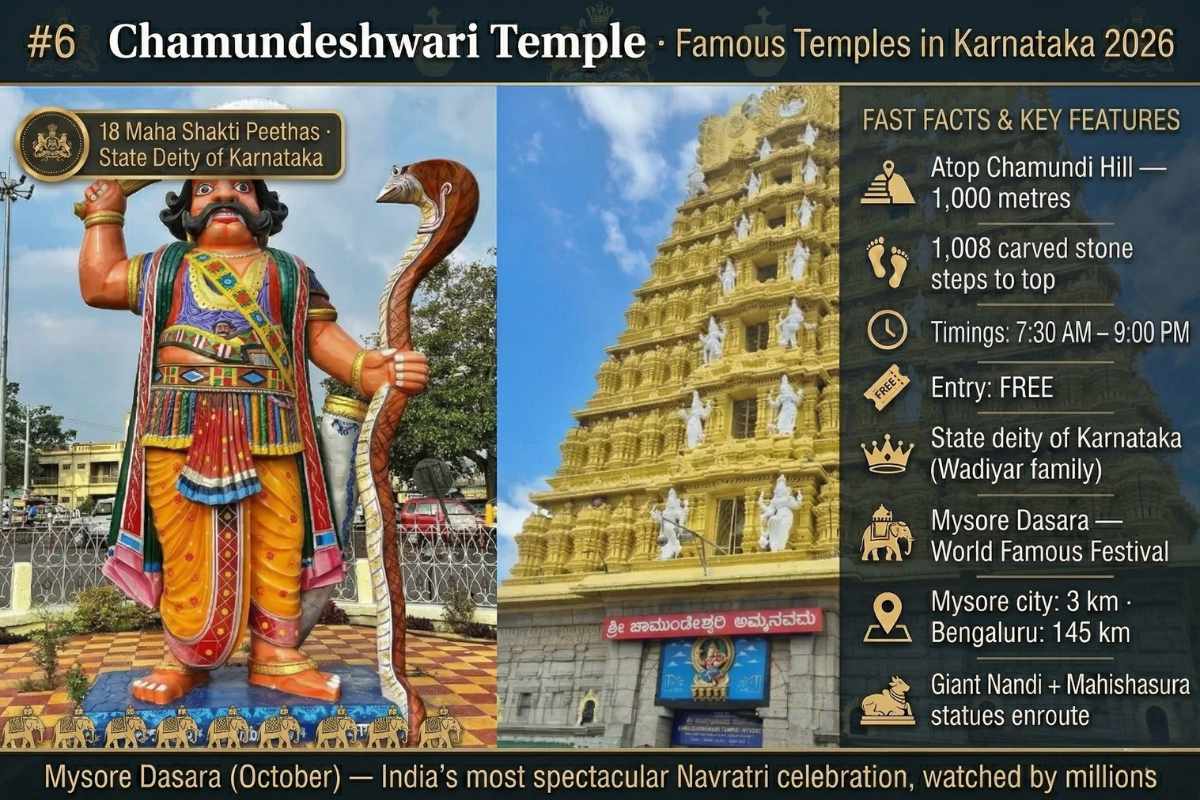
| Shakti Peetha Rank | One of the 18 Maha Shakti Peethas (Krouncha Peetham / Stana Peetha) celebrated by Adi Shankaracharya |
| State Guardian Deity | Revered as Nada Devate (State Deity of Karnataka) & Kuladevi of the royal Wodeyar dynasty |
| Darshan Timings | 7:30 AM-2:00 PM · 3:30-6:00 PM · 7:30-9:00 PM (Free Dharma Darshan; VIP ₹30 / ₹100) |
| The 1,008 Stone Steps | Traditional walking pilgrimage of 1,008 carved stone steps from the base, passing a 15-ft monolithic Nandi (1659 CE) |
| Signature Festival | Mysore Dasara (Navratri / Vijayadashami) - 400-year royal festival with the 750 kg Golden Howdah procession |
Perched 1,000 metres (3,300 feet) above sea level atop Chamundi Hill, 13 km southeast of Mysuru city, Sri Chamundeshwari Temple is the spiritual guardian of Karnataka. According to the Devi Bhagavata Purana, this hill was the battleground where Goddess Durga vanquished the buffalo-headed tyrant Mahishasura after a fierce nine-day battle, earning her the name Mahishasuramardini and giving the city of Mysuru (Mahishuru) its historic name.
The 7-tiered 40-metre Raja Gopuram built by Krishnaraja Wodeyar III in 1827 greets visitors at the hill summit. Devotees can either drive up the panoramic 13 km hill road or undertake the traditional fitness pilgrimage of climbing 1,008 stone steps cut in the 17th century by Maharaja Dodda Devaraja Wodeyar, halting halfway at the 700th step to admire the magnificent 15-foot high by 24-foot long monolithic Nandi bull adorned with bells and heavy stone chains. On Vijayadashami, the Goddess is placed atop decorated tusker elephants in a 750 kg pure golden howdah (Ambari) during the world-famous Jamboo Savari procession.
7. Murudeshwar Temple - 123-Foot Shiva Colossus Overlooking the Arabian Sea
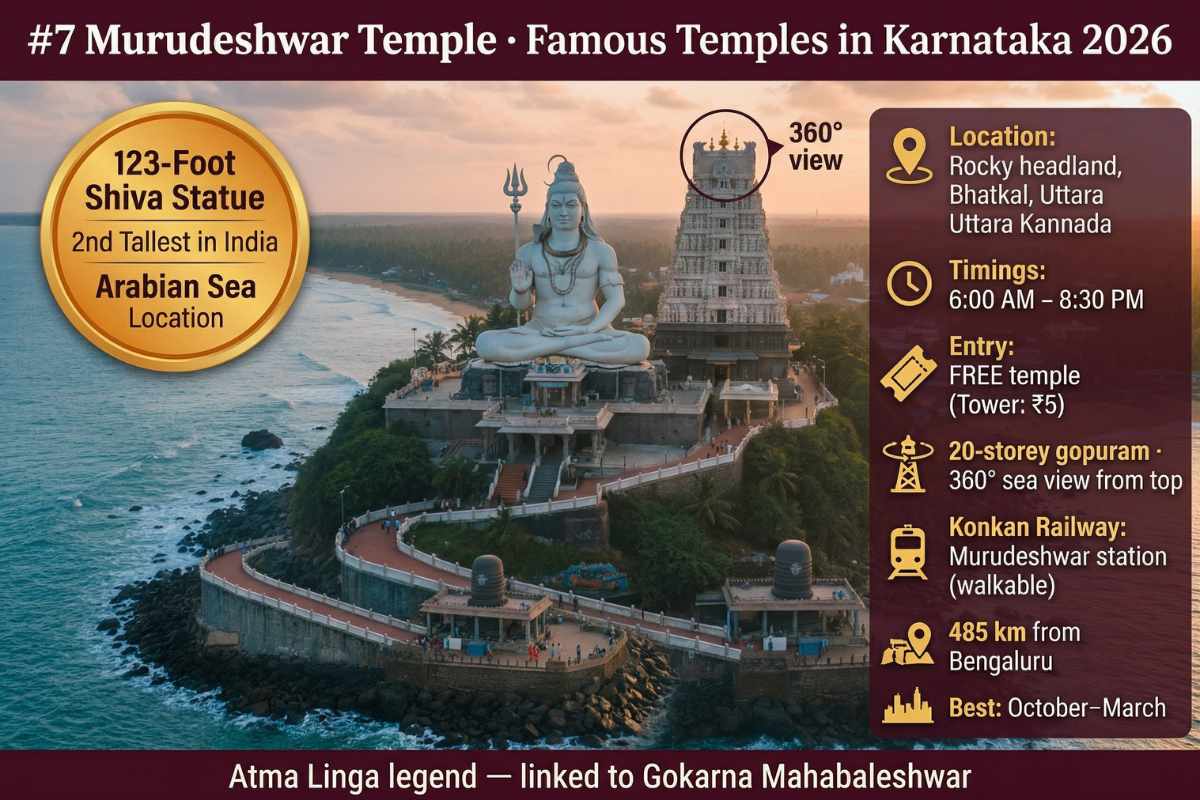
| Location | Kanduka Giri peninsula, Bhatkal taluk, Uttara Kannada (Surrounded on 3 sides by the Arabian Sea) |
| Lord Shiva Colossus | 123 feet (37 metres) tall - 2nd tallest Shiva statue in India; faces the ocean with golden sun reflections |
| Raja Gopuram | 20-storey Raja Gopuram (249 feet / 75 metres) with a high-speed elevator to the 18th floor (₹10 ticket) |
| Darshan Timings | 6:00 AM - 1:00 PM & 3:00 PM - 8:30 PM daily · Temple entry: FREE |
| Transport Hubs | Murdeshwar Railway Station (Konkan Railway - 2 km) · Mangaluru Airport (160 km) · Bengaluru 485 km |
Jutting dramatically into the turquoise waters of the Arabian Sea on the small rocky headland of Kanduka Giri, Murudeshwar Temple is one of the most visually breathtaking pilgrimage spots in Asia. The temple has an intimate scriptural connection with the Gokarna Atma Linga story: when Ravana attempted to yank the rooted Atma Linga from the ground with all his demonic might, pieces broke off and scattered across coastal Karnataka-the cloth wrapping of the Linga fell here at Kanduka Giri, giving the site its ancient name Mrideshwara (now Murudeshwar).
Under the philanthropic vision of industrialist R. N. Shetty, the complex was transformed with the erection of the towering 123-foot seated Shiva statue (built over two years by sculptor Kashinath) and the 249-foot, 20-tiered Raja Gopuram-the second tallest temple tower in India after Srirangam. Step into the glass-walled elevator inside the gopuram to ride up to the 18th-floor observation deck for an awe-inspiring 360-degree panoramic view of Lord Shiva against the limitless Arabian Sea, and explore the museum cave beneath the statue depicting the story of Ravana and child Ganesha in vibrant dioramas.
8. Dharmasthala Sri Manjunatha Temple - Unique Jain-Administered Shiva Kshetra & Annadana
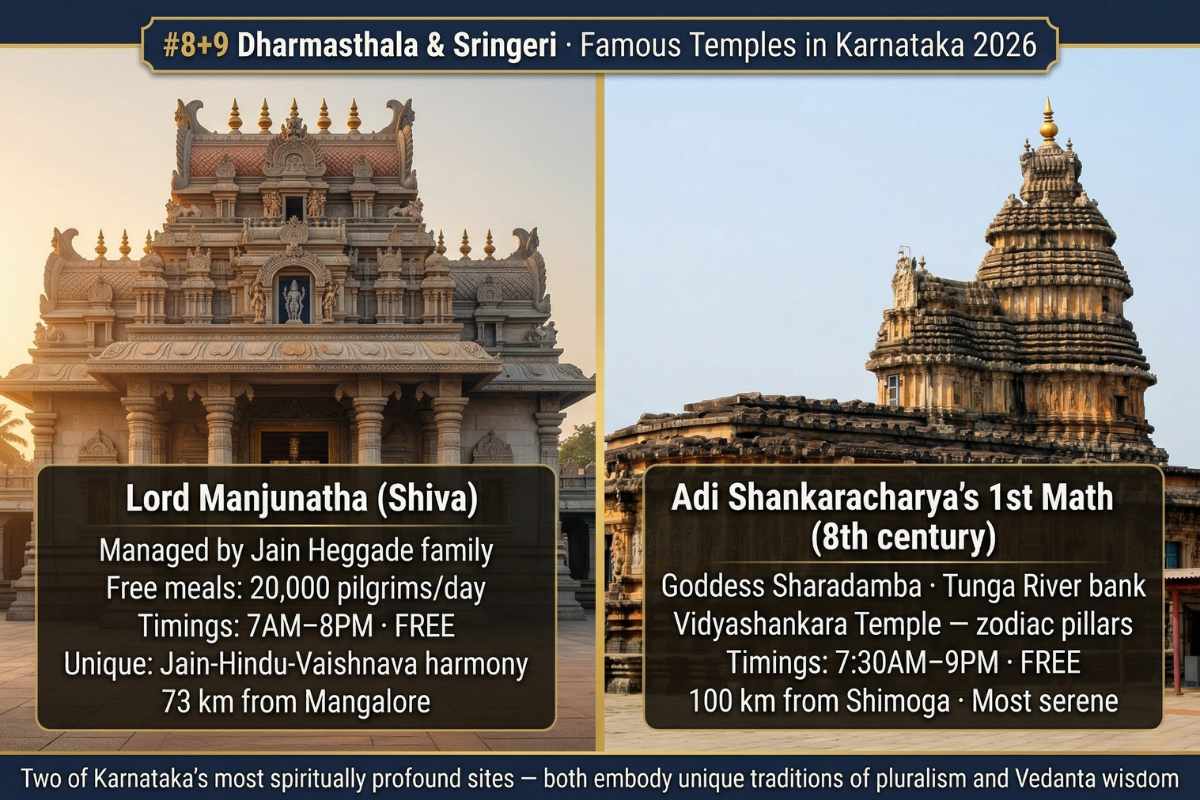
| Communal Harmony | Shiva is the presiding deity (Lord Manjunatha) · Administered by a hereditary Jain family (Heggade) · Priests are Madhva Vaishnava Brahmins |
| Darshan Timings | 6:30 AM - 2:00 PM & 5:00 PM - 8:30 PM daily · General entry: FREE |
| Annadana Tradition | Over 20,000 to 50,000 pilgrims receive free hot Satvik meals every single day at the automated Annapoorna dining hall |
| Four Pillars of Dharma | Practises the four Danas: Annadana (food), Aushadhadaana (medicine), Vidyadaana (education), and Abhayadaana (justice / Hoovu Danam) |
| Getting There | Belthangady taluk, Dakshina Kannada · Mangaluru (75 km) · Udupi (105 km) · Bengaluru (310 km) |
Nestled on the banks of the sacred Netravati River in Dakshina Kannada, Dharmasthala Sri Manjunatha Swamy Temple is one of the most remarkable living examples of inter-faith harmony anywhere in the world. For over 800 years, this temple has operated under a unique synthesis: the presiding deity is Lord Shiva (Manjunatha), consecrated originally from Kadri by saint Annappa Swamy; the daily Agamic pujas are performed by Vaishnava Madhva priests; and the administration and spiritual guardianship is held by a hereditary Jain family, headed by the respected Dharmadhikari Dr. Veerendra Heggade.
The hallmark of Dharmasthala is its legendary Annadana. At the multi-level automated kitchen and dining complex Annapoorna, every pilgrim-regardless of caste, religion, or economic standing-is served a freshly prepared, piping-hot meal of rice, sambar, rasam, and payasam. In Dharmasthala, disputes are resolved through traditional customary arbitration (Hoysala Nyaya Dana) at the Dharmadhikari's court, where the verdict given before Lord Manjunatha has been accepted without legal appeal for centuries. Before leaving, visit the 39-foot monolithic statue of Bhagwan Bahubali erected on Ratnagiri hill in 1973.
9. Sringeri Sharada Peetham - Adi Shankaracharya's First Advaita Peetham & Astronomical Wonder
| Established By | Jagadguru Adi Shankaracharya in the 8th century CE as the first of his 4 cardinal monastic seats (Dakshinamnaya Peetham) |
| Presiding Deities | Goddess Sharadamba (Saraswati) inside the main shrine + Sri Chandramouleeshwara Linga worshipped by the Jagadguru |
| Vidyashankara Temple | 14th-century architectural masterpiece with 12 Zodiac Pillars (Rashi Stambhas) - morning sun rays illuminate each pillar according to the active zodiac month! |
| Darshan & Meal Timings | 6:00 AM - 2:00 PM & 5:00 PM - 9:00 PM daily · Free entry · Free Annaprasada for all devotees at 12:00 PM & 7:30 PM |
| Sacred River Ritual | Feeding puffed rice to the thousands of giant sacred Mahseer fish in the crystal-clear Tunga River from the temple bathing steps |
Surrounded by mist-laden coffee plantations and dense rainforests in Chikkamagaluru district along the crystal-clear Tunga River, Sri Sringeri Sharada Peetham is the supreme philosophical fountainhead of South India. Traditional accounts in the Shankara Digvijaya narrate that when the 8th-century sage Adi Shankaracharya was walking through these hills, he stopped on the banks of the Tunga and saw an astonishing sight: a cobra had spread its venomous hood like an umbrella over a pregnant frog in labour to shield her from the burning midday sun. Recognizing a ground so permeated by peace that natural enemies protected each other, Shankaracharya chose Sringeri (named after the mountain hermitage of Sage Rishyasringa) to establish his first and pre-eminent southern seat of Advaita Vedanta.
The complex houses two distinct architectural jewels. The Sri Sharadamba Temple contains the glowing gold murti of the Goddess of Wisdom consecrated by Acharya Sri Vidyaranya in the 14th century over the original sandalwood icon installed by Shankaracharya atop a Sri Chakra. Directly adjacent stands the monumental stone Vidyashankara Temple, built in 1338 CE by the founders of the Vijayanagara Empire on a unique fusion of Hoysala, Chalukya, and Dravidian plans. The temple's assembly hall is supported by twelve carved Rashi Stambhas (Zodiac Pillars): astronomical engineers positioned the roof windows and pillars so that the morning sun's rays fall directly and exclusively on the pillar corresponding to the current sun-sign (zodiac month) of the Hindu solar calendar!
10. Gokarna Mahabaleshwar Temple - Home of the Sacred Atma Linga & South India's Kashi
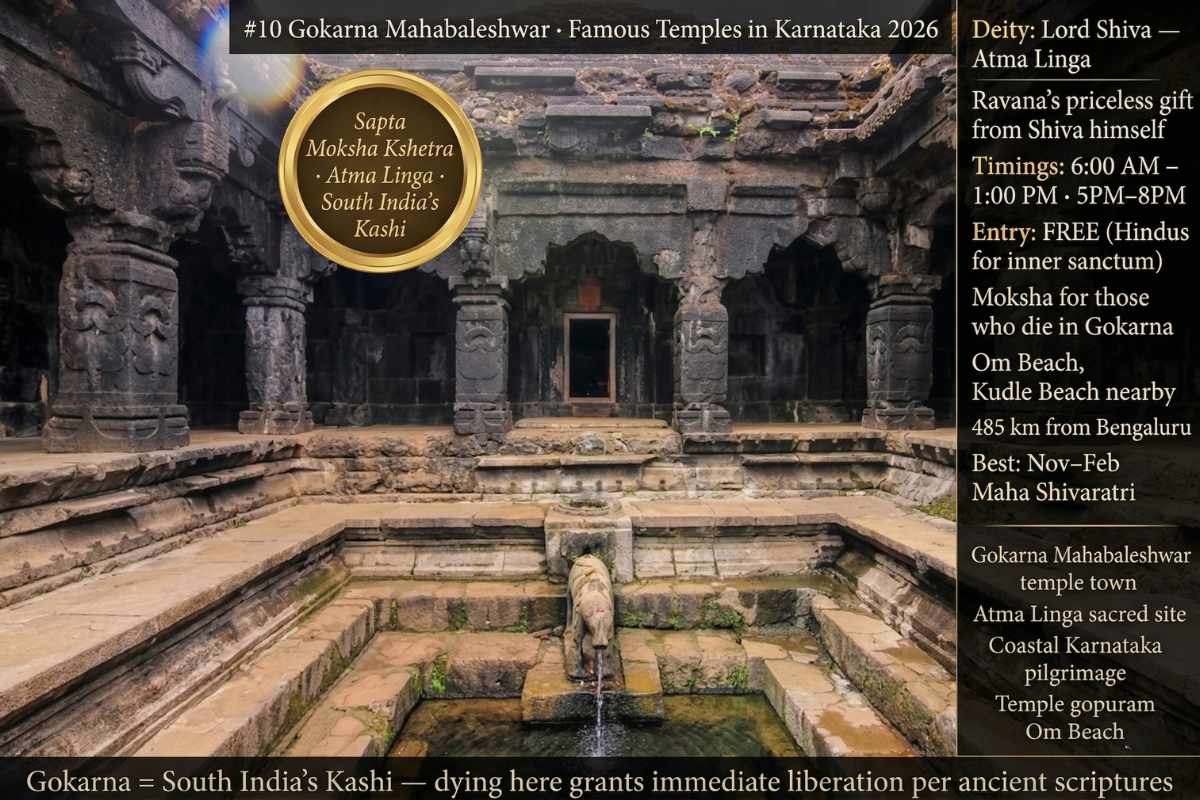
| Sacred Distinction | Enshrines the Prana Linga / Atma Linga of Lord Shiva · One of the Sapta Mukti Kshetras (revered as Dakshina Kashi) |
| Darshan Timings | 6:00 AM - 12:30 PM & 5:00 PM - 8:00 PM daily · Free general entry |
| Sparsha Darshan | Devotees are permitted to touch the sacred Atma Linga through a small square opening in the sanctum floor pit |
| Traditional Yatra Sequence | 1. Sea dip at Gokarna Main Beach → 2. Dip in Kotiteertha Tank → 3. Darshan at Maha Ganapati Temple → 4. Mahabaleshwar Atma Linga |
| Dress Code & Access | Men must wear traditional Dhoti (shirt removed) for inner sanctum touch · Gokarna Road Stn (9 km) · Goa Airport (140 km) |
Situated along the Arabian Sea coast in Uttara Kannada between palm-fringed cliffs and sacred beaches, Gokarna Mahabaleshwar Temple is revered across India as the southern counterpart to Varanasi (Dakshina Kashi). The name Gokarna ("Cow's Ear") refers both to the geographical ear-shaped confluence of two rivers and to the Puranic emergence of Lord Shiva from the ear of Mother Earth taking the form of a cow.
The legend of the Atma Linga forms the very bedrock of Gokarna: through unrelenting tapasya on Mount Kailash, the demon king Ravana obtained Lord Shiva's personal Atma Linga with the strict warning that wherever the Lingam touched the earth, it would remain rooted forever. Fearing that Ravana would become invincible, the Devas appealed to Lord Ganesha, who appeared before Ravana as a young cowherd boy as evening approached. Pretending he had to perform his Sandhyavandanam rituals, Ravana asked the boy to hold the Lingam without setting it down. Ganesha called out three times, placed the Atma Linga firmly upon the ground at Gokarna, and disappeared. When Ravana tried desperately to pull it out with all his might, the Lingam twisted into the shape of a cow's ear and could not be budged. To this day, devotees place their fingers through a small hole in the sanctum's marble pit to touch the tip of this self-same Atma Linga, receiving blessings that scriptures equate to a lifetime of pilgrimage.
Karnataka Temple Pilgrimage Circuits & Best Time to Visit (2026-2027)
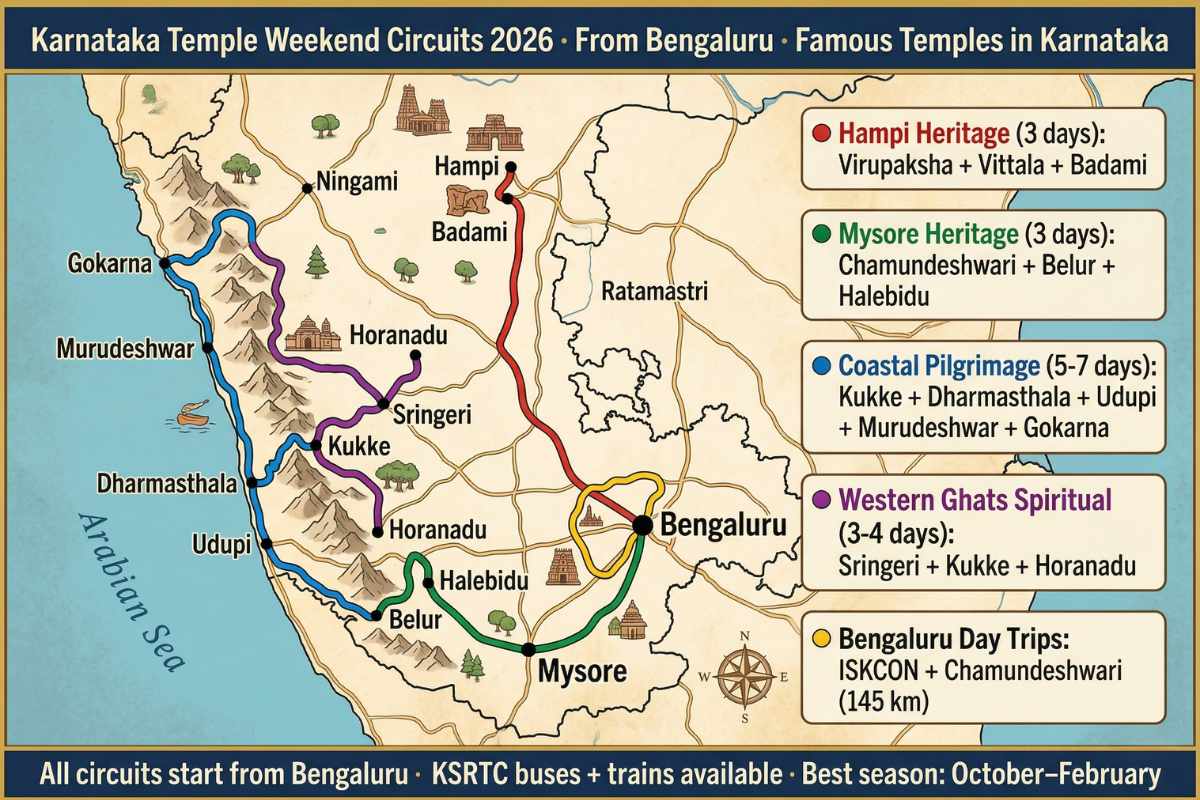
| Circuit Name | Route & Temples Covered | Ideal Duration |
|---|---|---|
| 1. Mysore & Hoysala Heritage | Bengaluru → Chamundeshwari (Mysuru) → Somanathapura Keshava → Hassan → Belur (Chennakeshava) → Halebidu (Hoysaleswara) | 3 days |
| 2. Coastal Karnataka Pilgrimage | Mangaluru (Kudroli / Mangaladevi) → Kukke Subramanya → Dharmasthala → Udupi Sri Krishna → Murudeshwar → Gokarna Mahabaleshwar | 5-7 days |
| 3. Hampi & North Karnataka UNESCO | Bengaluru / Hubballi → Hampi Virupaksha + Vittala Temple → Badami Cave Temples → Pattadakal (UNESCO) → Aihole | 3-4 days |
| 4. Western Ghats Spiritual Trail | Bengaluru → Chikkamagaluru → Sringeri Sharada Peetham → Horanadu Annapoorneshwari → Kalasa Kalaseshwara → Dharmasthala | 3-4 days |
| 5. Bengaluru Day Trips | ISKCON Bengaluru + Gavi Gangadhareshwara + Halasuru Someshwara OR Chamundeshwari Mysuru (145 km via Expressway) | 1 day each |
Best Time to Visit Famous Temples in Karnataka (2026-2027)
| Season | Weather & Pilgrimage Recommendations |
|---|---|
| Oct - Feb (BEST) | Cool, dry 18-28°C · Perfect for all 10 temples · Witness Mysore Dasara (October), Hampi Utsav (November), and Udupi Paryaya (January) |
| March - May (Summer) | Coastal temples pleasant in early morning breeze · North Karnataka (Hampi, Badami) hits 38-42°C · Complete darshan between 6:00 AM and 9:30 AM |
| June - Sept (Monsoon) | Lush green Western Ghats waterfalls · Magical time for Sringeri, Kukke Subramanya, and Dharmasthala · Exercise caution on winding coastal ghat roads |
| Key Festival Dates | Mysore Dasara (Oct) · Subramanya Shashti (Nov/Dec) · Udupi Paryaya (Jan 18, even years) · Hampi Virupaksha Chariot Festival (Apr) · Gokarna Maha Shivaratri (Feb) |
FAQs - Famous Temples in Karnataka (2026-2027)
Have a question about planning the Coastal Karnataka circuit, booking Kukke Subramanya Sarpa Samskara sevas, or combining Belur, Halebidu, and Mysore on a family road trip? Send me a message here-I read and reply to every fellow devotee personally. - Devendra Khambalkar, Nagpur
Written by Devendra Khambalkar, Nagpur, Maharashtra | Last updated: October 2026. Temple timings, entry fees, and puja guidelines are verified from official temple administration announcements, Karnataka Muzrai Department (itms.kar.nic.in), Archaeological Survey of India (ASI), and Karnataka Tourism (karnatakatourism.org). Always confirm festival schedules on official portals before travelling. Jai Karnataka · Jai Bhuvaneshwari!