
|
Kolhapur Mahalaxmi Temple (affectionately revered by locals as Shri Karveer Niwasini Ambabai Mandir) is an ancient 7th-century Chalukya-era shrine in Kolhapur, Maharashtra, counted among Maharashtra's 3.5 Shakti Peethas and India's 18 Maha Shakti Peethas (Shree Karveer Niwasini Ambabai Official Portal). The temple opens daily from 4:00 AM to 10:30 PM with free general darshan, beginning with Padyapooja at 5:00 AM and Kakad Aarti at 5:30 AM (Shree Karveer Niwasini Ambabai Official Portal). Situated just 2.5 km (a ₹20 shared auto ride) from Chhatrapati Shahu Maharaj Terminus (KOP), it is directly connected to Pandharpur by the daily Nagpur-Kolhapur Express (11403) in under 4 hours (MakeMyTrip Railways). Furthermore, a pilgrimage to Tirupati Balaji is traditionally considered complete only after seeking the blessings of Goddess Mahalaxmi in Kolhapur (Live History India). |
How Our Sunday Trip to Kolhapur Mahalaxmi Temple Began After Pandharpur
Kolhapur Mahalaxmi Temple is not merely a historic stone shrine in western Maharashtra; rather, it is a living powerhouse of maternal grace where over 1,300 years of unbroken devotion greet you the moment you step onto Mahadwar Road (Maharashtra Tourism). If you read my previous travelogue on Pandharpur Darshan: My Journey to Lord Vitthal's Temple, you already know how emotional our four-hour Charan Darshan queue in Pandharpur was. However, our spiritual journey across Maharashtra was only halfway done. One Sunday morning, three close friends and I packed our bags, boarded a morning train from Pandharpur, and set off to seek the blessings of Maa Ambabai at the world-famous Kolhapur Mahalaxmi Temple.
Honestly, most travel blogs on the internet give you recycled schedules and copy-pasted Wikipedia summaries without ever standing in the Sunday afternoon queue or figuring out where to keep heavy backpacks before catching a night train back to Pune. Therefore, in this comprehensive guide, I am taking you through our exact, unfiltered Sunday journey-from our ₹20 auto ride outside Kolhapur railway station and our ₹700 24-hour room at Shri Mahalaxmi Dharmashala to the one-hour darshan line, authentic Kolhapuri chappal shopping, and a rainy evening eating street food at Rankala Lake Khau Galli. Additionally, we will explore the deep Puranic history of this shrine, its architectural marvels, and why lakhs of devotees travel here directly after completing their Tirupati Balaji darshan.
Jai Ambe! Let us walk into the sacred courtyard of Karveer Niwasini together.
Spiritual Significance of Kolhapur Mahalaxmi Temple: The Shakti Peetha & Kolhasur Legend
Before I walk you through our train journey and darshan queue, let us understand what makes the Kolhapur Mahalaxmi Temple one of the most revered pilgrimage destinations in Hinduism. Locally and lovingly addressed as Ambabai (Divine Mother), the presiding deity here is worshipped as Karveer Niwasini-she who eternally resides in Karveer, the ancient scriptural name of Kolhapur (The Invincible India).
One of Maharashtra's Four Shakti Peethas & India's 18 Maha Shakti Peethas
In the Shakta tradition of Maharashtra, the Kolhapur Mahalaxmi Temple holds the supreme status of a Purna (complete) Shakti Peetha among the state's revered Sadhe Teen Shakti Peethas (Three-and-a-Half Shakti Peethas) (Shree Karveer Niwasini Ambabai Official Portal). Furthermore, several Puranic scriptures-including the Ashta Dasha Shakti Peetha Stotram attributed to Adi Shankaracharya-count this shrine among India's 18 Maha Shakti Peethas (TravelsHexa).
| Shakti Peetha Name | Location in Maharashtra | Presiding Form of Devi | Scriptural Status |
|---|---|---|---|
| Kolhapur Mahalaxmi Temple | Kolhapur (Karveer) | Goddess Ambabai (Mahalaxmi) | Full (Purna) Peetha - Adishakti (Official Portal) |
| Tuljabhavani Temple | Tuljapur (Dharashiv) | Goddess Bhavani | Full (Purna) Peetha - Swarajya Kulswamini (TripSaffron) |
| Renuka Mata Temple | Mahur (Nanded) | Goddess Renuka | Full (Purna) Peetha - Mother of Parashurama (Maharashtra Tourism) |
| Saptashrungi Devi Temple | Vani (Nashik) | Goddess Saptashrungi | Half (Ardha) Peetha - 18-Armed Mahishasuramardini (Maharashtra Tourism) |
The Legend of Goddess Sati's Three Eyes
The cosmic origin of the Kolhapur Mahalaxmi Temple is deeply rooted in the ancient Daksha Yagna narrative of Goddess Sati and Lord Shiva (Live History India). According to Puranic lore, when Lord Vishnu released his Sudarshan Chakra to sever the sacred body of Goddess Sati and calm Lord Shiva's grief-stricken Tandava, parts of Sati's form fell across the Indian subcontinent, consecrating each spot as a Shakti Peetha. Here in Kolhapur, sacred tradition holds that Sati's three divine eyes (Trinetra) fell upon this land. Because the three eyes represent complete spiritual vision and omniscience, Kolhapur is venerated as a complete, self-illuminated Shakti Peetha where devotees can attain both Bhukti (worldly fulfillment) and Mukti (spiritual liberation) (Shree Karveer Niwasini Ambabai Official Portal).
The Battle with Demon Kolhasur: How Kolhapur Got Its Name
In addition to the Sati legend, the Karveer Mahatmya (composed around 1730 CE) narrates a powerful local account involving a fierce demon named Kolhasur (Live History India). For years, Kolhasur tyrannized the sages and residents of the Karveer forest. Answering their prayers, Goddess Mahalaxmi descended to earth, engaged Kolhasur in a relentless battle, and finally vanquished him on Ashwin Panchami (celebrated today as Lalita Panchami) (TravelsHexa). Before taking his last breath, a repentant Kolhasur begged the Goddess that the region be remembered by his name alongside hers. Granting his dying wish, Maa Ambabai blessed the town, and thus Kola (from Kolhasur) and Pur (city) merged to become Kolhapur (Live History India).
1,300 Years of History & Hemadpanti Architecture of Ambabai Mandir

Walking through the grand stone gateways of the Kolhapur Mahalaxmi Temple, you immediately sense that you are stepping across centuries of royal Maratha and Deccan history.
Chalukya Foundation, Shilahara Expansion & Maratha Royal Legacy
Historians and epigraphical records trace the structural foundation of the Kolhapur Mahalaxmi Temple back to 634 CE (7th century CE) during the reign of the Chalukya king Karnadeva (The Invincible India). Subsequently, between the 9th and 12th centuries CE, the Shilahara dynasty of Konkan and Kolhapur-along with the Rashtrakuta rulers-expanded the shrine into a sprawling multi-mandapa complex (Live History India). In fact, around 1182 CE, the Shilahara kings proudly adopted the royal title Shriman Mahalakshmi-Labdhavaraprasada ("One who has obtained the boon of grace from the glorious Mahalaxmi") (Live History India).
During the 14th and 15th centuries, when repeated invasions threatened temples across the Deccan, the hereditary priests secretly removed the original black stone idol of Ambabai and hid it in a priest's private residence in Kapiltirth market to protect it from desecration (Live History India). For nearly three centuries, the sanctum remained silent until 1715 CE, when Chhatrapati Sambhaji II (under the guidance of Queen Tarabai, daughter-in-law of Chhatrapati Shivaji Maharaj, who founded the Kolhapur state in 1709 CE) ceremoniously reinstalled the sacred idol in the Garbhagriha (Live History India). Even today, the Kolhapur Mahalaxmi Temple serves as the revered Kuldevata (family deity) of the Kolhapur Royal Family, direct descendants of the Bhonsle clan of Chhatrapati Shivaji Maharaj.
Black Stone Hemadpanti Craftsmanship & the Secret Matulinga Shiva Shrine
Architecturally, the Kolhapur Mahalaxmi Temple is a masterpiece of the Hemadpanti and Chalukyan styles, constructed entirely from locally quarried black basalt stone (Krishna Shila) fitted together with mortarless interlocking joints (The Invincible India). Key architectural features you will notice inside the complex include:
- West-Facing Sanctum Alignment: Unlike the majority of Hindu temples that face east or north, the main sanctum of Kolhapur Mahalaxmi Temple faces strictly west toward the Mahadwar gate-an astronomical alignment engineered specifically for the twice-yearly Kiranotsav solar phenomenon (The Invincible India).
- Five Stepped Shikharas: Above the star-shaped planar base rises a multi-tiered, pyramid-shaped white-and-saffron Shikhara (spire) added during the 18th-century Maratha restoration, contrasting strikingly with the dark basalt base (TravelsHexa).
- Intricately Carved Mandapas: Moving inward from the western Mahadwar, devotees pass through the Garuda Mandap (a wide pillared wooden pavilion built in the 1840s), the Sabha Mandap, the Kurma Mandap (featuring a carved stone tortoise on the floor), and the Ganpati Chowk right before the inner sanctum (Kolhapur Bhatkanti).
- Upper-Storey Matulinga Shiva Shrine: Directly above the main Garbhagriha of Goddess Ambabai lies a hidden upper-floor Shiva shrine housing a Shivalinga (known as Matulingeshwar), built to harmonise the Shaiva and Shakta cosmic energies (Live History India). Although closed to general visitors today for structural preservation, it proves the temple's ancient synthesis of Shiva and Shakti worship.
The Sacred Black Stone Idol of Goddess Ambabai (40 Kg Murti & Diamond Particles)
When you finally reach the threshold of the Garbhagriha inside the Kolhapur Mahalaxmi Temple, your eyes are drawn immediately to the ancient, self-manifested (Swayambhu) aura of the idol. Unlike softer sandstone idols that erode over time, the murti of Maa Ambabai is carved from a single block of precious, glossy black stone mingled with microscopic diamond and quartz particles (Hirak-Mishrit Ratnashila), which archaeologists estimate to be between 5,000 and 6,000 years old in material origin (The Invincible India).
- Dimensions & Weight: Mounted on a raised stone platform, the black stone idol stands approximately 3 feet (0.9 meters) tall and weighs roughly 40 kilograms (The Invincible India).
- Four Divine Arms (Chaturbhuja Form): In her four hands, Karveer Niwasini holds four symbolic emblems of cosmic sovereignty:
- Lower Right Hand: A Matulinga (sacred citron fruit), symbolizing fertility, abundance, and the seeds of creation (The Invincible India).
- Upper Right Hand: A large Kaumodaki Gada (mace) whose head rests downward on the ground, signifying righteous authority and protection (The Invincible India).
- Upper Left Hand: A Khetaka (shield), representing defense of dharma against negative forces (The Invincible India).
- Lower Left Hand: A Panapatra (sacred drinking vessel or bowl), symbolizing the nectar of immortality and spiritual nourishment (The Invincible India).
- Crown with Shivalinga & Five-Hooded Cobra: Uniquely among Lakshmi idols across India, Ambabai's crown bears a carved Shivalinga encircled by a five-headed serpent (Sheshnaag) and a lotus, while her sacred mount (Vahana)-the stone lion-stands vigilantly right behind her on the pedestal (The Invincible India).
Why Devotees Visit Kolhapur Mahalaxmi Temple After Tirumala Tirupati Balaji
While standing in our Sunday afternoon darshan queue at the Kolhapur Mahalaxmi Temple, I noticed something fascinating: almost half the families standing around us were speaking Telugu, Tamil, and Kannada, and many still wore the sacred Namam from Tirumala! When I spoke with several yatris in the line, they confirmed one of India's most enduring pilgrimage traditions: a yatra to Lord Venkateswara (Balaji) at Tirumala is considered incomplete until you visit Goddess Mahalaxmi in Kolhapur (Live History India).
The Puranic Story of Sage Bhrigu, Lord Vishnu & Karveer Kshetra
Why do lakhs of pilgrims travel over 860 kilometers from Andhra Pradesh to Maharashtra on the daily Haripriya Express to complete their pilgrimage? As explained in our Tirupati Balaji Temple Guide 2026 and recorded in Vaishnavite tradition, the connection goes back to the test of the Trinity by Maharishi Bhrigu (Live History India):
- Bhrigu Rishi's Kick to Vishnu's Chest: When Sage Bhrigu visited Vaikuntha while Lord Vishnu was resting on Sheshnaag, the sage struck Vishnu's chest (Vaksha-Sthala) with his foot to test his temperament (Live History India).
- Vishnu's Apology & Lakshmi's Departure: Instead of showing anger, Lord Vishnu gently massaged the sage's foot and apologized. However, because Goddess Mahalaxmi permanently resides in Vishnu's chest (Srivatsa), she felt deeply disrespected that her sacred abode had been struck without protest (Live History India).
- Meditation in Kolhapur (Karveer): Leaving Vaikuntha in righteous indignation, Goddess Mahalaxmi descended to earth and settled in the lush forests of Karveer (Kolhapur) to perform deep penance (Tapasya), while Lord Vishnu descended to the Venkata Hills as Srinivasa (Tirupati Balaji) to search for her (Live History India).
Consequently, devotees believe that seeking wealth and grace from Lord Balaji in Tirumala without paying homage to his consort Maa Ambabai at Kolhapur Mahalaxmi Temple leaves the household blessing half-finished (TravelsHexa). Even today, the Tirumala Tirupati Devasthanams (TTD) sends a sacred silk Shalu (saree) to Kolhapur Ambabai every year during Navratri and Diwali-a tradition that beautifully binds South and West India in a single spiritual circuit.
Step-by-Step Travel Log: Pandharpur to Kolhapur Train & ₹20 Station Auto Ride
Now, with that rich 1,300-year history in mind, let me take you step-by-step through our actual Sunday pilgrimage from Pandharpur to the Kolhapur Mahalaxmi Temple.
Catching the Sunday Morning Train from Pandharpur (PVR) to Kolhapur (KOP)
After completing our Vitthal-Rukmini darshan in Pandharpur, my three friends and I headed to Pandharpur Railway Station (PVR) on Sunday morning. Many online guides claim you always have to change trains at Miraj Junction (TripSaffron), and while Miraj is a major rail hub 137 km away, Indian Railways actually operates direct morning express trains along the 184 km rail corridor (MakeMyTrip Railways).
| Train Name & Number | Departure (Pandharpur - PVR) | Arrival (Kolhapur - KOP) | Duration & Distance | Running Days & Class |
|---|---|---|---|---|
| Nagpur-Kolhapur Express (11403) | 09:10 AM / 10:10 AM (seasonal slot) | 01:30 PM / 02:00 PM | ~3h 50m (184 km) | Daily (SL, 3A, 2A, Unreserved) (MakeMyTrip Railways) |
| Kalaburagi-Kolhapur SF Exp (22155) | 10:20 AM | 02:15 PM | ~3h 55m (183 km) | Daily Direct Superfast (Rome2Rio) |
| Solapur-Kolhapur SF Exp (22133) | 01:55 AM | 05:30 AM | ~3h 35m (183 km) | Daily Early Morning Arrival (MakeMyTrip Railways) |
| Bidar-Kolhapur Express (11415) | 06:20 PM | 12:25 AM | ~6h 05m (184 km) | Daily Evening Train (MakeMyTrip Railways) |
We boarded our morning train from Pandharpur with palpable excitement-four friends, window seats, hot cutting chai at Sangola and Miraj halts, and continuous conversations about seeing this ancient Shakti Peetha in person. Right on schedule, our train pulled into Chhatrapati Shahu Maharaj Terminus, Kolhapur (Station Code: KOP) at 1:30 PM in the afternoon.
The ₹20 Auto-Rickshaw Secret from Kolhapur Station to Mahadwar Road
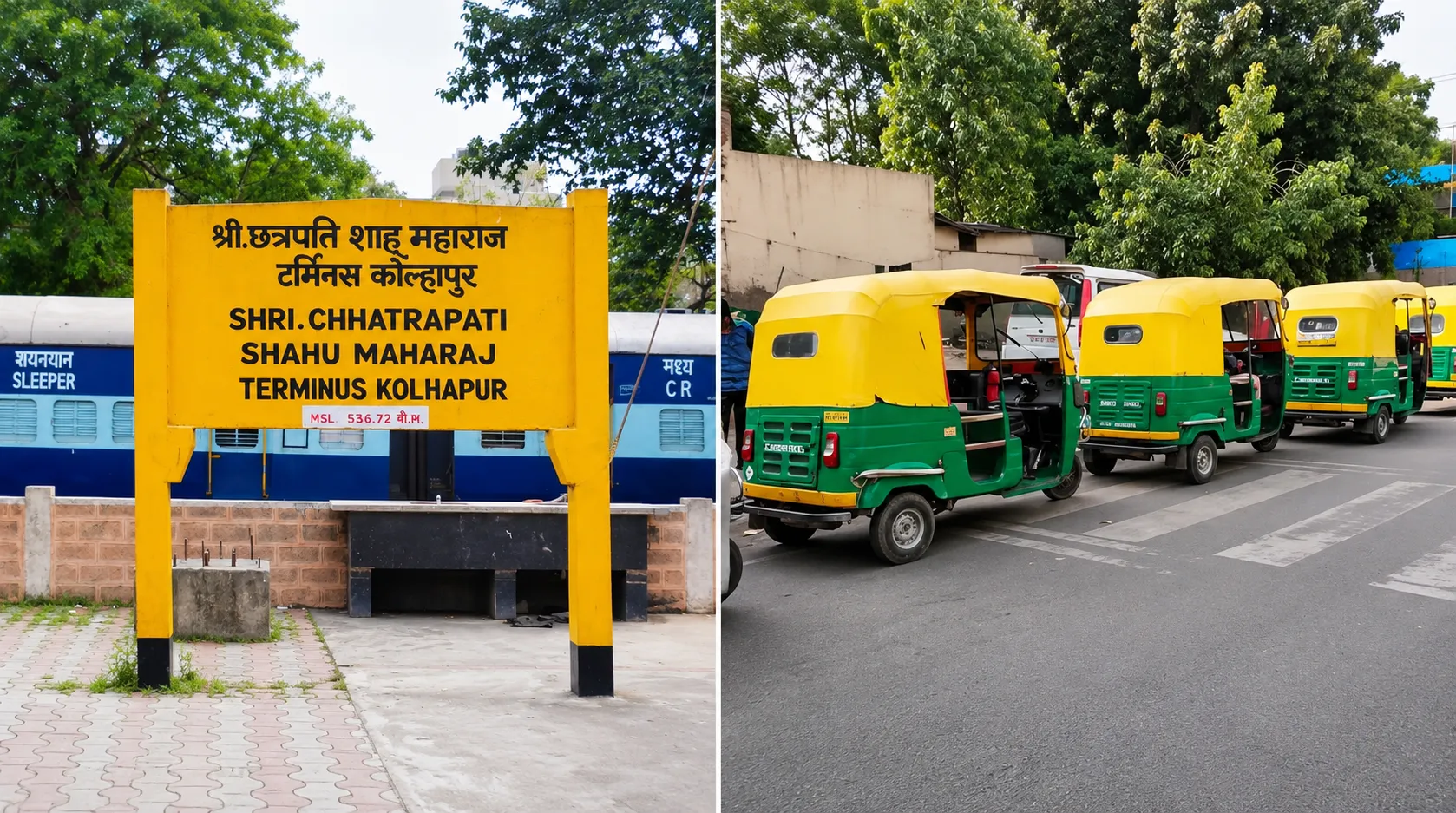
One of the best practical surprises of visiting the Kolhapur Mahalaxmi Temple is how remarkably close it sits to the railway station-just 2.5 kilometers away (AmbabaiMahalaxmi.com). As soon as you exit Kolhapur Railway Station, private auto drivers may quote ₹80 to ₹100 for a full drop. However, because the four of us split a shared/seat auto right outside the station exit, we paid just ₹20 per person and reached the bustling temple periphery in barely 10 minutes!
| Devendra's First-Hand Vlog Note: "The moment we arrived outside the temple gates, we realized it was Sunday afternoon, and the entire Mahadwar Road market was buzzing with infectious energy-glass bangles, red kumkum mounds, fresh lotus garlands, pedha prasad, and traditional sarees everywhere." |
Where to Stay & Freshen Up: Our ₹700 Shri Mahalaxmi Dharmashala Experience
Here was our biggest logistical challenge that Sunday afternoon: our return train to Pune was scheduled for late at night, which meant the four of us were carrying heavy travel bags for the entire day. Furthermore, after a four-hour train ride from Pandharpur, we wanted a clean room to shower, change into fresh traditional clothes, and lock our luggage safely before entering the Kolhapur Mahalaxmi Temple queue.
Why Shri Mahalaxmi Dharmashala (Tarabai Road) Is a Lifesaver for Day-Trippers
Instead of paying ₹2,500+ at a commercial hotel for just a few hours, we walked straight to Shri Mahalaxmi Dharmashala, located right opposite the temple's west side along Tarabai Road (Where to Stay Guide). Carrying a 69-year-old legacy of serving pilgrims, we booked a spacious room for just ₹700 for a full 24-hour cycle (Shri Mahalaxmi Dharmashala Tariff)! Split among friends, it cost us less than ₹180 per head.
| Room Category at Shri Mahalaxmi Dharmashala | Official 24-Hour Tariff | Included Capacity | Extra Person Charge | Booking Policy & Key Facilities |
|---|---|---|---|---|
| Simple Non-AC Room | ₹520 (4 Persons) / ₹650 (5 Persons) | 4 to 5 Pilgrims | ₹130 per person | Walk-in counter allotment; lockers & hot water (Official Tariff) |
| Deluxe Non-AC Room (Our Choice!) | ₹700 (3-4 Persons) / ₹1,200 (5 Persons) | 3 to 5 Pilgrims | ₹240 per person | Best value for day trips; clean beds & washroom (Official Tariff) |
| Attach Non-AC Room | ₹820 (4 Persons) / ₹1,025 (5 Persons) | 4 to 5 Pilgrims | ₹205 per person | Attached bath, natural ventilation, family-friendly (Official Tariff) |
| Standard AC Room | ₹1,180 (4 Persons) | 4 Pilgrims | ₹295 per person | Air-conditioned comfort for summer afternoons (Official Tariff) |
| Deluxe AC Room | ₹1,600 (5 Persons) | 5 Pilgrims | ₹320 per person | Spacious group room near West Gate (Official Tariff) |
Important Rule You Must Know: Shri Mahalaxmi Dharmashala does NOT accept online or phone bookings (Official Portal). Rooms are allotted strictly in person at the reception counter on a first-come, first-served basis with a valid government-issued photo ID (TravelsHexa). Therefore, never fall for fake WhatsApp numbers claiming to book Dharmashala rooms online. We dropped our heavy backpacks, freshened up in 25 minutes, and stepped out feeling light, energized, and spiritually ready for darshan.
Inside the Sunday Darshan Queue at Kolhapur Mahalaxmi Temple & Ongoing Restoration
After locking our bags at the Dharmashala around 2:30 PM, we walked barely 200 meters back to the Kolhapur Mahalaxmi Temple entrance, deposited our footwear at the free chappal stand, and joined the Sunday general darshan queue.
What the 1-Hour Sunday Queue Actually Feels Like
Because Sunday combines weekend travellers from Pune and Mumbai with outstation pilgrims arriving from Tirupati and Pandharpur, the general queue inside the steel barricades (Darshan Mandap) was lively and packed. However, compared to our four-hour wait in Pandharpur, the crowd management by the Paschim Maharashtra Devasthan Samiti at Kolhapur Mahalaxmi Temple moved at a steady, reassuring pace (Shree Karveer Niwasini Ambabai Official Portal).
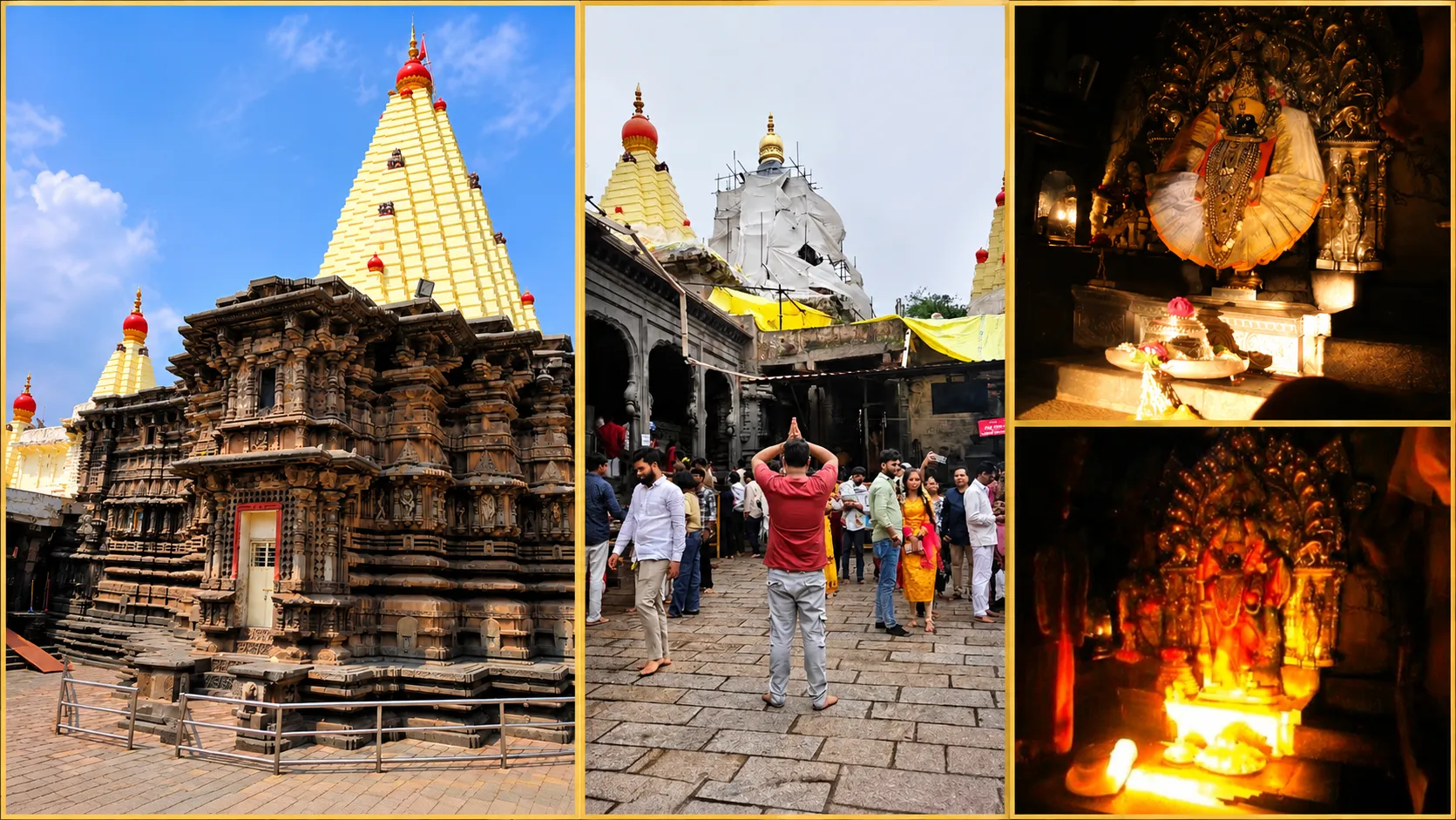
As we inched through the ventilated queue halls, one architectural detail immediately caught my eye: sections of the ancient temple exterior and upper structures were covered in protective scaffolding and white conservation cloth for ongoing heritage restoration. Yet, even with restoration work underway, the majesty of the stepped Shikhara rising against the afternoon sky and the intricate black basalt carvings on the lower pillars were not diminished one bit.
The Magical Moment Inside the Garbhagriha
After approximately one hour of standing in line, we crossed the Garuda Mandap and Ganpati Chowk and stepped directly in front of the Garbhagriha of Kolhapur Mahalaxmi Temple.
| My Real Reaction at the Sanctum: "When you are standing right in front of Maa Ambabai-looking at that glowing black stone face, the golden crown, the fragrance of haldi-kumkum and mogra flowers filling the air-you genuinely forget the train ride, the heat, and the one-hour queue. A deep, unshakable sense of peace just takes over your mind." |
Even though security guards gently keep the line moving so thousands of waiting devotees can get a glimpse, those 15 to 20 seconds of eye-to-eye darshan with Karveer Niwasini felt timeless. After bowing before the main sanctum, we also took darshan of the courtyard shrines dedicated to Mahasaraswati, Mahakali, Kashi Vishweshwar, and Dattatreya before stepping into the outer courtyard.
Official Kolhapur Mahalaxmi Temple Timings, Daily Aarti Schedule & Seva Prices (2026)
To help you time your visit without hitting ritual closures, I have compiled the verified Kolhapur Mahalaxmi Temple timings and daily Poojavidhi schedule directly from the Devasthan Management Committee, Western Maharashtra, Kolhapur (Shree Karveer Niwasini Ambabai Official Portal).
Daily Temple Opening, Pooja & Aarti Schedule
While the temple gates remain open from 4:00 AM to 10:30 PM, remember that direct sanctum darshan pauses briefly during the morning Abhishek and afternoon Alankar Pooja when the curtains are drawn for dressing the Goddess (Shree Karveer Niwasini Ambabai Official Portal).
| Daily Ritual / Darshan Window | Official Timing | What Happens Inside the Sanctum | Crowd & Queue Tip |
|---|---|---|---|
| Mandir Opening & Kakad Aarti | 04:00 AM - 05:30 AM | Temple doors open at 4:00 AM; dawn awakening ritual with butter and sugar offering (Official Portal) | Best window for peaceful, low-queue darshan (AmbabaiMahalaxmi.com) |
| Padyapooja & Mukhmarjan | 05:00 AM - 06:00 AM | Sacred foot worship and morning cleansing of the idol (Official Portal) | Serene devotional atmosphere |
| Morning Mahapooja & Naivedya | 08:00 AM - 09:30 AM | Bell rings at 8:30 AM; Panchamrut Abhishek, Shodashopchar Pooja & Khiri Naivedya (Official Portal) | Sanctum view briefly paused during Abhishek |
| Kumkumarchan & General Darshan | 09:30 AM - 11:30 AM | Continuous morning darshan & Kumkum Archana rituals (ShreeKarveerNivasini) | Peak morning crowd (45-60 min wait) |
| Afternoon Mahapooja | 11:30 AM - 01:30 PM | Midday Panchamrut Abhishek and Mahanaivedya offering (Official Portal) | Expect a ritual pause around noon |
| Alankar Pooja & Afternoon Darshan | 01:30 PM - 08:00 PM | Goddess is adorned in royal Mahavastra (silk saree) and traditional gold ornaments (Official Portal) | Our Sunday 2:30 PM-3:30 PM slot (Full royal Alankar darshan!) |
| Evening Dhuparti & Mangalarati | 08:00 PM - 08:30 PM | Evening bells, Ladu-Karanja Naivedya, Shankhtirtha; Friday Puranpoli & Palakhi at 8:15 PM (Official Portal) | High evening crowd; vibrant lamp-lit courtyard |
| Shejarti & Temple Closing | 10:00 PM - 10:30 PM | Night Shej Aarti with sweetened milk offering at 10:15 PM; gates close at 10:30 PM (Official Portal) | Calm late-evening darshan before 9:45 PM |
Seva Ticket Prices & Online E-Darshan Pass Booking
General walk-in darshan at the Kolhapur Mahalaxmi Temple is 100% free for all devotees (The Invincible India). However, if you wish to perform a personal Abhishek or book a timed entry slot during peak festivals, the temple trust offers official Seva tickets and QR-coded passes (TravelsHexa):
- Padya Pooja (Feet Worship): Approx. ₹350 (TravelsHexa)
- Kumkum Archana / Abhishek Pooja: Approx. ₹100 to ₹150 (TravelsHexa)
- Panchamrut Abhishek Seva: Approx. ₹300 to ₹750 (TravelsHexa, TripSaffron)
- Mahabhishek (Grand Abhishek): Approx. ₹1,100 (TravelsHexa)
- How to Book E-Pass / Live Darshan: Always use the official Devasthan portal (mahalaxmikolhapur.com) or the official Shree Ambabai Live Darshan mobile app mentioned on the trust noticeboard.
Kiranotsav (Festival of Sun Rays) & Daily Afternoon Visit of Lord Dattatreya
When you speak with temple priests and elderly devotees at the Kolhapur Mahalaxmi Temple, two extraordinary spiritual phenomena come up in every conversation-both of which I highlighted in my Sunday vlog.
1. Kiranotsav: When the Setting Sun Bows to Maa Ambabai
Because the Kolhapur Mahalaxmi Temple is engineered with a precise west-facing axis, twice every year a breathtaking astronomical alignment called Kiranotsav (Festival of Sun Rays) takes place (The Invincible India). At sunset, the golden rays of the setting sun enter straight through the western Mahadwar, travel unimpeded across the Garuda Mandap and Sabha Mandap, and illuminate the black stone idol inside the Garbhagriha (The Invincible India):
| Day of Kiranotsav | Winter Window Dates | Autumn Window Dates | Solar Alignment on the Idol |
|---|---|---|---|
| Day 1 (Charan Sparsh) | January 31 | November 9 | Setting sun rays bathe the sacred feet (Charan) of Maa Ambabai (The Invincible India) |
| Day 2 (Madhya Sparsh) | February 1 | November 10 | Sunlight rises to illuminate the chest and ornaments (Vaksha-Sthala) of the Goddess (The Invincible India) |
| Day 3 (Purna Bimb Sparsh) | February 2 | November 11 | Golden rays illuminate the entire face, crown, and full body before fading (The Invincible India) |
(Note: If you are planning a visit specifically during Diwali or Kartik month, also read our Dhanteras and Diwali 2026 Complete Guide to combine Lakshmi Puja muhurats with Kolhapur's festive calendar.)
2. Why Lord Dattatreya Visits Kolhapur Mahalaxmi Temple Every Afternoon
Here is a lesser-known spiritual secret that every devotee should know: according to sacred tradition in Maharashtra, Lord Dattatreya travels daily at noon (Madhyanha) to Kolhapur to seek alms (Bhiksha) directly from Goddess Ambabai! You may have heard the famous saying: "Kashi che Snan, Karveer chi Bhiksha, ani Mahur chi Nidra" (Lord Dattatreya takes his morning bath in Kashi, receives his afternoon Bhiksha at Kolhapur Mahalaxmi Temple, and rests at night in Mahur). Walking through the temple courtyard in the afternoon while remembering that Lord Dattatreya himself spiritually graces these stone corridors every midday gives you goosebumps.
Post-Darshan Market Trail: Buying Authentic Kolhapuri Chappals Outside the Temple
After completing our darshan around 3:45 PM, the four of us did not rush straight back to our room. Instead, we spent 40 minutes exploring the bustling Mahadwar Road and Bhavani Mandap bazaar right outside the Kolhapur Mahalaxmi Temple.
You simply cannot visit Kolhapur and return home without shopping for the city's most iconic GI-tagged craft: the authentic handmade Kolhapuri Chappal (The Invincible India). Crafted entirely from vegetable-tanned buffalo and cowhide leather without using a single iron nail, genuine Kolhapuri footwear is famous for softening to the shape of your foot and lasting for years.

How to Spot Genuine Kolhapuri Chappals Near Mahadwar Road
While walking through the lanes outside the Kolhapur Mahalaxmi Temple, I picked up a sturdy, hand-stitched pair for myself as a memory of our Sunday trip. Keep these three quick buyer checks in mind:
- Check the Hand-Corded Stitching: Genuine Kolhapuri chappals use leather cord (Wadi) stitching connecting the sole and upper strap rather than synthetic glue or metal tacks (The Invincible India).
- Look for Traditional Designs: Ask shopkeepers for classic styles such as Kapshi, Paytaan, Bakkalwali, or Kurundwadi in natural tan or deep maroon.
- Price Range: While lightweight daily-wear pairs in the temple market start around ₹350 to ₹600, heavy-duty artisanal leather pairs in established old-city shops range from ₹800 to ₹1,800.
Evening Drizzle at Rankala Lake & Exploring the Famous Khau Galli Street Food
By 4:30 PM, with our darshan fulfilled and new Kolhapuri chappals packed, we took a short ride from the Kolhapur Mahalaxmi Temple to Rankala Lake, located roughly 1.5 to 2 kilometers west of the shrine (The Invincible India).
Walking Along Rankala Lake in the Rain
Originally an ancient stone quarry from the 8th-9th century that filled with underground water after an earthquake-and later beautified by Chhatrapati Shahu Maharaj with the picturesque Shalini Palace on its western bank-Rankala Lake is the beating evening heart of Kolhapur (Kolhapur Bhatkanti). Just as my friends and I stepped onto the lakeside promenade (Chaupati), we caught a gentle afternoon rain shower. Honestly, walking along the wide waterbody with cool wind and a light drizzle coming down was the perfect, peaceful contrast to the bustling temple bazaar.
What to Eat at Rankala Lake Khau Galli
Right beside Rankala Lake sits Kolhapur's legendary Khau Galli (Evening Food Street). Because the rain had given all four of us an appetite, we dived straight into the steaming street food stalls lining the lakefront:
- Kolhapuri Bhel & Bhadang: Crispy spiced puffed rice (Kolhapuri Bhadang) tossed with tangy tamarind chutney, raw mango, onions, and fiery farsan (The Invincible India).
- Spicy Kolhapuri Misal Pav: Sprouted moth-bean (Matki) usal topped with crunchy sev and fiery red Kat (tarri), served with hot buttered pav (Kolhapur Bhatkanti).
- Cut Dosa, Appe & Steaming Corn: Piping-hot butter cut dosa and roasted masala bhutta eaten right by the water while watching the rain.
| My Favorite Evening Memory: "Rain, a historic lake stretching out behind us, and spicy Kolhapuri street food in hand with three best friends-honestly, Rankala Lake and Khau Galli turned out to be one of my favorite highlights of the entire Sunday trip." |
After spending a relaxed evening by the lake, we returned to Shri Mahalaxmi Dharmashala, picked up our bags, and caught our night train to Pune-grateful for a Sunday that gave us history, darshan, brotherhood, and unforgettable local flavors in a single day.
Complete How to Reach Kolhapur Mahalaxmi Temple Guide (Train, Road & Flight)
Whether you are travelling from Pandharpur like we did, driving down from Pune or Mumbai, or arriving from South India after Tirumala, reaching the Kolhapur Mahalaxmi Temple is straightforward across all transport modes (The Invincible India).
| Mode of Transport | Nearest Hub & Distance to Temple | Best Routes & Connectivity | Local Transfer to Ambabai Mandir |
|---|---|---|---|
| By Train (Most Convenient) | Chhatrapati Shahu Maharaj Terminus (KOP) - 2.5 km (AmbabaiMahalaxmi.com) | From Pandharpur: 11403 NGP-KOP Exp (~3h 50m). From Mumbai: 17411 Mahalaxmi Exp / 11029 Koyna Exp. From Tirupati: 17415 Haripriya Exp. From Pune: 11049 Maharashtra Exp (MakeMyTrip Railways, The Invincible India) | ₹20 per seat in shared auto or ₹80-₹100 private auto (10 mins to Mahadwar Road) |
| By Road (Bus / Car) | Kolhapur CBS (Central Bus Stand) - ~2.5 km | Connected via NH-48 (Pune-Bengaluru Highway) from Pune (~230 km, 4-4.5 hrs) & Mumbai (~375 km, 6.5 hrs), and NH-166 via Sangli-Miraj from Pandharpur (~180 km, 4 hrs) (TripSaffron) | MSRTC city bus or auto-rickshaw directly to Bhavani Mandap / West Gate |
| By Flight (Air) | Chhatrapati Rajaram Maharaj Airport, Kolhapur (KLH) - ~8 to 9 km (TravelsHexa) | Direct domestic flights from Mumbai, Hyderabad, Bengaluru, and Tirupati (seasonal schedules via IndiGo/Star Air) (The Invincible India) | Pre-paid taxi or cab (~20-25 mins, ₹250-₹350) |
Dress Code, Security Rules & Practical First-Timer Tips for Devotees
Before you step into the Kolhapur Mahalaxmi Temple, keep these official etiquette rules and first-hand crowd tips in mind so your visit remains smooth and stress-free:
- Follow the Traditional Dress Code: The Paschim Maharashtra Devasthan Samiti explicitly requests all devotees to wear modest, culturally respectful attire (Sanskriti-Anusar Veshbhusha) when entering the Kolhapur Mahalaxmi Temple (Shree Karveer Niwasini Ambabai Official Portal). Men should wear dhoti-kurta, kurta-pyjama, or full trousers with a shirt; women should wear a saree, salwar suit, or long kurti (TravelsHexa). Shorts, mini skirts, sleeveless tops, and ripped jeans are restricted. For complete temple attire guidelines across India, read our Temple Dress Code in India - Complete Guide for Men & Women.
- Use the 24-Hour Dharmashala Strategy for Luggage: If you are visiting Kolhapur on a one-day transit between Pandharpur and Pune/Mumbai, walk directly to Shri Mahalaxmi Dharmashala on Tarabai Road opposite the West Gate to get a ₹520-₹700 room for 24 hours (Official Tariff) or use their nominal locker facility (Dharmashala Facilities).
- Choose Queue-Free Darshan Windows: While our Sunday 2:30 PM darshan took roughly 1 hour, the calmest windows with minimal waiting (15-25 minutes) are early morning between 5:30 AM and 7:30 AM right after Kakad Aarti, or weeknights after 8:30 PM following Dhuparti (AmbabaiMahalaxmi.com).
- Keep Small Cash Ready: Although UPI works at larger shops, carry ₹10, ₹20, and ₹50 notes for shared station autos (₹20), floral offerings (Oti tray of coconut, blouse piece, and haldi-kumkum), and snacks at Rankala Lake Khau Galli (The Invincible India).
- Photography & Mobile Restrictions: Photography is strictly prohibited inside the inner Garbhagriha and main pillared sanctum halls, though you can take photos and record vlog clips in the outer courtyard against the backdrop of the stepped Shikhara (The Invincible India).
Architectural Mandapas & Sacred Courtyards Inside Kolhapur Mahalaxmi Temple
To help first-time pilgrims appreciate every corner of the Kolhapur Mahalaxmi Temple complex while walking through the queue, here is a walkthrough of the four main halls and sacred shrines:
1. The Mahadwar (Main Western Gateway) and Garuda Mandap
When you enter the Kolhapur Mahalaxmi Temple from Mahadwar Road, you first step through the towering western Mahadwar directly into the Garuda Mandap, an expansive 18th- and 19th-century wooden pillared pavilion supported by intricately carved teak columns (The Invincible India). During the Friday evening Palakhi procession and Navratri cultural recitals, hundreds of devotees gather along the edges of the Garuda Mandap to witness the ceremonial music and lamps (Shree Karveer Niwasini Ambabai Official Portal).
2. The Kurma Mandap and Ganpati Chowk
Moving eastward from the Garuda Mandap toward the inner sanctum of the Kolhapur Mahalaxmi Temple, you pass through the Sabha Mandap and the sacred Kurma Mandap, where a carved stone tortoise (Kurma) rests embedded in the black basalt floor-signifying complete surrender of the five senses before approaching the Divine Mother (Kolhapur Bhatkanti). Immediately ahead sits the Ganpati Chowk, where an ancient idol of Lord Ganesha receives the first worship prior to Ambabai's darshan.
3. The Trikuta Parivar Shrines: Mahakali and Mahasaraswati
Because the Kolhapur Mahalaxmi Temple embodies the supreme Trigunatmika Adishakti, the main sanctum of Goddess Mahalaxmi (Rajas) is flanked by two dedicated sanctums within the same structural complex: Goddess Mahakali (Tamas, destroyer of ignorance and evil) to the right/south and Goddess Mahasaraswati (Sattva, bestower of wisdom and sacred arts) to the left/north (Maharashtra Tourism). Taking darshan of all three forms completes the Trikuta Shakti circuit inside the temple.
4. The Manikarnika Kund, Kashi Vishweshwar & Sheshashayi Vishnu Carvings
As you perform Pradakshina (circumambulation) in the paved courtyard of the Kolhapur Mahalaxmi Temple, take 10 minutes to admire the outer wall sculptures-including the 64 Yoginis, dancing celestial Apsaras, and an exquisite octagonal stone carving of Lord Vishnu reclining on Sheshnaag near the eastern gate (Live History India). Adjacent to the Kashi Vishweshwar shrine lies the historic site of the Manikarnika Kund, reinforcing why ancient scriptures revere Karveer as Dakshin Kashi (TheDevLok).
Complete 1-Day Sunday Trip Budget Breakdown (Pandharpur to Kolhapur Mahalaxmi Temple)
One of the biggest reasons readers love our Hindu Temple Guide travelogues is transparent, real-world cost tracking. Below is the exact per-person and 4-friend group budget from our Sunday trip to the Kolhapur Mahalaxmi Temple:
| Expense Category | Total Group Cost (4 Friends) | Per-Person Cost | Practical Notes & Money-Saving Tips |
|---|---|---|---|
| Pandharpur to Kolhapur Morning Train | ₹680 - ₹760 | ₹170 - ₹190 | Express Sleeper / General ticket on 11403 NGP-KOP Express (Rome2Rio) |
| Kolhapur Station to Temple Shared Auto | ₹80 | ₹20 | Shared seat auto directly outside KOP railway station exit (AmbabaiMahalaxmi.com) |
| 24-Hour Stay at Shri Mahalaxmi Dharmashala | ₹700 | ₹175 | Deluxe Non-AC room on Tarabai Road opposite West Gate (Official Tariff) |
| Kolhapur Mahalaxmi Temple General Darshan | Free (₹0) | Free (₹0) | Optional Oti / Peda Prasad tray costs ₹100-₹150 (The Invincible India) |
| Auto to Rankala Lake & Back | ₹120 | ₹30 | 1.5-2 km ride each way from Mahadwar Road (The Invincible India) |
| Rankala Lake Khau Galli Street Food & Misal | ₹600 | ₹150 | Includes spicy Kolhapuri Misal Pav, Bhel, Cut Dosa & Chai (Kolhapur Bhatkanti) |
| Handmade Kolhapuri Chappal (Optional) | - | ₹450 - ₹900 | Bought directly in the Mahadwar Road bazaar outside the temple (The Invincible India) |
| Total 1-Day Pilgrimage Expense (Excl. Shopping) | ~₹2,180 | ~₹545 per person | An unforgettable Shakti Peetha pilgrimage under ₹600 per head! |
Nearby Temples & Heritage Attractions to Combine with Kolhapur Mahalaxmi Temple
If you have an extra half-day or overnight stay in Kolhapur after completing your darshan at the Kolhapur Mahalaxmi Temple, you can easily extend your itinerary to include these iconic shrines and Maratha heritage landmarks (The Invincible India, TripSaffron):
| Nearby Attraction / Shrine | Distance from Kolhapur Mahalaxmi Temple | Time Required | Spiritual & Historical Significance |
|---|---|---|---|
| Bhavani Mandap & Old Palace | 100 meters (Adjacent) | 30 mins | Historic royal pavilion housing the temple of Tulja Bhavani and Maratha court artifacts (Kolhapur Bhatkanti) |
| Rankala Lake & Khau Galli | ~1.5 to 2 km | 1.5 - 2 hours | Scenic 9th-century lake promenade, Shalini Palace views & authentic street food (The Invincible India) |
| New Palace Museum (Shahu Museum) | ~3 km | 1.5 hours | 1884 Indo-Saracenic royal palace of Chhatrapati Shahu Maharaj displaying Maratha weaponry (The Invincible India) |
| Shree Jyotiba Temple (Wadi Ratnagiri) | ~18 - 20 km | 3 - 4 hours | Revered hilltop shrine of Lord Jyotiba (Kedareshwar) covered in vibrant pink gulal (The Invincible India) |
| Panhala Fort | ~20 km | Half Day | Legendary Sahyadri hill fort tied to Chhatrapati Shivaji Maharaj and Veer Baji Prabhu Deshpande (The Invincible India) |
| Narsobawadi (Narsinhwadi Datta Mandir) | ~45 - 50 km (En route from Pandharpur) | 1 hour | Sacred Dattatreya shrine at the Krishna-Panchganga confluence on the Sangli-Miraj route (TripSaffron) |
Frequently Asked Questions (FAQs) on Kolhapur Mahalaxmi Temple Darshan
Q1. What are the official Kolhapur Mahalaxmi Temple timings for darshan in 2026?
The Kolhapur Mahalaxmi Temple opens daily at 4:00 AM and closes at 10:30 PM after the night Shejarti (Shree Karveer Niwasini Ambabai Official Portal). Morning rituals start with Padyapooja at 5:00 AM and Kakad Aarti at 5:30 AM, while Alankar Pooja takes place at 1:30 PM and evening Dhuparti begins at 8:00 PM (Shree Karveer Niwasini Ambabai Official Portal).
Q2. Why do devotees visit Kolhapur Mahalaxmi Temple after Tirupati Balaji?
According to Puranic tradition, after Sage Bhrigu struck Lord Vishnu's chest in Vaikuntha, Goddess Mahalaxmi felt insulted and came to Karveer (Kolhapur) to meditate, while Lord Vishnu descended to Tirumala as Balaji (Live History India). Therefore, devotees believe a pilgrimage to Tirupati Balaji is spiritually complete only after seeking the blessings of his consort, Maa Ambabai, at the Kolhapur Mahalaxmi Temple.
Q3. How can I travel from Pandharpur to Kolhapur Mahalaxmi Temple by train?
You can board a direct morning train from Pandharpur Railway Station (PVR) to Chhatrapati Shahu Maharaj Terminus, Kolhapur (KOP), such as the Nagpur-Kolhapur Express (11403) or the Kalaburagi-Kolhapur Superfast Express (22155), which cover the 184 km journey in roughly 3 hours and 50 minutes (MakeMyTrip Railways, Rome2Rio). From Kolhapur station, a ₹20 shared auto drops you at the temple gate in 10 minutes.
Q4. How can I book a ₹700 room at Shri Mahalaxmi Dharmashala near the temple?
Rooms at Shri Mahalaxmi Dharmashala (located opposite the West Gate on Tarabai Road) are allotted strictly offline in person on a first-come, first-served basis-online and phone bookings are not accepted (Official Portal). A 24-hour Deluxe non-AC room for 3 to 4 people costs ₹700, while a Simple non-AC room starts at ₹520 (Official Tariff).
Q5. What are the exact dates for Kiranotsav at Kolhapur Mahalaxmi Temple?
Kiranotsav (the Festival of Sun Rays) occurs twice a year over three evenings: from January 31 to February 2 and from November 9 to November 11 (The Invincible India). On Day 1, the setting sun's rays touch the Goddess's feet; on Day 2, they reach her chest; and on Day 3, they illuminate her entire body (The Invincible India).
Q6. How long does Sunday darshan take at Kolhapur Mahalaxmi Temple?
On a regular Sunday afternoon, the free general darshan queue at the Kolhapur Mahalaxmi Temple takes approximately 45 to 60 minutes, as we experienced first-hand. During Navratri, Diwali, and Friday evenings, queues can extend to 2-3 hours (TravelsHexa).
Q7. What are the best places to visit near Kolhapur Mahalaxmi Temple in one day?
Within 1.5 to 2 km of the Kolhapur Mahalaxmi Temple, you can explore Mahadwar Road Market (for authentic Kolhapuri chappals), Bhavani Mandap, Rankala Lake, and the lakeside Khau Galli for spicy Kolhapuri street food (The Invincible India). If you have a second day, add Jyotiba Temple (18 km) and Panhala Fort (20 km) (The Invincible India).
Final Thoughts & Your Next Sacred Yatra
Looking back at our Sunday pilgrimage, our trip to the Kolhapur Mahalaxmi Temple proved that you do not need a luxury budget or a week-long vacation to experience one of India's greatest Shakti Peethas. A morning train ride from Pandharpur with three friends, a ₹20 station auto, a convenient ₹700 room at Shri Mahalaxmi Dharmashala, an hour in the darshan queue gazing at Maa Ambabai's 1,300-year-old sanctum, a pair of handmade Kolhapuri chappals, and a rainy evening sharing street food by Rankala Lake-it genuinely had everything a devotee's heart could ask for.
Planning your own Maharashtra or South India temple circuit in 2026? Join our Hindu Temple Guide devotee family!
- Drop a comment below with "Jai Ambe!" or ask any question about train timings, Dharmashala rooms, or darshan queues-I personally reply to every fellow yatri!
- Explore our related first-hand pilgrimage guides before you travel:
- Pandharpur Darshan: My Journey to Lord Vitthal's Temple (17-Min Read)
- Tirupati Balaji Temple Guide 2026: All 9 Darshan Types, ₹300 SED Booking & Timings
- Dhanteras and Diwali 2026 Complete Guide: Exact Puja Muhurat & Famous Lakshmi Temples
- Nagchandreshwar Temple: My 24-Hour Nag Panchami Darshan at Ujjain's Once-a-Year Shrine
- Mahakaleshwar Temple Shravan-Bhadon 2026 Darshan Vyavastha: Complete Gate-Wise Guide
- Temple Dress Code in India: Complete Guide for Men & Women Across All Major Temples