Ram Navami 2026
Complete Guide: Date, Surya Tilak, Darshan Timings & Best Temples
Thursday, March 26, 2026 · Surya Tilak at 12:27 PM · Ayodhya Ram Mandir
March 26, 2026
Surya Tilak 12:27 PM
Free Darshan Slots
Jai Shri Ram!
Quick Summary
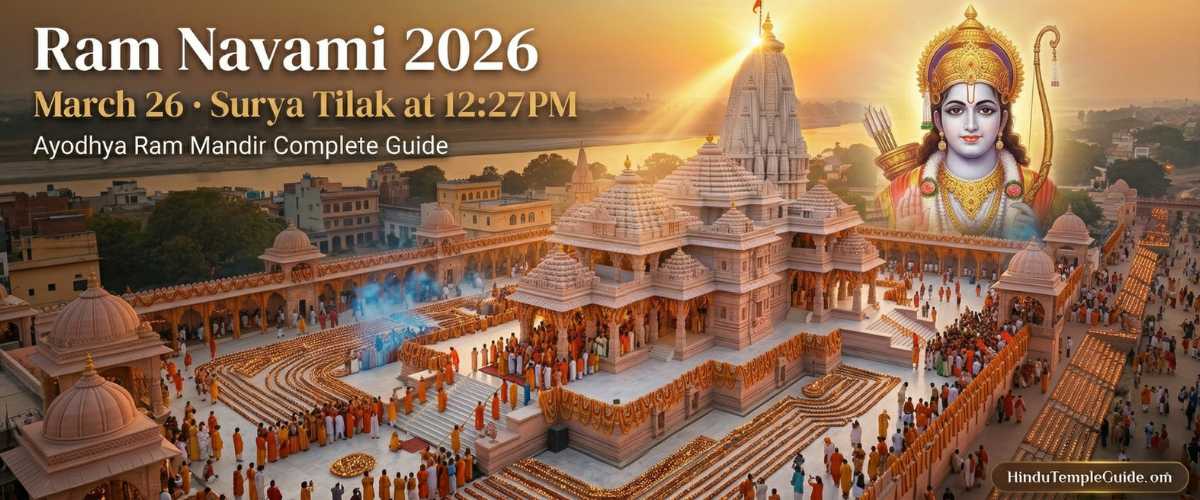
Ram Navami 2026 falls on Thursday, March 26. The most sacred moment is 12:27 PM — when the legendary Surya Tilak lights up Ram Lalla’s forehead at the Ayodhya Ram Mandir. This guide covers everything: exact muhurat timings, darshan slot details, top Ram temples across India, fasting rules, puja vidhi, and travel tips. Plan your visit early — crowds are expected in the millions.
Every year, on the ninth day of Chaitra Shukla Paksha, India pauses. Streets fill with the sound of bhajans. Temples glow with marigolds and diyas. And in Ayodhya, a ray of sunlight does something extraordinary at noon — it lands precisely on the forehead of Ram Lalla, the infant Lord Rama, inside the newly consecrated Ram Mandir.
Ram Navami 2026 falls on Thursday, March 26. It marks the birth anniversary of Maryada Purushottam Shri Ram, the seventh avatar of Lord Vishnu. With the Ram Mandir in full glory after its Pran Pratishtha on January 22, 2024, Ram Navami 2026 is expected to draw millions of pilgrims to Ayodhya.
SECTION 1
What Is Ram Navami and Why Is 2026 Special?
Ram Navami is the birthday of Lord Shri Ram — one of Hinduism’s most revered festivals, observed with fasting, prayer, and pilgrimage across India and around the world. Lord Rama was born to King Dasharatha and Queen Kausalya in Ayodhya. According to the Valmiki Ramayana, King Dasharatha performed the sacred Putrakameshti Yagna under the guidance of Sage Vashistha. Rama, born at the auspicious midday hour, grew to embody dharma in every test life placed before him.
Ram Navami 2026 is particularly significant for two reasons:
First — Second Major Ram Navami Inside the New Ram Mandir
This is only the second major Ram Navami celebration inside the newly built Ram Mandir — making it an extraordinarily charged spiritual event for every Ram bhakt in India and around the world.
Second — The Surya Tilak System Is Now Fully Calibrated
The Surya Tilak mechanism, developed by scientists at CSIR-CBRI Roorkee and the Indian Institute of Astrophysics, is now fully calibrated for a 19-year astronomical cycle — directing a beam of sunlight precisely onto Ram Lalla’s forehead at the exact birth moment.
SECTION 2
Ram Navami 2026 Date and Muhurat Timings
Ram Navami 2026
Thursday, March 26, 2026
Ram Janma Muhurat (most sacred moment): 12:27 PM
| Event |
Time |
| Navami Tithi begins |
11:48 AM, March 26 |
| Madhyahna Muhurat starts |
11:13 AM |
| Ram Janma Muhurat (most sacred) |
12:27 PM |
| Surya Tilak at Ram Mandir, Ayodhya |
12:27 PM |
| Madhyahna Muhurat ends |
1:41 PM |
| Navami Tithi ends |
10:06 AM, March 27 |
Puja Timing Guide: Begin your puja by 11:13 AM. Perform the Jhula Jhulana (cradle ceremony) at exactly 12:27 PM. Continue worship through 1:41 PM to receive the full spiritual benefit of the Madhyahna window. If celebrating outside Ayodhya, check your local Hindu Panchang as tithi timings can vary by region.
The Surya Tilak — a sacred beam of sunlight directed onto the forehead of Ram Lalla — takes place at exactly 12:27 PM on Ram Navami. This optical system was developed by CSIR-CBRI Roorkee and Indian Institute of Astrophysics scientists.
SECTION 3
What Is the Surya Tilak? The Science and Spirituality Behind It
Surya Tilak 2026 — 12:27 PM, March 26
A beam of sunlight lands precisely on Ram Lalla’s forehead at the exact moment of Lord Rama’s birth — for a few sacred minutes, science and devotion become one.
The Surya Tilak is a scientific-devotional achievement where a beam of sunlight is directed onto the forehead of the Ram Lalla idol using an optical setup of mirrors and lenses developed by CSIR-CBRI and IIA scientists. The system is based on the belief that Rama, born of the Surya (solar) dynasty, should receive the sun’s blessing at the exact moment of his birth.
In simple terms: as the clock hits 12:27 PM on March 26, sunlight travels through a precisely engineered set of lenses placed in the temple’s upper chambers. It bends, focuses, and lands as a golden tilak of light directly on the forehead of Ram Lalla’s idol in the sanctum sanctorum. The whole event lasts just a few minutes — but those minutes have moved millions to tears.
How the Surya Tilak Works
- Precisely calibrated mirrors, lenses, and optical tubes installed in the temple’s upper chambers
- Developed by scientists from CSIR-CBRI Roorkee and the Indian Institute of Astrophysics
- Calibrated for a 19-year astronomical cycle — works automatically every Ram Navami
- Captures the sun at its zenith and channels the beam down through the ceiling, into the sanctum
- Light falls exactly on Ram Lalla’s forehead (tilak point) for approximately 4–6 minutes
- Broadcast live on giant LED screens across Ayodhya for all devotees to witness
If you’re in Ayodhya on March 26: Find a spot near any of the giant LED screens well before noon. Darshan entry during the 11 AM to 12 PM slot gives you the best chance of being inside the temple complex during the Surya Tilak.
SECTION 4
Ayodhya Ram Mandir Darshan Timings on Ram Navami 2026
Important: All VIP Darshan, Sugam Darshan passes, and special Aarti bookings are typically suspended from a few days before Ram Navami until the festival concludes. Darshan is free for all on this day — organized in time slots. Read our full Ram Mandir visitor guide for regular darshan booking.
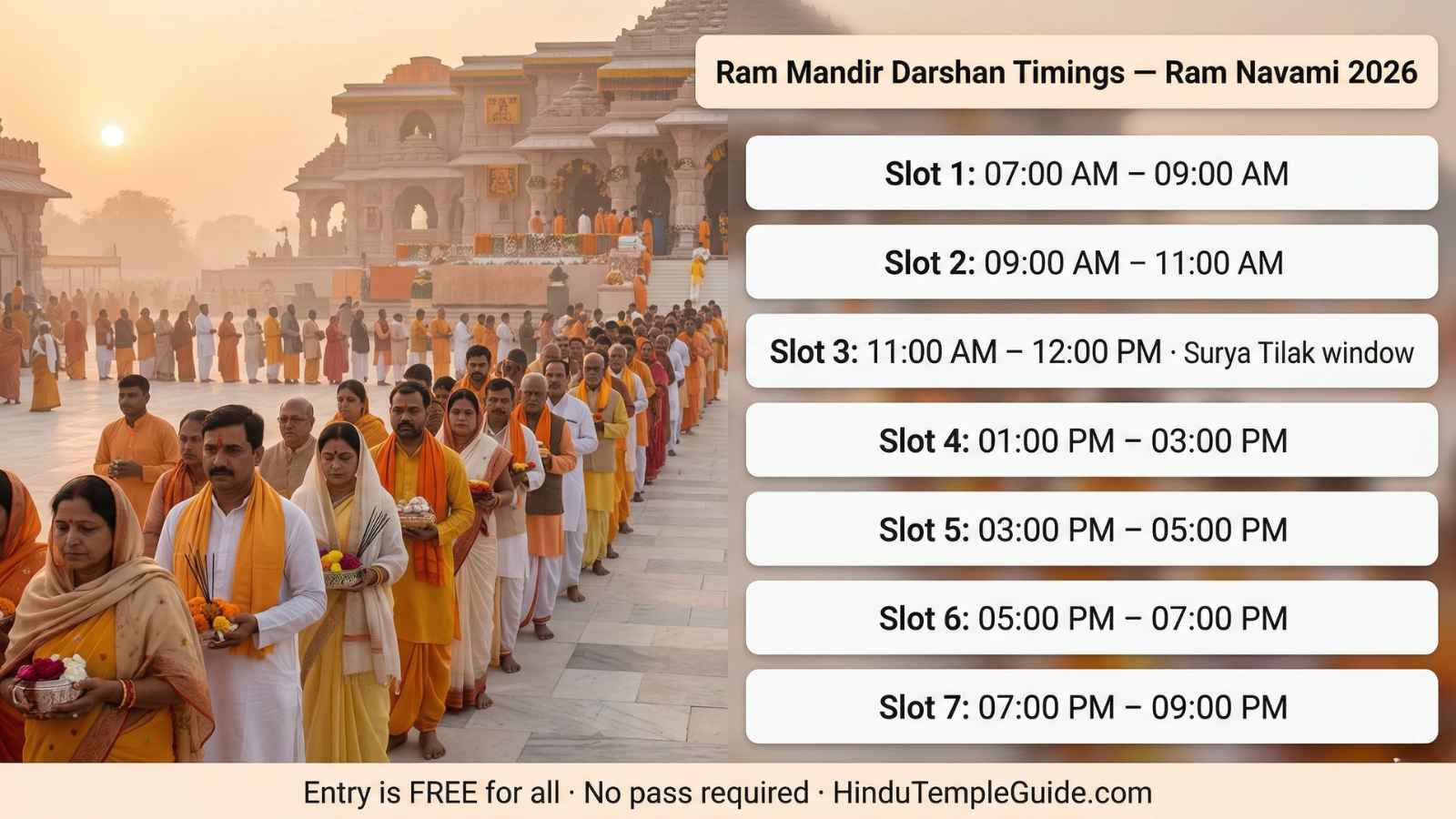
Free Darshan Slots on Ram Navami 2026
| Slot |
Timings |
Note |
| Slot 1 Best |
07:00 AM – 09:00 AM |
Lightest crowds — ideal for elderly & children |
| Slot 2 |
09:00 AM – 11:00 AM |
Good for being near temple during Surya Tilak |
| Slot 3 Surya Tilak |
11:00 AM – 12:00 PM |
Inside complex during Surya Tilak (12:27 PM) |
| Slot 4 |
01:00 PM – 03:00 PM |
Post-Surya Tilak afternoon darshan |
| Slot 5 |
03:00 PM – 05:00 PM |
Moderate crowds |
| Slot 6 |
05:00 PM – 07:00 PM |
Evening; Sarayu Aarti after this |
| Slot 7 |
07:00 PM – 09:00 PM |
Quieter than daytime |
Ram Mandir Ayodhya offers 7 free darshan slots on Ram Navami 2026, from 7:00 AM to 9:00 PM. No pass or booking is required. Arrive at least 90 minutes before your preferred slot to avoid long queues.
Daily Aarti Timings on Ram Navami
| Aarti |
Time |
| Mangal Aarti |
04:30 AM |
| Shringar Aarti |
06:30 AM |
| Shayan Aarti |
09:30 PM |
Darshan Tips for Ram Navami
- Arrive at least 90 minutes before your chosen slot — queues begin building hours earlier
- Wear comfortable footwear you can remove quickly
- Carry only a small bag — large bags and luggage are not permitted inside
- Carry your own drinking water and a light snack
- Keep your government ID (Aadhaar card) with you at all times
- If travelling with senior citizens or children, aim for the 07:00–09:00 AM slot when crowds are lightest
SECTION 5
Ram Navami Celebrations in Ayodhya: What to Expect
Ayodhya on Ram Navami is not just a temple visit — it’s a complete spiritual immersion. The city transforms from the night before. Streets are draped in saffron and marigold. The air smells of incense. Every lane near the Ram Mandir glows with diyas and fairy lights.
Before Sunrise
Sacred Sarayu Dip
Thousands of devotees gather at the Sarayu river ghats to take a holy dip before heading to the temple. This sacred bath is believed to cleanse the devotee before darshan on this auspicious day.
Morning
Special Abhishekam & Aartis
The idol of Ram Lalla is bathed with Panchamrit and adorned with exquisite ornaments and flowers. Multiple elaborate aartis are performed with thousands of devotees inside and outside the temple.
12:27 PM — The Sacred Moment
The Surya Tilak
The most awaited moment of the entire year — sunlight becomes tilak, and faith becomes visible. Broadcast live on giant screens across Ayodhya.
Afternoon
Grand Shobha Yatra
A vibrant religious procession with decorated chariots carrying idols of Lord Ram, Sita, Lakshman, and Hanuman moving through the city while devotees sing bhajans and chant prayers.
Evening
Sarayu Aarti at the River Ghats
The banks of the Sarayu witness the mesmerizing Sarayu Aarti — hundreds of lamps illuminate the ghats and create a deeply spiritual atmosphere rivalling the famous Ganga Aarti at Varanasi.
SECTION 6
Best Ram Temples to Visit on Ram Navami 2026 (Beyond Ayodhya)
Bhadrachalam temple in Telangana — called the “Ayodhya of the South” — has celebrated Ram Navami Kalyanam for over 400 years. The ceremonial wedding of Lord Rama and Goddess Sita is officially sponsored by the Telangana state government every year.
Not everyone can make it to Ayodhya. But Ram Navami is celebrated with equal devotion at Ram temples across the country. Here are the top pilgrimage destinations to consider:
1. Bhadrachalam Temple, Telangana — “Ayodhya of the South”
Famous for its world-renowned
Sri Sita Ramachandra Swamy Temple, where
Ram Navami Kalyanam — the celestial wedding ceremony of Lord Rama and Goddess Sita — is performed with great grandeur. The state government officially sponsors this ceremony. Often called the “Ayodhya of the South,” Bhadrachalam sits on the banks of the Godavari River. This Ram Navami Kalyanam has been celebrated for
over 400 years without interruption.
Read our temples in Andhra Pradesh guide →
2. Orchha Ram Raja Temple, Madhya Pradesh — Rama Worshipped as King
Orchha is the only place in India where Lord Rama is worshipped as a king, not a deity — addressed as “Ram Raja Sarkar.” The temple follows royal protocols, including a police guard of honour for Ram Navami. Celebrations here blend Rajput tradition with Vaishnav devotion in a way that’s unique to this region.
3. Rameswaram, Tamil Nadu — Where Rama Prayed Before Lanka
Rameswaram is where Lord Rama built his bridge to Lanka and prayed to Lord Shiva for blessings before battle. Ram Navami at the
Ramanathaswamy Temple involves special abhishekam rituals and attracts huge crowds from across South India.
Read our temples in Tamil Nadu guide →
4. Sita Ram Temple, Mathura Vrindavan, Uttar Pradesh
Ram Navami in Mathura Vrindavan is marked by deep devotion and spiritual energy. Temples organize Ram Katha, continuous bhajan-kirtan, floral decorations, and prasad distribution, creating a serene and festive Braj atmosphere.
5. Kodandarama Temple, Hampi, Karnataka — UNESCO Heritage Site
Located in Hampi — a
UNESCO World Heritage Site — this temple is built at the exact spot where, according to the Ramayana, Lord Rama crowned Sugriva as king of the Vanaras. Ram Navami here has a mythological significance that even seasoned pilgrims find deeply moving.
Read our temples in Karnataka guide →
SECTION 7
Ram Navami Puja Vidhi: How to Celebrate at Home
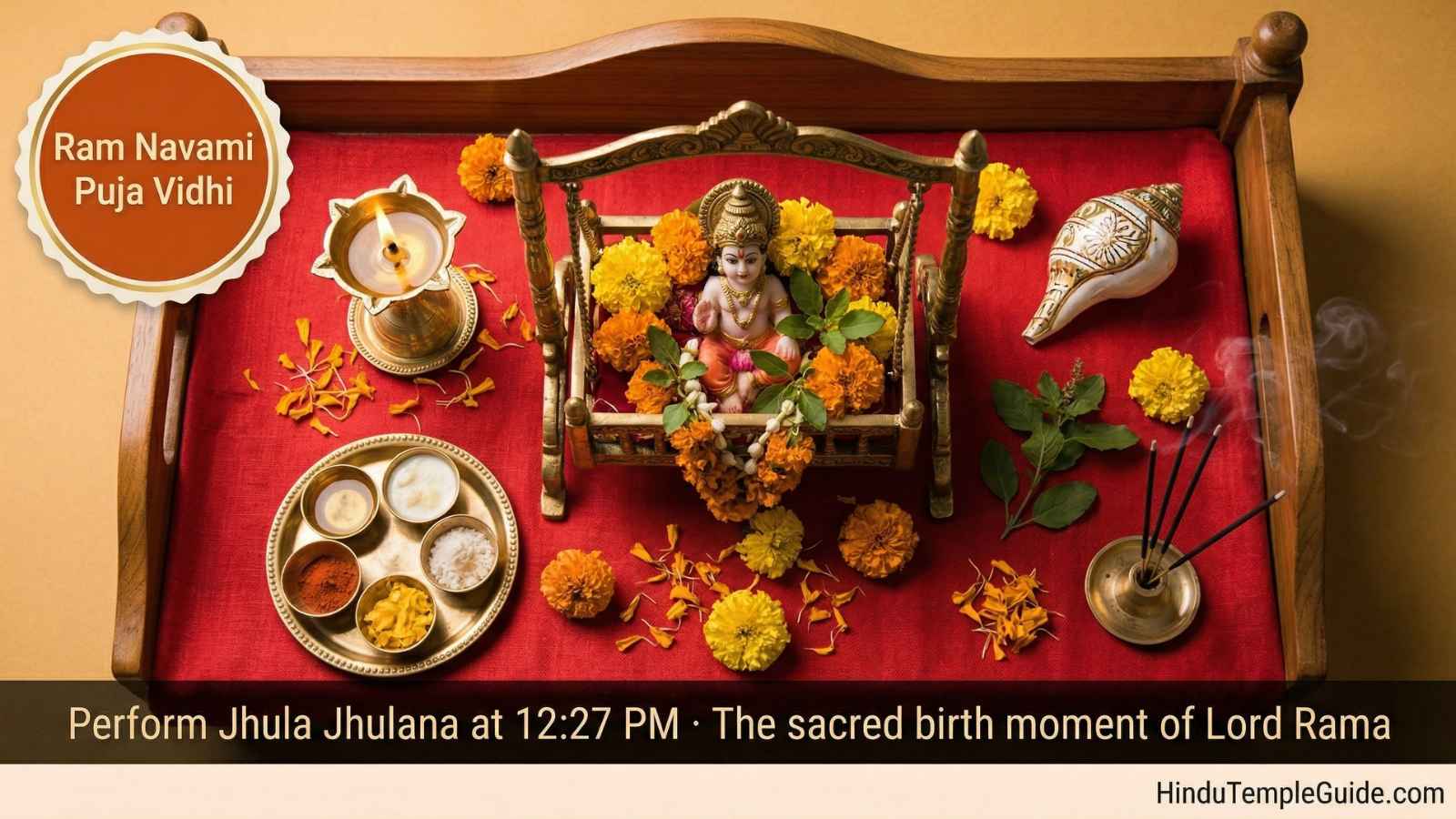
A traditional Ram Navami puja at home begins with placing the Bal Swaroop (infant Rama idol) in a small cradle. Perform the Jhula Jhulana ritual at exactly 12:27 PM on March 26, 2026 — the auspicious birth moment of Lord Rama.
A traditional Ram Navami puja begins with the Bal Swaroop ritual: Rama is worshipped in his infant form — complete with a cradle, lullabies, and offerings of milk and honey. On his birthday, you meet Rama as a child.
What You Need for the Puja
- Idol or image of infant Lord Rama (Bal Swaroop)
- Small cradle (jhula)
- Panchamrit (milk, curd, honey, ghee, sugar)
- Fresh flowers, especially tulsi leaves
- Incense sticks, a diya, and camphor
- Fruits and sweets for prasad (avoid non-vegetarian food and onion/garlic)
Step-by-Step Puja Vidhi
Step 1 — Early Morning
Wake before sunrise, take a bath, and wear clean clothes. Clean your puja space and set up the idol of infant Rama in a small cradle.
Step 2 — 11:13 AM
Begin the puja with a sankalp — a mental declaration of your intention to worship. Perform abhishekam by bathing the idol with Panchamrit, then water.
Step 3 — Continue Worship
Offer fresh flowers, tulsi, and dhoop. Chant the Ram Raksha Stotra or recite verses from the Ramayana.
Step 4 — 12:27 PM Most Sacred
Gently rock the cradle and sing a Ram lullaby (lori) — this is the Jhula Jhulana ritual marking the birth moment. This is the moment of Ram Janma.
Step 5 — Complete the Puja
Perform aarti with a lit diya and camphor. Continue through 1:41 PM (end of Madhyahna window).
Step 6 — Prasad
Distribute prasad to family members. Break your fast after this ritual.
SECTION 8
Ram Navami Fasting Rules and What to Eat
Ram Navami vrat is one of the most widely observed fasts in Hindu tradition. The fast is considered complete only after performing the Madhyahna puja at 12:27 PM and distributing prasad.
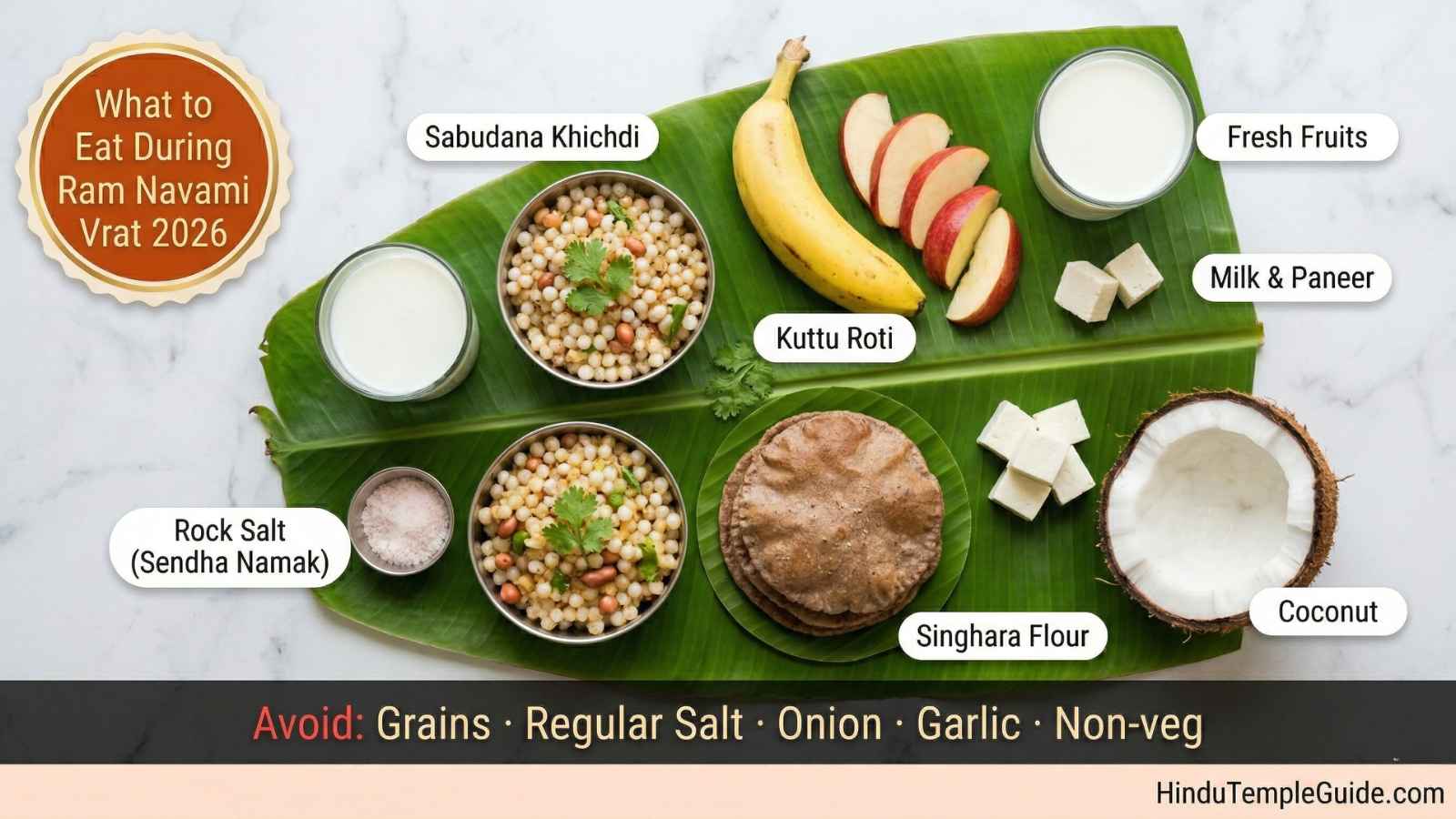
Foods allowed during the Ram Navami 2026 vrat: sabudana khichdi, kuttu flour roti, fresh fruits, milk, paneer, and singhara flour preparations. Always use sendha namak (rock salt) instead of regular salt while fasting.
Fasting Rules — What to Avoid
- Begin the fast from sunrise on March 26
- Avoid grains, lentils, and regular salt throughout the day
- Do not consume non-vegetarian food, onion, or garlic
- Maintain celibacy and avoid negative speech on this day
- Fast can be broken after the puja at noon, or extended until sunset/midnight depending on family tradition
What You Can Eat During the Fast
- Fresh fruits and fruit juices
- Milk, curd, and paneer
- Sabudana (sago) khichdi or vada
- Kuttu (buckwheat) flour rotis
- Singhara (water chestnut) flour preparations
- Rock salt (sendha namak) instead of regular salt
SECTION 9
How to Reach Ayodhya for Ram Navami 2026
Ayodhya is accessible by air (Maharishi Valmiki Airport, 10 km), train (Ayodhya Dham Junction, 2 km), and road (3 hours from Lucknow, 4 hours from Varanasi). For Ram Navami 2026, book accommodation at least 6 to 8 weeks in advance.
Book Early: Accommodation fills up months ahead for Ram Navami. Book at least 6–8 weeks in advance.
Maharishi Valmiki International Airport (AYJ) — approximately 10–12 km from the Ram Mandir. Direct flights connect Ayodhya to Delhi, Mumbai, and other major cities. Book at least 4–6 weeks in advance.
By Train — Most Popular Option
Ayodhya Dham Junction is 2–3 km from the Ram Mandir. Special festival trains are added from Lucknow, Varanasi, Delhi, and Mumbai — check the IRCTC website for Ram Navami special trains closer to the date. From Lucknow: ~3 hrs | From Varanasi: ~4 hrs | From Delhi: ~9–10 hrs.
Ayodhya is 135 km from Lucknow (~3 hours), 200 km from Varanasi (~4 hours), and 640 km from Delhi (~9–10 hours). State transport buses and private taxis are widely available.
Accommodation Tips
- Book at least 6–8 weeks before Ram Navami
- Budget dharamshalas near the temple fill up first — IRCTC and UPSTDC manage affordable pilgrim accommodations
- Hotels in Faizabad (5 km away) often have better availability than Ayodhya town itself
- Many pilgrims stay in Lucknow (135 km) and take an early morning train to Ayodhya for the day
SECTION 10
Ram Navami Across India: Regional Celebrations
Ram Navami is not just an Ayodhya festival. Celebrations vary beautifully across India, each adding its unique cultural flavour while maintaining the core devotion to Lord Rama:
| Region |
How Ram Navami Is Celebrated |
| South India |
Temples organize Kalyanam — the celestial wedding ceremony of Lord Rama and Goddess Sita. Special pujas, music concerts featuring Thyagaraja Kritis, and Harikatha sessions are held. |
| Maharashtra |
Ram Navami marks the beginning of Grantha Parayana — continuous, uninterrupted reading of the Ramayana that begins nine days before and concludes on the day itself. Communities take turns reading through the night. |
| Varanasi |
The ghats of the Ganga witness massive Ram Navami processions. Kashi Vishwanath Temple holds special abhishekam and aarti sessions through the day. |
| West Bengal |
Ram Navami is observed as a major Vaishnav festival, with temples hosting Ram Katha and devotional music sessions. |
SECTION 11
Frequently Asked Questions – Ram Navami 2026
Q1. What is the date and exact time of Ram Navami 2026?
Ram Navami 2026 falls on Thursday, March 26, 2026. The Navami Tithi begins at 11:48 AM on March 26 and ends at 10:06 AM on March 27. The most auspicious moment — the Ram Janma Muhurat — is at 12:27 PM on March 26, which is also when the Surya Tilak takes place at the Ayodhya Ram Mandir.
Q2. What is the Surya Tilak and when does it happen in 2026?
The Surya Tilak is a scientific-devotional ritual at the Ayodhya Ram Mandir where a beam of sunlight is directed onto the forehead of the Ram Lalla idol at noon on Ram Navami. In 2026, the Surya Tilak occurs at 12:27 PM on March 26. The system was developed by scientists at CSIR-CBRI Roorkee and the Indian Institute of Astrophysics using mirrors and lenses calibrated for a 19-year astronomical cycle.
Q3. Can I book a VIP Sugam darshan pass for Ram Navami at the Ayodhya Ram Mandir?
No. VIP Darshan and Sugam e-passes are typically suspended for several days before and during Ram Navami to ensure free and equal access for all pilgrims. Darshan on Ram Navami is free for everyone, organized in time slots from 7 AM to 9 PM. You do not need a pass — but arrive well before your intended slot as queues build up several hours in advance.
Q4. What should I eat during the Ram Navami fast?
During the Ram Navami vrat, devotees avoid grains, lentils, and regular salt. You can eat fresh fruits, milk and dairy products, sabudana preparations, kuttu flour rotis, and singhara flour items. Use rock salt (sendha namak) instead of table salt. The fast is typically broken after the Madhyahna puja at 12:27 PM by distributing and consuming prasad.
Q5. Which is the best temple to visit for Ram Navami outside Ayodhya?
The Bhadrachalam Sri Sita Ramachandra Swamy Temple in Telangana is widely considered the most spectacular Ram Navami celebration outside Ayodhya. The Ram Navami Kalyanam has been performed here for over 400 years and is officially sponsored by the Telangana state government. Other top destinations include the Orchha Ram Raja Temple in Madhya Pradesh, Ramanathaswamy Temple in Rameswaram, and the Kodandarama Temple in Hampi.
Conclusion — Plan Your Ram Navami 2026 Today
Ram Navami 2026 on March 26 is one of the most spiritually charged days of the Hindu calendar.
Whether you’re watching the Surya Tilak live from Ayodhya, observing the traditional Kalyanam at Bhadrachalam, or performing puja at home at 12:27 PM — the core of Ram Navami remains the same: a moment to connect with the ideals that Lord Rama embodied — dharma, courage, humility, and devotion.
Plan your travel early. Book your darshan slot. Keep your puja items ready. And at noon on March 26, wherever you are, take a moment of stillness. That’s when sunlight becomes tilak, and faith becomes visible.
Jai Shri Ram!
Read More Pilgrimage & Temple Guides on HinduTempleGuide.com
Disclaimer: Muhurat timings, darshan schedules, and festival procedures in this guide are based on the latest verified data as of March 2026. Temple authorities may revise timings at any time. Always verify the latest information at the official portal online.srjbtkshetra.org and official government sources before visiting. Jai Shri Ram!







Leave a Comment
Your email will not be published. Required fields are marked *