
Maha Shivaratri-the Great Night of Bhagwan Shiva-is the most sacred, inward-turning, and spiritually charged night in the Hindu calendar. Having stood in the pre-dawn queues at Kashi Vishwanath in Varanasi, Mahakaleshwar in Ujjain, Trimbakeshwar in Nashik, Somnath in Gujarat, and more of India's revered Shiva shrines, I have experienced firsthand how millions of devotees stay awake from sunset until dawn in fasting, Jagaran (all-night vigil), and Rudrabhishekam to offer three simple leaves of Bilva Patra to Bholenath, the Adiyogi.
This complete guide covers every verified Panchang detail for both Maha Shivaratri 2026 (Sunday, February 15, 2026) and Maha Shivaratri 2027 (Saturday, March 6, 2027)-including the exact Nishita Kaal midnight puja window (12:09 AM - 1:01 AM in 2026; 12:02 AM - 12:51 AM in 2027), all four Prahar timings and offerings, step-by-step Rudrabhishekam vidhi, sacred mantras, vrat rules, and official booking rules at India's top Jyotirlinga temples. Har Har Mahadev!
1. What Is Maha Shivaratri? Spiritual Significance & Why This Night Changes Lives
From the Sanskrit Maha (Great) + Shiva (Auspicious Consciousness) + Ratri (Night), Maha Shivaratri is observed annually on the fourteenth night of the waning moon (Krishna Paksha Chaturdashi) in the month of Phalguna (North Indian Purnimanta calendar) or Magha (Maharashtra, Gujarat, and South Indian Amanta calendar). Unlike daytime festivals of feasting and celebration, Maha Shivaratri is a festival of night-long stillness, fasting, wakefulness (Jagaran), and inner contemplation.
On the fourteenth night before the new moon (Amavasya), when the moon-the presiding deity of the human mind (Chandrama Manaso Jatah)-is reduced to its thinnest crescent resting on Lord Shiva's matted locks, yogic and Vedic traditions teach that keeping the spine erect in meditation and chanting Om Namah Shivaya effortlessly aligns the remaining subtle mind with supreme consciousness.
2. Maha Shivaratri 2026 & 2027 Dates, Tithi & Complete Puja Timings
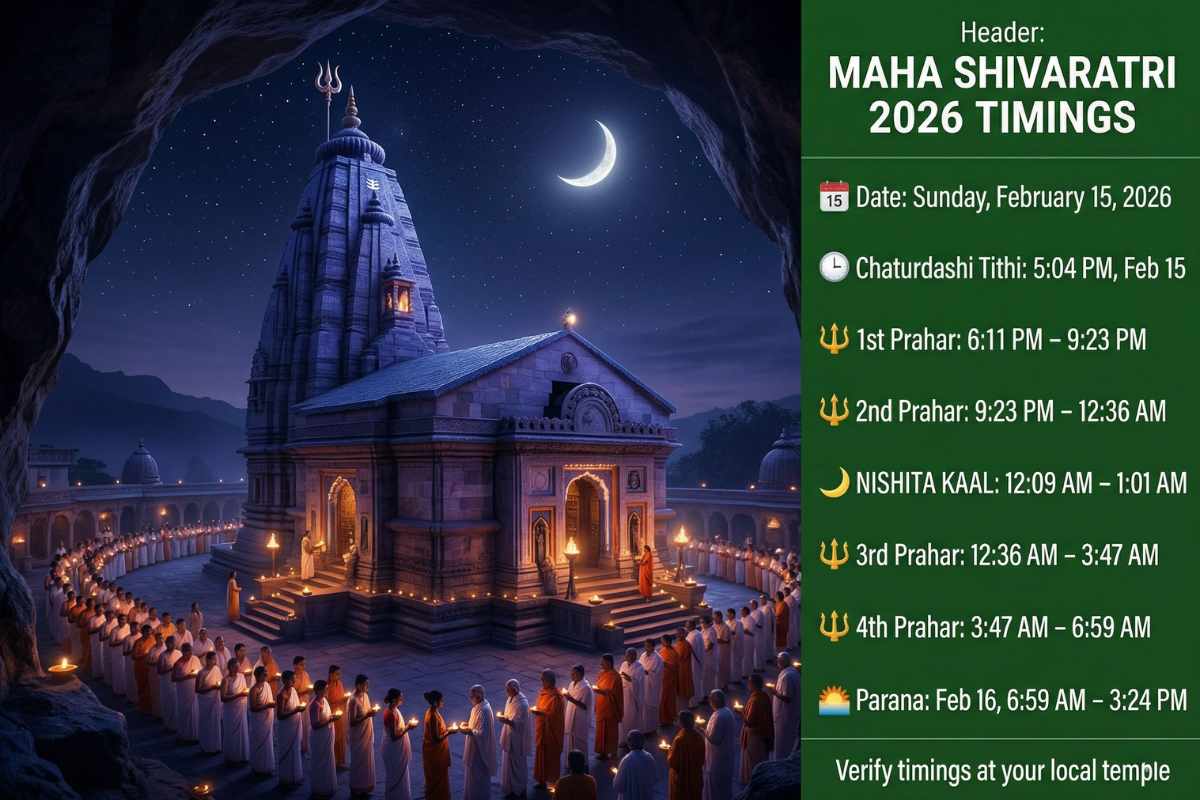
In 2026: Maha Shivaratri fell on Sunday, February 15, 2026 (Chaturdashi Tithi: 5:04 PM Feb 15 - 5:34 PM Feb 16; Nishita Kaal: 12:09 AM - 1:01 AM on Feb 16; Parana: 6:59 AM - 3:24 PM on Feb 16). In 2027: Maha Shivaratri falls on Saturday, March 6, 2027 (Chaturdashi Tithi: 12:03 PM Mar 6 - 1:46 PM Mar 7; Nishita Kaal: 12:02 AM - 12:51 AM on Mar 7; Parana: 6:42 AM - 1:46 PM on Mar 7).
| Maha Shivaratri Event | 2026 Date & Time (IST) | 2027 Date & Time (IST) |
|---|---|---|
| Maha Shivaratri Date | Sunday, February 15, 2026 | Saturday, March 6, 2027 |
| Chaturdashi Tithi Begins | 5:04 PM on February 15, 2026 | 12:03 PM on March 6, 2027 |
| Chaturdashi Tithi Ends | 5:34 PM on February 16, 2026 | 1:46 PM on March 7, 2027 |
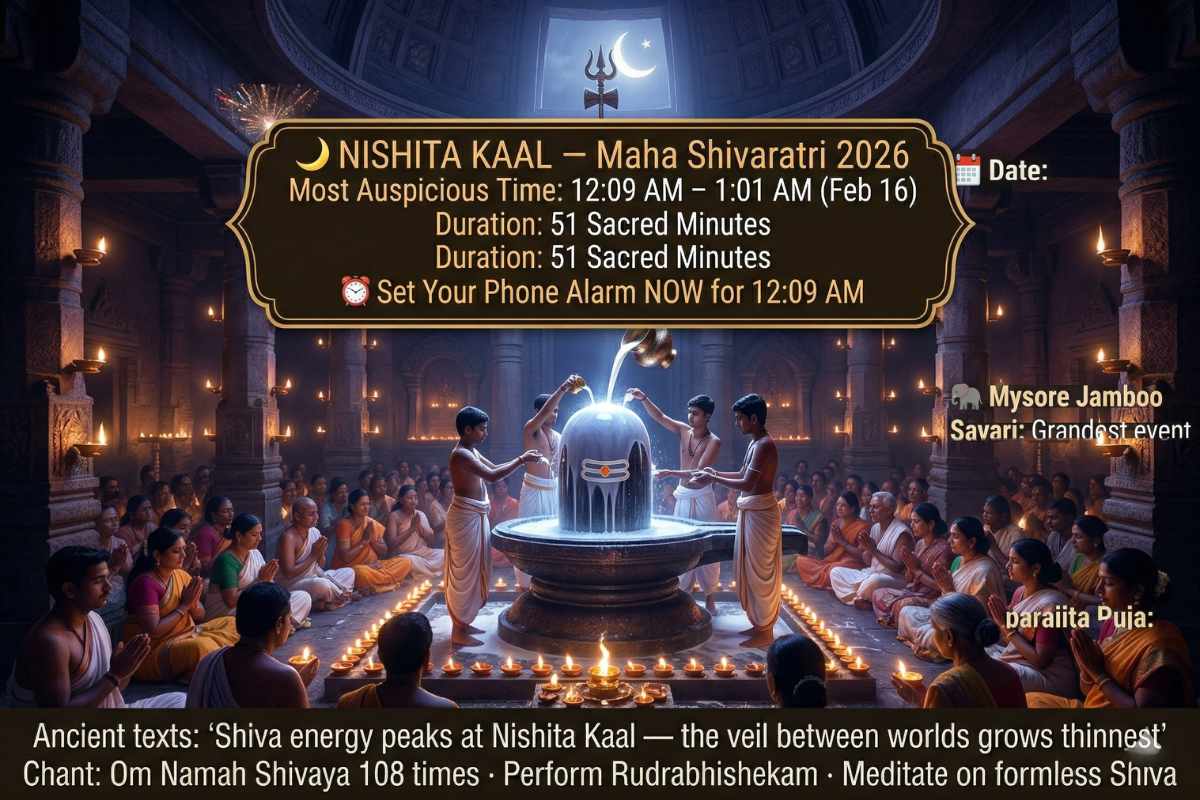
| Nishita Kaal (MOST AUSPICIOUS) | 12:09 AM - 1:01 AM (Feb 16 · 51 mins) | 12:02 AM - 12:51 AM (Mar 7 · 49 mins) |
| 1st Prahar Puja | 6:11 PM - 9:23 PM (Feb 15) | 6:24 PM - 9:29 PM (Mar 6) |
| 2nd Prahar Puja | 9:23 PM - 12:35 AM (Feb 15-16) | 9:29 PM - 12:33 AM (Mar 6-7) |
| 3rd Prahar Puja | 12:35 AM - 3:47 AM (Feb 16) | 12:33 AM - 3:38 AM (Mar 7) |
| 4th Prahar Puja | 3:47 AM - 6:59 AM (Feb 16) | 3:38 AM - 6:42 AM (Mar 7) |
| Vrat Parana (Fast-Breaking) | 6:59 AM - 3:24 PM (Feb 16) | 6:42 AM - 1:46 PM (Mar 7) |
3. Four Prahar Puja Timings - What to Offer & Chant in Each Prahar
For devotees observing the traditional night-long Chatur-Yama (Four Prahar) Puja described in the Shiva Mahapurana, each of the four quarters of the night has its own sacred Abhishekam offering, mantra, and spiritual fruit:
| Prahar | 2026 / 2027 Timing | Primary Abhishekam | Prahar Mantra | Spiritual Fruit |
|---|---|---|---|---|
| 1st Prahar | 6:11-9:23 PM (2026) 6:24-9:29 PM (2027) |
Milk (Ksheera) & Gangajal | Hreem Ishanaya Namah | Purity of mind, health & longevity |
| 2nd Prahar | 9:23 PM-12:35 AM (2026) 9:29 PM-12:33 AM (2027) |
Curd (Dadhi) | Hreem Aghoraya Namah | Prosperity, stability & family welfare |
| 3rd Prahar (Midnight Junction) |
12:35-3:47 AM (2026) 12:33-3:38 AM (2027) |
Pure Cow's Ghee (Ghrita) | Hreem Vamadevaya Namah | Overcoming karma & inner awakening |
| 4th Prahar | 3:47-6:59 AM (2026) 3:38-6:42 AM (2027) |
Honey (Madhu) & Sugar/Panchamrit | Hreem Sadyojataya Namah | Sweetness of speech & final liberation (Moksha) |
4. The 4 Sacred Legends of Maha Shivaratri - Why Shiva Chose This Night
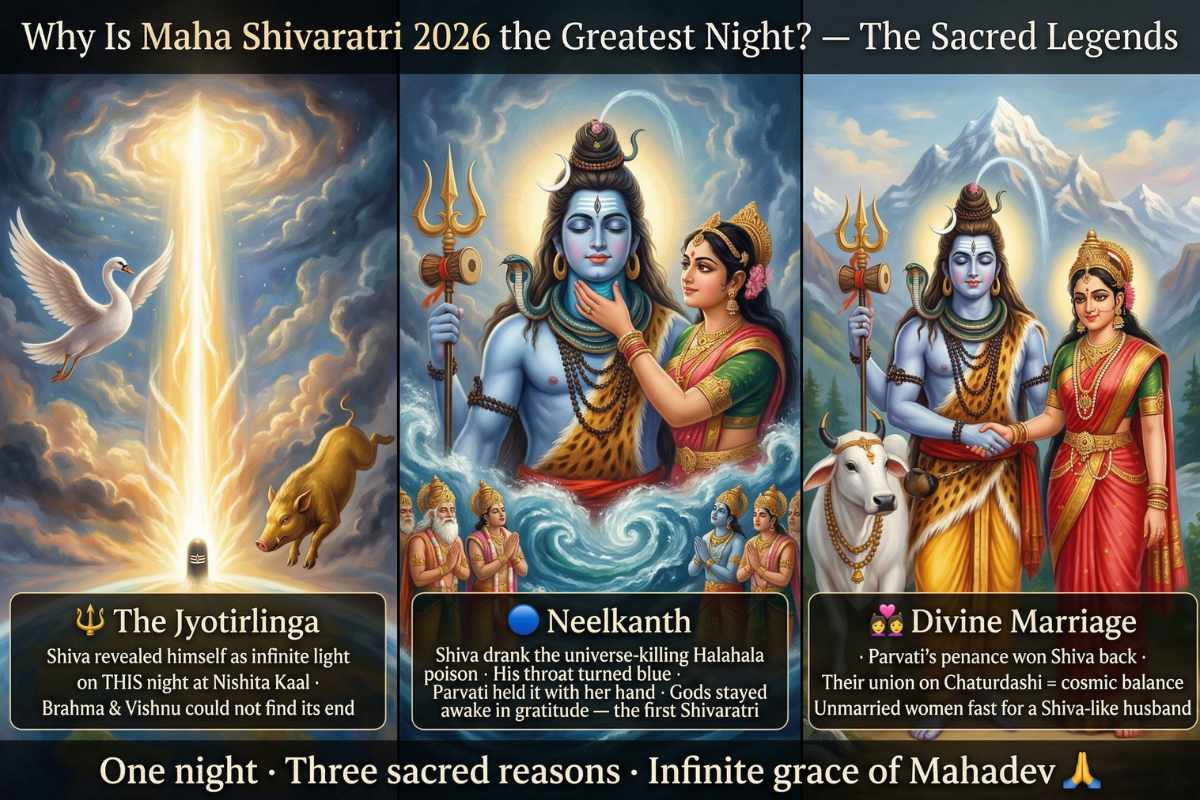
Legend 1: Lingodbhava - Shiva Manifests as the Infinite Pillar of Light (Jyotirlinga)
According to the Vidyesvara Samhita of the Shiva Mahapurana, when Lord Brahma and Lord Vishnu debated who was supreme in the universe, an infinite column of blazing fire and light (Anadi-Ananta Jyotistambha) appeared between them on the night of Phalguna Krishna Chaturdashi at Nishita Kaal (midnight). Neither Brahma (flying upward as a swan) nor Vishnu (burrowing downward as a boar) could find its beginning or end-and from that pillar of light emerged Sadashiva. The twelve places where this light manifested on Earth became India's sacred 12 Jyotirlingas.
Legend 2: Neelkanth - Shiva Drinks the Halahala Poison to Save Creation
During the churning of the cosmic ocean (Samudra Manthan), the deadly poison Halahala (Kalakuta) rose from the depths and threatened to consume all three worlds. Out of boundless compassion, Bhagwan Shiva drank the poison and held it in his throat (Vishuddhi Chakra), while Goddess Parvati steadied his neck so it would not descend-turning his throat a deep blue (Neelkanth). To cool the fiery heat of the poison, the Devas stayed awake all night pouring cool Ganga water, milk, and Dhatura over him, initiating the tradition of Maha Shivaratri Abhishekam and Jagaran.
Legend 3: The Celestial Marriage of Shiva and Parvati (Shiva-Shakti Milan)
After centuries of intense penance (Tapasya), Goddess Parvati won Lord Shiva out of his ascetic solitude and married him on this sacred Chaturdashi night (celebrated at shrines like Triyuginarayan near Kedarnath, Kashi, and Ujjain, where a nine-day Shiv Navratri wedding festival precedes Maha Shivaratri). Their union symbolises the cosmic harmony of Shiva (pure consciousness) and Shakti (creative energy).
Legend 4: The Hunter Gurudruh (Lubdhaka) and the Bilva Tree
In the Shiva Purana Vrat Katha, a poor forest hunter named Gurudruh (Lubdhaka) climbed a Bilva tree at nightfall on Maha Shivaratri to wait for deer. Fasting out of hunger, staying awake through all four Prahars in the cold, and plucking Bilva leaves that fell onto a hidden Shiva Lingam at the base of the tree along with water from his canteen, his heart softened with compassion when a doe and her family pleaded for their lives-and Lord Shiva blessed him with liberation and reborn grace as Nishadraj Guha in the Ramayana.
5. Rudrabhishekam & Puja Vidhi - Step-by-Step Complete Guide
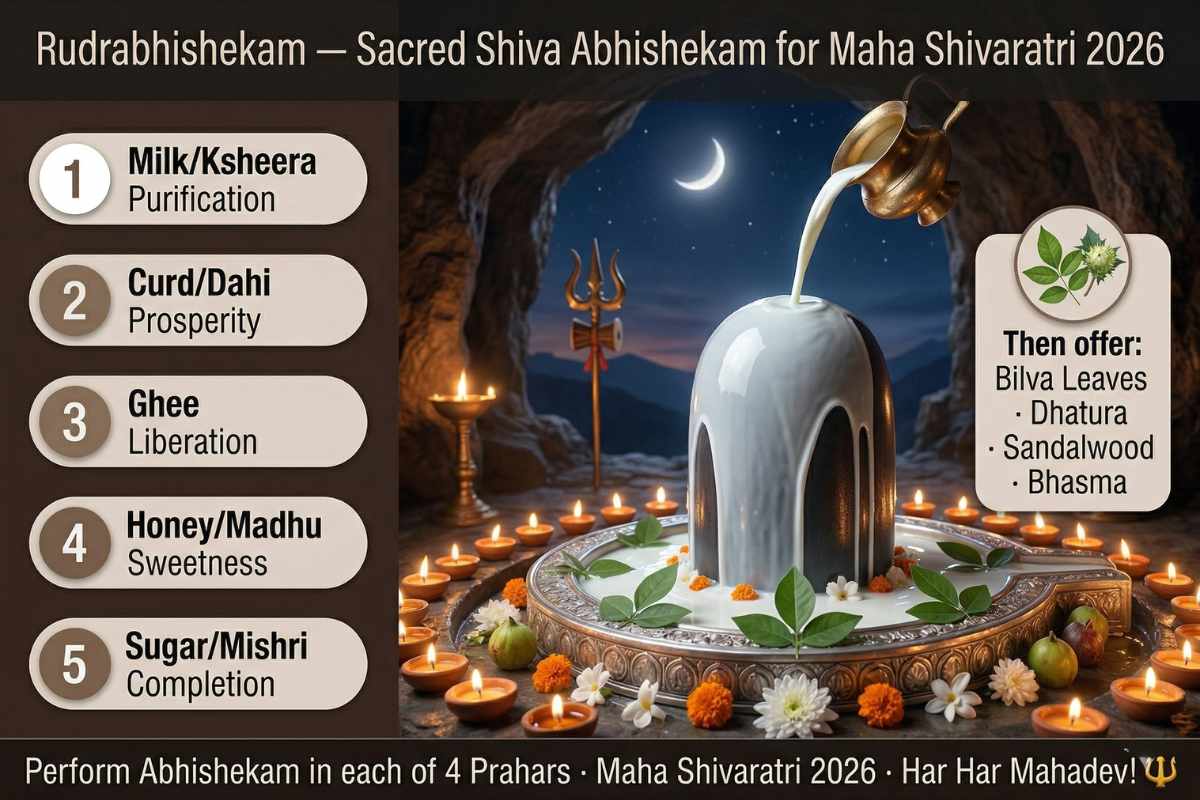
Step-by-Step Rudrabhishekam Sequence at Home
- 1
Sankalp & Ganesha Invocation: Sit facing North or East on a woollen or kusha mat, take water and Akshata in your right palm to make your puja Sankalp, and first invoke Lord Ganesha ('Om Gam Ganapataye Namah') and Nandi Ji.
- 2
Panchamrit & Gangajal Abhishekam: Pour a thin, steady stream over the Shiva Lingam while chanting 'Om Namah Shivaya' in this exact sequence-rinsing with pure water after each item: Water/Gangajal → Raw Milk → Curd → Cow's Ghee → Honey → Sugar/Sugarcane Juice → Final Gangajal Bath.
- 3
Apply Tripundra of Bhasma & Chandan: Gently wipe the Shiva Lingam with a clean white cloth, draw three horizontal lines (Tripundra) of cooling White Chandan paste and Bhasma (Vibhuti) on the Lingam, and offer whole unbroken rice grains (Akshata).
- 4
Offer Bilva Patra (Smooth Side Down): Wash whole 3-leafed Bilva (Bel Patra) leaves, remove the hard woody knot at the base of the stem, dab a dot of Chandan on each leaflet, and place them with the smooth side facing down on the Shiva Lingam while chanting 'Eka Bilvam Shivarpanam'.
- 5
Offer White Flowers, Dhatura & Shami Leaves: Offer white Aak (Mandar), Kaner, Dhatura flower/fruit, and Shami leaves. Never offer Tulsi, Ketaki, Champa, Haldi, or Sindoor on the Shiva Lingam.
- 6
Light Ghee Diya, Chant Mantras & Perform Aarti: Light dhoop and a pure ghee lamp, chant 'Om Namah Shivaya' and the Maha Mrityunjaya Mantra 108 times on a Rudraksha mala (along with Sri Rudram, Lingashtakam, or Shiva Panchakshara Stotram), offer seasonal fruits and Ber (jujube), and perform camphor Aarti ("Om Jai Shiv Omkara").
6. Sacred Offerings for Shiva - What to Offer & What Is Strictly Prohibited
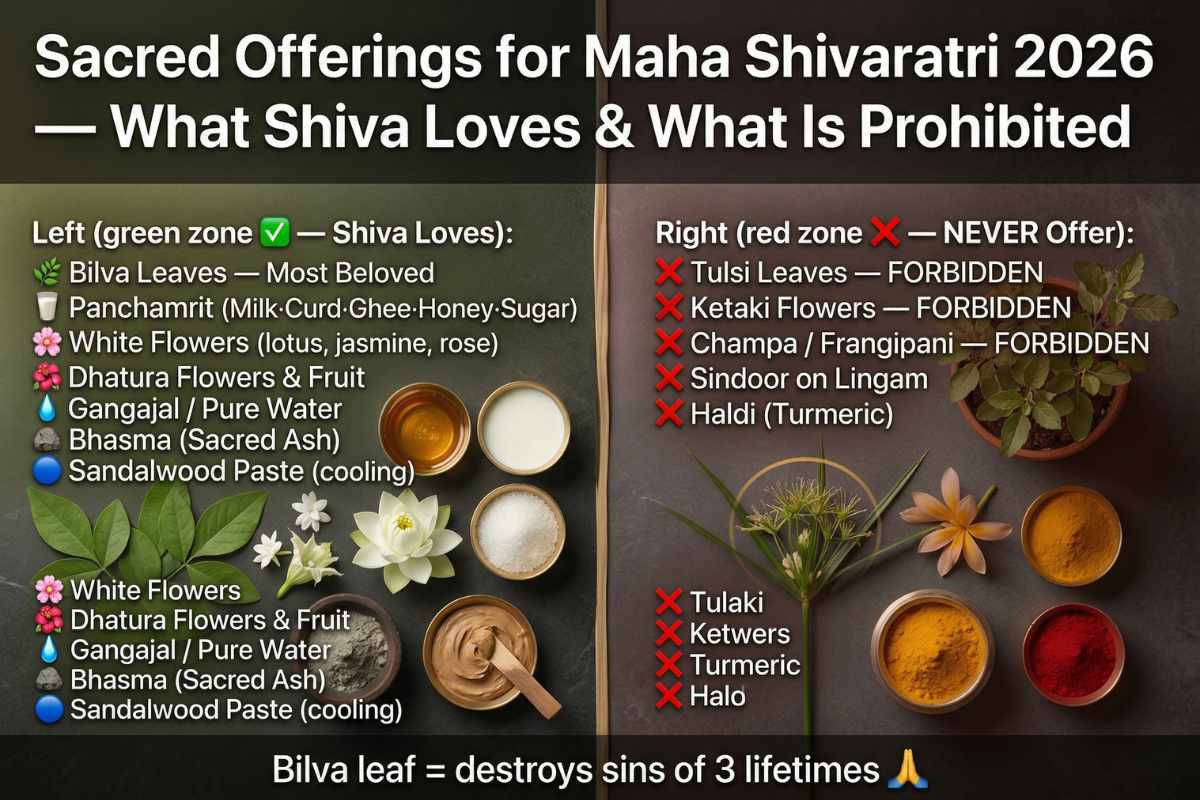
- Bilva Patra (3-leafed Bel leaves) - offered smooth side down
- Pure Gangajal, raw cow's milk, curd, ghee, honey & sugar (Panchamrit)
- White Aak (Mandar), white Kaner, white lotus & Shami leaves
- Dhatura flowers & thorny Dhatura fruit
- White Sandalwood paste (Chandan) & Bhasma (Vibhuti)
- Unbroken whole rice grains (Akshata) & black sesame (Kala Til)
- Ber (Indian jujube), sugarcane juice & seasonal fruits
- Rudraksha beads
- Tulsi (Holy Basil) leaves - reserved for Vishnu/Krishna puja
- Ketaki (Kewda) & Champa flowers - cursed in the Shiva Purana for false testimony
- Sindoor, Kumkum, or Roli on the Shiva Lingam (offer only to Maa Parvati)
- Turmeric (Haldi) on the Shiva Lingam
- Water poured from a Conch Shell (Shankha) - because Shiva slew Shankhachuda
- Broken rice grains (Khandit Chawal) or torn/insect-eaten Bilva leaves
- Coconut water poured directly on the Lingam (offer whole coconut as Sriphal instead)
- Full 360-degree Parikrama (always do Ardha-Parikrama, stopping at the water outlet Somasutra/Jalahari)
7. Shivaratri Mantras - Om Namah Shivaya, Maha Mrityunjaya & Sacred Stotras
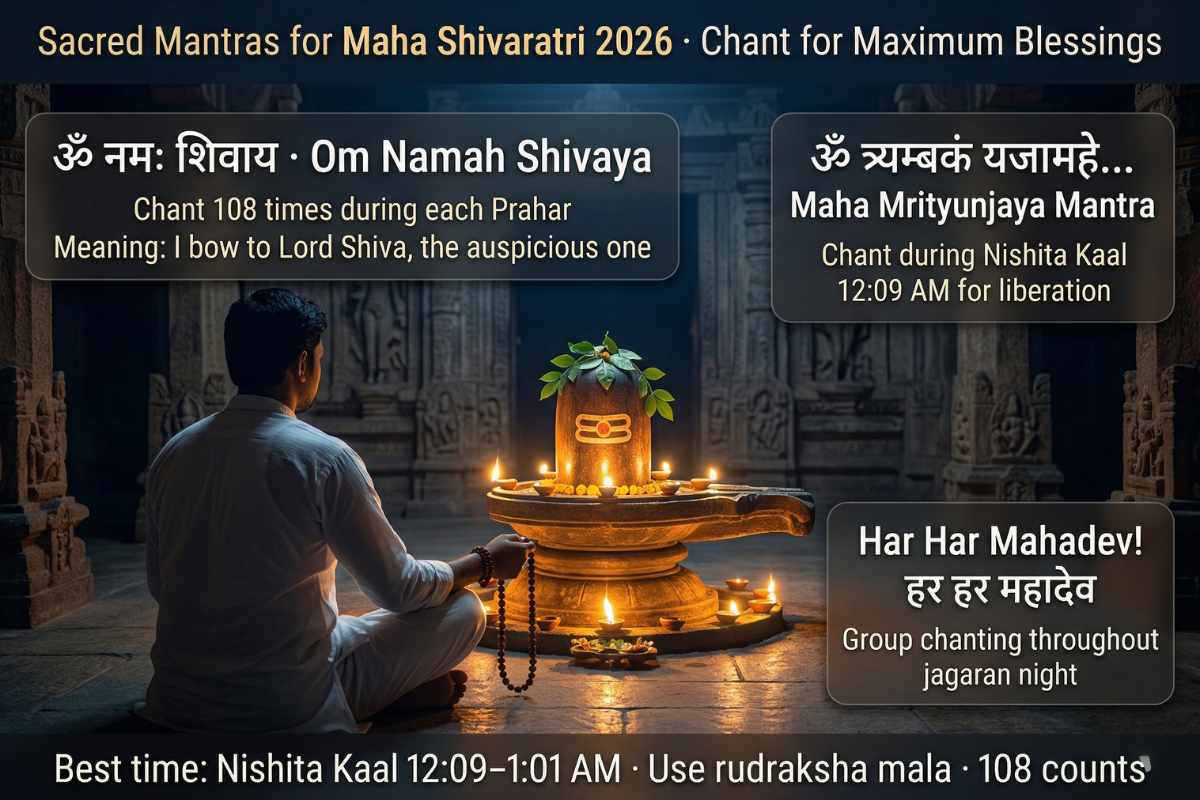
| Mantra Name | Full Sanskrit Text | When & How to Chant |
|---|---|---|
| Panchakshara Mantra (Yajurveda) | Om Namah Shivaya (ॐ नमः शिवाय) | All 4 Prahars - minimum 108 times (1 mala) per Prahar |
| Maha Mrityunjaya Mantra (Rigveda 7.59.12) | Om Tryambakam Yajamahe Sugandhim Pushtivardhanam, Urvaarukamiva Bandhanan Mrityor Muksheeya Maamritat | Nishita Kaal (Midnight) - 108 times for health, healing & fearlessness |
| Rudra Gayatri Mantra | Om Tatpurushaya Vidmahe Mahadevaya Dhimahi Tanno Rudrah Prachodayat | 4th Prahar / Brahma Muhurta (4:00-6:00 AM) - 108 times for clarity |
| Shiva Kshama Prarthana | Karacharana Kritam Vaa Kayajam Karmajam Vaa... Jaya Jaya Karunabdhe Shri Mahadeva Shambho | At the conclusion of puja to seek forgiveness for any ritual errors |
| Na-Ma-Shi-Va-Ya (Pancha Bhoota) | Earth (Na) · Water (Ma) · Fire (Shi) · Air (Va) · Space (Ya) | Meditate on the 5 cosmic elements while pouring Abhishekam |
8. Maha Shivaratri Fasting Rules - Vrat Vidhi, Foods & Parana Time
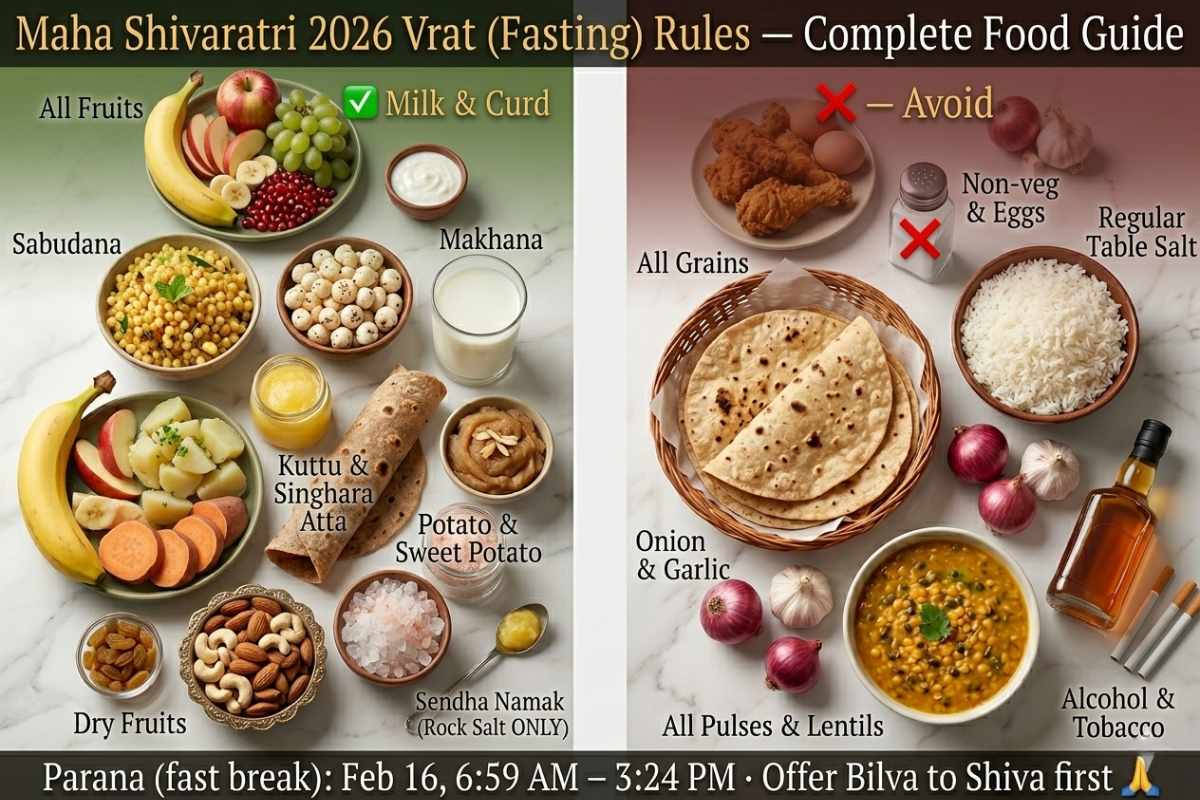
According to the Dharma Sindhu, the Maha Shivaratri Vrat begins at sunrise on Chaturdashi day and should be broken the next morning after sunrise before Chaturdashi Tithi ends. In 2026, Parana was on Monday, February 16 between 6:59 AM and 3:24 PM. In 2027, Parana is on Sunday, March 7 between 6:42 AM and 1:46 PM.
- All fresh fruits, Ber (jujube), bananas, and coconut water
- Milk, curd (dahi), paneer, and pure cow's ghee
- Sabudana (sago) khichdi, vada, or kheer
- Makhana (fox nuts) roasted in ghee & dry fruits
- Kuttu (buckwheat), Singhara (water chestnut), and Rajgira flours
- Boiled potato, sweet potato (shakarkandi), and arbi
- Sendha Namak (rock salt) ONLY, cumin, and black pepper
- All regular cereal grains - wheat, rice, maida, suji, oats, and corn
- All pulses, lentils, and legumes (dal, chana, besan)
- Regular iodised sea salt / table salt
- Onion and garlic in any household food
- Turmeric (haldi), hing (asafoetida), and mustard seeds in vrat meals
- Non-vegetarian food, eggs, alcohol, and tobacco
- Tulsi leaves in Shiva prasad offerings
9. Jagaran - Hour-by-Hour All-Night Vigil Schedule
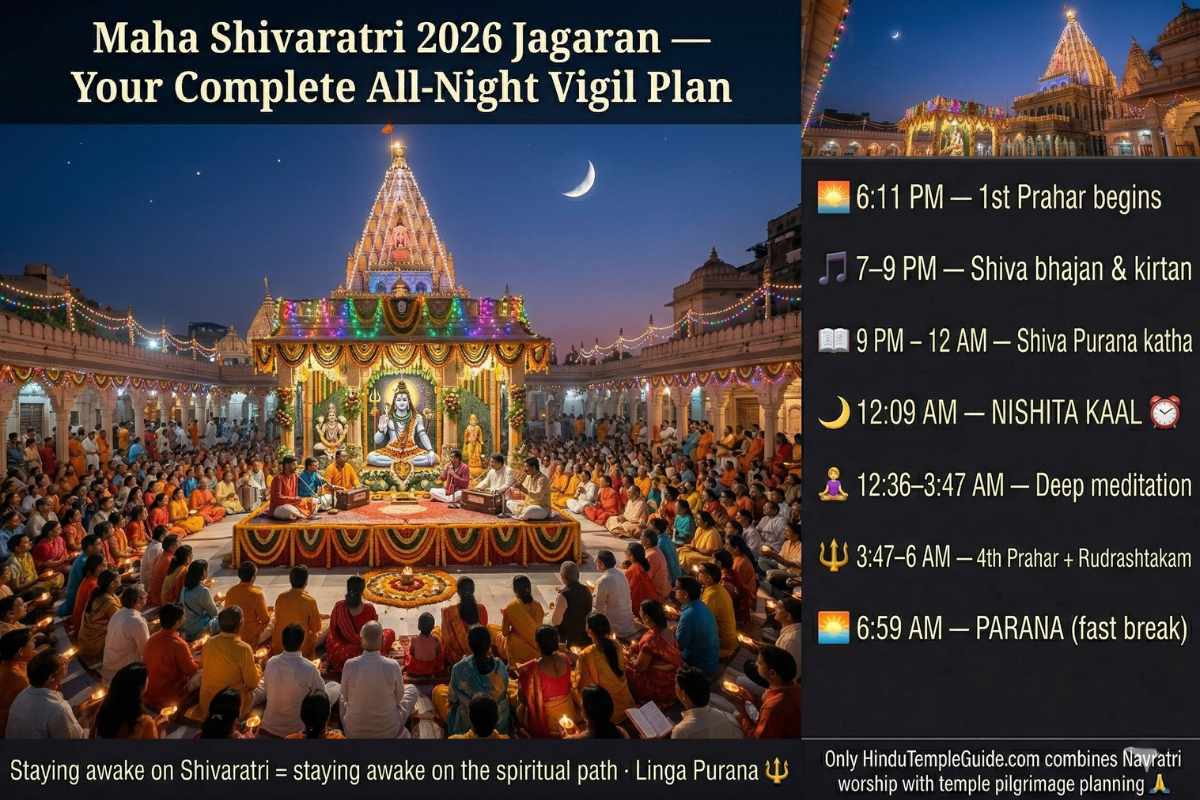
The Jagaran-staying awake with an upright spine throughout Maha Shivaratri night-symbolises spiritual wakefulness over the sleep of ignorance (Avidya). Here is a practical hour-by-hour schedule for your night vigil:
| Time Window | Spiritual Activity for Jagaran |
|---|---|
| Pradosh Kaal (Sunset) | Take an evening bath, wear clean white or light-coloured clothes, set up the Shiva altar, light a cow's ghee diya, and take your Jagaran Sankalp. |
| 1st Prahar (6:11-9:23 PM) | Perform 1st Prahar Rudrabhishekam (Gangajal & Milk), offer Bilva leaves, chant Om Namah Shivaya 108 times, and read the Maha Shivaratri Vrat Katha. |
| 2nd Prahar (9:23 PM-12:35 AM) | Perform 2nd Prahar Abhishekam (Curd), sing Shiva bhajans, and recite Shiva Panchakshara Stotram, Bilvashtakam, and Lingashtakam. |
| Nishita Kaal (Midnight) | 12:09-1:01 AM (2026) / 12:02-12:51 AM (2027): Perform full Panchamrit Rudrabhishekam, chant the Maha Mrityunjaya Mantra 108 times, and sit in silent meditation on Shiva as infinite light. |
| 3rd Prahar (12:35-3:47 AM) | Perform 3rd Prahar Abhishekam (Cow's Ghee), recite Sri Rudram or Rudrashtakam, and continue quiet japa on your Rudraksha mala. |
| 4th Prahar (3:47-6:59 AM) | Perform 4th Prahar Abhishekam (Honey & Sugar), recite the Dwadasha Jyotirlinga Stotram & Shiva Sahasranama during Brahma Muhurta, and perform dawn Aarti. |
| Sunrise Parana (After 6:59 AM) | Offer final Bilva leaves and Kshama Prarthana, distribute prasad, and break your fast (Parana) before Chaturdashi Tithi ends. Har Har Mahadev! |
10. Best Temples to Visit for Maha Shivaratri - First-Hand Jyotirlinga Guide
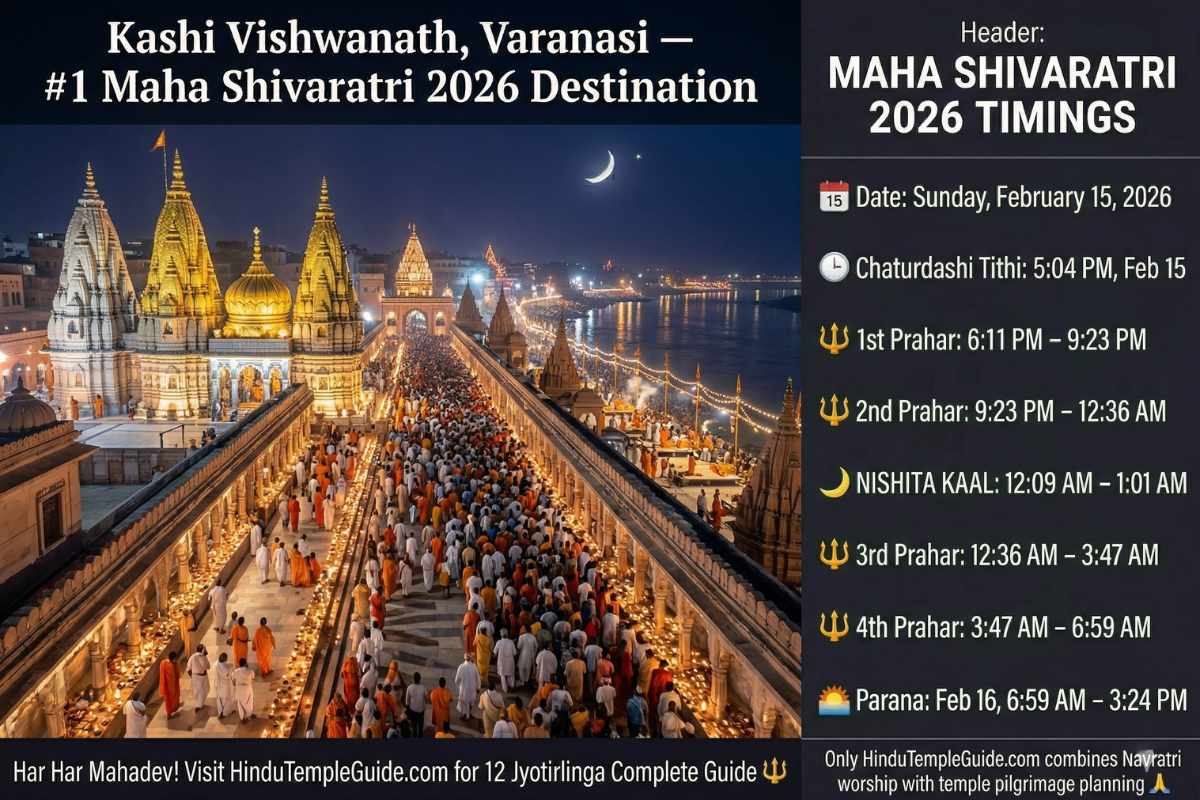
1. Shri Kashi Vishwanath Temple, Varanasi - Continuous All-Night Prahar Aartis
Having walked through the Shri Kashi Vishwanath Dham Corridor from Lalita Ghat myself, I can tell you that Kashi on Maha Shivaratri feels like the centre of the universe. Over 10 to 15 lakh devotees take a dip in the Ganga and queue for continuous Jharokha Darshan while the Naga Sadhus of the Akharas march in grand procession and the four special night-long Char Prahar Aartis are performed from 10:50 PM until dawn. Note that VIP/Sugam passes are suspended on Maha Shivaratri day on shrikashivishwanath.org so every devotee gets equal access.
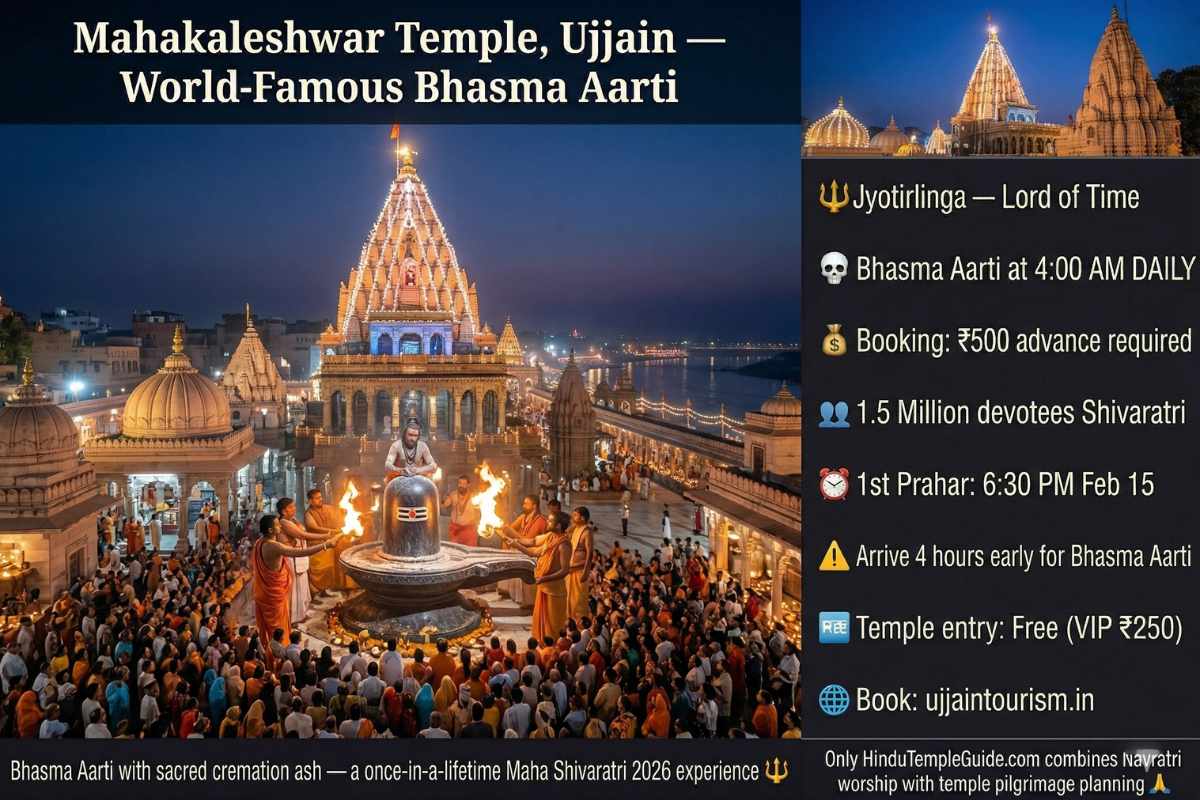
2. Shri Mahakaleshwar Temple, Ujjain - 9-Day Shiv Navratri & Noon Bhasma Aarti
At Mahakaleshwar in Ujjain-the only south-facing (Dakshinamukhi) Jyotirlinga-Maha Shivaratri is preceded by a unique 9-day Shiv Navratri festival during which Baba Mahakal is dressed as a bridegroom in a different royal form (Holkar, Chhabina, Manmahesh, Uma-Mahesh, and Shiva-Tandava) each evening. On Maha Shivaratri, the temple doors stay open for 44 hours non-stop, Lord Mahakal wears the 3-quintal flower crown (Sehra) at dawn, and at 12:00 PM noon the next day, the only daytime Bhasma Aarti of the entire year takes place!
3. Somnath (Gujarat) & Maharashtra's 3 Jyotirlingas (Trimbakeshwar, Bhimashankar, Grishneshwar)
At Shree Somnath-the first of the 12 Jyotirlingas on the Arabian Sea coast-the temple stays open for 42 continuous hours across Maha Shivaratri with four Prahar aartis and ocean-front bhajans (somnath.org). And here in Maharashtra, lakhs of devotees visit Trimbakeshwar (Nashik), Bhimashankar (Pune), and Grishneshwar (Ellora), while in central India near my hometown of Nagpur, over 5 lakh yatris trek up the Satpura hills to the sacred cave shrine of Pachmarhi Mahadeo (Chauragarh / Bada Mahadev)!
4. Omkareshwar Temple, Ukhimath - Where Kedarnath's Kapat Opening Date Is Announced!
Because high-altitude Kedarnath Dham (3,583 m) remains buried under 6 to 10 feet of snow and closed in February/March, Lord Kedarnath's winter worship takes place at Omkareshwar Temple in Ukhimath (Rudraprayag, Uttarakhand). Every year on Maha Shivaratri morning, the Rawal and Vedic acharyas of the Badrinath-Kedarnath Temple Committee (BKTC) gather at Ukhimath before the Panchmukhi idol to calculate and officially announce the summer Kapat Opening Date of Kedarnath Dham!
| More Major Shiva Shrines | Location & Signature Maha Shivaratri Tradition |
|---|---|
| Mallikarjuna (Srisailam) & Srikalahasti | Andhra Pradesh - 11-day Maha Shivaratri Brahmotsavam, Pagalankarana (cloth wrapping of temple vimana) & Lingodbhava midnight Abhishekam |
| Lingaraj Temple, Bhubaneswar | Odisha - Celebrated as Jagar Yatra; the Mahadipa (great lamp) is raised atop the 180-ft spire at 10:00 PM after which devotees break their daytime fast |
| Brihadeeswara & Nataraja (Chidambaram) | Tamil Nadu - UNESCO Chola heritage Abhishekam at Thanjavur & the Natyanjali classical dance festival at Chidambaram |
| Murudeshwar & Gokarna Mahabaleshwar | Karnataka - 123-ft coastal Shiva statue illumination at Murudeshwar & Atmalinga darshan at Gokarna |
| Pashupatinath (Kathmandu) & Mandi (HP) | Nepal's UNESCO-listed Pashupatinath hosts 10 lakh+ devotees on the Bagmati River, while Himachal's "Chhoti Kashi" Mandi hosts the 7-day International Shivaratri Fair |
11. Maha Shivaratri 2027 - Complete Date & Muhurat Preview
Nishita Kaal Midnight Muhurat: 12:02 AM - 12:51 AM on March 7, 2027 (49 mins)
Vrat Parana Window: 6:42 AM - 1:46 PM on Sunday, March 7, 2027. Because March 6-7, 2027 is a Saturday-Sunday weekend, devotees get a full uninterrupted weekend for Jyotirlinga yatra and all-night Jagaran!
12. FAQs - Maha Shivaratri 2026 & 2027
Have a question about visiting Kashi Vishwanath, Ujjain Mahakaleshwar, or Maharashtra's three Jyotirlingas? Send me a message here-I read and reply to every fellow Shiva devotee personally. - Devendra Khambalkar, Nagpur
Written by Devendra Khambalkar, Nagpur, Maharashtra | Last updated: October 2026. Maha Shivaratri 2026 and 2027 dates, Nishita Kaal windows, and 4 Prahar timings are verified against Drik Panchang (IST). Because local sunrise and sunset timings vary slightly by city, please confirm city-specific Prahar minutes with your local Panchang or temple priest. Har Har Mahadev!