
Shri Ram Mandir Ayodhya Guide 2026
Shri Ram Janmabhoomi Mandir · Ayodhya Dham, Uttar Pradesh · Pran Pratishtha 22 January 2024
Since 22 January 2024-the historic day when the Pran Pratishtha of Bhagwan Shri Ram Lalla was performed at the Shri Ram Janmabhoomi Mandir in Ayodhya-over 1 to 1.5 lakh devotees have been walking down Janmabhoomi Path every single day to behold the 51-inch black stone murti of the five-year-old Lord. Yet for first-time pilgrims, the ground logistics in Ayodhya have changed rapidly: mobile phones and bags must be deposited at the Pilgrim Facilitation Centre (PFC), e-rickshaw zones are regulated around Lata Mangeshkar Chowk and Ram Path, and fake "VIP ticket" websites frequently target unsuspecting families.
In this complete 2026 planning guide, I walk you through the verified darshan and aarti timings, step-by-step booking of your FREE Sugam Darshan E-Pass and Aarti Pass at the official trust portal (online.srjbtkshetra.org), the Janmabhoomi Path locker system, the Surya Tilak optical mechanism, Nagara stone architecture, must-visit shrines starting with Hanuman Garhi, and train/flight routes from Delhi, Lucknow, and Varanasi.
Jai Shri Ram!

Why Shri Ram Janmabhoomi Ayodhya Is the Defining Pilgrimage of Our Era
Across India there are thousands of shrines dedicated to Lord Ram, but there is only one Shri Ram Janmabhoomi-the sacred ground in Ayodhya where Maryada Purushottam Bhagwan Shri Ram manifested in the Treta Yuga. Revered in the Atharvaveda, the Valmiki Ramayana, and the Skanda Purana (Ayodhya Mahatmya) as the first of the seven liberation-granting cities (Sapta Puri), Ayodhya is not merely a destination for a Hindu devotee; it is a spiritual homecoming.
Following a nearly 500-year historical and legal journey, a five-judge Constitution Bench of the Supreme Court of India delivered a unanimous verdict on 9 November 2019, paving the way for the construction of the grand temple at the birthplace under the supervision of the Shri Ram Janmabhoomi Teerth Kshetra Trust. On 22 January 2024 (Pausha Shukla Dwadashi, Abhijit Muhurat), the 51-inch black-stone (Shyamashila) murti of five-year-old Bhagwan Shri Ram Lalla-sculpted by master sculptor Arun Yogiraj of Mysuru-was consecrated inside the Garbha Griha.
- Daily & Annual Footfall: An average of 1 to 1.5 lakh devotees visit every single day (over 4 crore pilgrims annually), rising to 5 lakh+ on Ram Navami and Deepotsav.
- The Sanctum Murti: A 51-inch monolithic black granite-schist (Krishna Shila) idol depicting Lord Ram as a smiling 5-year-old child holding a golden bow and arrow, framed by an arch carving of the Dashavatara, Hanuman, and Garuda.
- Sacred Geography: Situated on the southern bank of the sacred River Saryu in Ayodhya Dham, Uttar Pradesh.
- Sapta Puri Status: Listed first in the classical Sanskrit verse of the seven moksha-granting cities: "Ayodhya Mathura Maya Kashi Kanchi Avantika..."
Quick Snapshot: Ram Mandir Ayodhya at a Glance (2026)
| Detail | Verified Information |
|---|---|
| Temple Name | Shri Ram Janmabhoomi Mandir (Ram Mandir) |
| Location | Ram Kot, Ayodhya Dham, Uttar Pradesh - 224123 |
| Presiding Deity | Bhagwan Shri Ram Lalla (5-year-old child form, ground floor) & Ram Darbar (first floor) |
| Pran Pratishtha Date | 22 January 2024 (Consecrated by PM Narendra Modi) |
| Official Booking Portal | online.srjbtkshetra.org (Sugam E-Pass & Aarti Pass - 100% FREE) |
| General & Sugam Darshan Hours | 7:00 AM - 12:00 PM & 1:00 PM - 9:00 PM (Midday Bhog Rest: 12:00-1:00 PM) |
| Pass-Based Aartis | Mangala Aarti (4:00 AM), Shringar Aarti (6:00 AM) & Shayan Aarti (10:00 PM) |
| Main Entry Corridor | Janmabhoomi Path (Off Ram Path, near Birla Dharamshala - Free Cloakroom at PFC) |
| Architecture & Dimensions | Nagara Style · 380 ft long × 250 ft wide × 161 ft high · 392 pillars · 44 doors · No iron/steel |
| Nearest Airport | Maharishi Valmiki International Airport, Ayodhya (IATA: AYJ - 10 km) |
| Nearest Railway Stations | Ayodhya Dham Junction (AY - 1.5 km) & Ayodhya Cantt (AYC - 10 km) |
| Best Months to Visit | October to March (Pleasant winter weather) | Deepotsav & Ram Navami |
Ram Mandir Darshan Timings 2026: Complete Daily Temple Schedule
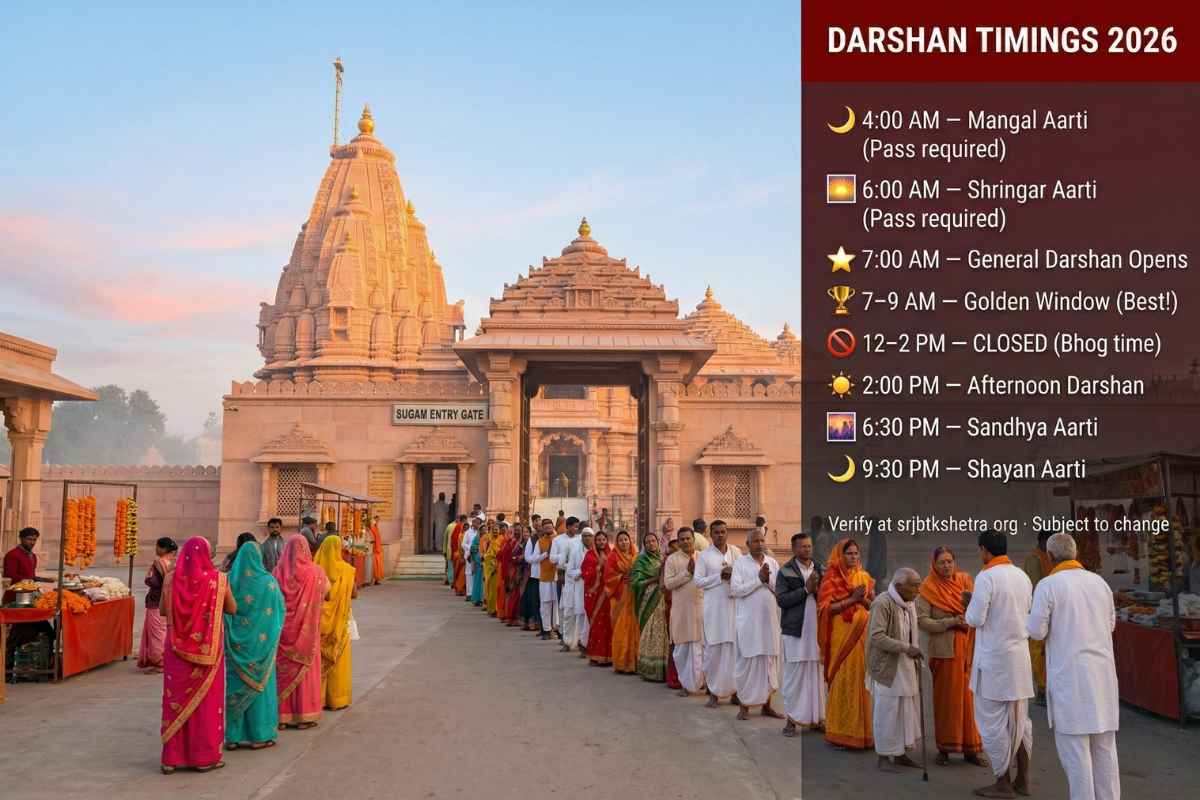
According to the official schedule published by the Shri Ram Janmabhoomi Teerth Kshetra Trust (srjbtkshetra.org), the temple operates in two main darshan sessions with 2-hour Sugam Darshan time slots and five daily aartis:
| Ritual / Darshan Window | Official Timing | Pass & Entry Notes |
|---|---|---|
| Mangala Aarti | 4:00 AM - 4:30 AM | Aarti Pass required. Pre-dawn awakening ritual; report at Gate by 3:30 AM. |
| Shringar Aarti | 6:00 AM - 6:30 AM | Aarti Pass required. Ram Lalla adorned in fresh silk garments, jewels & flowers. |
| Morning Darshan Opens (Golden Window) | 7:00 AM - 9:00 AM | Shortest queue of the day; Sugam Slot 1 (7-9 AM) & General Queue open. |
| Mid-Morning Darshan Continues | 9:00 AM - 12:00 PM | Sugam Slots: 9:00-11:00 AM & 11:00 AM-12:00 PM + Free General Queue. |
| Rajbhog Aarti & Midday Rest | 12:00 PM - 1:00 PM | Midday Bhog offered at 12:00 PM; sanctum curtains close for the Lord's rest. |
| Afternoon Darshan Session | 1:00 PM - 7:00 PM | Sugam Slots: 1:00-3:00 PM, 3:00-5:00 PM & 5:00-7:00 PM + General Queue. |
| Sandhya (Evening) Aarti | 6:30 PM - 7:00 PM | Evening lamp offering while the temple complex glows under architectural lighting. |
| Night Darshan Session | 7:00 PM - 9:00 PM | Final Sugam Slot (7:00-9:00 PM) & General Queue; cooler weather in summer. |
| Shayan Aarti (Closing Ritual) | 9:30 PM - 10:00 PM | Aarti Pass required. Final lullaby aarti before Ram Lalla rests for the night. |
Realistic Queue Waiting Time: Thanks to the wide multi-lane Janmabhoomi Path and the Pilgrim Facilitation Centre (PFC), devotees in the General (Samanya) Queue complete locker deposit and darshan in 45 to 90 minutes on normal weekdays (and 2 to 4 hours on weekends or festival days). With a free Sugam Darshan E-Pass, your total time from entry to exit is typically 30 to 45 minutes.
Sugam Darshan E-Pass Booking 2026: FREE Step-by-Step Guide
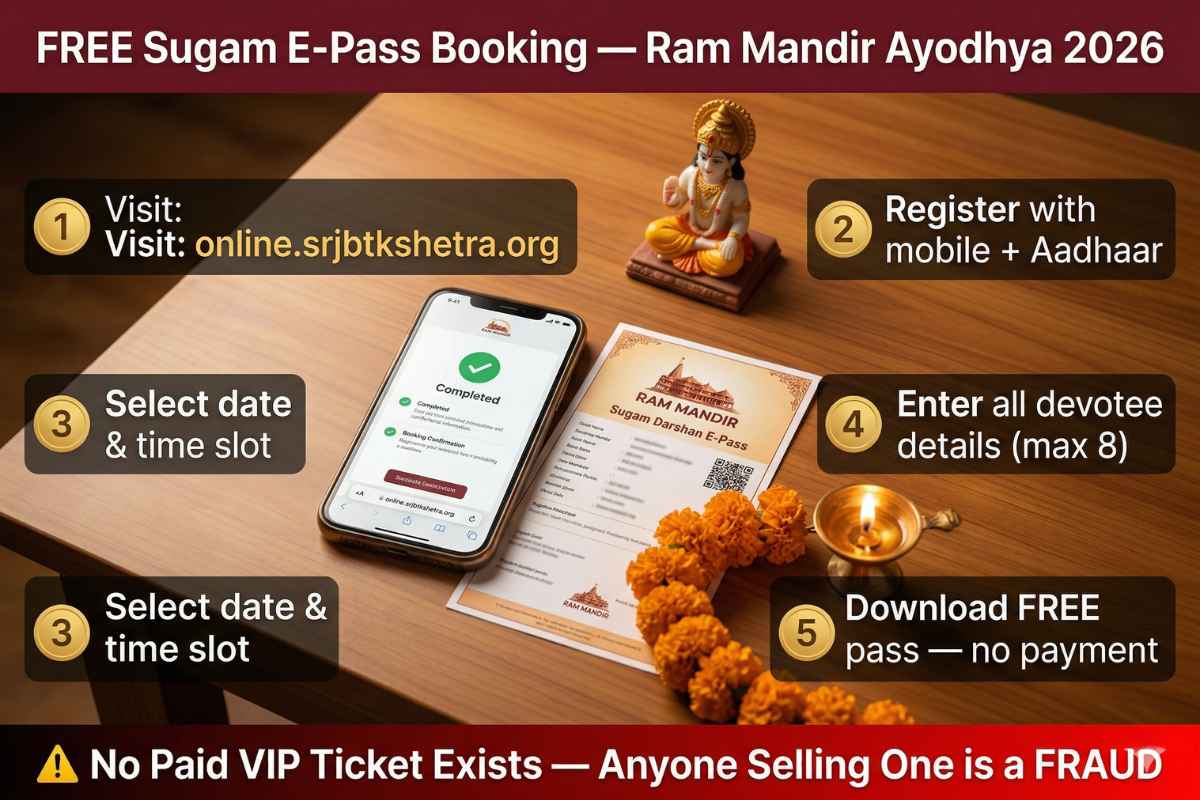
CRITICAL FRAUD WARNING: There is NO paid VIP darshan ticket at Ram Mandir Ayodhya. All Sugam Darshan and Aarti passes are 100% FREE and issued exclusively through online.srjbtkshetra.org. Any agent, hotel tout, or WhatsApp number demanding ₹500-₹2,100 for "VIP Darshan" is committing fraud. Report scams to the UP Police / Tourist Helpline (112 / 1800-180-5145).
Step-by-Step Sugam E-Pass Booking Process
Online Slots Full? Check Same-Day Offline Camp Office Quota: A limited number of same-day Sugam and Aarti passes are also issued offline (subject to availability) at the Shri Ram Janmabhoomi Teerth Kshetra Camp Office near Ram Kachahari / Birla Dharamshala upon showing your original Aadhaar card. And remember: you do not need any pass to enter the regular General Darshan queue!
Ram Mandir Aarti Pass Booking 2026: All 5 Daily Aartis Explained
Five sacred aartis (Ashtayama Seva) are performed before Bhagwan Shri Ram Lalla every day. Of these five, three aartis (Mangala, Shringar, and Shayan) take place when general queues are paused and require a separate, 100% free Aarti Pass booked at online.srjbtkshetra.org, while the midday Bhog Aarti and evening Sandhya Aarti take place during active darshan hours:
| Aarti Name | Timing | Pass Rule & Spiritual Experience |
|---|---|---|
| 1. Mangala Aarti | 4:00 AM | Free Online Pass Required. First pre-dawn ritual awakening the child Lord with Vedic hymns. |
| 2. Shringar Aarti | 6:00 AM | Free Online Pass Required. Ram Lalla is bathed in Panchamrit and dressed in the day's silk attire and gold ornaments. |
| 3. Rajbhog (Bhog) Aarti | 12:00 PM | Midday meal offering before the sanctum closes for rest from 12:00 PM to 1:00 PM. |
| 4. Sandhya Aarti | 6:30 PM - 7:00 PM | Evening lamp ceremony with bells, conch shells, and incense; witnessed by evening darshan pilgrims. |
| 5. Shayan Aarti | 10:00 PM | Free Online Pass Required. Intimate closing ritual preparing Ram Lalla for night rest. |
Aarti Pass Reporting Rule: Because only around 30 to 100 pass-holders are admitted into the Gudh Mandapa per aarti, report at the Janmabhoomi Path security gate 45 minutes before the aarti time with your printed Aarti Pass and original ID. Every Aarti Pass holder receives an SMS reminder 24 hours prior to the slot to reconfirm attendance.
Ram Mandir History: From Ram Janmabhoomi to Pran Pratishtha 2024

The Ram Janmabhoomi site at Ram Kot in Ayodhya has stood at the centre of Hindu civilisational memory for millennia. Below are the key historical milestones that led to the reconstruction of the temple:
| Year / Era | Historical Milestone |
|---|---|
| Treta Yuga & Antiquity | Birthplace of Bhagwan Shri Ram in the Ikshvaku (Suryavamsha) dynasty, celebrated in the Valmiki Ramayana and Skanda Purana; grand stone temple traditions attributed to Emperor Vikramaditya and the Gahadavala kings. |
| 1528 CE | A three-domed structure is built at the site by Mughal commander Mir Baqi; Hindu devotees continue worship at the Ram Chabutra and Sita Rasoi in the courtyard. |
| 1885 & 1949 | Mahant Raghubar Das files the first civil suit to build a canopy over Ram Chabutra (1885); in December 1949, idols of Ram Lalla are placed under the central dome and civil title suits begin. |
| 2003 ASI Excavation | On the orders of the Allahabad High Court, the Archaeological Survey of India (ASI) excavates 90 trenches and documents a massive underlying 10th-12th century North Indian temple structure with 50 pillar bases, carved amalaka, and makara pranala water chute. |
| 9 Nov 2019 | A 5-judge Constitution Bench of the Supreme Court of India unanimously awards the entire 2.77-acre Ram Janmabhoomi land to the deity Bhagwan Shri Ram Virajman and directs the Government of India to form a Trust for temple construction. |
| 5 Aug 2020 | Prime Minister Narendra Modi performs the sacred Bhoomi Pujan (foundation-stone laying ceremony) as L&T and Tata Consulting Engineers begin deep roller-compacted concrete foundation work. |
| 22 Jan 2024 | PRAN PRATISHTHA: Bhagwan Shri Ram Lalla is consecrated in the Garbha Griha by PM Narendra Modi in the presence of saints from every sampradaya across India. |
| 2025 - 2026 | Completion of the first-floor Shri Ram Darbar, the 161-foot main Shikhara, the 732-metre rectangular Parkota perimeter wall, and the six surrounding Panchayatana/Rishi temples inside the 70-acre complex. |
Ram Mandir Architecture: Nagara Style, Zero Iron & Surya Tilak
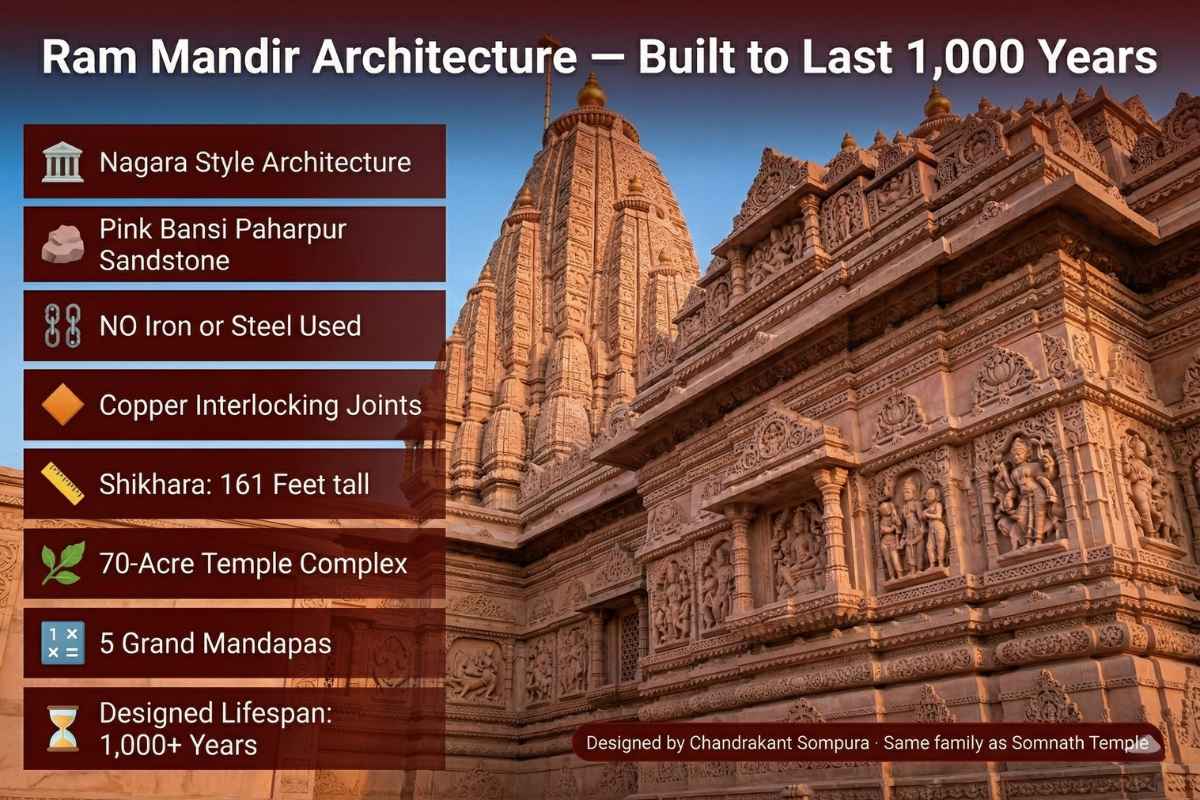
Key Architectural Specifications
- Chief Architects: Designed in the classical Gurjara-Chaulukya (Mahu-Gurjara) Nagara style by Chandrakant B. Sompura and his sons Nikhil and Ashish Sompura-the same hereditary temple-architect family whose patriarch Prabhashankar Oghadbhai Sompura designed the reconstructed Somnath Temple.
- Dimensions & 3-Storey Layout: Measuring 380 feet long (east-west), 250 feet wide, and 161 feet tall at the main Shikhara, the three-storey structure is supported by 392 intricately carved pillars (each bearing 16-24 sculpted deities) and 44 Maharashtra teakwood doors (14 on the ground floor plated in gold).
- Zero Iron or Steel (1,000+ Year Lifespan): Because buried iron rusts and expands over 80-100 years, cracking stone masonry, the temple uses zero structural iron or steel. Blocks of pink sandstone from Bansi Paharpur (Bharatpur, Rajasthan) are locked together via tongue-and-groove joints and pure copper plates, resting on a 21-foot granite plinth from Karnataka and Telangana.
- Five Mandapas Leading to the Sanctum: Entering from the eastern 32-step Singhdwar, devotees pass through five pavilions-Nritya Mandapa, Rang Mandapa, Sabha Mandapa, Prarthana Mandapa, and Kirtan Mandapa-before reaching the octagonal Makrana white-marble Garbha Griha.
- The 70-Acre Complex & Sapta Mandapam: Surrounding the main temple are six perimeter shrines dedicated to Lord Surya, Ganesha, Shiva, Durga, Vishnu, and Hanuman (along the Parkota), plus seven sage temples honouring Maharishi Valmiki, Vashishtha, Vishwamitra, Agastya, Nishadraj Guha, Mata Shabari, and Devi Ahilya.
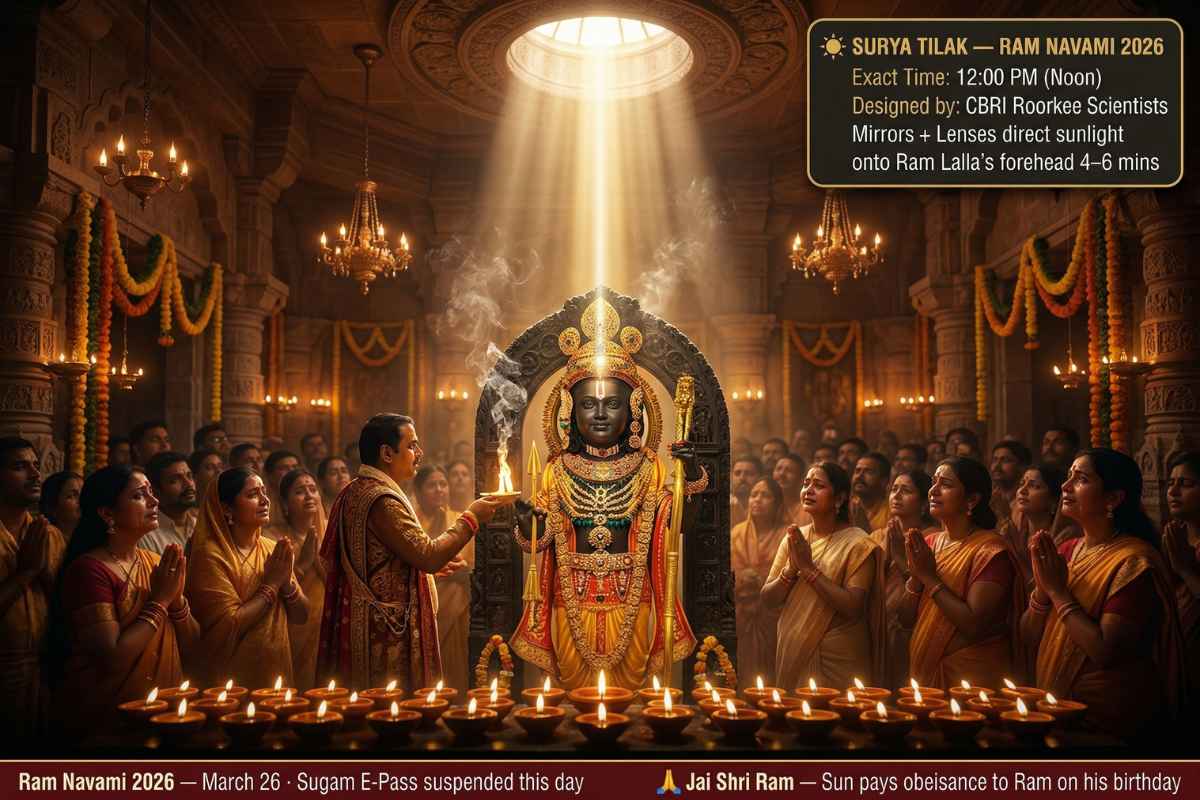
Surya Tilak: How the Ram Navami Solar Tilak Works
Because Bhagwan Shri Ram belongs to the Suryavamsha (Solar Dynasty), the temple features a permanent opto-mechanical Surya Tilak apparatus designed jointly by scientists from the Central Building Research Institute (CBRI, Roorkee) and the Indian Institute of Astrophysics (IIA, Bengaluru). Every year on Chaitra Shukla Navami (Ram Navami) at exactly 12:00 PM noon-the birth moment of Lord Ram-a 58 mm circular tilak of natural sunlight illuminates the centre of Ram Lalla's forehead for 4 to 5 minutes.
Engineering Without Electricity: Using four precision lenses and four brass-mounted mirrors housed inside corrosion-proof brass piping running from the third floor down into the Garbha Griha-coupled with a 19-gear mechanical lunar-solar calendar mechanism that adjusts for the changing Gregorian date of Ram Navami each year without batteries or electricity-sunlight is reflected straight onto the deity's brow.
Ram Navami Visiting Note: During the 3-day Ram Navami festival in March/April, Sugam Darshan and Aarti E-Passes are temporarily suspended so that all 5 lakh+ pilgrims can move continuously through the general darshan lanes from 3:30 AM until 11:00 PM.
Hanuman Garhi & 8 Must-Visit Sacred Places in Ayodhya
1. Shri Hanuman Garhi - Visit Here FIRST Before Ram Mandir
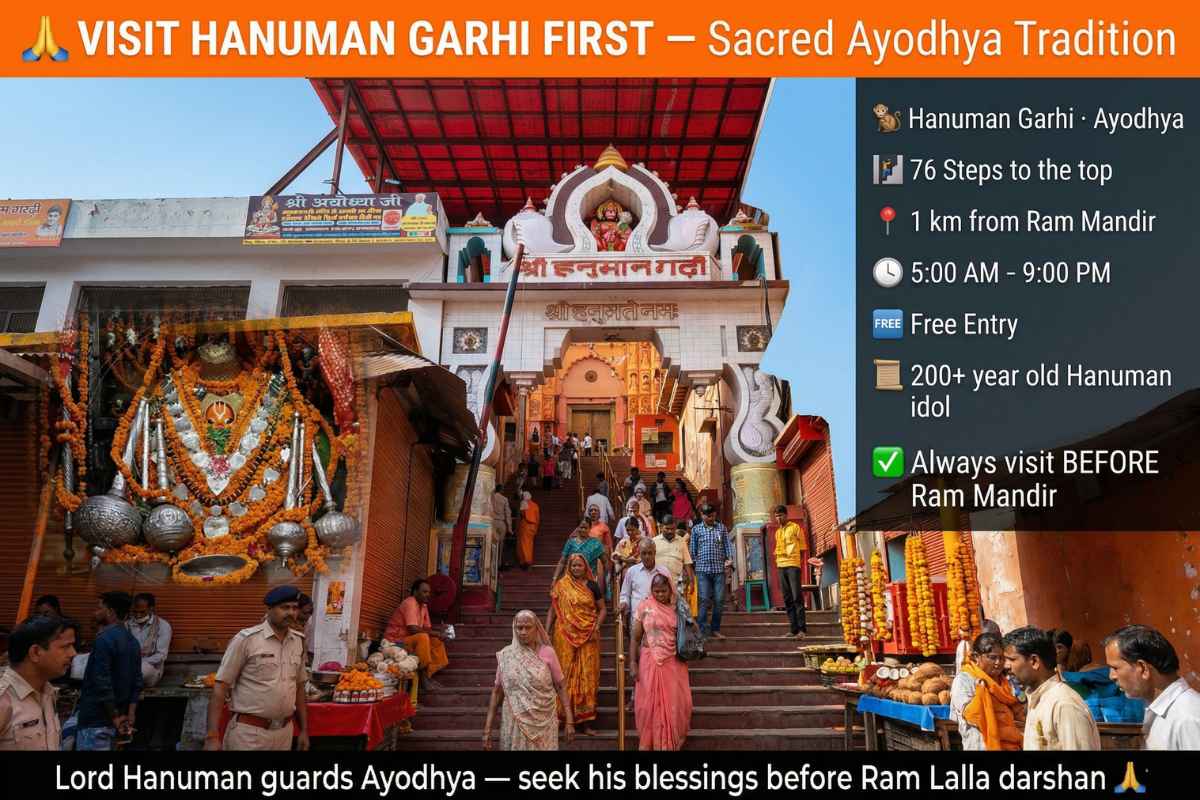
Before returning to Vaikuntha, Lord Ram entrusted the protection of Ayodhya Dham to Lord Hanuman, decreeing that any devotee visiting Ayodhya must first seek Hanuman's blessings. Built like a four-sided fort in the 10th century and reconstructed in the 18th century by Nawab Shuja-ud-Daula and Swami Abhayaram Das, Hanuman Garhi is reached via 76 stone steps along the newly widened Bhakti Path (just 700 metres from Janmabhoomi Path). Inside the cave-like sanctum sits Mother Anjani holding young Bal Hanuman on her lap.
- Timings: 4:00 AM - 10:00 PM daily (Brief afternoon Bhog break) | Entry: Free
- Traditional Offerings: Pure desi ghee Besan Ladoo (famous Hanuman Garhi Tiranga/Besan ladoos) and red sindoor/tulsi garland.
2. Ram Ki Paidi & Naya Ghat - Sacred Dip & Evening Saryu Aarti
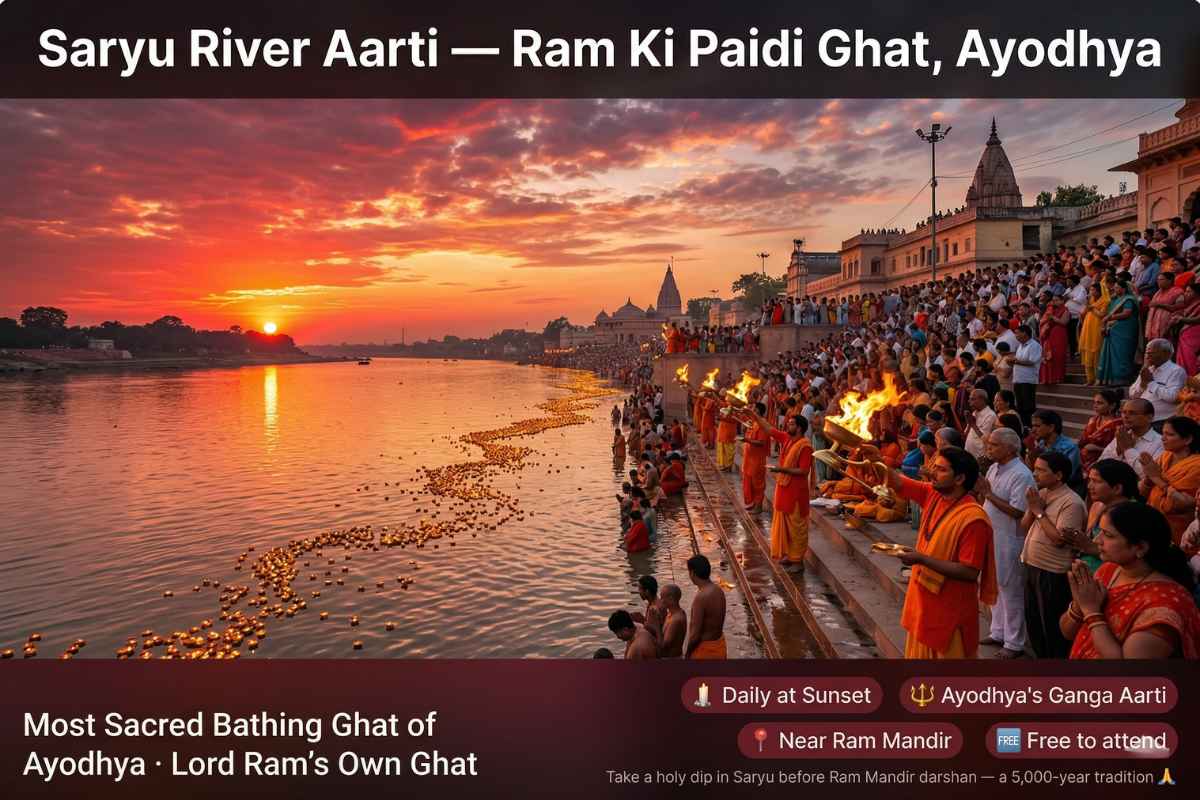
Located 2.5 km north of Ram Mandir right beside the iconic Lata Mangeshkar Chowk (the 40-foot bronze Veena roundabout), Ram Ki Paidi and Saryu Naya Ghat form a series of stepped bathing ghats along the Saryu River. Take a morning dip at Naya Ghat before starting your temple circuit, and return 30 minutes before sunset for the Evening Saryu Aarti (6:00-7:00 PM depending on season) and the free projection-mapping light & sound show at Ram Ki Paidi.
3. Kanak Bhawan - The Golden Palace Gifted to Mata Sita
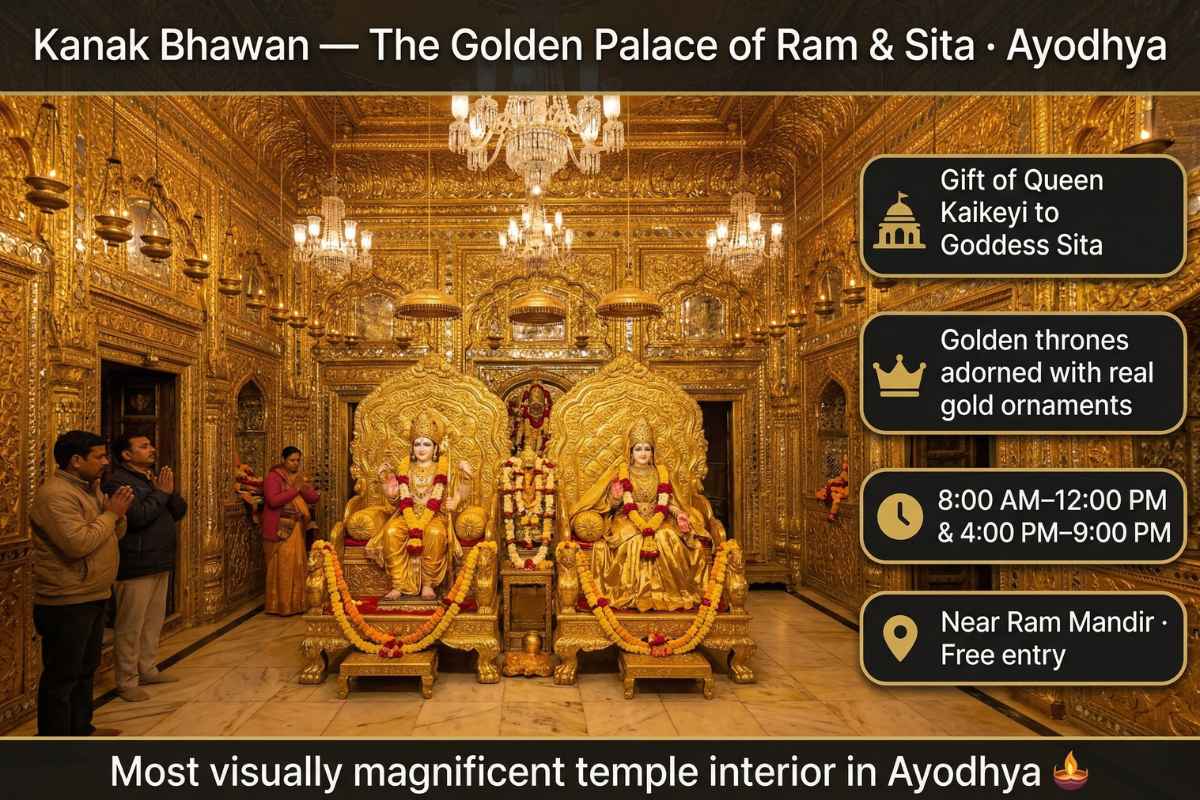
Just a 5-minute walk from Hanuman Garhi and Dashrath Mahal, Kanak Bhawan ("Palace of Gold") is believed to have been gifted to Goddess Sita by Queen Kaikeyi immediately after her marriage to Lord Ram (Muh-Dikhai). Renovated in 1891 in Bundelkhandi palace style by Maharani Vrishabhanu Kunwari of Orchha, its inner sanctum houses three pairs of crowned golden idols of Shri Ram and Janaki inside a silver-and-gold throne pavilion, while musicians sing soulful Awadhi bhajans in the checkered courtyard. Timings: 8:00 AM - 11:30 AM & 4:30 PM - 9:00 PM.
4-8. Five More Sacred Landmarks to Include in Your Ayodhya Circuit
| Sacred Site | Significance & Distance from Ram Mandir |
|---|---|
| 4. Dashrath Mahal (Bada Asthan) | Located right between Hanuman Garhi and Kanak Bhawan (400 m); marks the royal palace of King Dashrath where Ram, Lakshman, Bharat, and Shatrughna spent their childhood. |
| 5. Nageshwarnath Temple | Situated right at Ram Ki Paidi (2.5 km); ancient Shiva temple established by Lord Ram's younger son Kusha after a Naga princess returned his lost armlet from the Saryu river. |
| 6. Treta Ke Thakur | Near Naya Ghat along the Saryu (2.5 km); marks the site of Lord Ram's Ashwamedha Yagna and houses ancient black Touchstone (Kasauti) idols of the Ram Darbar. |
| 7. Guptar Ghat | Peaceful riverfront ghat 10 km west of Ram Mandir (near Ayodhya Cantt) where Lord Ram took Jal Samadhi in the Saryu to return to his eternal Vaikuntha form. |
| 8. Bharat Kund (Nandigram) | Located 20 km south on the Prayagraj highway; the sacred ashram where Bharat placed Lord Ram's wooden sandals (Charan Paduka) on the throne and ruled as an ascetic for 14 years. |
How to Reach Ayodhya Ram Mandir from Delhi, Lucknow & Varanasi
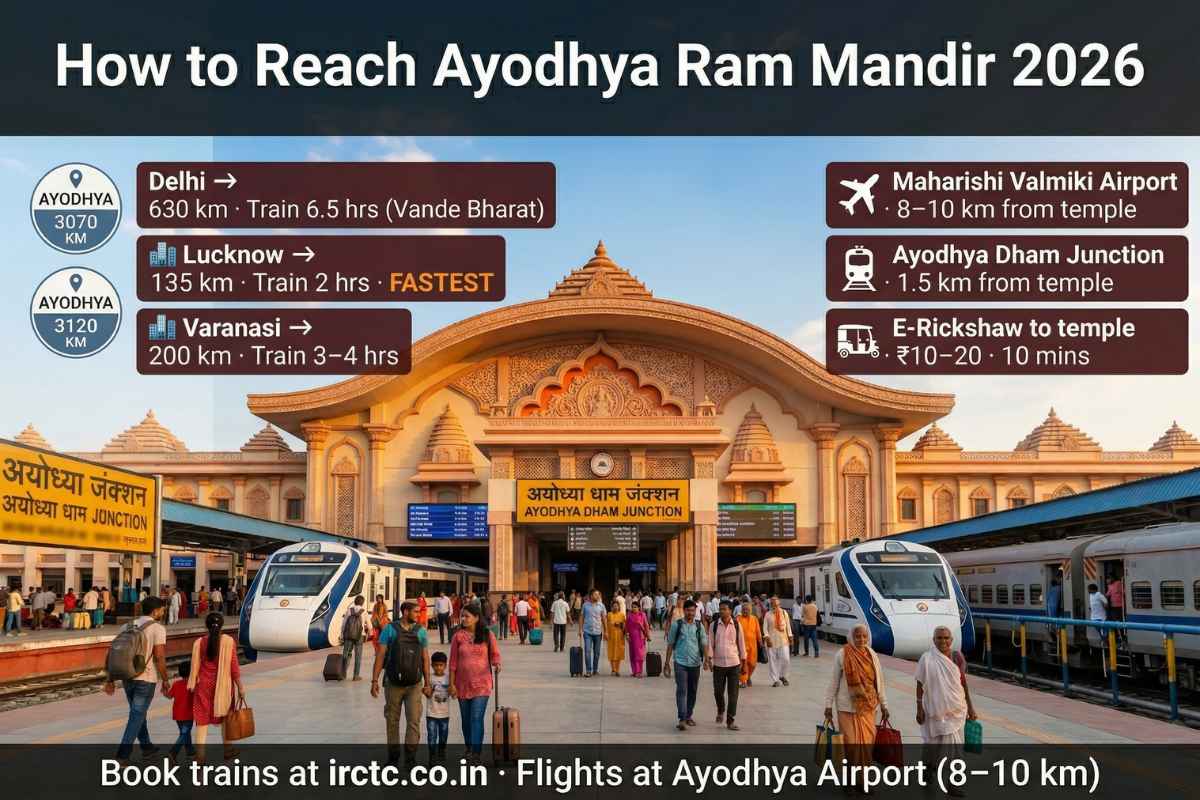
Local Transport inside Ayodhya Dham (Station/Airport to Janmabhoomi Path)
| Mode | Route | Duration | Official / Standard Fare |
|---|---|---|---|
| Colour-Coded E-Rickshaw / Golf Cart | Ayodhya Dham Jn → Janmabhoomi Path | 8-10 mins | ₹15-₹20 per seat |
| Walking on Ram Path | Ayodhya Dham Jn → Janmabhoomi Path (1.2 km) | 15-20 mins | Free (Paved pedestrian corridor) |
| Electric City Bus (Pink/Saffron EV) | Ayodhya Cantt / Airport → Ram Path / Naya Ghat | 20-25 mins | ₹25-₹50 per person |
| Pre-Paid Auto / Airport Cab | Maharishi Valmiki Airport (AYJ) → Ram Path | 20-25 mins | ₹300-₹500 (Full Auto/Cab) |
Where to Stay in Ayodhya 2026: Dharamshalas, Tent Cities & Hotels
| Accommodation Category | Tariff Range | Top Recommended Options & Location |
|---|---|---|
| Trust & Charitable Dharamshalas | ₹200 - ₹1,200/night | Birla Dharamshala (right opposite Janmabhoomi Path), Shri Janaki Mahal Trust, Kanak Bhawan Dharamshala & Gujarati/Marwari Bhawans. |
| UPSTDC Govt. Tourist Bungalows | ₹1,500 - ₹3,500/night | Rahi Yatri Niwas & Hotel Saket (UP Tourism) near Ayodhya Dham Station; book via UP Tourism portal. |
| Registered Ayodhya Homestays | ₹1,000 - ₹2,500/night | Over 1,000 ADA-registered family homestays within 1-2 km of Ram Path & Shringar Hat (book via Divya Ayodhya app). |
| Mid-Range & Boutique Hotels | ₹2,500 - ₹5,500/night | Hotels along Ram Path, Naya Ghat, and Faizabad (Ayodhya Cantt) with AC family rooms and pure vegetarian dining. |
| Premium Hotels & Saryu Tent Cities | ₹6,000 - ₹15,000/night | Park Inn by Radisson, Cygnett Collection,Ira by Orchid, Praveg Tent City (Brahma Kund / Saryu), and The Ramayana Hotel. |
Vehicle Entry Tip for Hotel Booking: If you are arriving in your own private car on a busy weekend or festival, remember that outer police barriers restrict outstation four-wheelers along the inner Ram Kot / Hanuman Garhi zone. Booking a hotel with dedicated parking near Naya Ghat bypass, Faizabad (Ayodhya Cantt), or NH-27 and taking an ₹20 e-rickshaw to Janmabhoomi Path is much smoother than driving into narrow inner lanes.
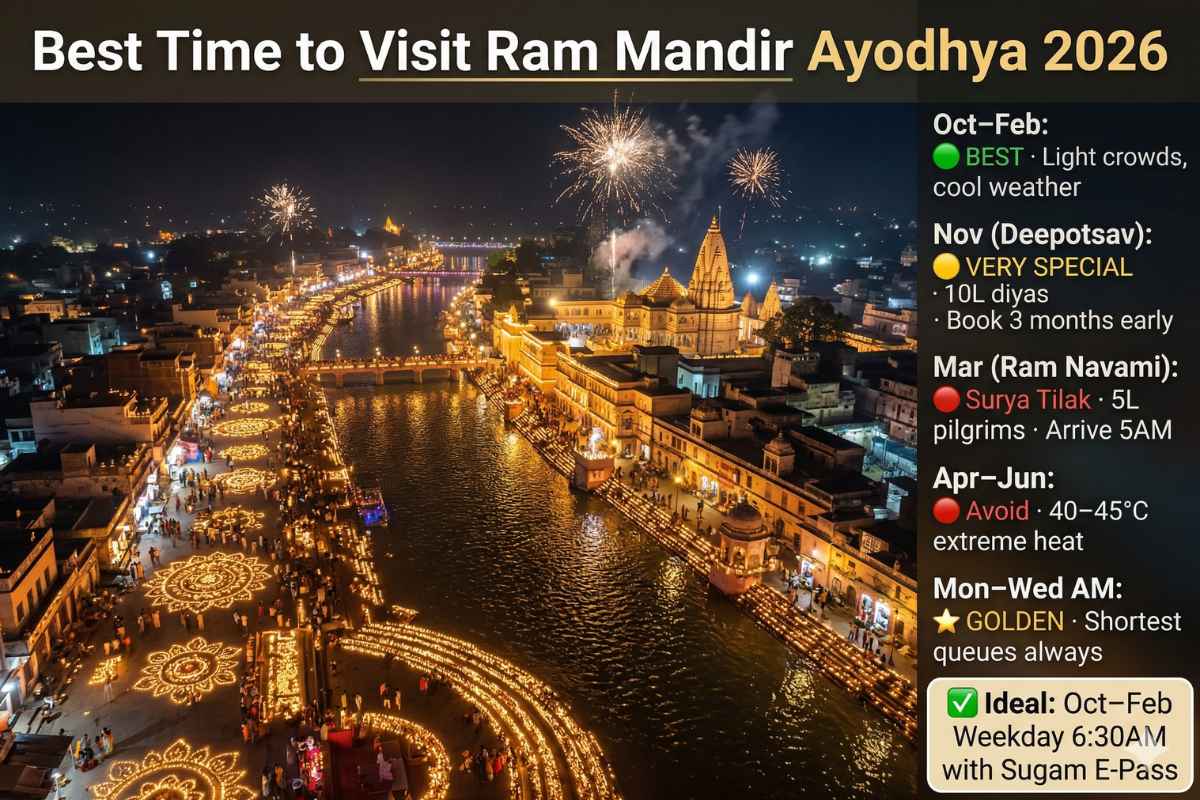
Best Time to Visit Ram Mandir Ayodhya in 2026
| Season / Festival | Crowd Level | Weather & Planning Recommendation |
|---|---|---|
| October to March (Winter) | Moderate | Best overall season. Cool, pleasant weather (10°C-26°C) makes walking barefoot on the sandstone courtyard comfortable for seniors and children. |
| Diwali / Deepotsav (Oct/Nov) | Very High | Over 25 lakh diyas lit along Ram Ki Paidi. Book trains and hotels 60-90 days in advance. |
| Chaitra Ram Navami (March/April) | Extreme | Witness the 12:00 PM Surya Tilak; Sugam passes remain suspended and general queues run from 3:30 AM. |
| April to June (Peak Summer) | Low-Medium | Daytime temperatures hit 42°C-45°C (though jute mats and mist canopies are laid on Janmabhoomi Path). Visit only between 7:00-9:30 AM or after 6:00 PM. |
| July to September (Monsoon & Jhulan Mela) | Low-Moderate | Fast darshan on non-festival weekdays; Shravan Jhulan Utsav and Kartik Parikrama draw regional devotees. |
| BEST SWEET SPOT | Tue-Thu Mornings | Mid-week mornings (7:00-9:00 AM) between October and March with a pre-booked Sugam E-Pass. |
Ram Mandir Security Rules, Locker System, Dress Code & First-Timer Tips
1. How the Janmabhoomi Path & Free PFC Locker System Works
Knowing the exact entry flow before you reach the gate will save you at least 30 minutes of confusion:
- Where to Enter: All devotees (both General Queue and Sugam/Aarti Pass holders) enter via the wide Janmabhoomi Path corridor located directly opposite Birla Dharamshala on Ram Path.
- Strict Ban on Mobile Phones, Smartwatches & Electronic Keys: Unlike many temples where phones are allowed up to the outer courtyard, high-security CRPF/SSF protocols at Ram Mandir strictly prohibit mobile phones, smartwatches, cameras, earphones, electronic car key remotes, leather belts, lighters, and handbags anywhere beyond the Pilgrim Facilitation Centre (PFC).
- 100% Free Cloakroom & Shoe Counters at PFC: As you walk down Janmabhoomi Path, you first pass through the sprawling Pilgrim Facilitation Centre (Teerth Yatri Suvidha Kendra). Here, dozens of numbered counters provide completely FREE lockers and shoe deposits with a printed barcoded token-you do not need to pay ₹100-₹200 to private shopkeepers outside to hold your phone or shoes!
- What You CAN Carry Past Security: Only your printed paper Sugam/Aarti Pass, original Aadhaar/ID card, cash/currency notes, spectacles, and essential baby milk/medicine are allowed through the DFMD frisking gates.
- Free Wheelchairs & Elaichi Dana Prasad: Free wheelchairs with volunteer assistants (Sevadars) are available at the Janmabhoomi Path entrance for senior citizens and differently-abled devotees, and every devotee receives a free packet of sacred Elaichi Dana prasad on the exit path after darshan.
2. Recommended Dress Code for Ram Mandir
3. Five Common Mistakes First-Time Visitors Should Avoid
Mistake 1 - Relying on a Mobile Screenshot of Your E-Pass: Because phones must be deposited in the PFC locker before the inner Sugam/Aarti checkpoint, always bring a physical paper printout of your pass and your original Aadhaar Card.
Mistake 2 - Buying Outside Prasad/Garlands for Ram Mandir: For security reasons, outside flowers, coconuts, and sweet boxes are not allowed past the Janmabhoomi Path security frisking point (though they are allowed at Hanuman Garhi). At Ram Mandir, the Trust distributes free Elaichi Dana prasad inside the complex after darshan.
Mistake 3 - Carrying a Car Key Fob to the Frisking Gate: Remote car keys with batteries are turned back at the security scanner and must be walked all the way back to the PFC locker.
Mistake 4 - Arriving Right at 12:00 PM Noon: The sanctum closes between 12:00 PM and 1:00 PM for Rajbhog and the Lord's afternoon rest; time your entry before 11:15 AM or after 1:00 PM.
Mistake 5 - Paying Fake "VIP Darshan" Touts: Every darshan and aarti pass at Ram Mandir is 100% free via online.srjbtkshetra.org.
Frequently Asked Questions (FAQs)

Official Shri Ram Janmabhoomi Trust Portals - Trust Only These
Plan Your Ayodhya Dham Yatra With Confidence
Mangal Bhavan Amangal Hari · Dravahu Sudasarath Ajir Bihari
Have a question about combining Kashi Vishwanath, Prayagraj Sangam, and Ayodhya Ram Mandir on a family trip? Send me a message here-I read and reply to every fellow pilgrim personally. - Devendra Khambalkar, Nagpur
Jai Siya Ram · Jai Hanuman!
Read More Sacred Pilgrimage Guides on HinduTempleGuide.com
- Kedarnath Temple Travel Guide 2026 - 16 km Trek Route, Registration & Tips
- Char Dham Yatra 2026 Complete Guide - Dates, Registration, Route & Cost
- 12 Jyotirlinga Temples in India - Names, Locations, Stotram & Route Guide
- Tirupati Balaji Temple Guide 2026 - Darshan Types, SED Booking & Timings
- Top 20 Oldest Temples in India - Complete Architectural & Heritage Guide
Written by Devendra Khambalkar, Nagpur, Maharashtra | Last updated: October 2026. Temple timings, Sugam Darshan slot windows, and security guidelines in this guide are verified against official announcements by the Shri Ram Janmabhoomi Teerth Kshetra Trust (srjbtkshetra.org). Always book passes directly through online.srjbtkshetra.org and never pay third-party agents.