
Pandharpur Darshan is not just a temple visit, it is an emotion that lives in the heart of every Maharashtrian household, and honestly, in mine too. I had heard my grandmother sing "Vitthal Vitthal" since I was a child, but nothing prepared me for the moment I actually stood in front of Panduranga with my mom, dad and wife beside me. This is the story of our real, unfiltered Pandharpur Darshan trip: the overnight bus, the queue, the tears, the Chandrabhaga river in full flow, and a bowl of humble dal-roti that tasted like blessings. If you are planning your own Pandharpur Darshan, I promise this guide will feel like a friend walking beside you, not a checklist.
Jai Hari Vitthal! Let me take you along on our journey. 🙏
How Our Pandharpur Darshan Journey Began
Our Pandharpur Darshan plan was simple on paper but deeply emotional in reality. We decided to go exactly one week after Ashadhi Ekadashi, thinking the crowd would have thinned out a little. My parents, my wife and I boarded a sleeper bus from Pune Wakad at 10 PM on a Friday night, and honestly, none of us slept much. There was a strange excitement in the air, the kind you feel as a child before a big festival.
Our bus was supposed to reach Pandharpur between 5:00 AM and 5:30 AM, but we arrived early, around 4:00 AM. Our plan was to stay at Shree Gajanan Maharaj Sansthan near Shivaji Chowk, a place known for being affordable, clean, and full of devotional peace, perfect for families. But when we reached the gate, the guard told us all rooms were full and the reception opens only after 5:30 AM.
I won't lie, we were disappointed. Shree Sant Gajanan Maharaj Sansthan has such a warm, family-friendly atmosphere that everyone recommends it, and we had built our whole plan around it. With no other option at that hour, we booked a nearby hotel room for ₹1,500 for four people: my mom, dad, my wife, and me. We rested for barely 30 minutes, freshened up quickly, and by 6:00 AM we were walking towards the temple, hearts pounding with anticipation.
A small tip from our experience: Even one week after Ashadhi Ekadashi, Pandharpur Darshan crowds do not fully disappear. If you're travelling as a family, try to pre-book your stay a few days in advance rather than relying on walk-in availability at dawn.

Who is Lord Vitthal? The Divine Story Behind Pandharpur
Before I tell you about our darshan, let me share why Pandharpur means so much to millions of devotees like us. Lord Vitthal, also called Vithoba, Panduranga, or Pandharinath, is worshipped as a form of Lord Krishna, standing beside his consort Rukmini. Unlike most Hindu deities shown seated or in elaborate poses, Vitthal stands humbly with both hands resting on his hips, on top of a brick, waiting patiently for his devotees. That single posture is, to me, the most touching part of the whole legend.
The Legend of Pundalik and the Brick: How Vitthal Got His Name
This is the story I love telling my daughter, and I retell it here for you too, because it explains everything about Pandharpur's soul.
Long ago, a devoted son named Pundalik lived in a forest called Dindirvan with his aged parents, Janudev and Satyavati. After his marriage, Pundalik began neglecting his parents. On a pilgrimage to Kashi, he witnessed something that changed him forever. He saw that even the sacred rivers Ganga and Yamuna felt "unclean" after being used to wash away his sins caused by mistreating his parents. This realization broke him open, and from that day, Pundalik dedicated his entire life to serving his parents with selfless devotion.
One day, Lord Krishna himself, in the form of Vitthal, came searching for Pundalik in Pandharpur. But when the Lord arrived, Pundalik was in the middle of massaging his father's feet and could not leave his duty even for God. Without turning away, Pundalik threw a brick (vit) outside for the Lord to stand (thal) on and wait until he finished serving his parents.
Instead of feeling offended, Krishna was so moved by this act of devotion that He agreed to stand on that very brick, hands on hips, and He is believed to still be standing there, waiting, to this day. This is where the name Vitthal comes from: Vit (brick) plus Thal (standing). Pundalik later requested the Lord to remain in Pandharpur forever and bless every devotee who came seeking Him, and that is exactly what happened.
Every time I do Pandharpur Darshan, I remember this story, and it changes the way I look at the idol, not as a distant god, but as someone who is simply waiting for us, patient beyond imagination.
Why Lord Vitthal is Called Panduranga
Pandharpur is also known as Pandarga Kshetra or Paundarika Kshetra, named after Pundalik (Pundarika Muni). Some inscriptions dating back to around the 7th century CE refer to the deity as "Pandaraga Vittaga," which over centuries transformed into Panduranga Vitthala. The town itself is often called South Kashi (Dakshin Kashi) because of the immense spiritual merit associated with a single Pandharpur Darshan.
History of the Vitthal Rukmini Temple, Pandharpur
Standing in front of the sanctum during our Pandharpur Darshan, I couldn't help but wonder how old these walls actually were. So here is what history tells us.
Ancient Origins and Royal Patronage
According to inscriptions found within the temple, a small shrine structure existed here as early as 1189 CE, financed by the Yadava king Bhillama. Some historical accounts also credit King Vishnuvardhana of the Hoysala Empire (ruled 1108 to 1152 CE) with constructing an early version of the temple after being deeply moved by Pundalik's devotion. Over the following centuries, the temple was expanded significantly, especially in the second half of the 13th century, when it took the grand form devotees see today. An inscription of Hoysala king Vira Someshwara, dated 1237 CE, records a grant of a village for the temple's maintenance, proof of how far back royal reverence for this shrine goes.
Like many great Indian temples, the Vitthal Rukmini Mandir also faced attacks and damage during periods of invasion, yet it was rebuilt and restored time and again by devoted rulers and communities, a true testament to the unbreakable faith behind every Pandharpur Darshan.
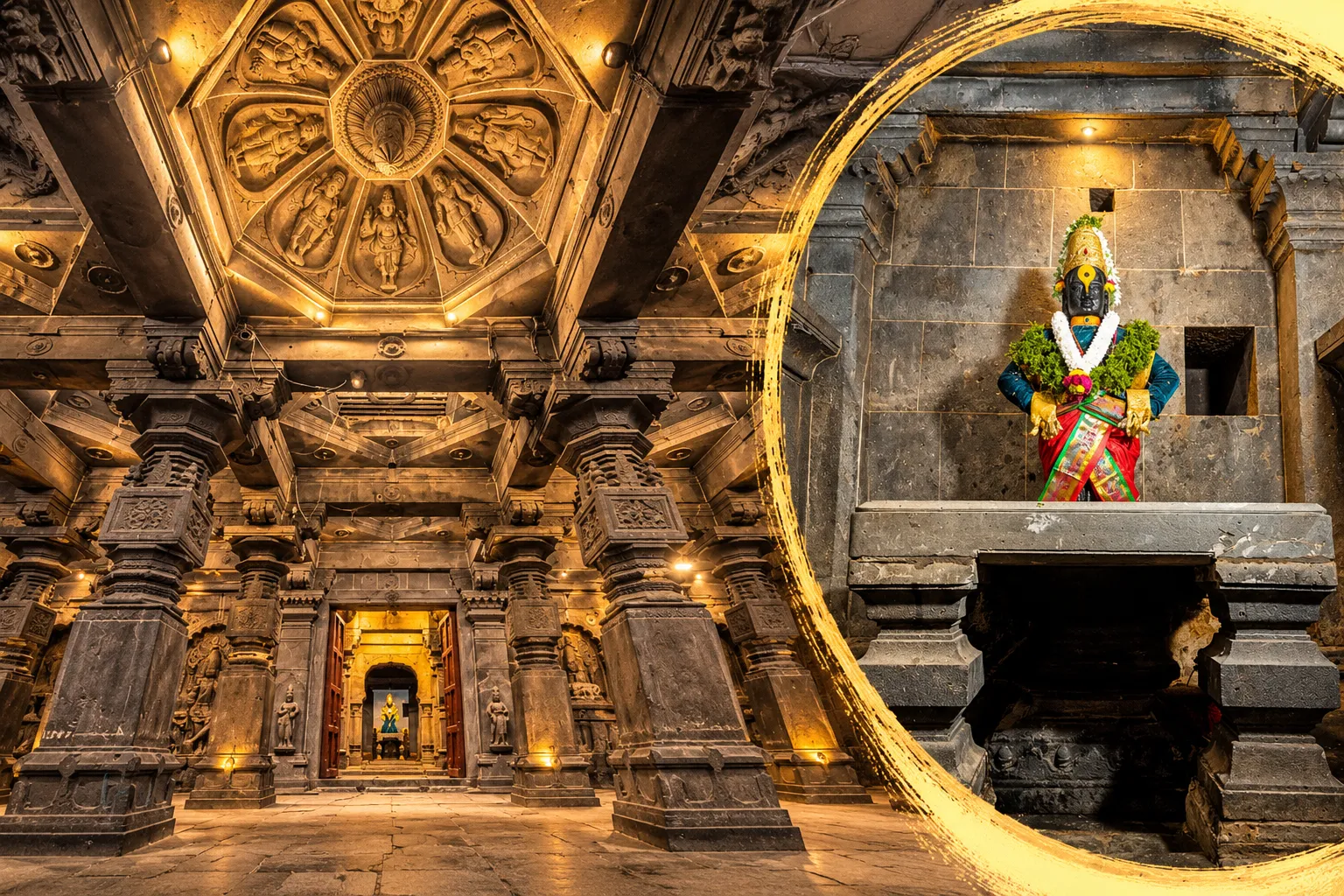
Temple Architecture: Hemadpanti and Deccan Style
The temple is built predominantly in the Hemadpanti and Deccan architectural style, known for its heavy use of black basalt stone, intricately carved pillars, and closely fitted stonework without excessive mortar. A few architectural highlights that left me speechless:
- Six gates lead into the temple complex, with the eastern gate popularly known as Namdev Ghat, named after the great saint-poet Namdev.
- A massive quadrangular wooden hall (Sabha Mandap) filled with beautifully carved deepmalas (lamp towers) leads devotees inward.
- The Sola Khambi Hall, a square chamber supported by sixteen ornately carved pillars, is one of the most photographed spots inside.
- The main deity, a black stone idol of Vitthal, about three and a half feet tall, stands with a Shivalinga on his head and the sacred Kaustubha Mani around his neck.
- Smaller shrines within the complex are dedicated to Rukmini, Radha, Satyabhama, and Lord Ganapati, among others.
What struck me most is that this temple was among the first in India to formally allow priests from backward and marginalized communities to conduct rituals, a living reflection of the Bhakti movement's core message that Lord Vitthal belongs to everyone, regardless of caste, gender, or status.
Importance and Spiritual Significance of Pandharpur
Ashadhi Ekadashi and the Pandharpur Wari
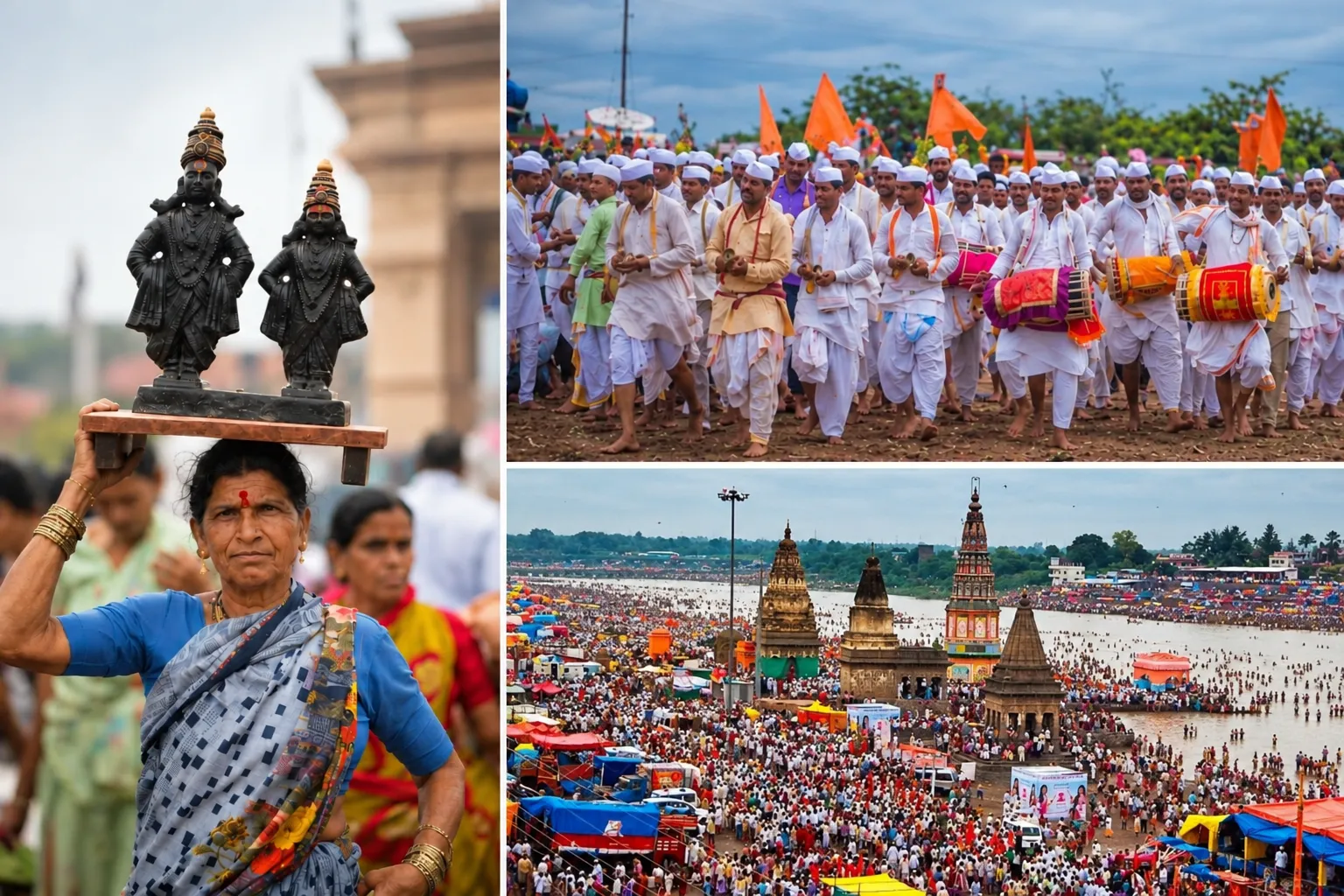
If there's one thing that defines the spiritual importance of Pandharpur Darshan, it is the Wari, an over 800-year-old tradition where lakhs of Varkaris (pilgrims) walk hundreds of kilometres carrying the paduka (sacred sandals) of saints like Sant Dnyaneshwar and Sant Tukaram in beautifully decorated palkhis, all converging in Pandharpur on Ashadhi Ekadashi. We visited exactly one week after this massive festival, and even then, the town was buzzing with devotion. I can only imagine what the actual Ekadashi days must feel like.
Why Devotees Call it Dakshin Kashi
Ancient texts describe Pandharpur as being many times more spiritually rewarding than other holy pilgrimage sites when it comes to acts of pilgrimage, charity, and devotion. This is why it earned the title of Dakshin Kashi (South Kashi). Saints such as Dnyaneshwar, Tukaram, Namdev, Eknath, and Pundalik shaped this land's identity, turning ritualistic worship into pure, personal, heartfelt devotion, a philosophy that is impossible to miss the moment you step into the temple premises for your own Pandharpur Darshan.
Chanting "Vitthal Vitthal" is believed to bring peace, remove negativity, increase patience, and cleanse the soul, and honestly, after our darshan, I felt every bit of that.
Our Real Pandharpur Darshan Experience: Mukh Darshan vs Charan Darshan
Around 6:00 AM, we entered the temple premises, and even a week after Ashadhi Ekadashi, the crowd was massive. At the entrance, we realized there are two separate queues for Pandharpur Darshan, and choosing between them completely changes your experience.
| Darshan Type | What You Get | Approx. Time (Our Experience) | Best For |
|---|---|---|---|
| Mukh Darshan | View of Lord Vitthal's face from a short distance | Under 1 hour | Families with elderly members or children, limited time |
| Charan Darshan | Chance to physically touch Lord Vitthal's feet | Nearly 4 hours (in our case) | Devotees seeking the deepest, most personal connection |
We chose Charan Darshan, because how often does one get the chance to actually touch the feet of Panduranga? We stood in that queue for almost four hours, slowly shuffling forward, chanting bhajans with strangers who felt like family by the end of it. My mother's eyes were wet the entire last stretch. Around 10:00 AM, we finally reached the sanctum, and the moment my hand touched those cool stone feet, every ounce of tiredness from the overnight bus journey simply vanished.
The atmosphere inside is impossible to describe in words: the fragrance of tulsi and camphor, the continuous chanting of "Vitthal Vitthal," temple bells, and the sheer emotion on every devotee's face. If you ask me what Pandharpur Darshan truly feels like, it is this, a queue of strangers united by one shared love.
After darshan, we stepped out and had a simple, satisfying breakfast at one of the small eateries near the temple before continuing to explore the surrounding lanes and old temples of Pandharpur.

Chandrabhaga River: The Soul of Pandharpur
No Pandharpur Darshan story is complete without the Chandrabhaga River, technically a branch of the Bhima River, so named because of its crescent-moon-shaped curve as it flows past the town. This river is considered as sacred as the temple itself, and a holy dip here is believed to wash away sins before darshan.
The Pundalik Temple in the River (And Why We Couldn't Enter)
We visited in August, during the monsoon season, and the Chandrabhaga was in full flow, wide, fast, and beautiful, but also intimidating. The Pundalik Temple, built on an island-like spot in the middle of the river to mark the very place where Pundalik lived and attained samadhi, was completely surrounded by overflowing water. We could see the temple from the bank, but entry was closed for safety. It was a strange, humbling feeling, being unable to reach a place connected to the very devotee whose story gave Lord Vitthal His name.
If you're planning your Pandharpur Darshan in the monsoon months, keep this in mind: the river's beauty comes with limitations, and the Pundalik Temple may not always be accessible.
Where We Stayed: Shree Gajanan Maharaj Sansthan Experience
Even though we couldn't get a room at Shree Gajanan Maharaj Sansthan early that morning, we still visited the ashram later in the day, and I have to mention it here because it deserves the recognition. Located close to the temple on the banks of the Chandrabhaga, this Sansthan is known across Maharashtra for:
- Extremely affordable and clean rooms, ideal for families
- A peaceful, spiritually charged atmosphere with regular aarti, pooja, and kirtan
- Genuinely warm hospitality from staff and volunteers
Our honest tip: If Pandharpur Darshan is on your calendar, try calling ahead or booking your room at Shree Gajanan Maharaj Sansthan a few days in advance, especially if you're travelling within a week or two of Ashadhi Ekadashi or Kartiki Ekadashi. Walk-in availability at dawn is simply not guaranteed during peak season.
Nearby Temples You Must Visit Around Pandharpur

After breakfast, we spent the rest of the morning until about 3:00 PM exploring the many smaller, equally sacred temples scattered around the main Vitthal Rukmini Mandir. Pandharpur is full of these hidden gems, and honestly, most first-time visitors rush through Pandharpur Darshan without giving these a second look. Don't make that mistake.
| Temple | Distance | Significance |
|---|---|---|
| Vishnupad Temple | ~2 km (Gopalpur) | Houses a large lotus footprint believed to belong to Lord Vishnu; partially submerged during monsoon |
| Kaikadi Maharaj Math | ~1.5 km | Known for detailed sculptural depictions of Hindu mythology and stories |
| Pundalik Temple | On the Chandrabhaga riverbank | Marks the samadhi spot of devotee Pundalik, whose devotion gave Vitthal His name |
| ISKCON Pandharpur (Shree Radha Pandharinath Mandir) | Across the river | A serene Krishna temple ideal for a peaceful, meditative visit |
| Shri Gopalkrishna Temple | Near Gopalpur | Associated with Krishna's childhood pastimes in local tradition |
We couldn't cover every single one due to time, but even walking through the narrow lanes around the main temple, lined with shops selling tulsi malas, Vitthal idols, and prasad, felt like stepping into a living devotional museum.
Evening Atmosphere at Chandrabhaga Ghat
After a short rest back at our room, we returned to the temple area in the evening, and this, for me, was the most magical part of the entire Pandharpur Darshan experience. We sat by the Chandrabhaga ghat for almost 30 to 45 minutes, just watching.
The sky slowly turned orange and pink, temple bells rang in the distance, groups of Varkaris sang abhangs on the steps, and the river carried it all forward with a gentle, constant flow. There is a certain stillness that settles over Pandharpur in the evening: the crowds thin out slightly, the air cools down, and you finally get a moment to simply be with your thoughts and with God. My father, a man of few words, just sat there quietly holding my mother's hand, and I didn't need him to say anything. I understood exactly what that moment meant to him.
If your Pandharpur Darshan itinerary allows even 30 minutes for this, please don't skip it. The morning queue gives you darshan of the Lord; the evening ghat gives you darshan of His atmosphere.
Prasad Seva at Gajanan Maharaj Seva Sansthan
For dinner, we walked to the Shree Sant Gajanan Maharaj Seva Sansthan, a place as beloved for its food seva as for its beautiful temple and garden dedicated to Gajanan Maharaj. For a humble ₹80 per person, we were served an absolutely delicious, unlimited thali featuring:
- Fresh roti
- Steamed rice
- Two vegetable sabzis
- Dal
- Sweet halwa as prasad
Every single item tasted authentic, homely, and made with genuine devotion, no wonder this Sansthan is so famous for its seva. Sitting there, eating with hundreds of other devotees on long communal benches, I realized that this simple ₹80 meal held more warmth than any restaurant we'd ever visited. After dinner, we walked back to our room, exhausted but overflowing with gratitude, because the next morning we had a train to catch to Kolhapur for Mahalakshmi Temple darshan.
Practical Pandharpur Darshan Guide (Timings, Travel, Tips)
Based entirely on our own experience, here is a quick practical table for anyone planning their Pandharpur Darshan:
| Detail | Information |
|---|---|
| Temple Timings | Generally 4:00 AM to 11:00 PM (subject to festival-day changes) |
| Best Time to Visit | October to February for pleasant weather; Ashadhi/Kartiki Ekadashi for peak devotional experience (expect huge crowds) |
| How We Reached | Overnight sleeper bus from Pune Wakad (10 PM departure, approx. 5 to 5:30 AM arrival) |
| Darshan Options | Mukh Darshan (faster) and Charan Darshan (longer queue, touch the feet) |
| Where to Stay | Shree Gajanan Maharaj Sansthan (book in advance), or hotels near Shivaji Chowk |
| Budget Meal | Gajanan Maharaj Seva Sansthan, unlimited thali at ₹80 |
| Nearby Temples | Vishnupad Temple, Pundalik Temple, Kaikadi Maharaj Math, ISKCON Pandharpur |
| River | Chandrabhaga, holy dip recommended (check water levels in monsoon) |
Quick Tips from Our Trip:
- Pre-book your accommodation, especially within two weeks of Ashadhi or Kartiki Ekadashi.
- Carry water and snacks if opting for Charan Darshan, as the queue can take several hours.
- Visit in the evening for the peaceful riverside atmosphere, not just the morning rush.
- If travelling during monsoon, confirm whether the Pundalik Temple is accessible, as it often gets submerged.
- Dress modestly and comfortably, you'll be standing and walking for hours.
For official information and darshan updates, you can always check the Shri Vitthal Rukmini Mandir Sansthan's official website before your visit.
FAQs on Pandharpur Darshan
Q1. What is the best time to do Pandharpur Darshan?
The pleasant winter months from October to February are ideal for a comfortable visit. However, if you want to witness the temple at its most devotionally alive, plan your Pandharpur Darshan around Ashadhi Ekadashi (June to July) or Kartiki Ekadashi, though be prepared for very large crowds.
Q2. How long does Pandharpur Darshan take?
Mukh Darshan can be completed in under an hour on a normal day. Charan Darshan, where you touch the Lord's feet, can take anywhere from 2 to 5 hours depending on the crowd, as we experienced firsthand.
Q3. Is there an online darshan pass for Pandharpur?
Yes, the temple sansthan offers online and VIP darshan pass options during peak seasons to help manage crowds. It's best to check the official Vitthal Rukmini Mandir Sansthan website closer to your travel date for current booking details.
Q4. Why is Lord Vitthal called Vithoba or Panduranga?
Vitthal comes from "Vit" (brick) and "Thal" (standing), referencing the legend of Pundalik. Panduranga comes from ancient inscriptions referring to the deity as "Pandaraga Vittaga."
Q5. Can we take a dip in the Chandrabhaga River before darshan?
Yes, most devotees take a holy dip in the Chandrabhaga before entering the temple, as it is considered spiritually purifying. During monsoon, however, water levels rise significantly, so exercise caution.
Q6. What are the must-visit temples near Pandharpur besides Vitthal Rukmini Mandir?
Vishnupad Temple, Pundalik Temple, Kaikadi Maharaj Math, and ISKCON Pandharpur are among the most significant nearby shrines worth including in your Pandharpur Darshan itinerary.
Q7. Where can families get affordable and clean accommodation near the temple?
Shree Gajanan Maharaj Sansthan near Shivaji Chowk is highly recommended for families due to its affordability, cleanliness, and devotional atmosphere, though advance booking is strongly advised.
Final Thoughts
Looking back, our Pandharpur Darshan was tiring, emotional, occasionally disappointing (that early-morning room mix-up still makes us laugh), and ultimately, deeply fulfilling. Standing in that four-hour Charan Darshan queue with my parents, watching the Chandrabhaga flow past the half-submerged Pundalik Temple, and sharing an ₹80 thali that tasted like home, these are the moments that stay with you long after the trip ends.
If you're planning your own Pandharpur Darshan, go with an open heart, comfortable shoes, and enough patience for the queue. Lord Vitthal has been patiently waiting on that brick for centuries; He won't mind waiting a little longer for you either. 🙏
Jai Hari Vitthal!
📌 Loved this personal travelogue? Explore more real pilgrimage stories and complete temple guides on Hindu Temple Guide, your trusted companion for temple travel across India. Learn more about us here, and don't miss these related reads:
- Nagchandreshwar Temple: My 24-Hour Nag Panchami Darshan at Ujjain
- Mahakaleshwar Temple Shravan-Bhadon 2026 Darshan Vyavastha, Gate-Wise Guide
- Tirupati Balaji Temple Guide 2026: Darshan Types, SED Booking & Tips
- Temple Dress Code in India: Complete Guide
Coming up next: our Mahalakshmi Kolhapur Darshan journey, stay tuned!