
Kerala's most famous temples are:
(1) Guruvayur Sri Krishna Temple revered as 'Bhuloka Vaikunta' (Heaven on Earth) and the 4th most visited temple in India with 50,000+ daily visitors;
(2) Sree Padmanabhaswamy Temple, Thiruvananthapuram the world's wealthiest temple (over 22 billion USD in underground vaults, with Vault B still unopened);
(3) Sabarimala Sree Dharma Sastha (Ayyappa) Temple one of the world's largest annual pilgrimages drawing 40-50 million devotees every Mandala-Makaravilakku season;
(4) Attukal Bhagavathy Temple holder of the Guinness World Record for the largest gathering of women at the annual Attukal Pongala;
(5) Vadakkunnathan Temple, Thrissur venue of the iconic Thrissur Pooram; and
(6) Aranmula Parthasarathy, Ettumanoor Mahadeva & Chottanikkara Bhagavathy Temples. Entry inside the inner sanctum at most major Kerala temples is restricted to practising Hindus under strict traditional dress codes, and general darshan is 100% FREE.
Famous temples in Kerala offer a spiritual atmosphere that even seasoned pilgrims across India rarely anticipate. The first time you wake up at 2:30 in the morning in a small room near a Kerala temple, your phone screen is the only light. Outside in the darkness, you can already hear thin, clear temple bells and conch shells cutting through the pre-dawn stillness. You splash cold water on your face, drape a plain white cotton mundu (or kasavu saree), and step out into a lane that smells of wet earth, coconut oil, and fresh jasmine. Hundreds of devotees are already walking quietly in the dark toward the oil-lit sanctum for the 3:00 AM Nirmalyam darshan-a scene that has repeated itself every single morning for centuries without change.
A Pilgrim's Perspective: From the 3:00 AM Nirmalyam lamp light of Guruvayur and the three doorways of Sree Padmanabhaswamy in Thiruvananthapuram, to the streets of Attukal during Pongala, the percussion of Thrissur on Pooram morning, the riverbanks of Aranmula, and the three daily moods of the Goddess at Chottanikkara near Kochi-Kerala's shrines leave a mark on every devotee. This 2026-2027 guide brings together everything you need to know in advance: the strict dress codes nobody warns you about clearly, the exact darshan windows, festival dates, and a practical 5-day pilgrimage circuit.
Kerala-God's Own Country-is home to some of the most extraordinary temples in India. Whether you stand before Padmanabhaswamy's 18-foot reclining Vishnu and understand why the Travancore kings ruled strictly as Padmanabhadasa (servants of the Lord), or walk 3 km from Guruvayur at 9:30 AM to watch 50+ temple elephants resting under the trees at Punnathur Kotta, this guide will help you experience Kerala's sacred heritage at its best. Jai Guruvayurappa! Swamiye Saranam Ayyappa!
1. Why Kerala Is Genuinely God's Own Country - My Honest Take
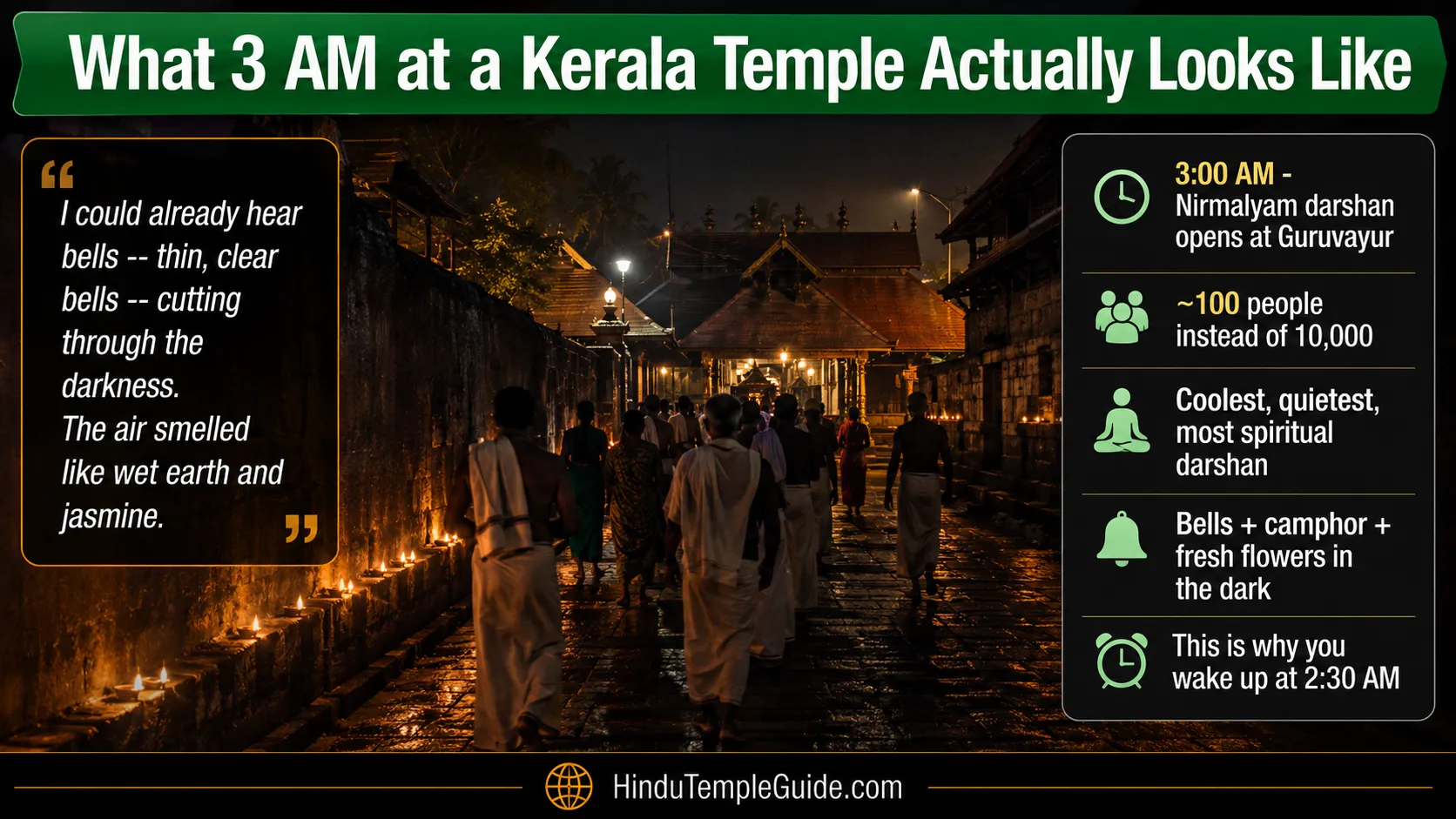
We have all seen the phrase 'God's Own Country' printed on Kerala tourism posters for decades. At first glance, it sounds like a clever marketing slogan. Then you spend a week visiting the famous temples of Kerala and realise why the name stuck. What sets Kerala apart is not just the age of its shrines-it is the fact that their Tantric-Agamic rituals remain completely, uncompromisingly alive. The sanctums are still lit solely by brass oil lamps (Chuttuvilakku and Nilavilakku), never harsh electric bulbs. The priests (Tantris and Melsanthis) follow the exact ritual manuals codified centuries ago. The percussion (Panchavadyam and Chenda Melam) and the 3:00 AM floral decorations remain untouched by modern shortcuts.
Here is what makes the famous temples in Kerala unlike anywhere else in the country:
- Two global records in a single state: The world's wealthiest place of worship (Sree Padmanabhaswamy Temple) and the Guinness World Record for the largest gathering of women for a religious activity (Attukal Pongala)-both in Thiruvananthapuram, just 2 kilometres apart.
- India's strictest egalitarian dress code: Shrines like Guruvayur and Padmanabhaswamy turn away men wearing shirts or trousers inside the sanctum. Men must wear only a plain mundu (dhoti) with a bare chest (or simple veshti/angavastram), stripping away every outward marker of wealth or status at the temple gate.
- One of the world's largest annual pilgrimages: Sabarimala draws an estimated 40 to 50 million devotees across its Mandala-Makaravilakku season-a river of black-clothed Ayyappa స్వాമിs (Swamis) walking barefoot through the Western Ghats forest after observing a strict 41-day ascetic vow (Vratham).
- Unique Kerala temple architecture: Built according to the regional treatise Tantrasamuchaya and Manushyalaya Chandrika, Kerala's temples feature sloping copper-and-terracotta roofs adapted to heavy monsoons, circular or square sanctums (Sreekovil), carved wood ceilings (Namaskara Mandapam), outer walls lined with thousands of brass oil lamps (Vilakkumadam), and sacred temple ponds (Kshetra Kulam).
| Temple & City | Presiding Deity | What Makes It Extraordinary |
|---|---|---|
| 1. Guruvayur Temple (Thrissur) | Lord Krishna (Guruvayurappan) | 'Bhuloka Vaikunta' · 50,000+ daily visitors · Opens at 3:00 AM for Nirmalyam · Punnathur Kotta elephant camp. |
| 2. Sree Padmanabhaswamy (Trivandrum) | Lord Vishnu (Anantha Shayana) | World's wealthiest temple ($22B+ in vaults; Vault B unopened) · 18-ft idol viewed through 3 doorways. |
| 3. Sabarimala Temple (Pathanamthitta) | Lord Ayyappa (Dharma Sastha) | 40-50M pilgrims per season · 41-day Mandala Vratham vow · 18 sacred golden steps · Open to all faiths. |
| 4. Attukal Bhagavathy (Trivandrum) | Goddess Bhadrakali (Kannaki) | 'Sabarimala of Women' · Guinness World Record Attukal Pongala (Millions of women cook Pongala on city streets). |
| 5. Vadakkunnathan (Thrissur) | Lord Shiva (Vadakkunnathan) | UNESCO Award of Excellence for Conservation · Venue of the world-famous Thrissur Pooram festival. |
| 6. Aranmula Parthasarathy (Pathanamthitta) | Lord Krishna (Parthasarathy) | 108 Divya Desam on the Pampa River · Sacred Aranmula Kannadi metal mirror & Onam Uthrattathi Boat Race. |
| 7. Ettumanoor Mahadeva (Kottayam) | Lord Shiva (Aghora Murthy) | Masterpiece 16th-century Pradosha Nritham murals & Ezharaponnana (7.5 golden elephants) darshan. |
| 8. Chottanikkara Bhagavathy (Kochi) | Rajarajeswari (Saraswati, Lakshmi, Durga) | Goddess worshipped in 3 forms across 3 daily sessions · Renowned for spiritual healing & Guruthi Pooja. |
2. Guruvayur Sri Krishna Temple - Bhuloka Vaikunta & The 3 AM Nirmalyam Experience
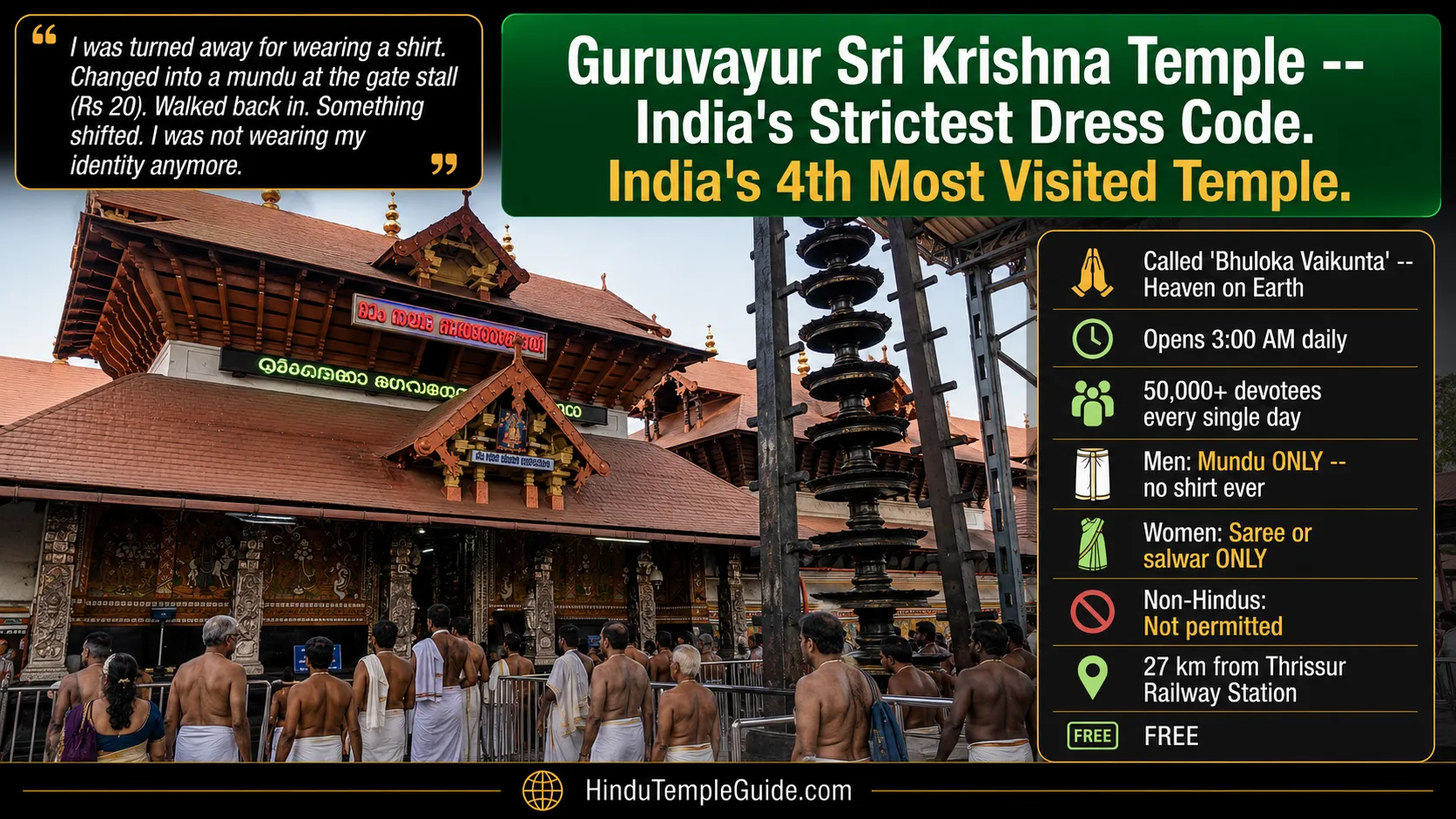
Almost every first-time visitor from outside Kerala learns the Guruvayur Temple dress code rule the hard way. You arrive at the East Nada gate wearing what would be considered respectful traditional attire at any North or West Indian temple-a clean full-sleeve cotton shirt or kurta and trousers. The guard at the outer gate stops you politely but firmly: no shirt, kurta, vest, or trousers are allowed inside for men. Men must wear only a plain mundu around the waist with a bare chest (an optional small veshti/towel over the shoulder is allowed).
What Happens When You Change Into a Mundu: Thirty metres from the East Nada gate, small textile stalls sell or rent plain white cotton mundus for ₹50-₹150, and helpful local devotees are always ready to show you how to tuck and secure the waist fold in 30 seconds. Once you deposit your shirt, trousers, and mobile phone at the cloakroom and step bare-chested into the lamp-lit queue, something unexpected shifts inside you. You are no longer wearing your job title, your city, your watch, or any outward marker of status. You are simply one devotee in a plain piece of white cloth standing among hundreds of other men in the exact same white cloth, all moving toward the same oil-lit doorway. That is what the Kerala temple dress code actually accomplishes-it makes everyone equal before the Lord.
Inside the gold-plated Sreekovil stands the extraordinary four-armed murti of Guruvayurappan-Lord Vishnu/Krishna carved from sacred Pathalanjana Shila (black bismuth-antimony stone), holding the Panchajanya conch, Sudarshana discus, Kaumodaki mace, and lotus, worshipped by Vasudeva and Devaki in Dwarka and installed here by Guru (Brihaspati) and Vayu (the Wind God) when Dwarka submerged. It was right here in this temple hall in 1586 CE that the poet-saint Melpathur Narayana Bhattathiri composed the 1,036 Sanskrit verses of the Narayaneeyam while being cured of paralysis.
Entry Policy: Strictly restricted to practising Hindus. Men: Plain white or off-white mundu (dhoti) worn around the waist ONLY-no shirt, T-shirt, vest/baniyan, kurta, or trousers (a small neriyathu/veshti cloth may be draped over the chest/shoulder). Women: Saree, set-mundu, half-saree, or modest salwar kameez/churidar with dupatta (jeans, leggings without long kurta, and western tops are strictly barred). Daily Timings: Opens at 3:00 AM - 3:30 AM (Nirmalyam Darshan), followed by poojas and darshan until 1:30 PM (closes 1:30-4:30 PM), and reopens 4:30 PM - 9:15 PM (Thrippuka). Official Devaswom Portal: guruvayurdevaswom.in.
| Detail | Verified Information (2026-2027) |
|---|---|
| Presiding Deity | Lord Guruvayurappan (Sri Krishna / Mahavishnu) in 4-armed standing form (Pathalanjana Shila) |
| Sacred Title & Footfall | Revered as 'Bhuloka Vaikunta' (Heaven on Earth) & 'Dwarka of the South' · 50,000+ devotees daily |
| Darshan Timings | 3:00 AM - 1:30 PM & 4:30 PM - 9:15 PM (Nirmalyam: 3:00-3:30 AM · Seeveli elephant processions: 7:00 AM, 4:30 PM & 8:30 PM) |
| Men's & Women's Dress Code | Men: Plain white/cream mundu ONLY (no shirt/vest/pants) · Women: Saree, set-mundu, or salwar kameez (no jeans/western wear) |
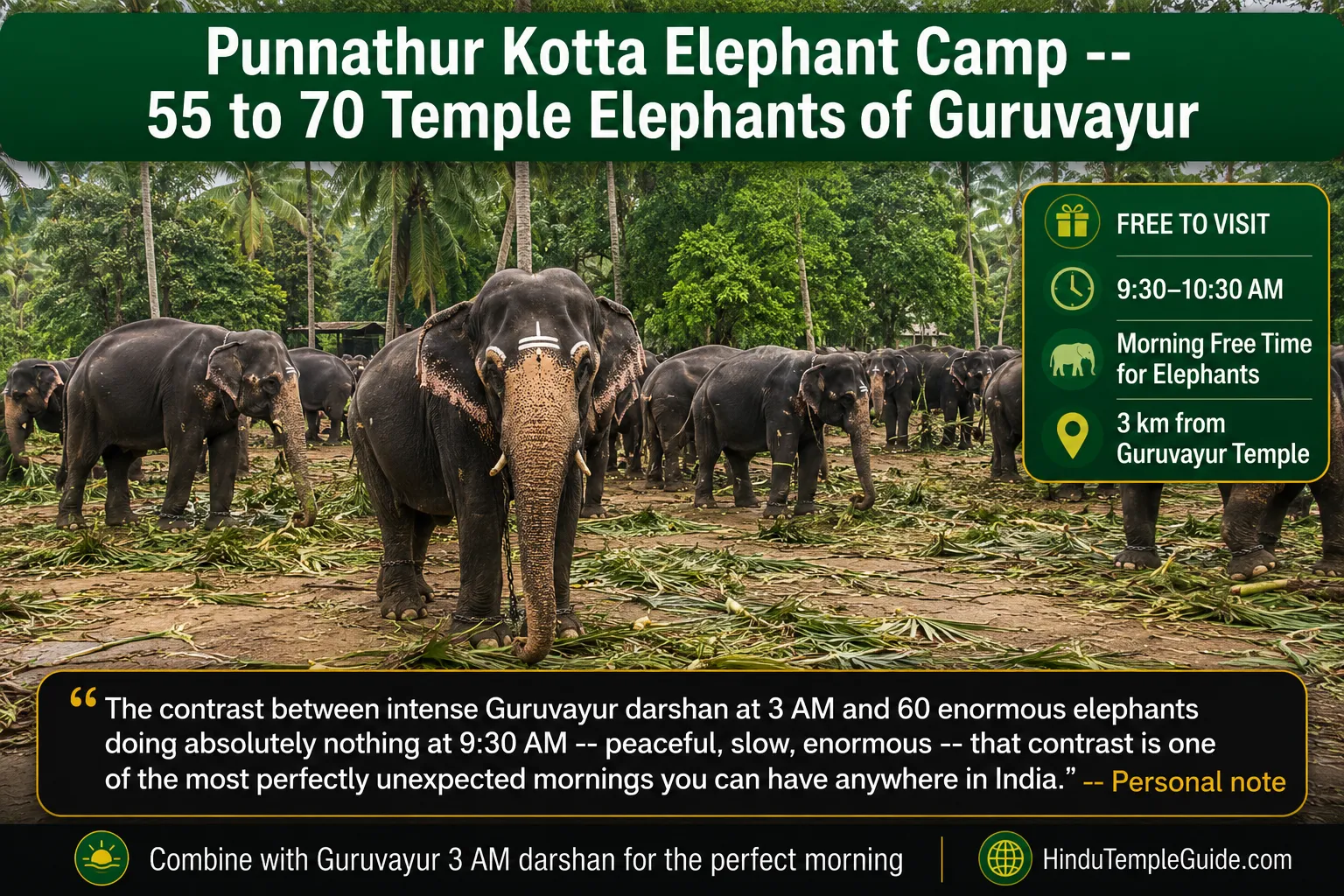
| Punnathur Kotta (Aanakkotta) | Sanctuary for ~40-55 temple elephants located 3 km from the temple · Open 9:00 AM - 5:00 PM (Entry ₹20) |
| Major Festivals | Guruvayur Ekadashi & Chembai Sangeetholsavam (Nov/Dec) · Ashtami Rohini (Janmashtami) · 10-day Utsavam (Feb/Mar) |
| How to Reach & Official Site | Guruvayur Railway Stn (800 m) · Thrissur Stn (28 km) · Cochin Airport (80 km) · guruvayurdevaswom.in |
3. Sree Padmanabhaswamy Temple - The 3-Doorway Darshan & Vault B Mystery
Standing inside the sanctum corridor of Sree Padmanabhaswamy Temple in Thiruvananthapuram is an experience that defies ordinary description. Because the 18-foot reclining murti of Lord Mahavishnu-composed of 12,008 sacred Shaligram stones brought from the Gandaki River in Nepal and coated with a special herbal mortar called Katusarkara Yogam-is too vast to be viewed through a single door, devotees behold the Lord through three separate doorways in sequence: the serene face and Lord Shiva's Shivalinga beneath his right hand through the first door; the reclining torso and Lord Brahma seated on the lotus rising from his navel through the second door; and the lotus feet attended by Bhudevi and Sridevi through the third door.
Why Thiruvananthapuram Exists Because of This Temple: In 1750 CE, Maharaja Marthanda Varma surrendered the entire kingdom of Travancore to Lord Padmanabhaswamy in the historic act of Thrippadidanam-declaring that the Lord himself was the true King of Travancore and the royal family would rule only as his humble stewards (Padmanabhadasa). Even the capital city's name-Thiru-Anantha-Puram-literally means "The Sacred Abode of Lord Anantha Padmanabha." When you sit on the cool granite slabs of the 364-pillared Kulasekharamandapam after darshan, that centuries-old devotion feels palpable in every stone.
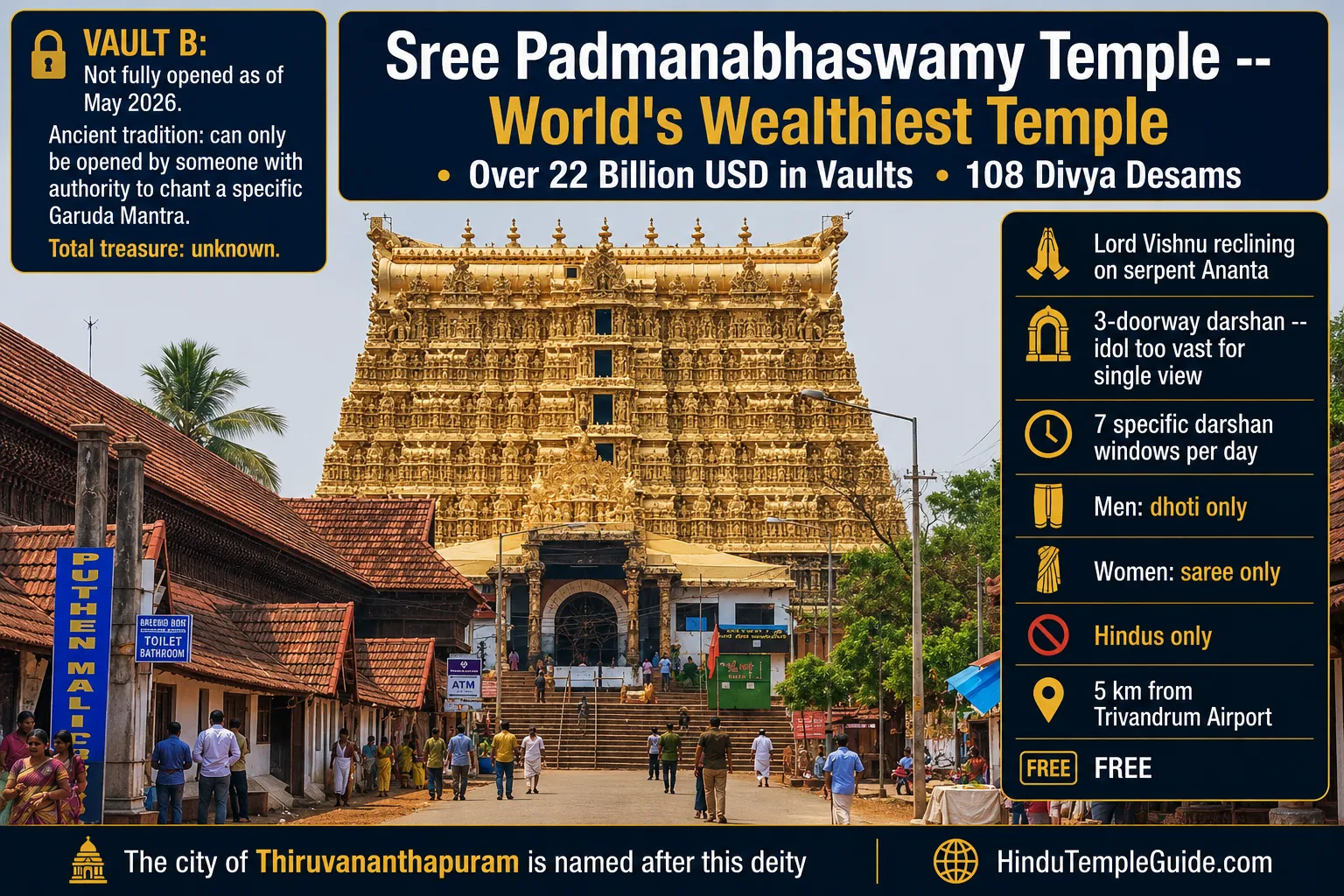
In 2011, five of the temple's subterranean vaults (Chambers A, C, D, E, and F) were opened by a Supreme Court-appointed committee and found to contain gold coins, gem-encrusted crowns, solid gold idols, and ceremonial treasures valued at over 22 billion USD (₹1.2+ lakh crore in intrinsic value alone, excluding antique value)-making it the wealthiest place of worship on Earth. However, the innermost chamber of Vault B (Kallara B)-guarded by a heavy door carved with serpent motifs-and two additional subterranean chambers (Vaults G and H, identified in 2014) have never been opened due to sacred Deva Prashnam (astrological) and religious traditions. In July 2020, the Supreme Court of India upheld the hereditary trusteeship of the Travancore Royal Family and left any decision on Vault B to the temple's administrative and advisory committees.
| Detail | Verified Information (2026-2027) |
|---|---|
| Presiding Deity | Lord Anantha Padmanabhaswamy (Vishnu reclining on 5-hooded serpent Anantha; 12,008 Shaligrams) · 108 Divya Desam |
| The 3-Doorway Darshan | 18-foot reclining idol viewed through 3 doors: Door 1 (Face & Shiva Linga), Door 2 (Torso & Brahma on Navel Lotus), Door 3 (Lotus Feet) |
| 7 Daily Darshan Windows | Morning: 3:15-4:15 AM (Nirmalyam), 6:30-7:00 AM, 8:30-10:00 AM, 10:30-11:10 AM, 11:45 AM-12:00 PM · Evening: 5:00-6:15 PM, 6:45-7:20 PM |
| Strict Dress Code & Entry | Practising Hindus Only. Men: Dhoti/mundu ONLY (bare chest; no shirt/vest/pants). Women: Saree, set-mundu, half-saree, or mundu wrapped over salwar/maxi. |
| Entry Fee & Official Portal | FREE General Darshan (Special Sreebali/Ottakkal Mandapam tickets ₹150-₹500 at spst.in) |
| How to Reach | East Fort, Thiruvananthapuram · 1 km from Trivandrum Central Railway Stn (TVC) · 5 km from Trivandrum Airport (TRV) |
4. Sabarimala Sree Dharma Sastha Temple - The 41-Day Vratham & 2026-2027 Season
Nestled at 1,260 metres (4,134 feet) inside the dense Periyar Tiger Reserve of the Western Ghats in Pathanamthitta district, Sabarimala Sree Dharma Sastha (Ayyappa) Temple is unlike any other shrine in India. It does not remain open 365 days a year-instead, it opens primarily for the 41-day Mandala Pooja season (November-December), the Makaravilakku festival (December 30 - January 20), Vishu (April), Onam, and the first five days of every Malayalam month.
The Pre-Dawn River of Devotion at Pamba: Stand at Pamba base camp at 4:00 AM during the Mandala season and you will witness a sight that rearranges your understanding of collective faith. Curving down the mountain valley as far as the eye can see is an unbroken stream of millions of pilgrims dressed in black and dark-blue mundus, each carrying the two-compartment Irumudi Kettu (containing a ghee-filled coconut for the Lord's abhishekam in the front compartment and personal sustenance in the rear-symbolising Prarabdha Karma and Bhakti) balanced on their head. Every pilgrim addresses every other pilgrim-whether a CEO or a daily-wage labourer-by the same name: "Swami." As the low, rhythmic chant of "Swamiye Saranam Ayyappa!" echoes off the forest hills, every distinction of class, language, and ego dissolves into one shared ascent.
For the 2026-2027 pilgrimage season: (1) Mandala Pooja Mahotsavam: Temple opens on the evening of November 16, 2026 (1st of Vrischikam: November 17) and culminates with the Mandala Pooja on December 27, 2026 (closes night of Dec 27 for 2 days). (2) Makaravilakku Mahotsavam: Reopens on December 30, 2026 at 5:00 PM, with the sacred Makaravilakku & Makara Jyothi Darshan on January 14, 2027, and closes for the season on January 20, 2027. Free advance Virtual Queue registration at the official Travancore Devaswom Board / Kerala Police portal (sabarimalaonline.org) is mandatory for all pilgrims.

| Detail | Verified Information (2026-2027) |
|---|---|
| Presiding Deity | Lord Ayyappa (Hariharaputra / Dharma Sastha)-born of Shiva and Mohini (Vishnu), enshrined in Naishtika Brahmachari (eternal celibate yogic) form |
| 2026-2027 Main Season Dates | Mandala Season: Nov 16 - Dec 27, 2026 (Mandala Pooja: Dec 27) · Makaravilakku Season: Dec 30, 2026 - Jan 20, 2027 (Makaravilakku: Jan 14, 2027) |
| The 41-Day Vratham Vow | Initiated by wearing a Tulasi/Rudraksha Mudra Mala; requires black/navy attire, strict satvik vegetarian diet, celibacy, twice-daily baths & prayer |
| Pathinettam Padi (18 Steps) | Only devotees who have observed the Vratham and carry the sacred Irumudi Kettu on their head are permitted to climb the 18 gold-plated sacred steps |
| Secular Harmony (Vavar Nada) | Open to devotees of all religions; pilgrims traditionally offer prayers to Ayyappa's Muslim companion Vavar Swamy at Erumely and Sannidhanam |
| How to Reach & Virtual Queue | Train to Chengannur (87 km) or Kottayam (115 km) → KSRTC bus to Nilakkal & Pamba → 5 km forest trek to Sannidhanam · sabarimalaonline.org |
5. Attukal Bhagavathy Temple - The Day an Entire City Becomes One Temple
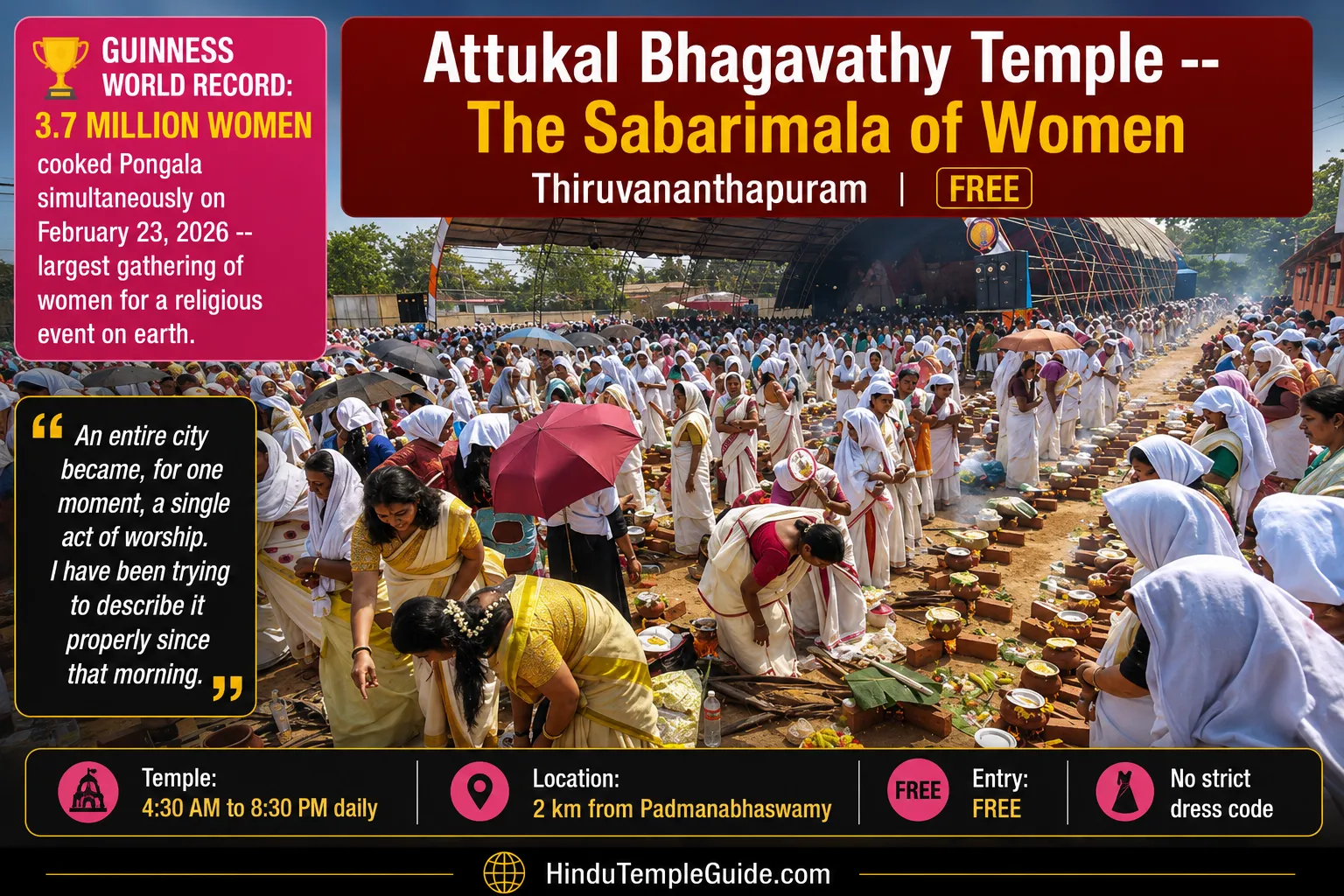
Revered across Kerala as the 'Sabarimala of Women', Attukal Bhagavathy Temple in Thiruvananthapuram (just 2 km from Sree Padmanabhaswamy Temple) holds the Guinness World Record for the largest single gathering of women for a religious activity (first entering the Guinness Book in 1997 with 1.5 million women, surpassing its own record in 2009 with 2.5 million women, and drawing an estimated 3.5 to 4 million women in recent editions).
What Attukal Pongala Morning Looks and Feels Like: On the ninth day of the 10-day festival in the Malayalam month of Kumbham (which fell on March 3, 2026 and will next be celebrated on Monday, February 22, 2027), step outside at 5:30 AM and the entire capital city of Thiruvananthapuram-within a 10-kilometre radius of the temple-has transformed into a single open-air sacred kitchen. Every highway, lane, railway station courtyard, and residential street is lined with millions of three-brick hearths (Aduppu) and fresh clay pots. At around 10:15-10:30 AM, when the chief priest lights the main sacred hearth (Pandara Aduppu) inside the temple sanctum and the temple drums and firecrackers signal the moment across the city, millions of women light their brick hearths in unison to cook sweet Pongala (rice, jaggery, coconut, cardamom, and ghee) as an offering to Attukal Amma. By afternoon, hundreds of temple priests walk through every street of the city to sprinkle holy water (Theertham) over the jutaan pots.
| Detail | Verified Information (2026-2027) |
|---|---|
| Presiding Deity | Attukal Bhagavathy (Bhadrakali / incarnation of Kannaki from the Tamil epic Silappatikaram) |
| Attukal Pongala 2026 & 2027 Dates | 2026 Festival: Feb 23 - Mar 4 (Main Pongala: March 3, 2026) · 2027 Festival: Feb 14 - Feb 23, 2027 (Main Pongala: Monday, February 22, 2027) |
| Daily Darshan Timings | 4:30 AM - 12:30 PM & 5:00 PM - 8:30 PM daily (Open to men, women & families all year; only the Pongala cooking hearth is exclusively for women) |
| Dress Code & Entry Fee | FREE entry · Modest traditional/formal attire (no shirtless requirement for men) |
| Location & Official Portal | Attukal, Thiruvananthapuram (2 km from Padmanabhaswamy Temple & Central Station) · attukal.org |
6. Vadakkunnathan Temple & Thrissur Pooram - The Greatest Temple Festival on Earth
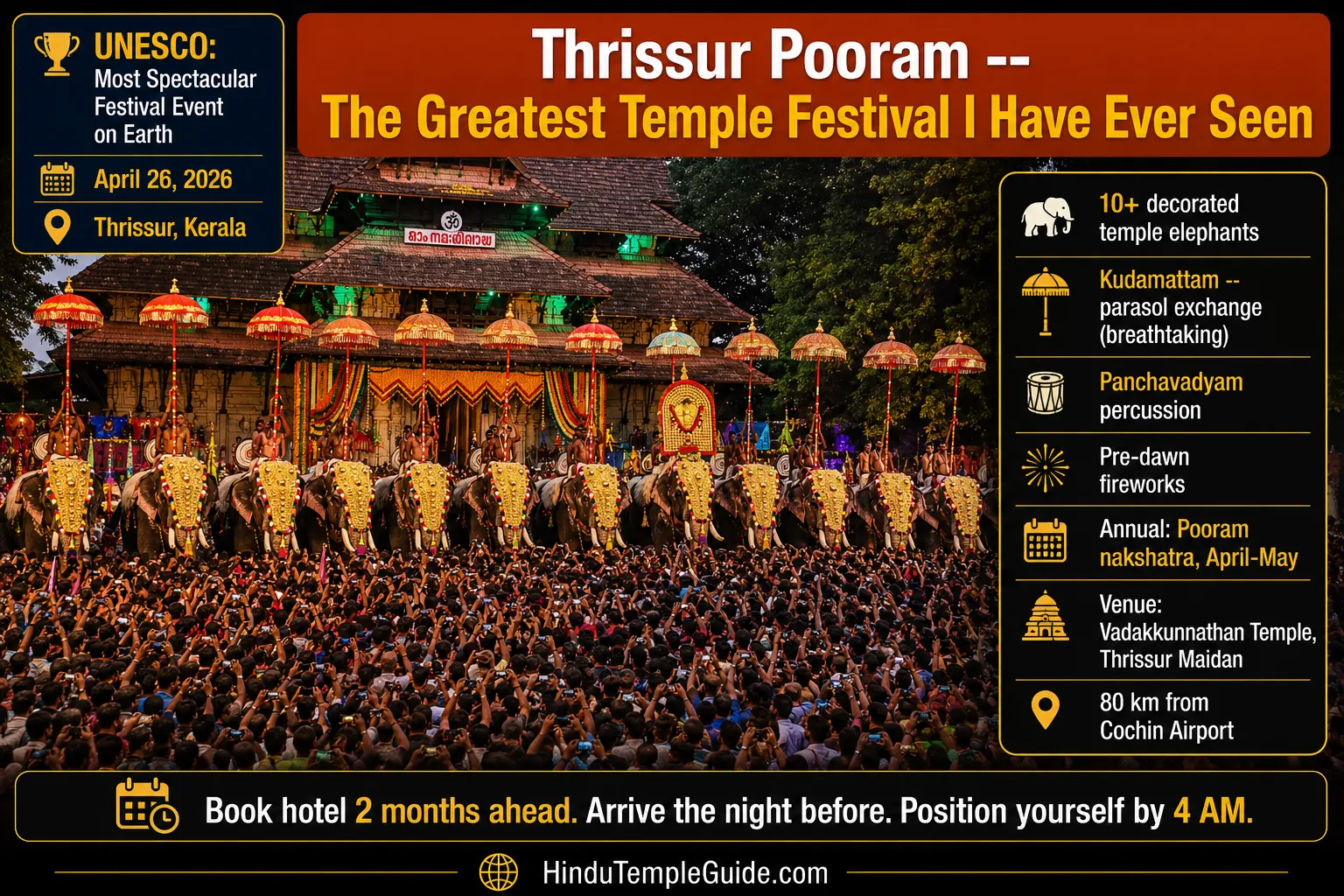
Crowning the 65-acre hillock of Thekkinkadu Maidan right at the centre of Thrissur (Kerala's cultural capital), Sree Vadakkunnathan Temple is one of the oldest Shiva temples in South India-founded according to tradition by Sage Parashurama and honoured with the UNESCO Asia-Pacific Award of Excellence for Cultural Heritage Conservation (2015). Inside the circular Sreekovil, the main Shiva Lingam is completely covered under a 16-foot-high mound of pure cow's ghee accumulated from centuries of daily Neyyabhishekam (ghee offerings) that amazingly never melts or spoils even in the tropical heat, alongside shrines to Shankaranarayana and Lord Rama and an ancient white-painted dance hall (Koothambalam).
Experiencing Thrissur Pooram at Vadakkunnathan Maidan: Instituted in 1798 CE by Raja Rama Varma (Sakthan Thampuran) of Cochin, Thrissur Pooram brings ten neighbouring temples-led by the two main competing sides, Paramekkavu Bagavathi and Thiruvambady Sri Krishna-to pay homage to Lord Vadakkunnathan. Arrive the evening before Pooram for the Sample Vedikkettu fireworks and the opening of the southern Thekke Gopuranada gate, then take your place at the Maidan on Pooram day to witness the 250-artist Ilanjithara Melam percussion symphony inside the temple courtyard at 2:00 PM, followed at 5:30 PM by the unforgettable Kudamattam-where two lines of 15 caparisoned elephants each face off across a sea of 5 lakh people, rhythmically exchanging brilliantly coloured silk parasols against the setting sun!
| Detail | Verified Information (2026-2027) |
|---|---|
| Presiding Deities | Lord Vadakkunnathan (Shiva) (enshrined under a 16-ft mound of sacred ghee), Shankaranarayana & Lord Rama |
| Thrissur Pooram 2026 & 2027 Dates | 2026 Pooram: April 26-27, 2026 · 2027 Pooram: Saturday, April 17, 2027 (Pooram nakshatra in Malayalam month of Medam) |
| Key Pooram Events | Madathil Varavu Panchavadyam (11:30 AM) · Ilanjithara Melam (2:00 PM) · Thekkottirakkam & Kudamattam (5:30 PM) · Pre-dawn fireworks (3:00 AM) |
| UNESCO Recognition | Vadakkunnathan Temple won the 2015 UNESCO Asia-Pacific Award of Excellence for Cultural Heritage Conservation |
| Daily Darshan Timings | 4:00 AM - 11:00 AM & 4:30 PM - 8:20 PM daily · Entry: FREE (Practising Hindus inside inner nalambalam) |
| How to Reach | Heart of Thrissur Swaraj Round · 1.5 km from Thrissur Railway Stn (TCR) · 28 km from Guruvayur · 52 km from Cochin Airport (COK) |
7. More Incredible Temples in Kerala - Aranmula, Ettumanoor & Chottanikkara
1. Aranmula Parthasarathy Temple - On the Banks of the Pampa River
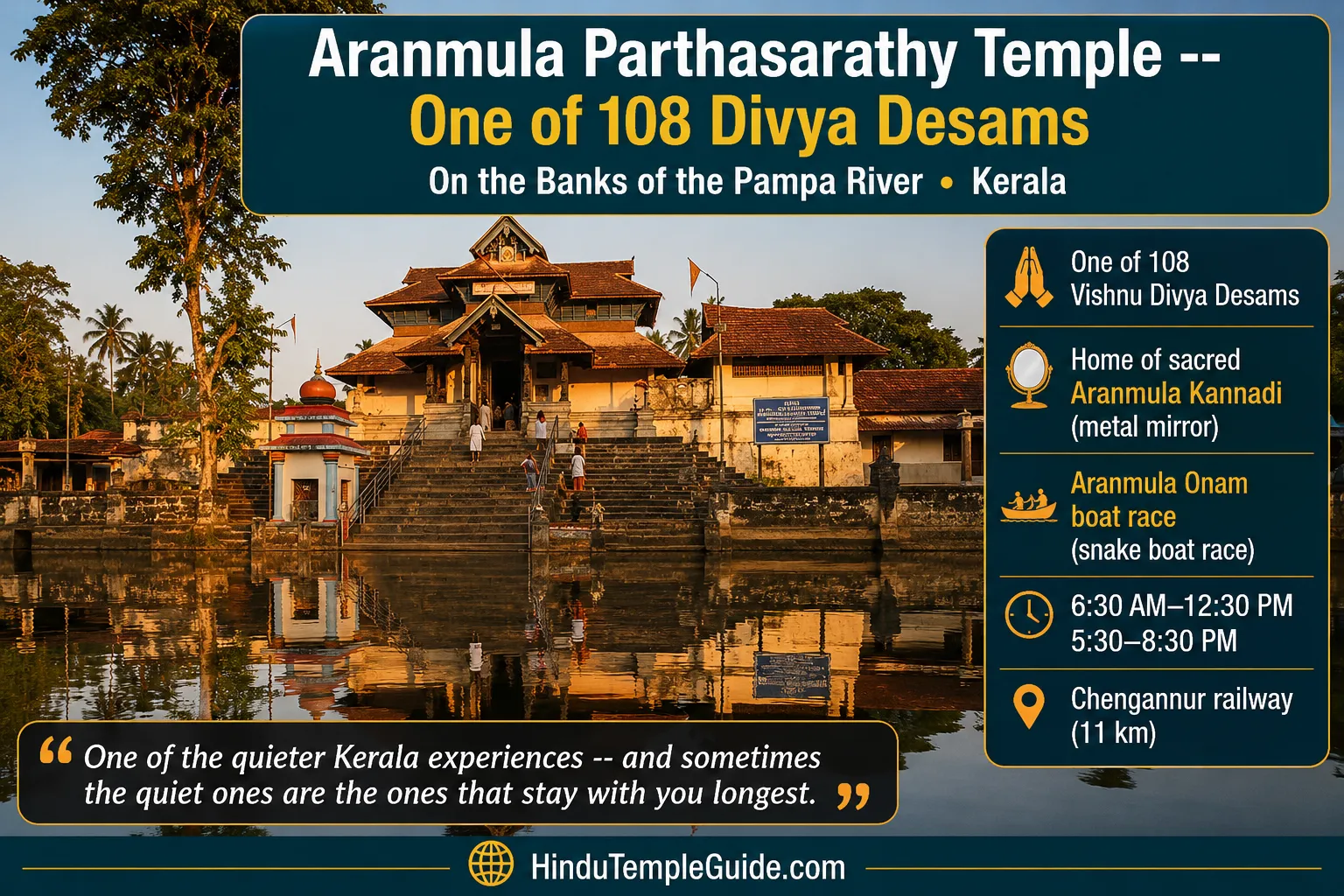
Sitting on the southern bank of the Pampa River in Pathanamthitta district (just 10 km from Chengannur Railway Station), Aranmula Sree Parthasarathy Temple is one of the five ancient Pandava Temples of Central Travancore (consecrated by Arjuna to Lord Krishna as Parthasarathy, the Charioteer of Partha, holding the Sudarshana Chakra during the Kurukshetra war) and one of the revered 108 Divya Desams. It is also the point from which the sacred Thanka Anki (golden attire of Lord Ayyappa) departs in procession for Sabarimala every December. The heritage village of Aranmula is famous for three living traditions: the GI-tagged Aranmula Kannadi (a front-surface sacred metal mirror cast from a secret copper-tin alloy by hereditary Vishwakarma artisans), the 64-dish Aranmula Vallasadya ritual feast, and the Uthrattathi Vallamkali snake boat (Palliyodam) race held on the Pampa River during Onam. Timings: 4:30 AM - 11:30 AM & 5:00 PM - 8:00 PM.
2. Ettumanoor Mahadeva Temple - Masterpiece 16th-Century Kerala Murals & Ezharaponnana
Located 12 km north of Kottayam on the MC Road toward Ernakulam, Ettumanoor Sree Mahadeva Temple is a must-visit for anyone who loves ancient Indian temple art. Painted on the outer wall of the entrance gopuram in 1542-1546 CE is the world-famous Pradosha Nritham (Cosmic Dance of Shiva)-widely regarded as the finest surviving fresco in the traditional Kerala mural style, painted using natural mineral and vegetable pigments on lime plaster. Inside the courtyard hangs a massive brass oil lamp (Valiya Vilakku) whose soot is applied by devotees as sacred eye-salve (Mashi) for vision clarity and protection. Every February/March on the eighth night of the annual Arattu festival, the temple reveals its priceless treasure: the Ezharaponnana ("Seven-and-a-Half Golden Elephants")-eight jackfruit-wood elephants plated in roughly 13 kg of pure gold (seven two-foot elephants and one one-foot elephant) gifted in 1754 CE by Travancore Maharaja Marthanda Varma. Timings: 4:00 AM - 12:00 PM & 5:00 PM - 8:30 PM. Nearest station: Ettumanoor (1.5 km) / Kottayam (12 km).
3. Chottanikkara Bhagavathy Temple - The Goddess in Three Daily Moods
Located just 18 km southeast of Ernakulam/Kochi, Chottanikkara Bhagavathy Temple is one of the most spiritually powerful Shakti shrines in South India, where the self-manifested laterite (Rudraksha Shila) idol of Goddess Rajarajeswari is worshipped together with Lord Mahavishnu as Ammanarayana ("Lakshmi-Narayana"). What makes Chottanikkara theologically extraordinary is that the Goddess is dressed and worshipped in three distinct forms across the day: as Maha Saraswati in the morning (wrapped in a pure white garment-Sattvic, bestowing knowledge and wisdom), as Maha Lakshmi at noon (wrapped in crimson red-Rajasic, bestowing prosperity and auspiciousness), and as Maha Durga in the evening (wrapped in blue/decked in ornaments-Tamasic/Protective, destroying sorrow and fear). In the lower shrine (Keezhkkavu), the fierce form of Bhadrakali is worshipped every evening at 8:45 PM with the dramatic Guruthi Pooja, famous for healing mental anguish and spiritual afflictions. Timings: 4:00 AM - 12:00 PM & 4:00 PM - 8:45 PM. Nearest railway: Tripunithura (8 km) / Ernakulam Jn (18 km).
8. Kerala Temple Dress Code - The Strictest in India (Temple-by-Temple Guide)
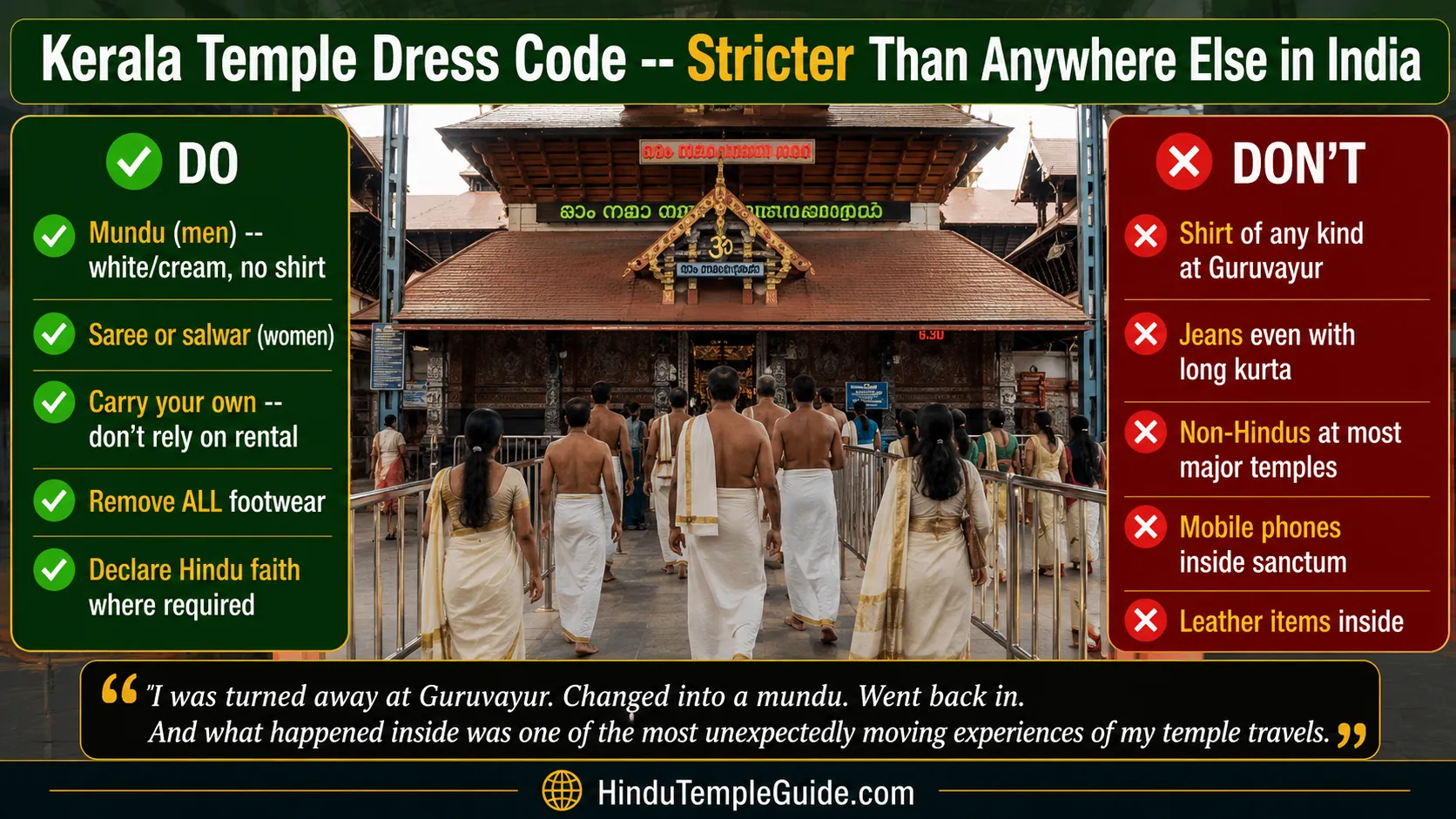
Knowing the exact Kerala temple dress code before you pack your suitcase will save you embarrassment at the temple gate. Across Kerala's Devaswom boards (Guruvayur, Travancore, Cochin, and Malabar Devaswom Boards), traditional attire is not a mere suggestion-it is strictly enforced at the entrance threshold. When every devotee inside the Nalambalam (inner enclosure) wears simple, unstitched traditional cloth and leaves phones, watches, and footwear outside, the sanctum remains quiet, egalitarian, and deeply meditative.
| Temple | Men's Dress Code | Women's Dress Code | Non-Hindu Entry |
|---|---|---|---|
| Guruvayur | Mundu ONLY (bare chest; veshti allowed). No shirt/pants. | Saree, set-mundu, or salwar kameez. No jeans/western wear. | Hindus only (Punnathur Kotta open to all). |
| Padmanabhaswamy | Mundu/Dhoti ONLY (bare chest). No shirt/vest/pants. | Saree, set-mundu, half-saree, or mundu wrapped over salwar/maxi. | Hindus only (Declaration required if asked). |
| Sabarimala | Black/navy blue/saffron mundu + Tulasi/Rudraksha mala. | Traditional modest attire (Customary age norms observed). | Open to all faiths. |
| Attukal Bhagavathy | Mundu or modest formal trousers + shirt. | Saree, salwar kameez, or modest Indian wear. | Generally welcoming to all. |
| Vadakkunnathan | Mundu (shirt removed inside inner sanctum enclosure). | Saree, set-mundu, or salwar kameez with dupatta. | Inner sanctum Hindus only (Maidan open to all). |
| Aranmula & Ettumanoor | Mundu (shirt removed inside inner Nalambalam). | Saree, set-mundu, or salwar kameez with dupatta. | Inner sanctum Hindus only. |
| Chottanikkara | Mundu (bare chest in inner area) or modest traditional wear. | Saree or salwar kameez with dupatta. | Accessible to respectful devotees. |
- Buy your own Velcro-belted mundu before your trip: For ₹250-₹400 at any Kerala textile shop (or online), you can buy a white gold-bordered Kasavu mundu with an adjustable Velcro waist belt and pocket-making it impossible for the mundu to slip while walking and saving you from searching for rental stalls at 3:00 AM!
- How the "Mundu Over Salwar" rule works at Padmanabhaswamy: Women wearing a salwar kameez or long skirt at Padmanabhaswamy do not need to change into a full saree-you can simply buy or rent a cotton mundu outside the East Fort gate (₹30-₹50) and tie it around your waist over your salwar.
- Mobile phones and leather are strictly prohibited inside: Deposit mobile phones, smartwatches, cameras, earphones, and leather belts at the official Devaswom cloakroom counters before entering.
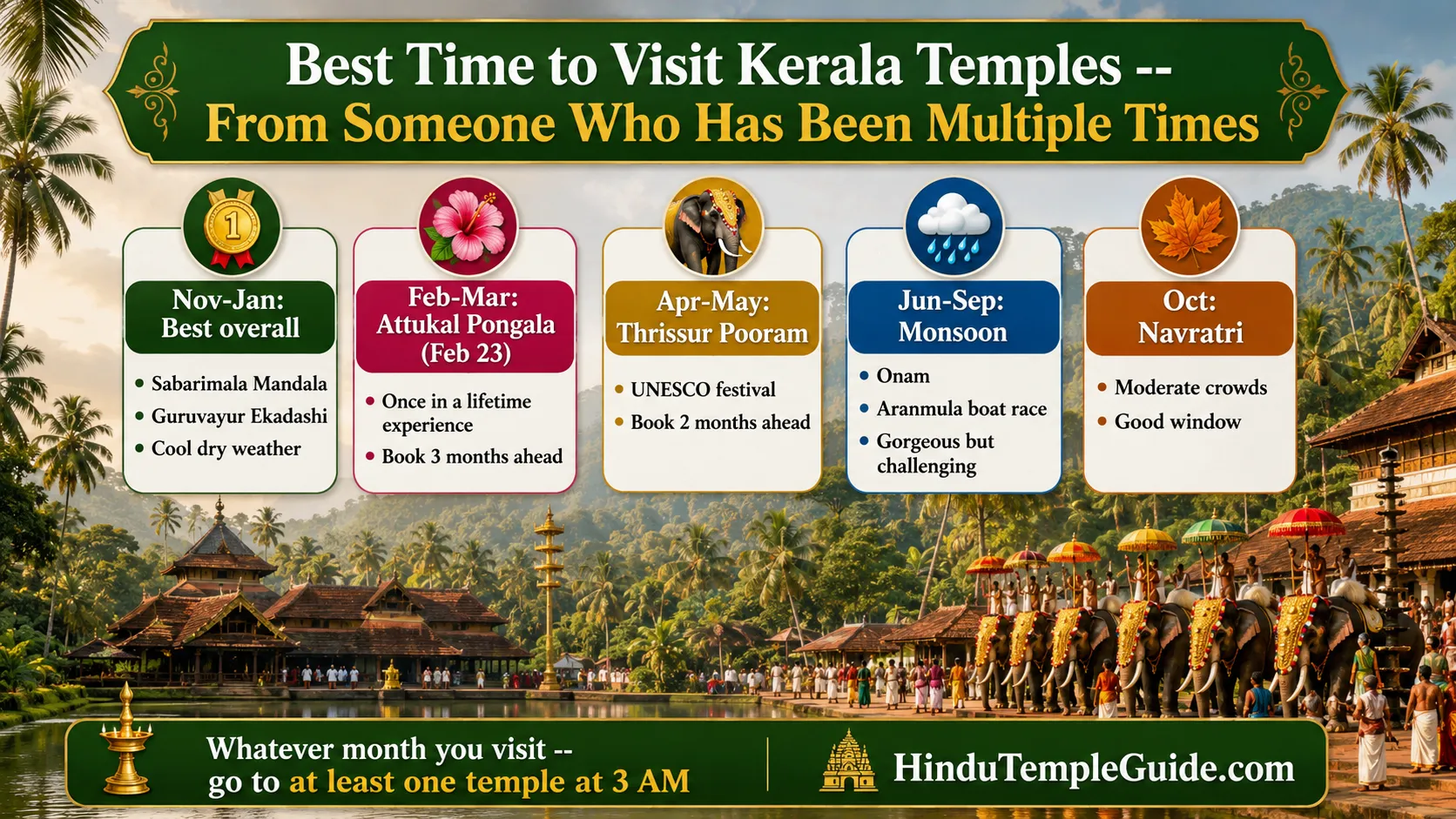
9. Best Time to Visit Kerala Temples - Season & Festival Calendar (2026-2027)
| Season | Major Festivals & Events | Pilgrim Recommendation |
|---|---|---|
| Nov to Jan (BEST) | Sabarimala Mandala-Makaravilakku (Nov 16, 2026 - Jan 20, 2027) · Guruvayur Ekadashi · Padmanabhaswamy Alpashy Utsavam. | Best overall weather (22-30°C). Note that Guruvayur, Ettumanoor, and Chottanikkara see heavy Sabarimala pilgrim footfall-visit at 3:00-5:00 AM or mid-week after January 15 for shorter queues. |
| Feb to March | Attukal Pongala (Mar 3, 2026 / Feb 22, 2027) · Chottanikkara Makam Thozhal · Ettumanoor Ezharaponnana · Guruvayur Utsavam. | Peak temple festival season (Utsava Kalam). Dry, sunny weather and quieter weekday queues once the Sabarimala season concludes. |
| April to May | Vishu (April 14/15 - Vishukkani darshan) · Thrissur Pooram (April 26-27, 2026 / April 17, 2027) · Padmanabhaswamy Painkuni Utsavam. | Warm and humid afternoons (32-35°C), but essential if you want to witness Thrissur Pooram or dawn Vishukkani at Guruvayur. |
| June to Sept | Ramayana Masam (Karkidakam - Jul/Aug) · Onam & Aranmula Boat Race (Aug/Sep) · Ashtami Rohini. | Lush monsoon greenery and famous Nalambalam Darshanam (visiting the 4 brothers' temples-Triprayar, Koodalmanikyam, Moozhikkulam & Payammal-in a single day). |
| October | Navratri & Vidyarambham (Ezhuthiniruthu) at Chottanikkara, Panachikkadu & Padmanabhaswamy. | Calm pre-Mandala window with moderate crowds; thousands of toddlers are initiated into writing their first letters (Hari Sri Ganapataye Namah) on Vijayadashami. |
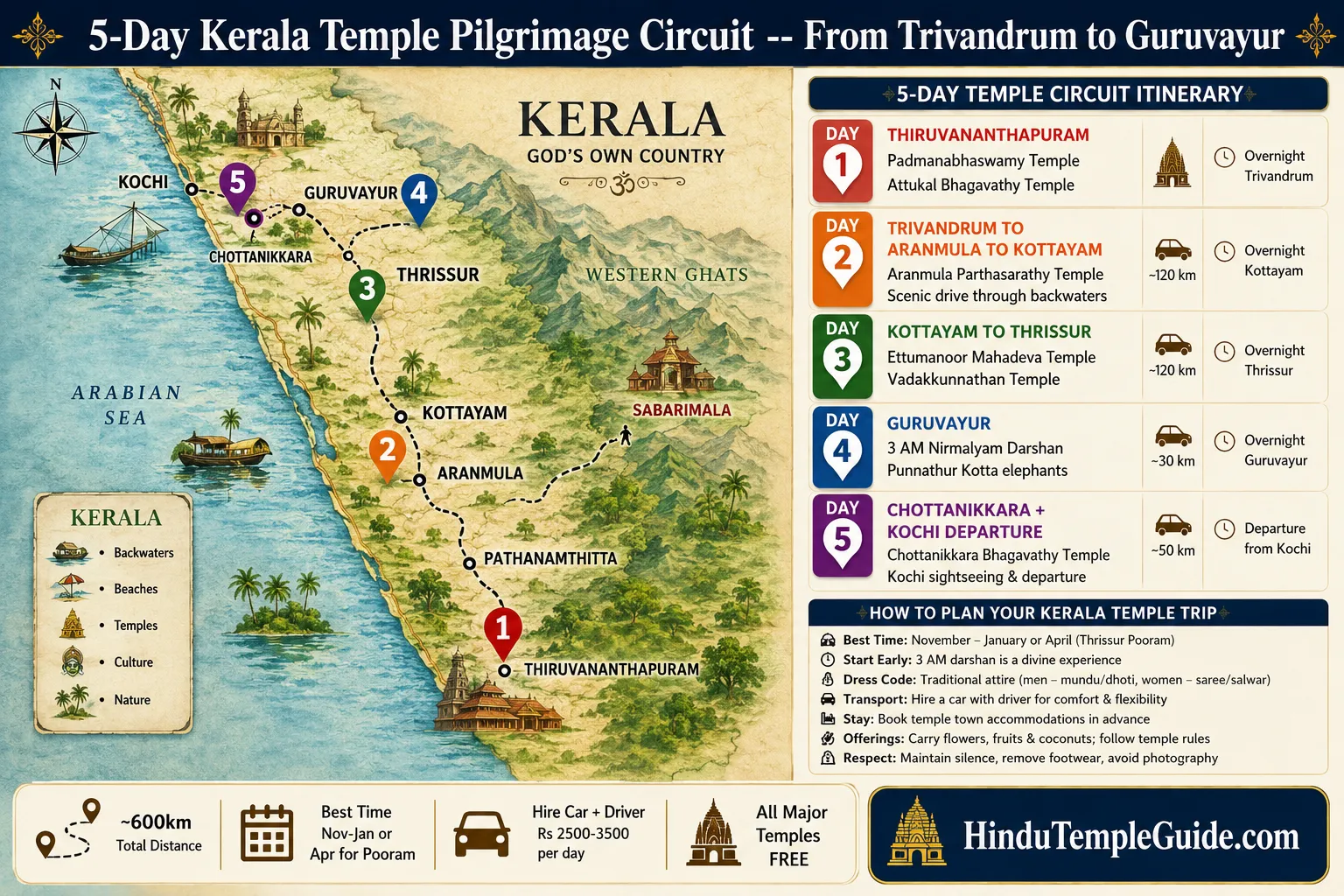
10. How to Plan Your Kerala Temple Trip - 5-Day South-to-North Itinerary
This route-optimised 5-day Kerala temple circuit starts at Thiruvananthapuram in the south and finishes at Cochin International Airport (Kochi) in the north (or can be run in reverse from Kochi to Trivandrum), covering ~420 km without a single kilometre of backtracking:
| Day | Route & Base | Temples, Timings & Logistics |
|---|---|---|
| Day 1 | Thiruvananthapuram | Arrive in Trivandrum. Attend the 8:30-10:00 AM or 5:00-6:15 PM darshan window at Sree Padmanabhaswamy Temple, and visit Attukal Bhagavathy Temple (2 km away) and Pazhavangadi Ganapathy Temple. Night stay: Thiruvananthapuram. |
| Day 2 | Trivandrum → Aranmula → Kottayam | Optional 3:15 AM Padmanabhaswamy Nirmalyam. Depart at 6:00 AM along MC Road (115 km / 3 hrs) to Aranmula Parthasarathy Temple (before 11:30 AM closure) & Chengannur Mahadeva Temple. Afternoon drive to Kottayam (50 km) for 5:00 PM darshan at Ettumanoor Mahadeva Temple. Night stay: Kottayam / Vaikom. |
| Day 3 | Vaikom → Chottanikkara → Thrissur | Morning darshan at Vaikom Mahadeva Temple & Chottanikkara Bhagavathy Temple (near Kochi). Drive 75 km north during the afternoon temple closure to Thrissur for 5:00 PM darshan at Vadakkunnathan Temple & Paramekkavu/Thiruvambady shrines, then drive 28 km to Guruvayur. Night stay: Guruvayur. |
| Day 4 | Guruvayur | Wake at 2:15 AM for the 3:00 AM Nirmalyam Darshan at Guruvayur Sri Krishna Temple + Mammiyoor Shiva Temple (800 m away-traditionally required to complete Guruvayur darshan!). Visit Punnathur Kotta Elephant Sanctuary at 9:30 AM and witness the evening Seeveli elephant procession. Night stay: Guruvayur. |
| Day 5 | Guruvayur → Triprayar / Kodungallur → Kochi | Morning drive south via Triprayar Sree Rama Temple (25 km) and Kodungallur Bhagavathy Temple (or Kalady Adi Shankara Janmabhoomi near the airport) before departing from Cochin International Airport (COK) or Ernakulam Junction. |
Practical Travel Tips for Your Kerala Temple Circuit
11. FAQs - Famous Temples in Kerala (2026-2027)
Answers to the most common practical questions pilgrims ask when planning a trip to famous temples in Kerala:
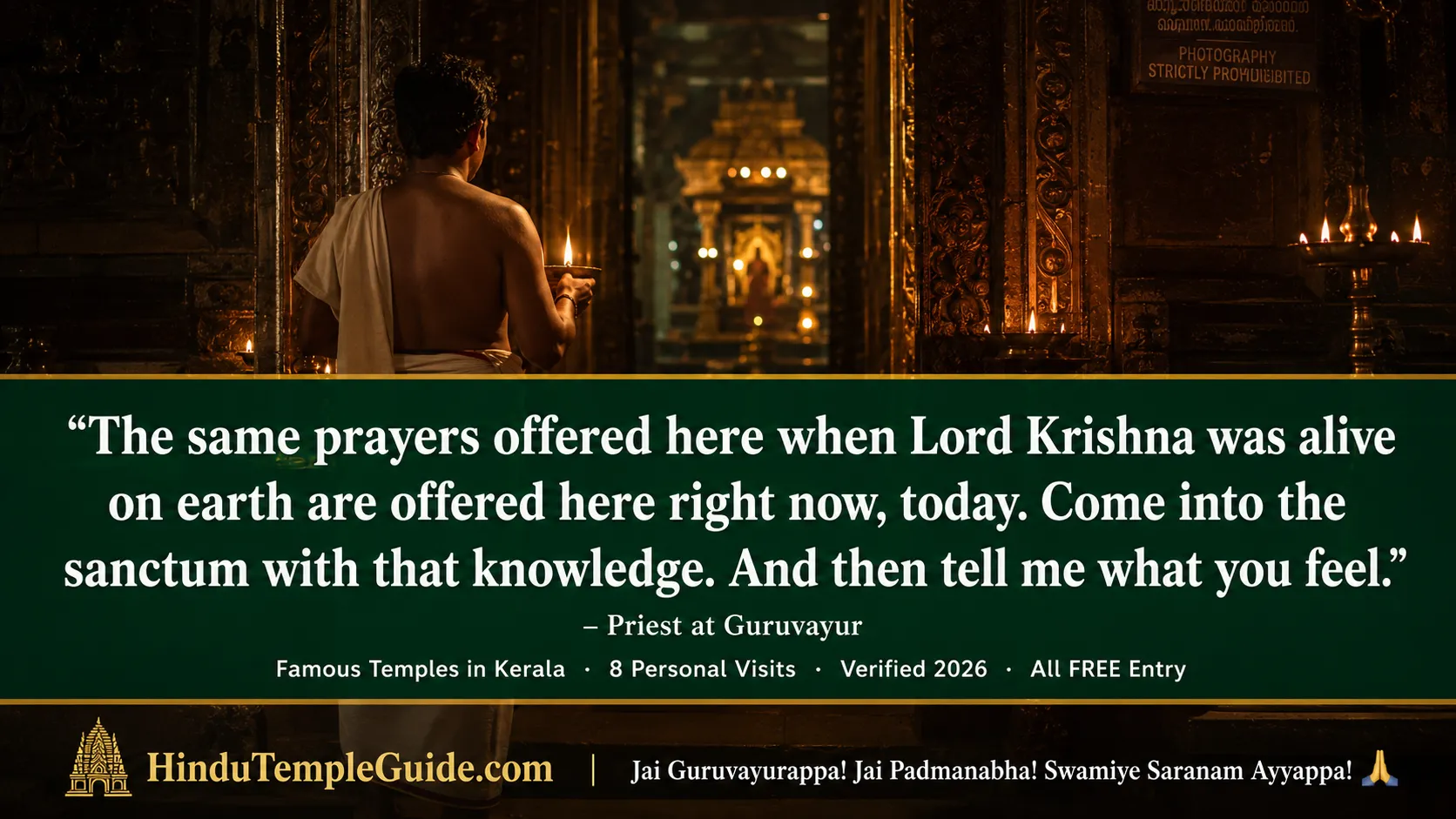
- Traditional Teaching at Guruvayur Temple
Wake up before dawn. Wear your white mundu or your finest saree. Remove your footwear at the stone threshold, let the oil-lit corridors close around you in the pre-dawn quiet, and wait for the Nirmalyam lamp to be revealed.
Have a question about planning your 5-day Kerala temple itinerary, Padmanabhaswamy darshan windows, or Sabarimala Virtual Queue booking? Send me a message here-I read and reply to every fellow pilgrim personally. - Devendra Khambalkar, Nagpur
Jai Guruvayurappa! Jai Padmanabha! Swamiye Saranam Ayyappa!
Written by Devendra Khambalkar, Nagpur, Maharashtra | Last updated: October 2026. All darshan windows, dress codes, and 2026-2027 festival schedules are verified from Guruvayur Devaswom (guruvayurdevaswom.in), Sree Padmanabhaswamy Temple Trust (spst.in), Travancore Devaswom Board / Sabarimala Online (sabarimalaonline.org), and Attukal Bhagavathy Temple Trust (attukal.org). Because temple timings shift during Ekadashi, Utsavam, and Pooram festivals, always verify live schedules on official portals before travelling. Jai Guruvayurappa!