
Panch Kedar is the most sacred and physically demanding pilgrimage circuit dedicated entirely to Lord Shiva in the Himalayan world. While the grand Char Dham Yatra sweeps across four divine valleys, the Panch Kedar Yatra takes the devotee deeper into the rugged sanctuaries of the Garhwal Himalayas in Uttarakhand, reaching five remote, high-altitude shrines where each enshrines a distinct divine manifestation of Mahadev himself. Rooted in ancient scriptural history and the sacred Mahabharata tradition, these are not mere stone monuments erected by kings, but the hallowed spots where Lord Shiva physically revealed his divine presence to the Pandavas.
Having personally trekked the steep mountain trails of Uttarakhand, I can share that undertaking the Panch Kedar is a transformative tapasya. This complete Panch Kedar 2026 guide covers all verified details: confirmed temple opening dates, trekking distances, elevation profiles, the traditional 14-day Pandava circuit itinerary, packing essentials, emergency safety protocols, and the profound devotional significance of each of the five sacred Kedar shrines. Om Namah Shivaya!
Panch Kedar 2026 - All 5 Temples Quick Reference
| # | Temple | Altitude | Shiva's Part | Opens 2026 | Trek | Difficulty |
|---|---|---|---|---|---|---|
| 1 | Kedarnath | 3,583 m | Hump (Kamar) | Apr 22, 2026 | 16-18 km | Moderate-Hard |
| 2 | Tungnath | 3,680 m | Arms (Bahu) | May 2, 2026 | 3.5 km | Easy-Moderate |
| 3 | Rudranath | 3,600 m | Face (Mukh) | May 18, 2026 | 19 km | Difficult |
| 4 | Madhyamaheshwar | 3,497 m | Navel (Nabhi) | May 21, 2026 | 16-18 km | Moderate-Hard |
| 5 | Kalpeshwar | 2,200 m | Hair / Jata | Open All Year | 2 km | Easy |
The Mahabharata Origin Story - Why Panch Kedar Exists
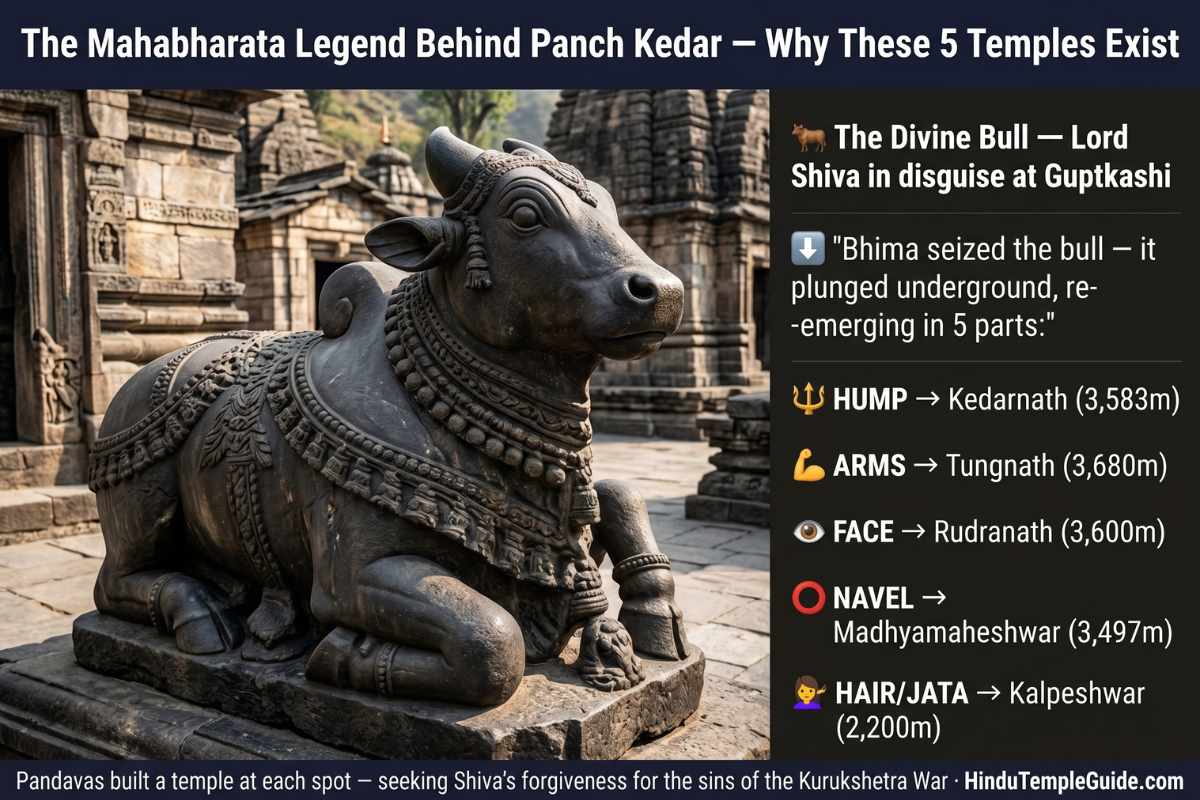
The Panch Kedar circuit is rooted in one of the most poignant episodes in the epic Mahabharata: the Pandavas' desperate quest for Lord Shiva's absolution after the cataclysmic Kurukshetra War. Though victorious, the Pandava brothers were weighed down by a soul-crushing sin: brahmahatya and gotrahatya-the slaying of their revered teachers, respected elders, and maternal kin. Among the fallen were Dronacharya, Bhishma Pitamah, Karna, and countless cousins. The great sage Ved Vyasa counselled the Pandavas that only Lord Shiva's divine darshan and forgiveness could cleanse this deep spiritual stain.
The Pandavas journeyed first to Kashi (Varanasi), but Shiva-knowing their guilt and testing their resolve-departed Kashi secretly and took refuge in the Garhwal Himalayas, grazing disguised as a celestial bull among cattle in the meadows around Guptkashi. When Bhima recognized the majestic animal's divine radiance and stood astride two hills to trap it, he seized the bull by its hindquarters. The bull dove into the earth to escape, but its divine form reappeared across five distinct high-altitude points: the hump at Kedarnath, the arms at Tungnath, the face at Rudranath, the navel and stomach at Madhyamaheshwar, and the matted locks (jata) at Kalpeshwar.
Overwhelmed with gratitude and deep remorse, the Pandavas built stone temples at each sacred spot to enshrine these five bodily manifestations of Mahadev. Moved by their unshakeable perseverance, Lord Shiva granted them direct darshan, absolved their sins, and opened the path to Swargarohini and moksha. This is why completing the Panch Kedar Yatra is revered as a full spiritual purification that cleanses the negative karmas of lifetimes. Om Namah Shivaya!
Kedar 1 - Kedarnath Temple (3,583m): The Crown Jewel of Panch Kedar
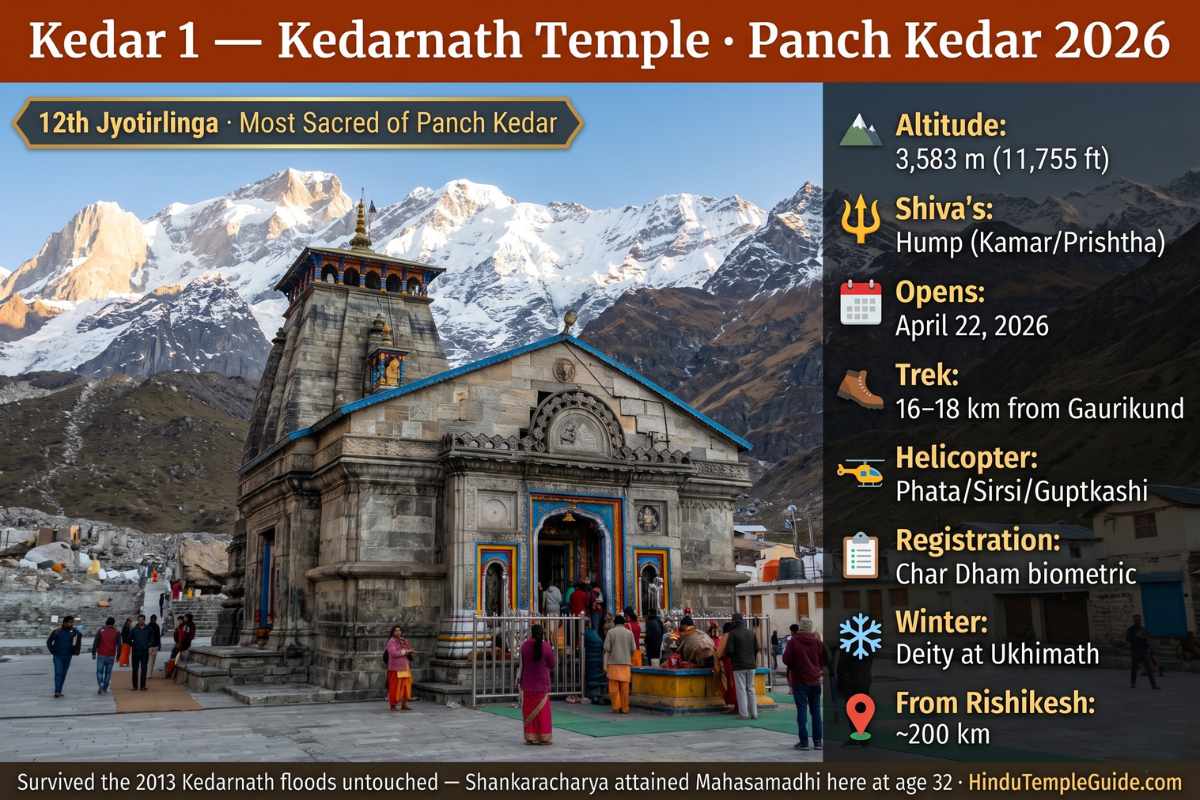
Rudraprayag District, Uttarakhand · Shiva's Hump (Kamar) · Altitude: 3,583 m (11,755 ft)
| Detail | Information |
|---|---|
| Opening Date 2026 | April 22, 2026 (Akshaya Tritiya) at 8:00 AM |
| Closing Date 2026 | November 11, 2026 (Bhai Dooj) at 8:30 AM |
| Trek Distance | 16-18 km one way from Gaurikund · Base camp at Sonprayag (shuttle jeep to Gaurikund) |
| Trek Difficulty | Moderate to Hard · Paved trail with significant vertical gain (1,600m rise) |
| Helicopter Service | Available via heliyatra.irctc.co.in from Sersi, Phata, and Guptkashi (~₹5,800-₹8,500 round trip) |
| Significance | 1st of Panch Kedar · 11th of the 12 Jyotirlingas · Supreme Shiva shrine of the Himalayas |
| Winter Abode | Deity worshipped at Omkareshwar Temple, Ukhimath during winter closure |
| Registration | Uttarakhand Char Dham registration mandatory · 100% FREE · registrationandtouristcare.uk.gov.in |
Kedarnath is the undisputed spiritual anchor of the Panch Kedar circuit. It occupies a unique status in Hinduism by being both a Panch Kedar shrine and one of India's revered 12 sacred Jyotirlingas. Nestled in the upper Mandakini river valley with the towering snow walls of the Kedar Dome and Kedarnath Peak providing a majestic backdrop, the temple stands at an elevation of 3,583 metres as an eternal symbol of faith.
Built from giant ashlar-cut grey granite slabs interlocked with iron clamps in the ancient Katyuri-Nagara style, the temple famously survived the catastrophic June 2013 glacial flash floods when a massive boulder-now revered as Bhim Shila-halted just behind the sanctum, diverting the torrent safely around the walls. Behind the temple lies the sacred samadhi sthal of Adi Shankaracharya, who attained Mahasamadhi here at the age of 32 after restoring the shrine. For detailed trek and helicopter tips, consult our Kedarnath Temple Travel Guide.
Kedar 2 - Tungnath Temple (3,680m): Highest Shiva Temple in the World
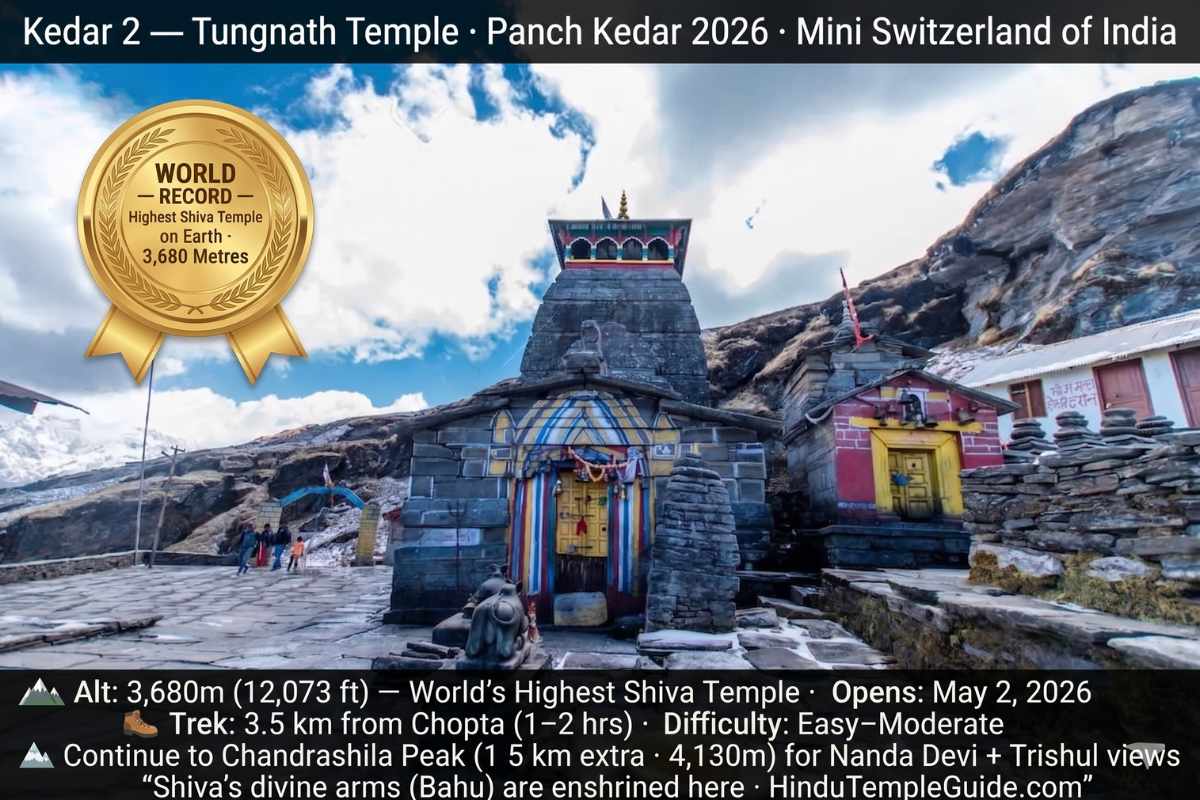
Rudraprayag District, Uttarakhand · Shiva's Arms (Bahu) · Altitude: 3,680 m - World's Highest Shiva Temple
| Detail | Information |
|---|---|
| Opening Date 2026 | May 2, 2026 |
| Trek Distance | 3.5 km one way from Chopta · Well-paved stone switchbacks |
| Trek Difficulty | Easy to Moderate · Most accessible trek in the circuit; suitable for fit families |
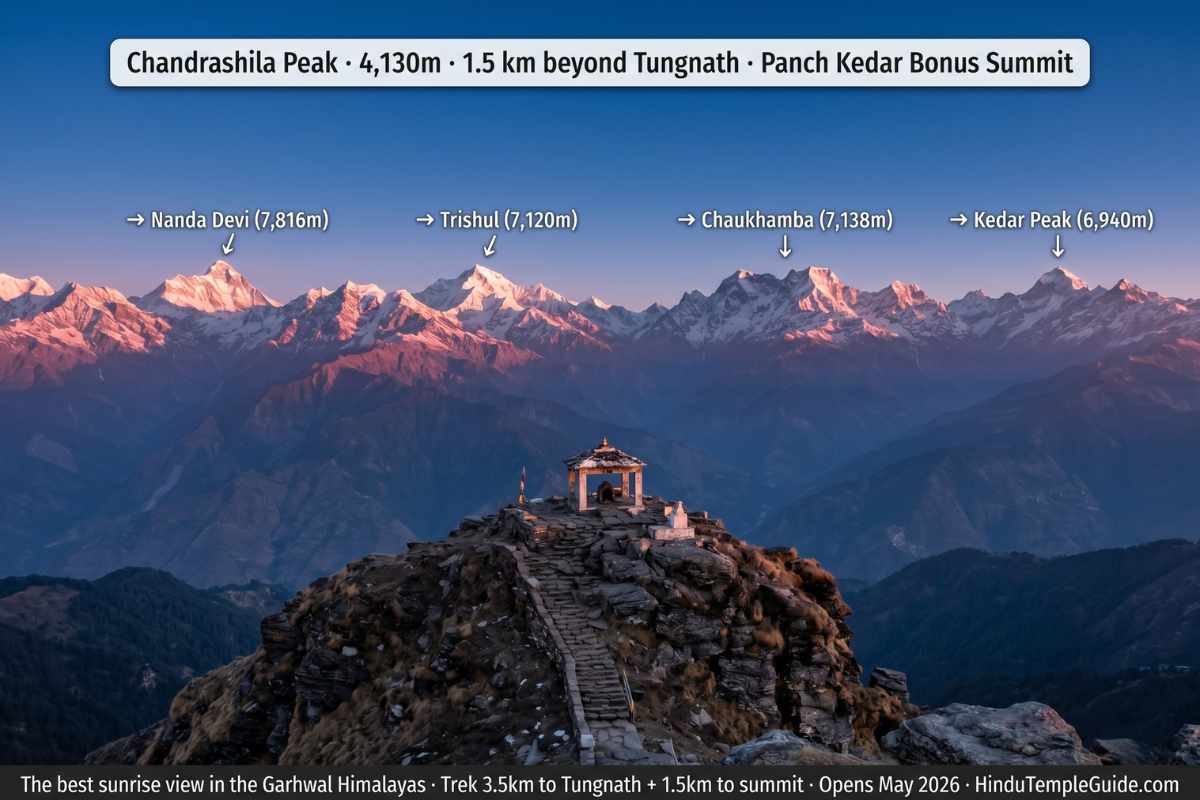
| Chandrashila Summit | Additional 1.5 km beyond Tungnath (4,130m / 13,550 ft) · 360° Himalayan vista |
| Base Village (Chopta) | Referred to as the 'Mini Switzerland of Uttarakhand' · 202 km from Rishikesh via Ukhimath |
| Winter Abode | Deity ceremonially transferred to Markandeya Temple, Makkumath during winter months |
| Peak Spring Feature | Scarlet and pink rhododendron (buransh) blooms covering the trail in May |
Tungnath holds the distinction of being the highest Shiva temple in the world at 3,680 metres. Built in classical North Indian stone style, the temple is dedicated to Lord Shiva's divine arms (bahu). Despite its great elevation, the 3.5 km trail from Chopta is wide, cleanly paved with stone steps, and manageable for most age groups who acclimatize properly. The surrounding Chopta meadows burst into a vivid canopy of crimson rhododendron blossoms throughout May.
Kedar 3 - Rudranath Temple (3,600m): The Most Remote & Mystical
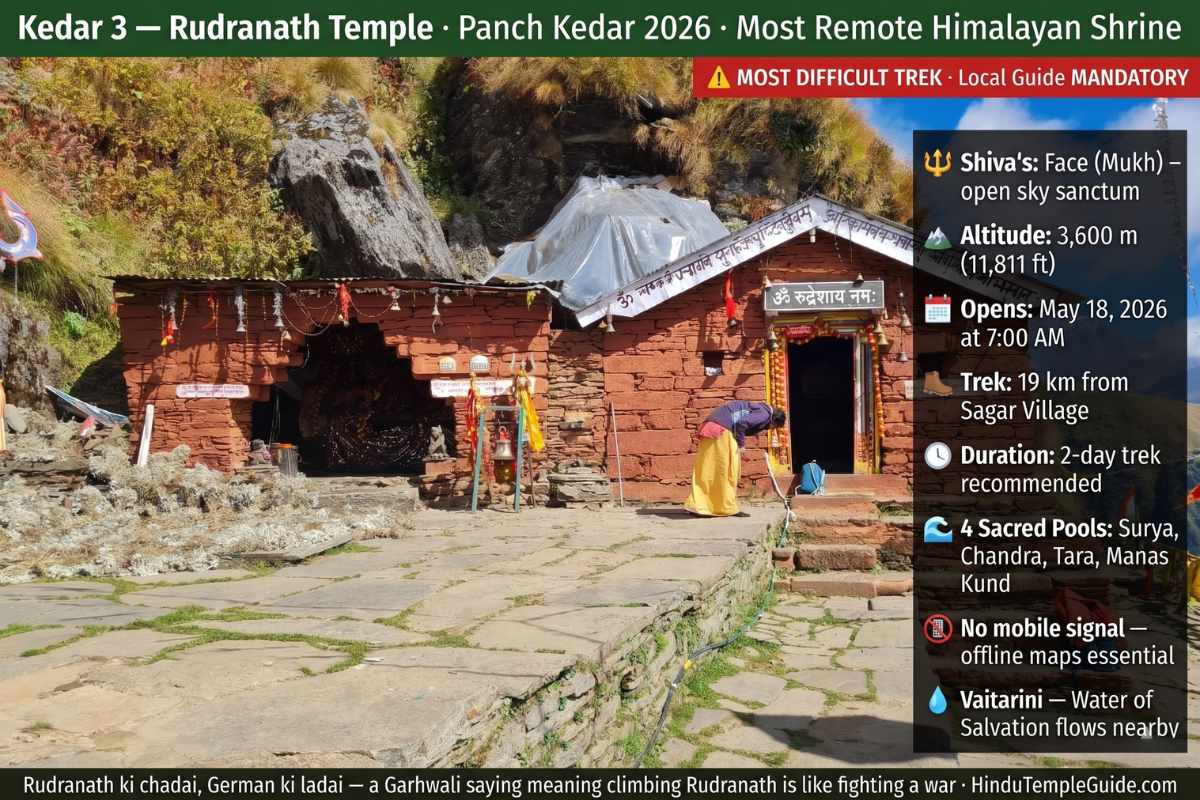
Chamoli District, Uttarakhand · Kedarnath Wildlife Sanctuary · Shiva's Face (Mukh) · Altitude: 3,600 m
| Detail | Information |
|---|---|
| Opening Date 2026 | May 18, 2026 at 7:00 AM (officially confirmed) |
| Trek Distance | 19 km one way from Sagar Village (5 km from Gopeshwar) · 2-day trek required |
| Trek Difficulty | HARD · Most physically challenging among the five · Steep climb via Punar Bugyal & Pitradhar pass |
| Trail Checkpoints | Sagar Village → Punar Bugyal → Panar Bugyal (night camp) → Pitradhar Pass → Rudranath |
| Sacred Kunds (Pools) | Surya Kund, Chandra Kund, Tara Kund, Manas Kund sacred mountain pools near the temple |
| Sanctum Murti | Swayambhu rock-carved face of Shiva (worshipped as Neelkanth Mahadev) inside a natural cave |
| Winter Abode | Deity worshipped at the historic Gopinath Temple, Gopeshwar during winter |
Rudranath is the shrine that tests a devotee's pure resolve. Among all five Panch Kedar temples, Rudranath is the most secluded, the most physically arduous, and the most spiritually charged. The 19 km trail begins at Sagar Village near Gopeshwar and climbs relentlessly through thick pine and oak forests into the sweeping alpine grasslands of Panar Bugyal, before crossing the high wind-swept pass of Pitradhar (where pilgrims offer stone cairns to their ancestors).
Unlike enclosed architectural temples, Rudranath is a natural stone cave sanctuary where Lord Shiva's divine face (Mukh) is worshipped as Neelkanth. Devotees behold the serene, compassionate stone countenance of Mahadev framed by sacred natural springs including the Vaitarini stream, Surya Kund, and Chandra Kund. Accommodation near the temple is limited to basic pilgrim huts and meadow tents; carry a reliable sleeping bag and warm thermal layers.
Kedar 4 - Madhyamaheshwar Temple (3,497m): Shiva's Navel in the Sky
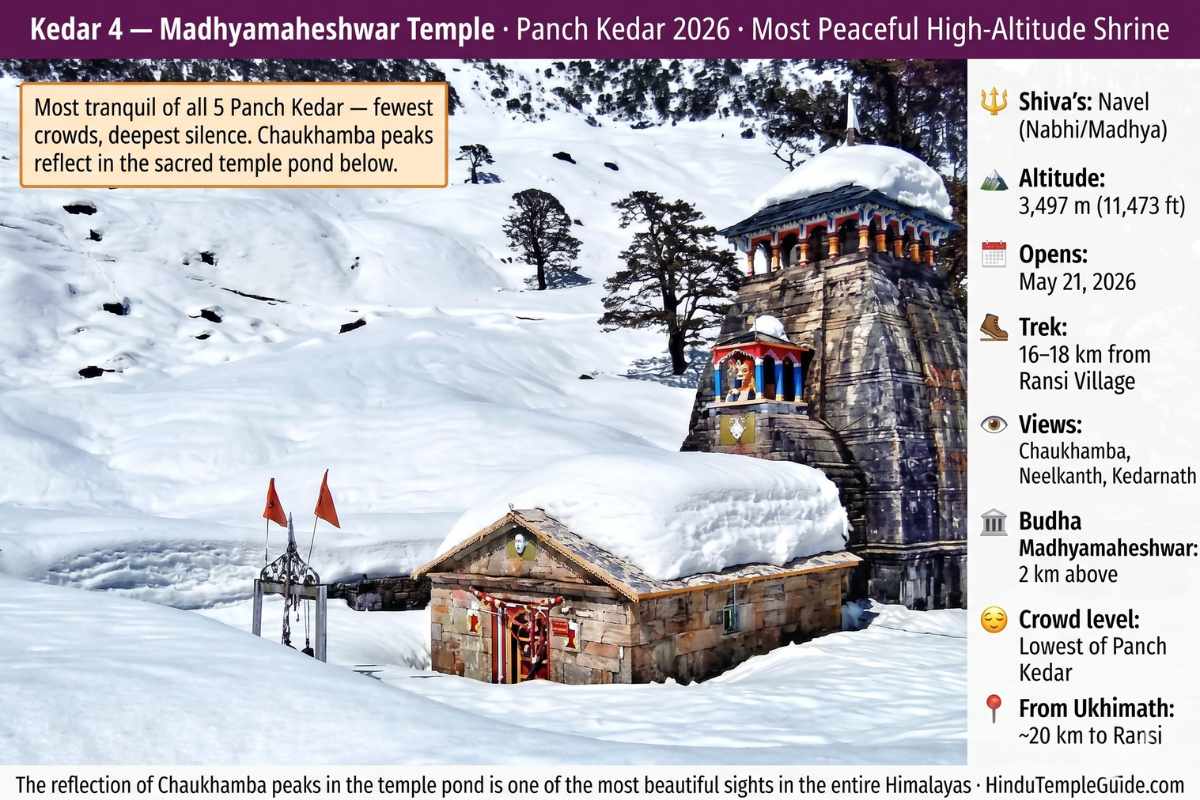
Rudraprayag District (near Ukhimath), Uttarakhand · Shiva's Navel (Nabhi / Madhya) · Altitude: 3,497 m
| Detail | Information |
|---|---|
| Opening Date 2026 | May 21, 2026 |
| Trek Distance | 16-18 km one way from Ransi Village · 2 days recommended |
| Trek Difficulty | Moderate to Hard · Long valley walk followed by steep ascent from Bantoli to Nanu |
| Trail Route | Ransi → Gaundhar → Bantoli (confluence of Madhu Ganga & Markanga) → Khatara → Nanu → Madhyamaheshwar |
| Budha Madhyamaheshwar | 2 km meadow climb above main temple · Mirrors Chaukhamba in a glacial tarn |
| Winter Abode | Deity worshipped at Omkareshwar Temple, Ukhimath during winter |
| Pilgrim Atmosphere | Fewest crowds, deep meditative peace, absolute Himalayan silence |
Madhyamaheshwar (colloquially called Madmaheshwar) enshrines Lord Shiva's divine navel and stomach (Nabhi / Madhya). Located in a tranquil high-altitude amphitheatre encircled by the towering massifs of Chaukhamba and Neelkanth, it is widely considered the most meditative and serene shrine in the entire circuit. The trek begins from Ransi Village (reached via Ukhimath) and crosses pristine rivers and hanging footbridges at Bantoli before ascending through dense oak forests into the open meadows of Nanu.
Kedar 5 - Kalpeshwar Temple (2,200m): Open All Year, Enter Through a Cave
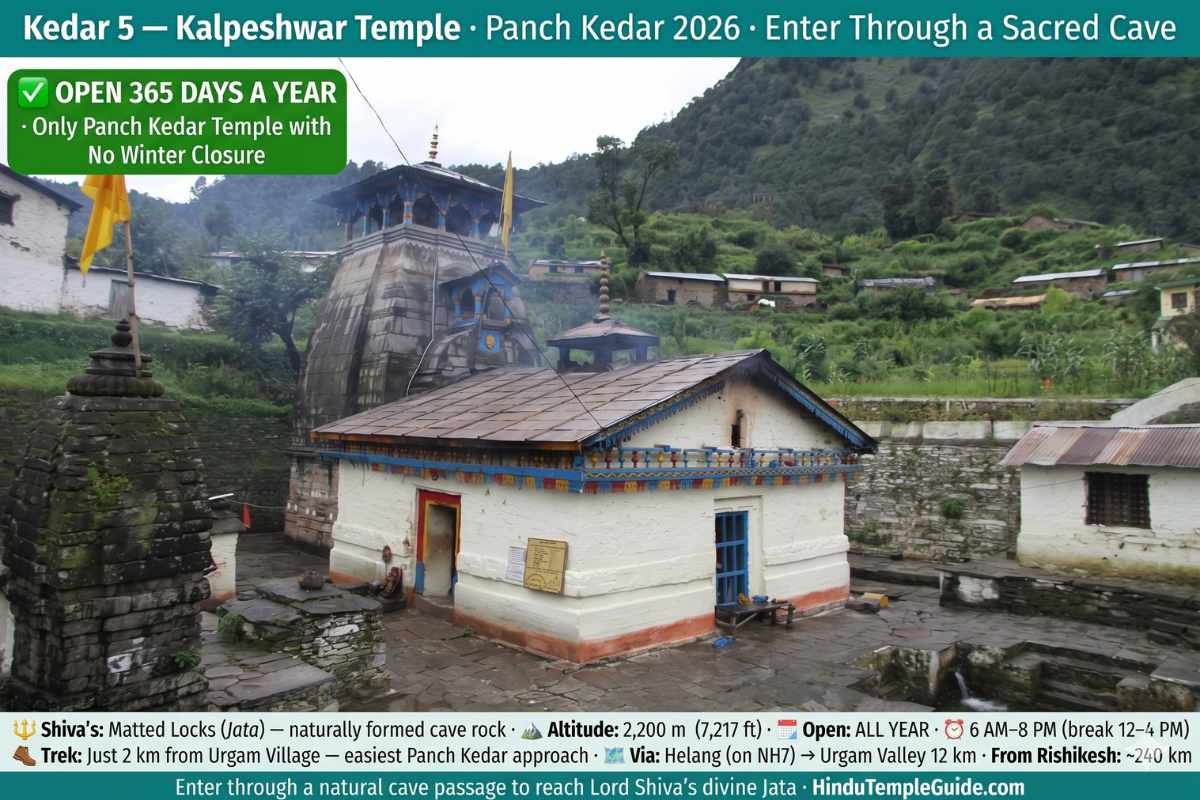
Urgam Valley, Chamoli District, Uttarakhand · Shiva's Matted Hair / Jata · Altitude: 2,200 m
| Detail | Information |
|---|---|
| Seasonal Status | Open All 365 Days · The only Panch Kedar temple without a winter shutdown |
| Daily Timings | 6:00 AM - 8:00 PM · Afternoon puja break: 12:00 PM - 3:30 PM |
| Trek Distance | 2 km one way from Urgam Village (easiest in the circuit) |
| Trek Difficulty | Easy · Flat trail through apple orchards; suitable for seniors and children |
| Cave Approach | Natural subterranean stone tunnel leads straight to the rock-cut sanctum |
| Kalpavriksha Legend | Sage Durvasa meditated beneath the wish-fulfilling Kalpavriksha tree in Urgam Valley |
| Access Point | Helang on NH-7 (Badrinath Highway) → drive 10 km to Urgam → walk 2 km |
Kalpeshwar is the final temple of the traditional circuit and the most accessible. Enshrining Lord Shiva's matted hair (Jata)-the symbol of his ascetic renunciation and the Ganga that he holds within his locks-the sanctum is entered through an atmospheric natural cave passage. It sits within the lush, fertile Urgam Valley along the Kalpaganga river, surrounded by terraced fields, apple orchards, and village homestays.
Complete Panch Kedar Yatra 14-Day Itinerary 2026 - Traditional Circuit
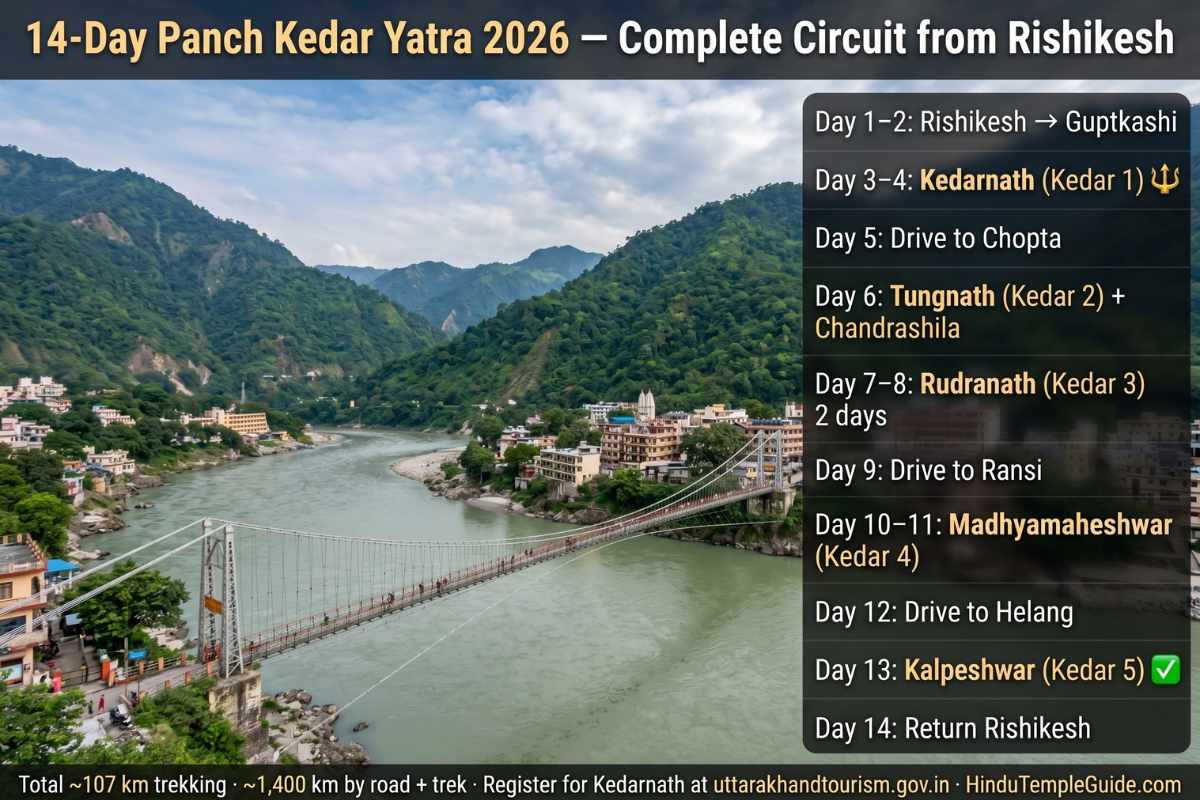
The traditional Panch Kedar circuit follows the Pandava order: beginning with Kedarnath (the most holy), proceeding to Tungnath, climbing to Rudranath, descending to Madhyamaheshwar, and concluding with Kalpeshwar. Here is the realistic 14-day master itinerary starting and ending in Rishikesh:
| Day | Base / Location | Activity & Distance |
|---|---|---|
| Day 1 | Rishikesh → Guptkashi | Drive 200 km · 8 hrs via Devprayag & Rudraprayag · Acclimatisation & biometric pass check · Overnight Guptkashi |
| Day 2 | Guptkashi → Sonprayag / Gaurikund | Drive to Sonprayag · Local shuttle to Gaurikund · Rest, hydrate & prepare trek packs · Overnight Gaurikund / Sitapur |
| Day 3 | Gaurikund → Kedarnath (Kedar 1) | Start trek at 5:00 AM · 16-18 km ascent via Bheembali & Lincholi · Evening Sandhya Aarti at Kedarnath · Overnight at Kedarnath top |
| Day 4 | Kedarnath → Chopta | Early morning Garbha Griha darshan · Trek down 16 km to Gaurikund · Drive ~90 km via Ukhimath to Chopta meadows · Overnight Chopta |
| Day 5 | Tungnath + Chandrashila (Kedar 2) | Trek 3.5 km Chopta → Tungnath · Continue 1.5 km to Chandrashila Peak (4,130m) · Return to Chopta · Overnight Chopta |
| Day 6 | Chopta → Sagar Village → Panar Bugyal | Drive 35 km to Sagar Village (near Gopeshwar) · Meet registered local guide · Trek 10 km steep ascent to Panar Bugyal · Overnight camp/hut |
| Day 7 | Panar Bugyal → Rudranath (Kedar 3) | Trek 9 km via Pitradhar pass to Rudranath · Cave sanctum darshan & holy kunds · Overnight stay near Rudranath temple |
| Day 8 | Rudranath → Sagar Village → Mandal | Early morning aarti · Trek 19 km downhill back to Sagar Village · Drive 5 km to Mandal / Gopeshwar · Rest & recovery |
| Day 9 | Mandal → Ukhimath → Ransi Village | Drive 65 km through scenic valleys to Ransi (base of Madhyamaheshwar) · Visit ancient Rakeshwari Temple in Ransi · Overnight homestay |
| Day 10 | Ransi → Madhyamaheshwar (Kedar 4) | Trek 16-18 km via Gaundhar, Bantoli, and Nanu · Reach Madhyamaheshwar alpine meadow by late afternoon · Evening aarti · Overnight stay |
| Day 11 | Budha Madhyamaheshwar → Ransi Village | Pre-dawn 2 km hike to Budha Madhyamaheshwar for Chaukhamba reflection · Trek 16 km down to Ransi · Overnight Ransi/Ukhimath |
| Day 12 | Ransi → Chamoli → Helang | Drive ~95 km from Ransi via Chamoli to Helang (on the Badrinath NH-7 highway) · Rest day & gear check · Overnight Helang |
| Day 13 | Helang → Urgam → Kalpeshwar (Kedar 5) | Drive 10 km to Urgam Valley · Easy 2 km walk to Kalpeshwar · Cave darshan of Shiva's Jata · Explore Kalpavriksha · Overnight Urgam / Joshimath |
| Day 14 | Joshimath / Helang → Rishikesh | Drive 250 km along the Alaknanda · 8-9 hrs via Karnaprayag & Devprayag · Panch Kedar Yatra complete · Har Har Mahadev! |
Best Time to Visit Panch Kedar 2026 - Season-by-Season Guide
| Season | What to Expect on the Panch Kedar Circuit |
|---|---|
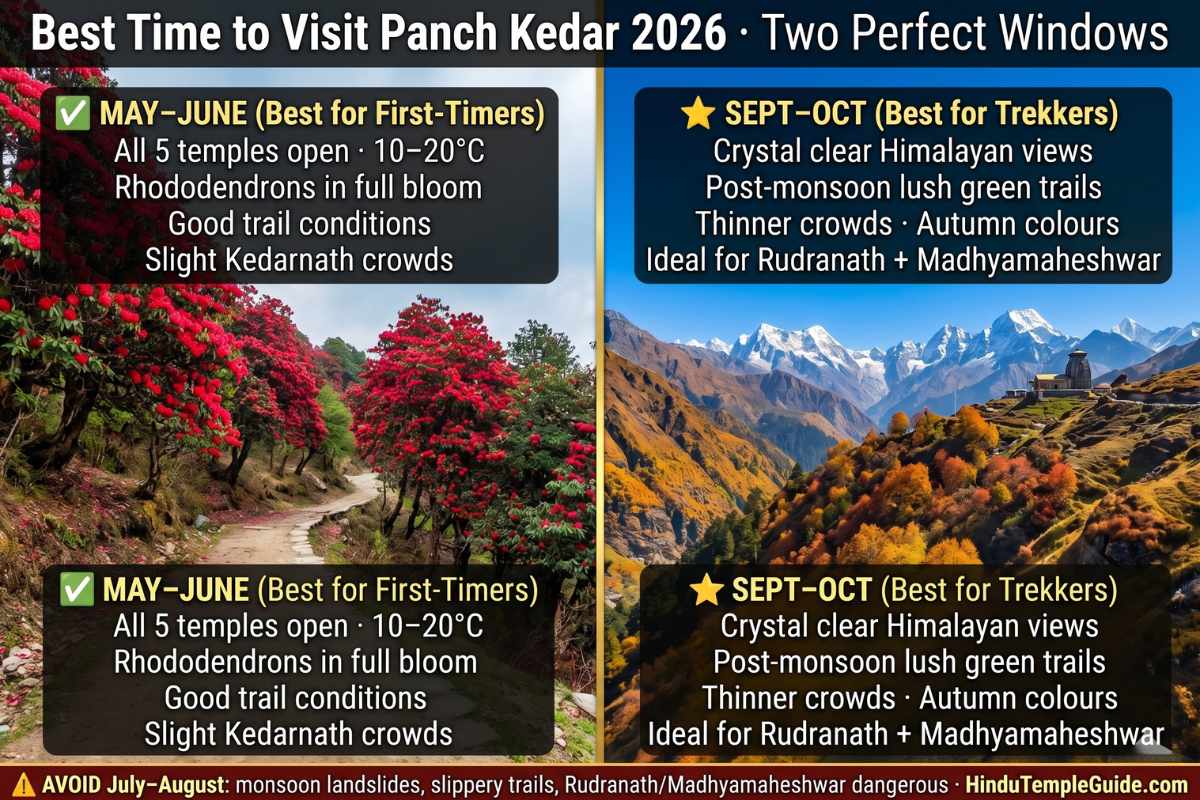
| Late May - June (BEST for all 5) | All five temples open · High mountain passes free of deep snow · Pleasant 10-18°C daytime temperatures · Rhododendrons in full bloom in Chopta and Rudranath bugyals |
| July - August (MONSOON - AVOID) | NOT recommended · Torrential rain triggers landslides along Rudranath and Madhyamaheshwar trails · Leeches on forest paths · Kedarnath helicopter sorties frequently halted |
| Sept - October (BEST for Trekkers) | Post-monsoon crisp weather · Crystal-clear Himalayan vistas · Golden alpine bugyals · Thinner crowds · Ideal for photography and high-altitude solitude |
| Nov onwards (Winter Closing) | Kedarnath, Tungnath, Rudranath, and Madhyamaheshwar close in early to mid-November · Only Kalpeshwar remains open |
| Dec - April (Winter Yatra) | Kalpeshwar is fully accessible in Urgam Valley · Winter seats at Ukhimath, Makkumath, and Gopeshwar open for worship |
How to Reach Panch Kedar Base Camps 2026 - Complete Route Guide
Key Gateway Cities
The primary gateway for all Garhwal mountain yatras · Connected by highway, rail, and state transport buses from Delhi (240 km)
Major nationwide railway hub (HW) · Direct express trains and Vande Bharat routes connecting Delhi, Mumbai, and Kolkata
Closest airport · Daily flights from major Indian cities · 20 km to Rishikesh via bypass
All 5 Base Camps from Rishikesh
| Temple | Base Village | Distance from Rishikesh | Road & Trek Connection |
|---|---|---|---|
| 1. Kedarnath | Gaurikund (via Sonprayag) | ~215 km · 7-8 hrs drive | Bus/cab to Sonprayag → shuttle to Gaurikund → 16-18 km trek |
| 2. Tungnath | Chopta | ~202 km · 7 hrs drive | Drive to Chopta via Rudraprayag & Ukhimath → 3.5 km stone trail |
| 3. Rudranath | Sagar Village (Gopeshwar) | ~215 km · 8 hrs drive | Bus/cab to Gopeshwar → 5 km to Sagar Village → 19 km wilderness trek |
| 4. Madhyamaheshwar | Ransi Village (Ukhimath) | ~200 km · 7.5 hrs drive | Drive to Ukhimath → 20 km to Ransi → 16-18 km alpine trek |
| 5. Kalpeshwar | Urgam Valley (via Helang) | ~245 km · 8.5 hrs drive | Drive on NH-7 to Helang → 10 km mountain road to Urgam → 2 km walk |
Panch Kedar Packing List & High-Altitude Safety Guide 2026
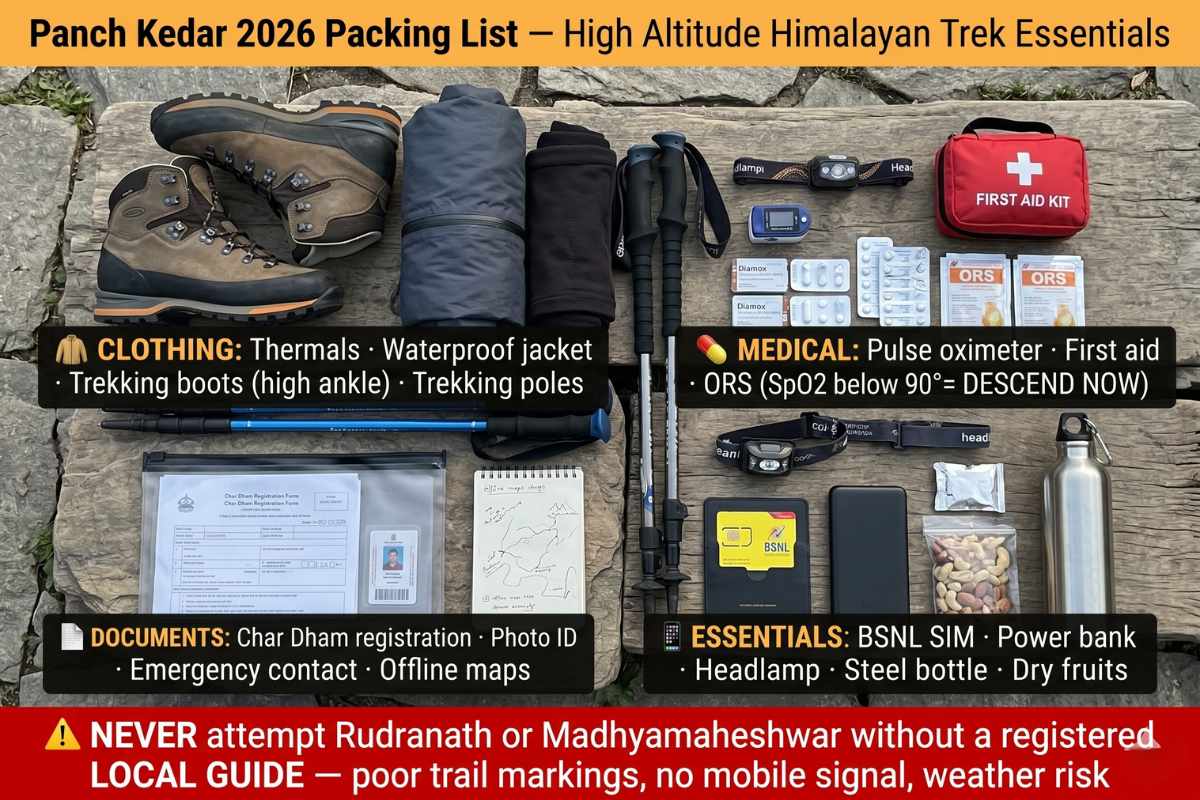
- Thermal innerwear (top & bottom) - 2 sets
- Waterproof windproof trekking jacket (mandatory)
- Quick-dry trekking trousers + fleece mid-layer
- High-ankle waterproof trekking boots with good grip
- Trekking poles (essential for knees on steep descents)
- Fleece gloves, woollen balaclava & 4 pairs of woollen socks
- Pulse oximeter (SpO2 under 90% = halt or descend immediately!)
- Doctor-advised Diamox for altitude acclimatization
- ORS electrolyte sachets & glucose powder
- Paracetamol, anti-diarrheal, blister band-aids & pain spray
- Personal medications (carry a 4-day extra buffer supply)
- Government photo ID + printed Char Dham passes
- BSNL Postpaid SIM (only network with coverage in remote zones)
- High-capacity power bank (20,000 mAh; cold drains batteries)
- Offline GPS maps (Maps.me or OsmAnd downloaded)
- Headlamp with spare batteries (for early 4:30 AM starts)
- Insulated water bottle & water purification tablets
- ₹8,000-₹12,000 physical cash (no working ATMs past Guptkashi)
FAQs - Panch Kedar Yatra 2026
Char Dham Yatra 2026 Complete Guide - Dates, Registration, Route & Cost
Helicopter Booking Guide 2026 - Kedarnath, Badrinath & Char Dham
12 Jyotirlinga in India 2026 - Complete Guide (Kedarnath is Jyotirlinga #11)
Vaishno Devi Yatra Guide 2026 - Registration, Route & Tips
The Pandavas climbed these high Himalayan passes burdened by the heaviest guilt a warrior soul can bear, and in finding Lord Shiva in his five bodily forms, they found their souls absolved and free. The Panch Kedar Yatra invites the same devotion from every pilgrim today: not athletic perfection, but faith, physical endurance, and humility before the mountains. Five temples. Five divine forms of Mahadev. Five opportunities to stand in divine presence at the roof of the world.
Have questions about finding trusted guides in Sagar Village, booking GMVN tents, or planning the 14-day circuit? Send me a message here-I read and reply to every fellow pilgrim personally. - Devendra Khambalkar, Nagpur
Written by Devendra Khambalkar, Nagpur, Maharashtra | Last updated: October 2026. Panch Kedar 2026 opening dates and trekking regulations are verified from official Uttarakhand Tourism (uttarakhandtourism.gov.in) and Badrinath-Kedarnath Temple Committee (BKTC) announcements. Mountain routes at Rudranath and Madhyamaheshwar pass through wilderness zones; always hire a registered local guide and check live weather updates before starting. Har Har Mahadev!