Panch Kedar 2026 – Complete Guide to All 5 Sacred Himalayan Shiva Shrines: Kedarnath, Tungnath, Rudranath, Madhyamaheshwar & Kalpeshwar

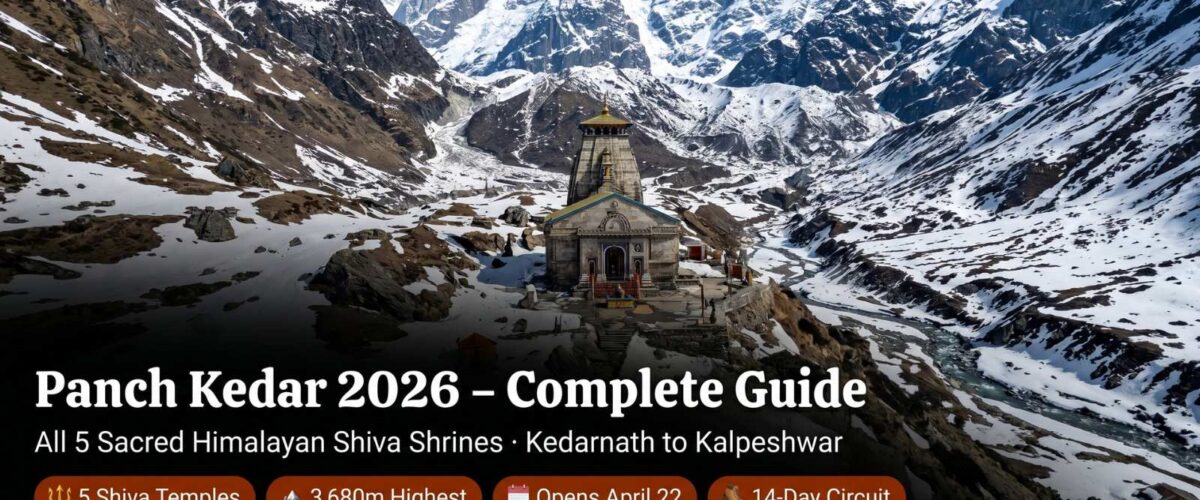
Panch Kedar is the most sacred and most demanding pilgrimage circuit dedicated entirely to Lord Shiva in the Himalayan world. While the great Char Dham Yatra sweeps across four divine dhams, the Panch Kedar Yatra goes deeper into five remote, high-altitude shrines scattered across the Garhwal Himalayas, each enshrining a different divine form of Mahadev himself. According to Hindu scripture and the ancient Mahabharata tradition, these are not temples built by architects and kings, but the sacred spots where Lord Shiva himself chose to appear.
This complete Panch Kedar 2026 guide covers every essential detail all five temple opening dates, trekking distances and difficulty levels, the complete 14-day Pandava circuit itinerary, altitude profiles, best time to visit, what to pack, essential safety rules, how to reach each base camp, and the devotional significance that makes each of the Panch Kedar temples uniquely irreplaceable. Om Namah Shivaya!
Quick Navigation
Table of Contents
★All 5 Temples – Quick Reference
📖Mahabharata Origin Story
1Kedarnath – Crown of Panch Kedar
2Tungnath – Highest Shiva Temple
3Rudranath – Most Remote & Mystical
4Madhyamaheshwar – Shiva’s Navel
5Kalpeshwar – Open All Year
🗺14-Day Complete Itinerary
📅Best Time to Visit 2026
🚌How to Reach Base Camps
🎒Packing List & Safety Guide
❓FAQs – Panch Kedar 2026
Panch Kedar 2026 – All 5 Temples Quick Reference
| # | Temple | Altitude | Shiva’s Part | Opens 2026 | Trek | Difficulty |
|---|---|---|---|---|---|---|
| 1 | Kedarnath | 3,583 m | Hump (Kamar) | Apr 22, 2026 | 16–18 km | Moderate–Hard |
| 2 | Tungnath | 3,680 m | Arms (Bahu) | May 2, 2026 | 3.5 km | Easy–Moderate |
| 3 | Rudranath | 3,600 m | Face (Mukh) | May 18, 2026 | 19 km | Difficult |
| 4 | Madhyamaheshwar | 3,497 m | Navel (Nabhi) | May 21, 2026 | 16–18 km | Moderate–Hard |
| 5 | Kalpeshwar | 2,200 m | Hair/Jata | Open All Year | 2 km | Easy |
The Mahabharata Origin Story – Why Panch Kedar Exists
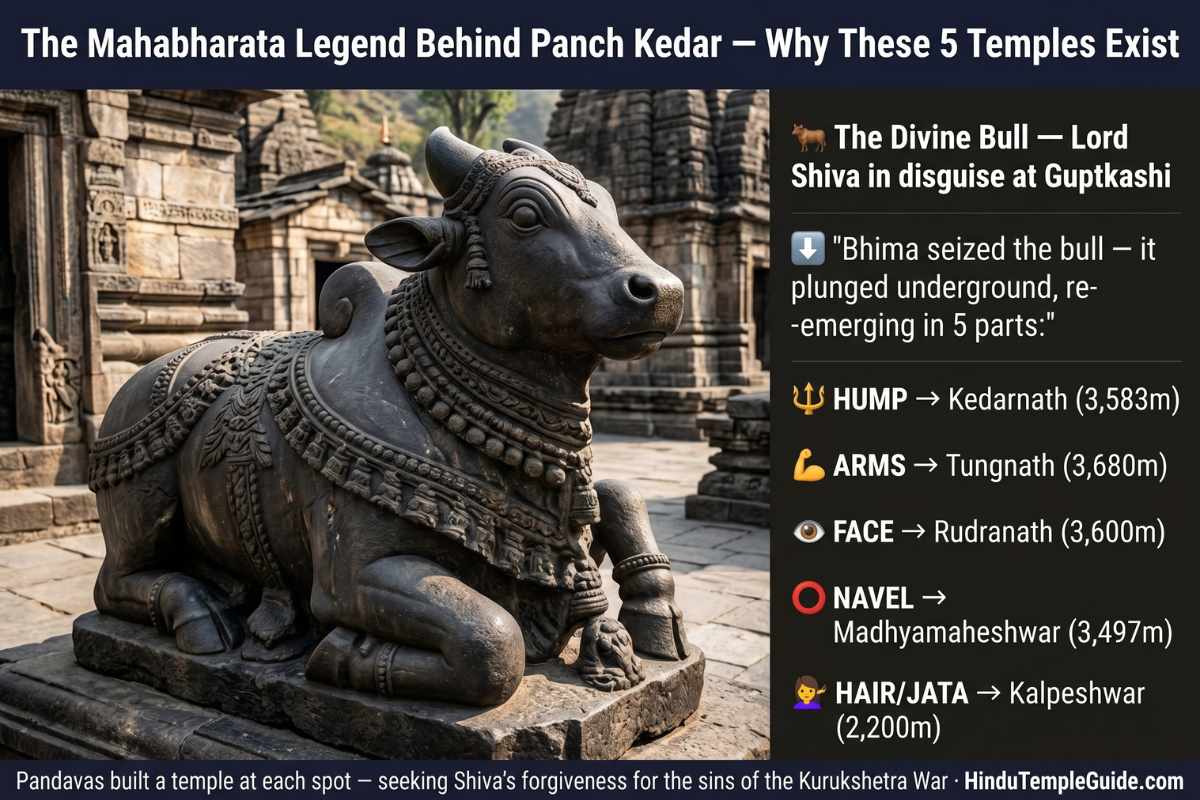
The Panch Kedar circuit is rooted in one of the most poignant stories in the Mahabharata the Pandavas’ desperate search for Lord Shiva’s absolution after the devastating Kurukshetra War. The war ended in Pandava victory, but their hearts were heavy with the weight of a terrible sin: brahmahatya the killing of brahmins, warriors, and kin. Among the dead were Drona, Ashwatthama’s lineage, and countless cousins. The great sage Vyasa counselled the Pandavas that only Lord Shiva’s grace could cleanse this sin.
The Pandavas journeyed to Varanasi, but Shiva knowing of their sin and unwilling to grant absolution so easily left Kashi and fled to the Garhwal Himalayas, disguised as a magnificent bull grazing in the meadows of Guptkashi. When Bhima the most physically powerful of the Pandavas spotted the bull and recognized its divine nature, he tried to seize it. The bull plunged into the earth to escape, but its hump emerged at Kedarnath, its arms at Tungnath, its face at Rudranath, its navel at Madhyamaheshwar, and its matted locks at Kalpeshwar.
At each site, the Pandavas overwhelmed with gratitude and devotion built stone temples to enshrine these manifestations of Mahadev. The Lord, moved by their perseverance and penance, finally granted them darshan and moksha. This is why the Panch Kedar Yatra is not merely a trek but a tapasya a spiritual atonement whose merit is said to wash away the sins of many lifetimes. Om Namah Shivaya!
Kedar 1 – Kedarnath Temple (3,583m): The Crown Jewel of Panch Kedar
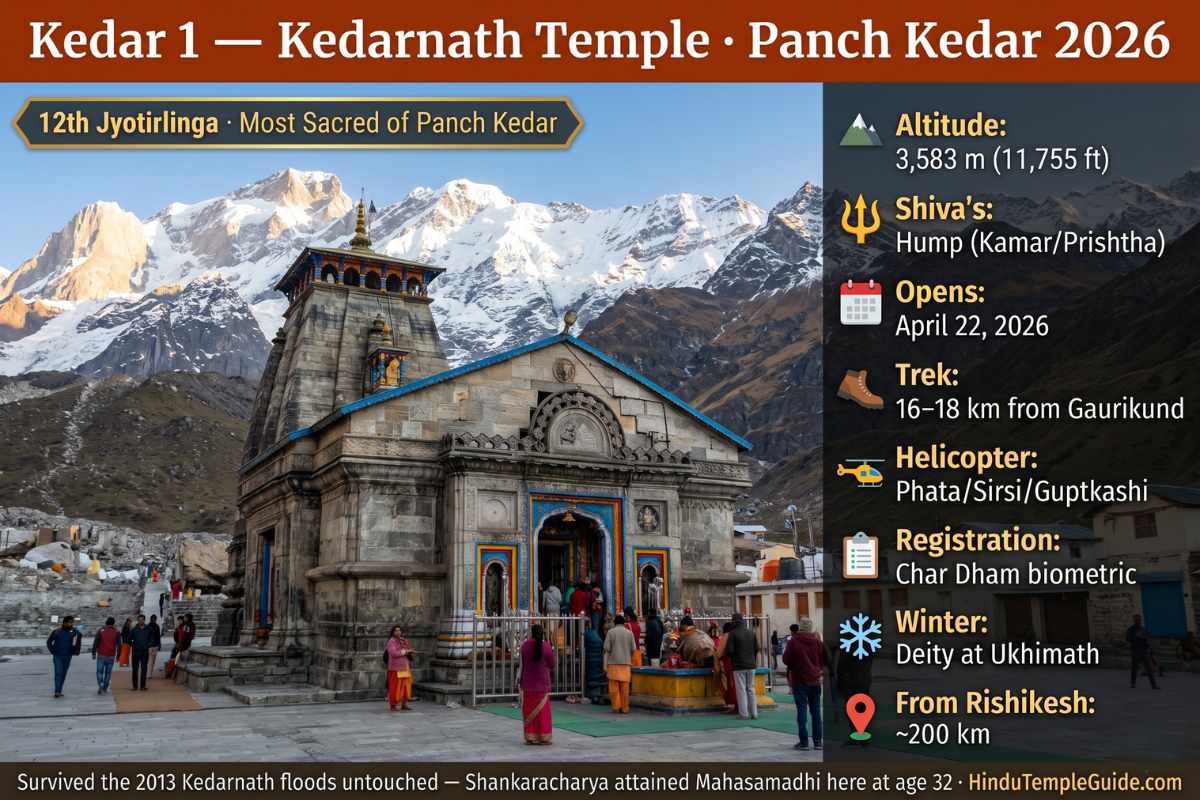
Rudraprayag District, Uttarakhand · Shiva’s Hump (Kamar) · Altitude: 3,583 m (11,755 ft)
| Detail | Information |
|---|---|
| Opening Date 2026 | April 22, 2026 (Akshaya Tritiya) at 7:00 AM |
| Closing Date 2026 | November 11, 2026 (Bhai Dooj) tentative |
| Trek Distance | 16–18 km one way from Gaurikund · Base camp at Sonprayag |
| Trek Difficulty | Moderate to difficult · Well-paved Himalayan path · Regular rest points |
| Helicopter | Available from Phata, Sirsi, Guptkashi → Kedarnath helipad · Book early |
| Significance | 1st of Panch Kedar · Also one of the 12 Jyotirlingas · Most visited Himalayan shrine |
| Winter Abode | Deity transferred to Ukhimath (Omkareshwar Temple) during winter closure |
| Registration | Char Dham biometric registration mandatory · FREE · registrationandtouristcare.uk.gov.in · or at Haridwar/Rishikesh/Sonprayag |
Kedarnath is the first and most revered among the Panch Kedar and carries an added significance that places it in a category of its own: it is simultaneously a Panch Kedar and one of the 12 sacred Jyotirlingas of Lord Shiva. Set in the upper Mandakini valley with the towering Kedarnath and Kedar peaks forming its dramatic backdrop, the temple sits at 3,583 metres the most powerful Shiva shrine in the Himalayas.
The ancient stone temple, believed to have been originally built by the Pandavas and later reconstructed by Adi Shankaracharya in the 8th century, survived the catastrophic 2013 Kedarnath floods that destroyed everything around it a massive boulder diverted the floodwaters around its walls, which devotees received as a divine miracle. The famous Shankaracharya Samadhi is located directly behind the temple the great philosopher took Mahasamadhi at Kedarnath at the age of 32.
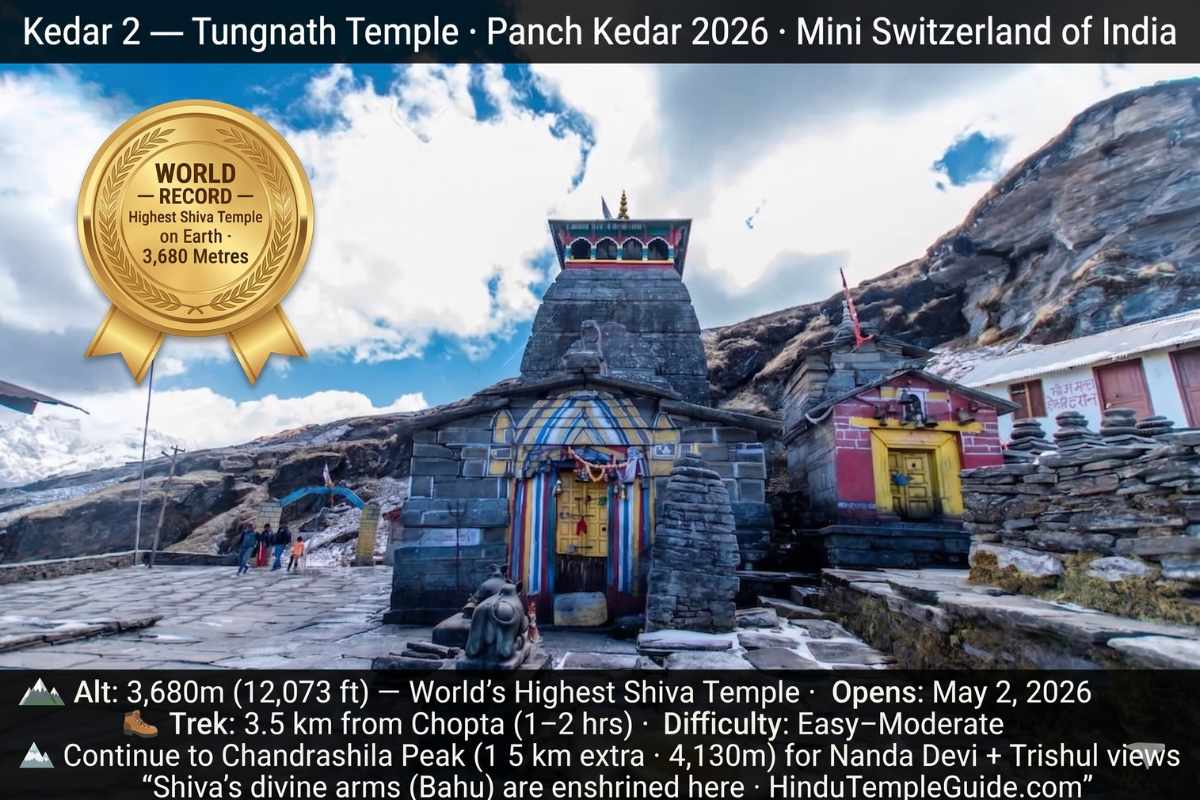
Kedar 2 – Tungnath Temple (3,680m): Highest Shiva Temple in the World
Rudraprayag District, Uttarakhand · Shiva’s Arms (Bahu) · Altitude: 3,680 m World’s Highest Shiva Temple
| Detail | Information |
|---|---|
| Opening Date 2026 | May 2, 2026 |
| Trek Distance | 3.5 km one way from Chopta · 1–2 hours ascent |
| Trek Difficulty | Easy to moderate · Suitable for most pilgrims including fit seniors |
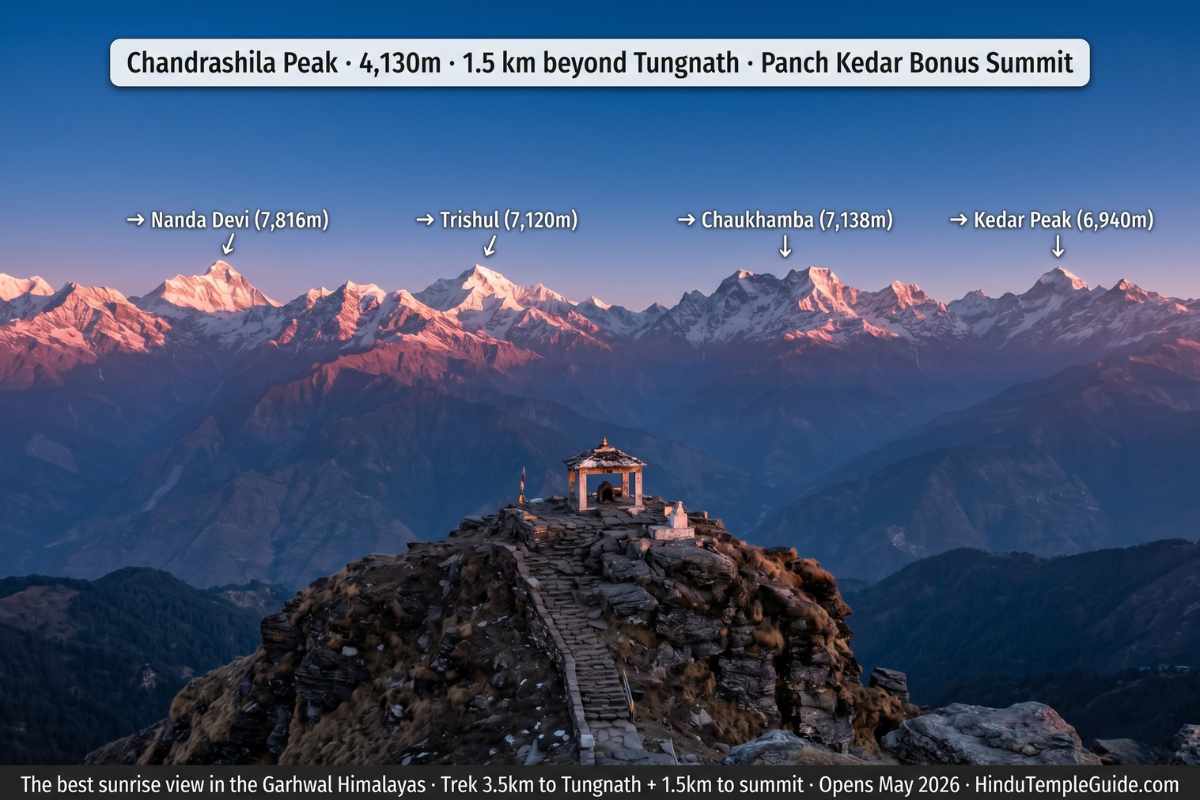
| Chandrashila Peak | Additional 1.5 km beyond Tungnath · 4,130m · 360° panoramic Himalayan views |
| Chopta | ‘Mini Switzerland of India’ · 202 km from Rishikesh · Best rhododendron forest in Garhwal |
| Winter Abode | Deity transferred to Markandeya Temple, Ukhimath |
| Best Feature | Sunrise view from Chandrashila Kedarnath, Nanda Devi, Trishul, Chaukhamba all visible on clear days |
Tungnath holds a distinction unique in all of Hinduism it is the highest Shiva temple in the entire world at 3,680 metres. Built in the style of an ancient stone temple over a thousand years old, Tungnath sits in the breathtaking meadows above Chopta surrounded by dense forests of rhododendron that burst into blazing red and pink during May. The trek from Chopta (3.5 km) is the most accessible of all Panch Kedar treks manageable for most age groups with reasonable fitness.
Kedar 3 – Rudranath Temple (3,600m): The Most Remote & Most Mystical
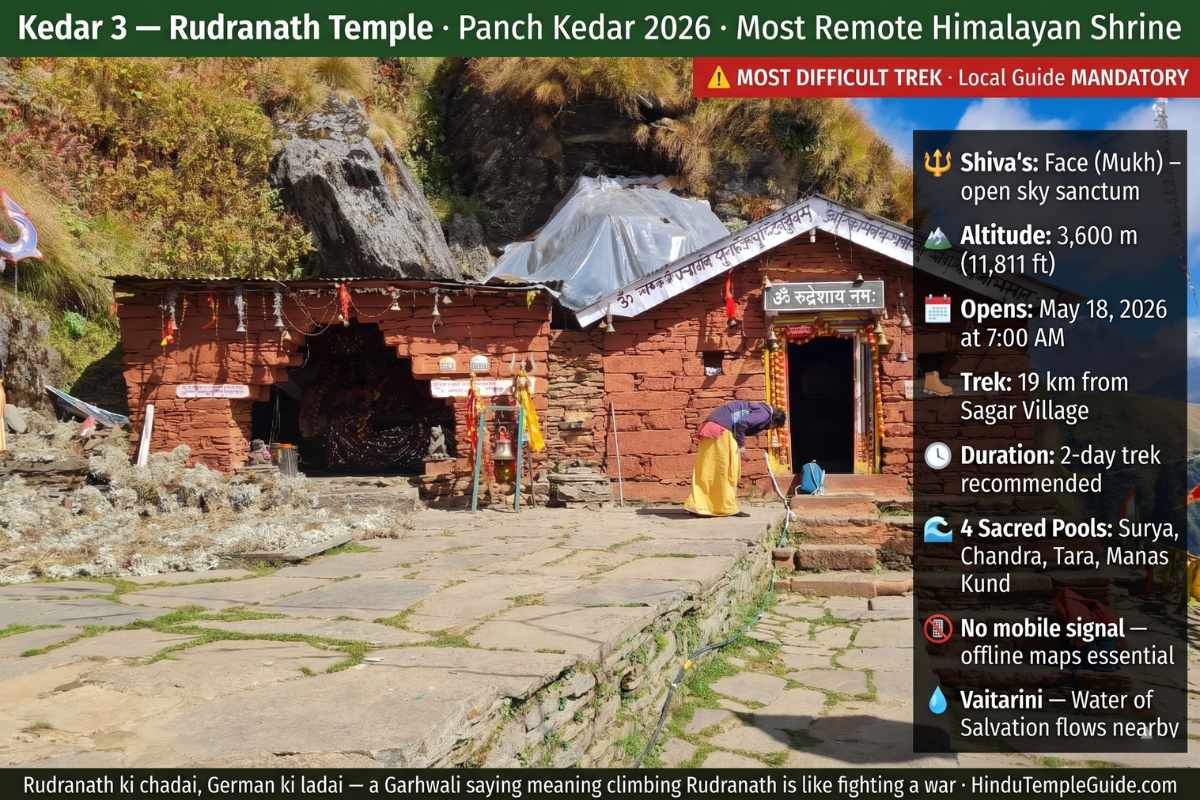
Chamoli District, Uttarakhand · Kedarnath Wildlife Sanctuary · Shiva’s Face (Mukh) · Altitude: 3,600 m
| Detail | Information |
|---|---|
| Opening Date 2026 | May 18, 2026 at 7:00 AM (officially confirmed) |
| Trek Distance | 19 km one way from Sagar Village · 2-day trek recommended |
| Trek Difficulty | DIFFICULT · Most challenging among Panch Kedar · Local guide MANDATORY |
| Trail Type | Rhododendron forests → alpine bugyals → Kedarnath Wildlife Sanctuary |
| Sacred Pools | Surya Kund, Chandra Kund, Tara Kund, Manas Kund four sacred pools near temple |
| Idol | Swayambhu (self-manifested) natural rock face unique open-sky sanctum |
| Winter Abode | Deity transferred to Gopinath Temple, Gopeshwar |
Rudranath is the temple that separates the casual pilgrim from the dedicated Shiva bhakta. Among all Panch Kedar temples, Rudranath is the most remote, the most physically demanding, and the most spiritually electric a place where the Himalayan wilderness presses so close that the boundary between the natural and the divine dissolves completely. The 19-km trek from Sagar Village passes through one of the most spectacular landscapes in Uttarakhand dense rhododendron forests giving way to sweeping alpine bugyals (meadows) carpeted with wildflowers.
What makes Rudranath utterly unique is its open-sky sanctum unlike most enclosed temples, the main idol here is a Swayambhu natural rock formation resembling Lord Shiva’s divine face, exposed to the Himalayan sky. Around the temple lie four sacred pools Surya Kund, Chandra Kund, Tara Kund, and Manas Kund whose waters are believed to purify the soul. The Vaitarini stream flowing near the temple is known locally as the Water of Salvation.
Kedar 4 – Madhyamaheshwar Temple (3,497m): Shiva’s Navel in the Sky
Chamoli District (near Ukhimath), Uttarakhand · Shiva’s Navel (Nabhi/Madhya) · Altitude: 3,497 m
| Detail | Information |
|---|---|
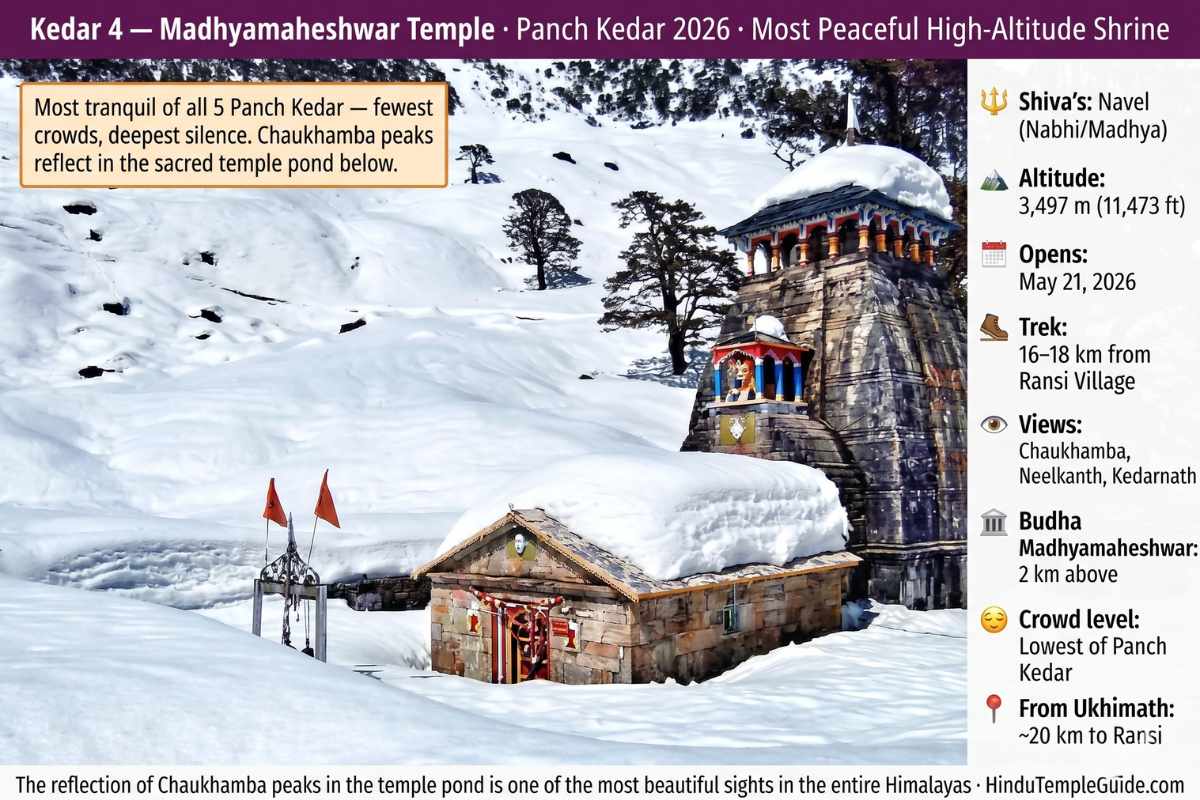
| Opening Date 2026 | May 21, 2026 |
| Trek Distance | 16–18 km one way from Ransi Village |
| Trek Difficulty | Moderate to difficult · 2–3 days recommended |
| Signature View | Chaukhamba peaks reflected in the sacred temple pond one of Uttarakhand’s most iconic sights |
| Bugyal Route | Spectacular high-altitude meadows + rhododendron forests · Chaukhamba, Neelkanth, Kedarnath peaks |
| Budha Madhyamaheshwar | Additional 2 km above main temple · Ancient shrine · Kanchani Tal (lake) nearby |
| Why Visit | Least crowded of all Panch Kedar peaceful, deeply meditative atmosphere · Absolute serenity at altitude |
Madhyamaheshwar the temple of Shiva’s navel is the most peaceful and spiritually contemplative of all Panch Kedar shrines. Unlike the famous Kedarnath or the easily accessible Tungnath, Madhyamaheshwar requires a dedicated 16–18 km trek and this effort pays off with absolute serenity at altitude. The temple sits in a high-altitude meadow surrounded by the grandest peaks of the Garhwal Chaukhamba, Neelkanth, and Kedarnath with the reflection of Chaukhamba peaks in the sacred temple pond creating one of the most photographically and spiritually powerful scenes in all of Uttarakhand.
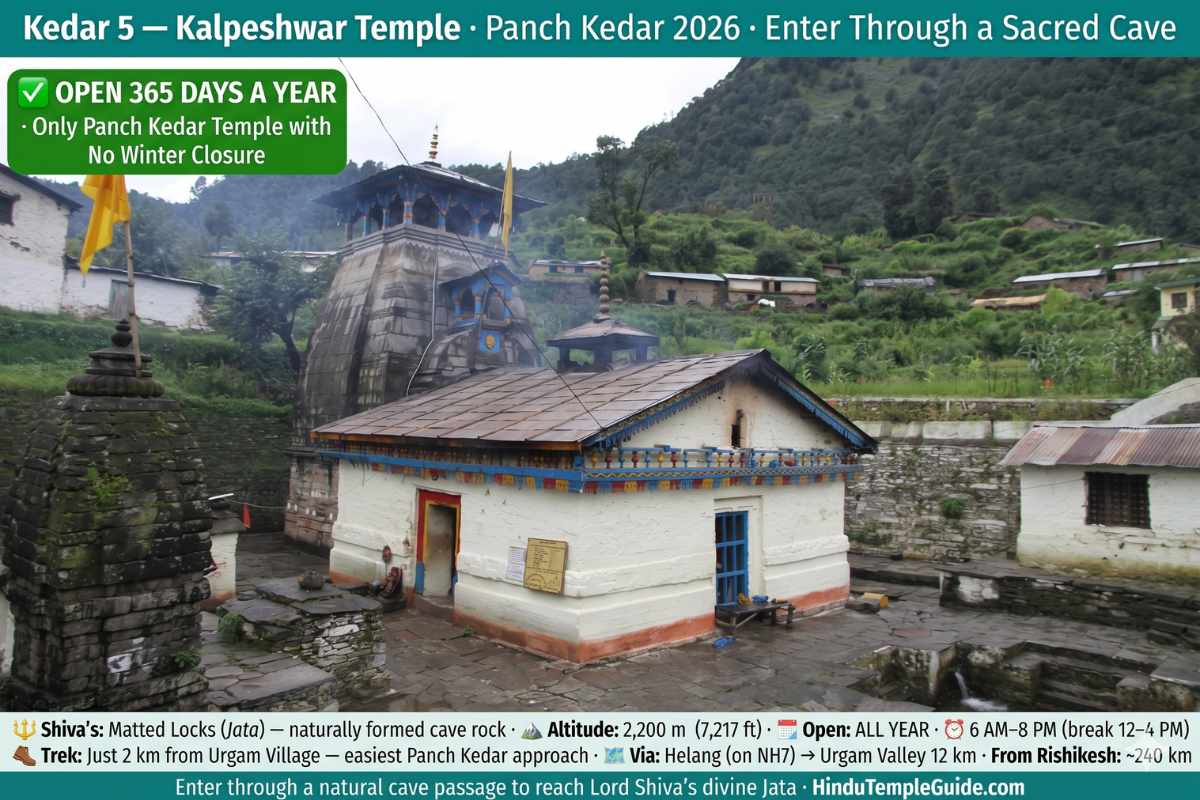
Kedar 5 – Kalpeshwar Temple (2,200m): Open All Year, Enter Through a Cave
Urgam Valley, Chamoli District, Uttarakhand · Shiva’s Hair / Jata (Matted Locks) · Altitude: 2,200 m
| Detail | Information |
|---|---|
| Open | 365 days a year the ONLY Panch Kedar temple with no seasonal closure |
| Timings | 6:00 AM – 8:00 PM · Afternoon break 12:00 PM – 4:00 PM |
| Trek Distance | 2 km one way from Urgam Village easiest in the circuit |
| Trek Difficulty | Easy · Suitable for all ages including elderly and children |
| Cave Approach | Unique natural cave passage leads to inner sanctum atmospheric and intensely sacred |
| Idol | Naturally formed rock depiction of Shiva’s matted locks inside cave |
| Nearest Base | Helang (on NH7) → Urgam Valley 12 km · Combine with Joshimath and Valley of Flowers |
Kalpeshwar is the final temple of the Panch Kedar circuit and perhaps the most intimate and quietly powerful. Enshrining Lord Shiva’s matted locks (Jata) the symbol of his renunciation and the Ganga he holds in his hair this temple is approached through a natural cave passage that pilgrims must walk through to reach the inner sanctum. The experience of entering through darkness and emerging before Shiva’s Jata is, for many devotees, the most emotionally intense moment of the entire Panch Kedar circuit.
Complete Panch Kedar Yatra 14-Day Itinerary 2026 – Traditional Circuit
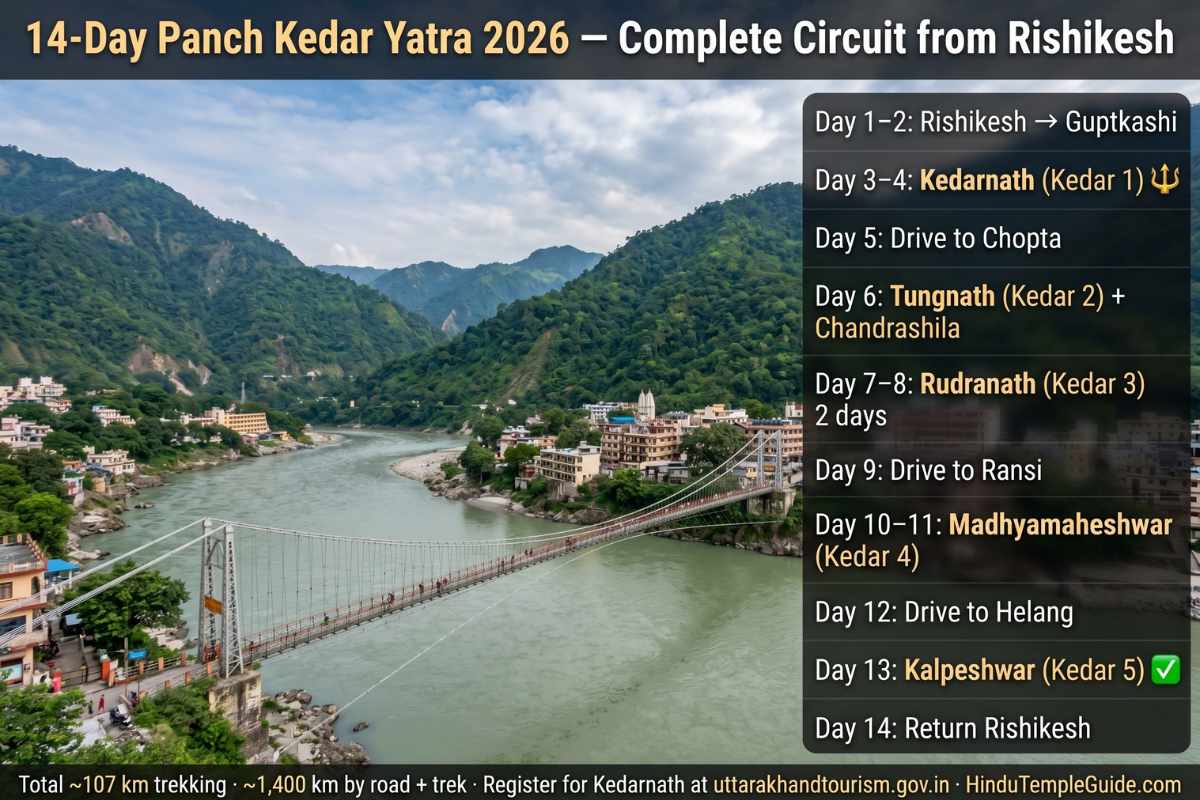
The traditional Panch Kedar circuit follows the Pandava order beginning at Kedarnath (the most sacred) and ending at Kalpeshwar. Here is the complete Panch Kedar itinerary 2026 from Rishikesh:
| Day | Base / Location | Activity & Distance |
|---|---|---|
| Day 1 | Rishikesh → Guptkashi | Drive 200 km · 8–9 hrs · Acclimatisation and registration · Overnight Guptkashi |
| Day 2 | Guptkashi → Gaurikund | Drive to Sonprayag/Gaurikund (base) · Register for Kedarnath Yatra · Overnight Gaurikund |
| Day 3–4 | Kedarnath | Trek 16–18 km to Kedarnath · Darshan at Kedarnath Jyotirlinga · Overnight at Kedarnath |
| Day 5 | Kedarnath → Chopta | Trek down to Gaurikund · Drive ~90 km to Chopta · Overnight Chopta |
| Day 6 | Tungnath + Chandrashila | Trek 3.5 km Chopta → Tungnath (2nd Kedar) · Optional: Chandrashila Peak (+1.5 km) · Return Chopta |
| Day 7 | Chopta → Sagar Village | Drive 35 km to Sagar Village · Register for Rudranath · Begin trek 8 km to Pannar Bugyal · Overnight camp |
| Day 8 | Pannar → Rudranath | Trek 9 km to Rudranath (3rd Kedar) and back to Pannar Bugyal · Darshan + four sacred pools · Overnight camp |
| Day 9 | Sagar → Ransi Village | Trek 8 km back to Sagar · Drive to Ukhimath then Ransi (Madhyamaheshwar base) · Overnight Ransi |
| Day 10–11 | Madhyamaheshwar | Trek 16–18 km to Madhyamaheshwar (4th Kedar) · Darshan · Optional: Budha Madhyamaheshwar (+2 km) · Overnight camp · Return Day 11 |
| Day 12 | Ransi → Helang | Drive from Ransi to Helang via Ukhimath and Chamoli · Check into hotel · Rest day |
| Day 13 | Kalpeshwar | Drive 12 km from Helang to Urgam Valley · Trek 2 km to Kalpeshwar (5th Kedar) · Cave entry darshan · Return to Helang/Joshimath |
| Day 14 | Return to Rishikesh | Drive Joshimath → Rishikesh · 256 km · 8 hrs · Panch Kedar Yatra complete · Om Namah Shivaya! |
Yatra Tips:
Best Time to Visit Panch Kedar 2026 – Season-by-Season Guide
| Season | What to Expect for Panch Kedar Yatra |
|---|---|
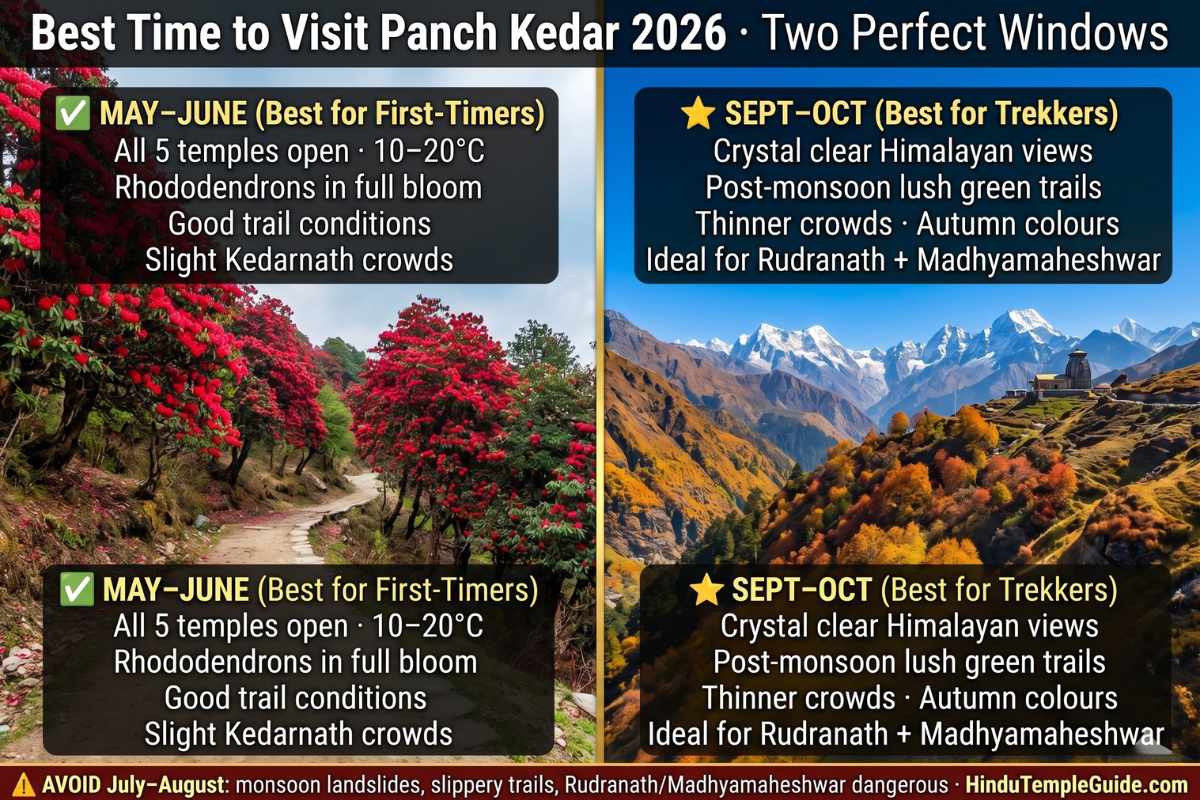
| May–June (BEST for most) | All temples open · Trails clear · Pleasant 10–20°C · Rhododendrons in full bloom (May) · Manageable Kedarnath crowds |
| July–August (AVOID) | NOT recommended · Heavy monsoon rain · Landslide risk on Rudranath and Madhyamaheshwar trails · Kedarnath sometimes suspended · BSNL signal poor |
| Sept–Oct (BEST for trekkers) | Post-monsoon · Crystal clear Himalayan views · Fewer crowds · Autumn colours · Trails lush green · Ideal for Rudranath and Madhyamaheshwar |
| Nov onwards (Closing) | Temples begin closing · Kalpeshwar open all year · Winter circuit Kalpeshwar + Joshimath only |
| Dec–April (Winter) | Only Kalpeshwar accessible · Roads to Chopta/Gaurikund may be snow-blocked · Perfect for solo winter devotees |
How to Reach Panch Kedar Base Camps 2026 – Complete Route Guide
Nearest Gateway Cities
Starting point for most circuits · 238 km from Delhi · Road, rail (Haridwar 24 km), air (Dehradun 35 km)
Second major gateway · Overnight buses from Delhi, Mumbai · Haridwar Junction directly connected nationwide
Jolly Grant Airport · Daily flights from Delhi, Mumbai, Bengaluru · 50 km to Rishikesh by road
Base Camps from Rishikesh
| Temple | Base Village | Distance | Transport |
|---|---|---|---|
| Kedarnath | Sonprayag / Gaurikund | ~200 km · 7–8 hrs | GMOU/private bus or taxi · Then 16 km trek |
| Tungnath | Chopta | ~202 km · 7–8 hrs | Private cab/GMOU bus to Chopta · Then 3.5 km trek |
| Rudranath | Sagar Village (Gopeshwar) | ~212 km · 8–9 hrs | Bus/taxi to Gopeshwar → taxi to Sagar · 19 km trek |
| Madhyamaheshwar | Ransi Village (Ukhimath) | ~185 km · 7 hrs | Bus/taxi to Ukhimath → Ransi · 16–18 km trek |
| Kalpeshwar | Urgam Valley (via Helang) | ~240 km · 8–9 hrs | Bus/taxi to Helang (NH7) → Urgam 12 km · 2 km walk |
Panch Kedar Packing List & High-Altitude Safety Guide 2026
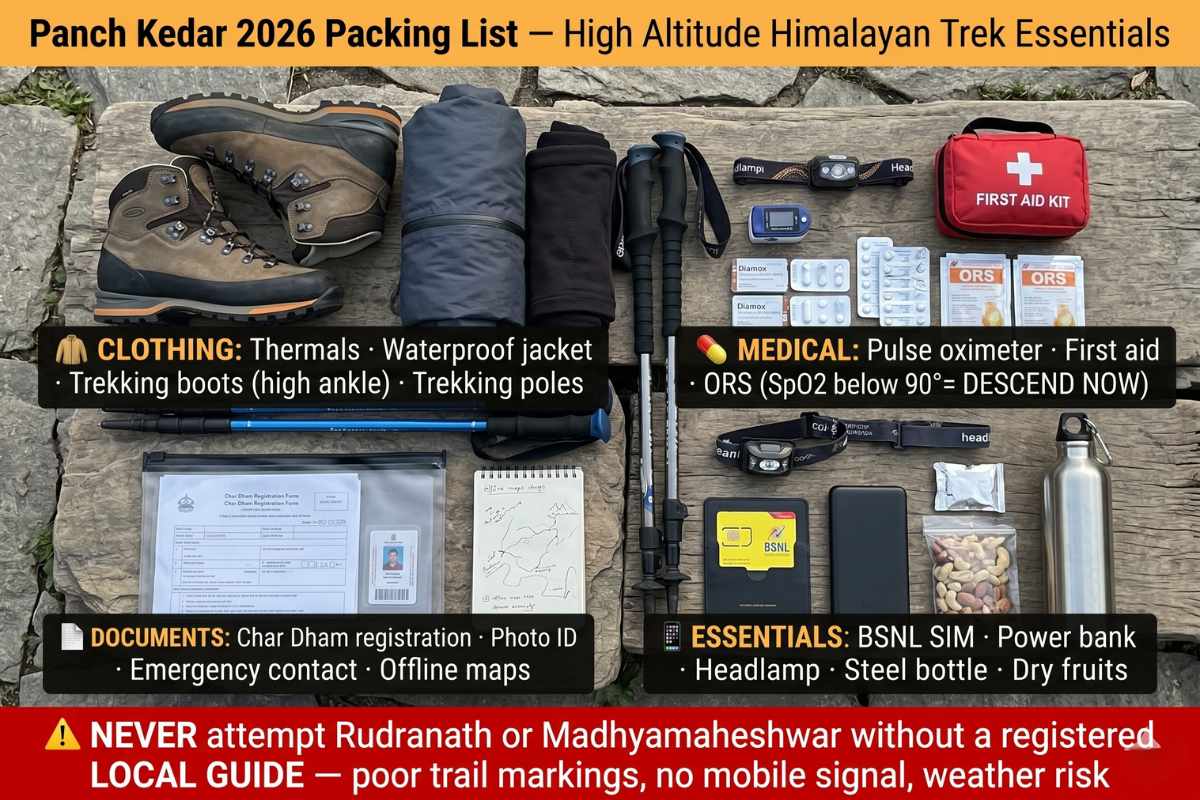
- Thermals (top + bottom) 2 sets
- Waterproof trekking jacket mandatory
- Trekking trousers + fleece mid-layer
- High-ankle waterproof trekking boots
- Trekking poles mandatory for Kedarnath + Rudranath
- Headlamp + extra batteries
- Char Dham biometric registration card (free)
- Diamox consult doctor before yatra
- Pulse oximeter SpO2 below 90% = descend!
- Personal medicines 3 extra days supply
- Photo ID + 2 photocopies
- BSNL SIM only only network on remote trails
- Power bank 20,000 mAh minimum
- Offline maps Maps.me / OsmAnd
- Dry fruits, energy bars, glucose biscuits
- Steel bottle + water purification tablets
FAQs – Panch Kedar Yatra 2026
How to Reach Badrinath Temple 2026 – Complete Travel Guide
Helicopter Booking Guide 2026 – Kedarnath, Badrinath & Char Dham
12 Jyotirlinga in India 2026 – Complete Guide (Kedarnath is Jyotirlinga #11)
Vaishno Devi Yatra Guide 2026 – Registration, Route & Tips
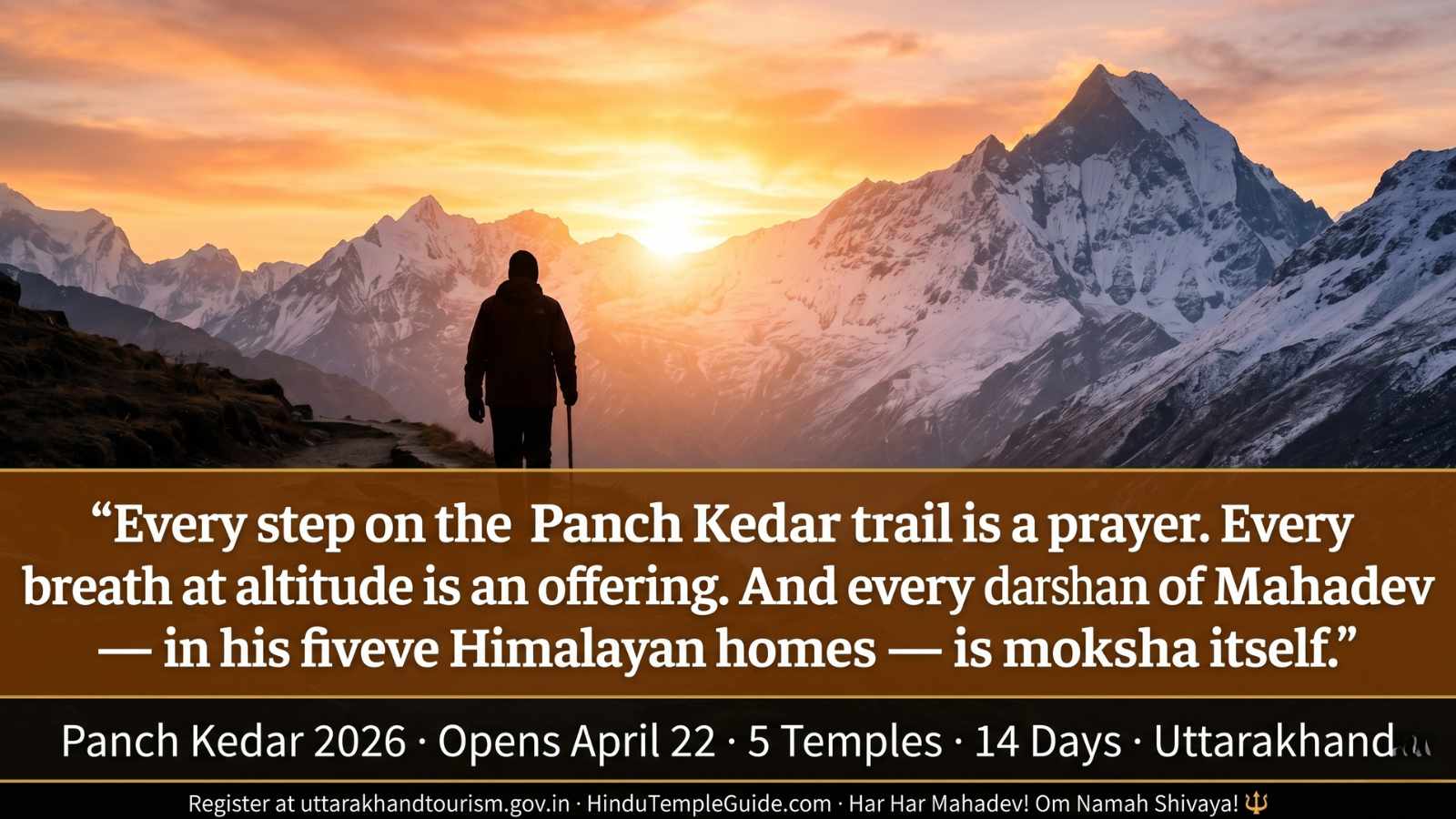
Begin Your Panch Kedar Yatra 2026 | Har Har Mahadev!
The Pandavas climbed these Himalayan passes burdened with the heaviest guilt a warrior soul can carry and in finding Shiva in his five divine forms, they found themselves absolved, whole, and free. The Panch Kedar Yatra asks the same of every devotee: not a perfect body, not wealth just sincerity, endurance, and faith. Five temples. Five body parts of Mahadev. Five chances to stand in the direct presence of the divine at the roof of the world. Har Har Mahadev! Om Namah Shivaya!
Disclaimer: Panch Kedar 2026 opening dates and trekking information are verified from official Uttarakhand Tourism and temple committee sources as of April 2026. Dates are subject to weather conditions, Panchang calculations, and government announcements. Always verify at uttarakhandtourism.gov.in before departing. Trek conditions at Rudranath and Madhyamaheshwar are remote always hire a registered local guide. HinduTempleGuide.com is not affiliated with any Uttarakhand government body. Har Har Mahadev!