
Panch Bhoota Sthalam these five sacred temples represent the most profound and cosmically ambitious conception in all of Hindu sacred architecture: the realization that Lord Shiva is not merely a deity worshipped inside a shrine, but the living consciousness within the five prime elements that constitute all of creation the earth beneath our feet, the water in our blood, the fire of our awareness, the breath in our lungs, and the infinite space in which the universe unfolds. Revered in the 7th-century Tamil Tevaram hymns of the Nayanmar saints as Paadal Petra Sthalams, the Pancha Bhoota Sthalams are five ancient temples across Tamil Nadu and Andhra Pradesh where each elemental form of Shiva is enshrined, worshipped, and experienced directly.
Whether you approach these five shrines as a Shaiva devotee, a student of Vedanta and Agama Shastra, or a temple heritage traveller exploring South India's Chola, Pallava, and Vijayanagara monuments, the Panch Bhoota Sthalam yatra is one of the most transformative pilgrimages in India. In this complete 2026-2027 guide, we cover all five temples, their timings, legends, architectural wonders, the 79°E meridian alignment, and a practical 4-day road itinerary from Chennai and Tirupati. Om Namah Shivaya!
In Hindu cosmology, Sankhya, and Ayurveda, the five prime elements (Pancha Mahabhuta) are: Prithvi (Earth - solidity, stability, form), Apas / Jalam (Water - purification, flow, adaptability), Agni / Tejas (Fire transformation, light, tapas), Vayu (Air - breath, prana, movement), and Akasha (Ether/Space pure consciousness, the substratum of sound). All physical existence including the human body is a composition of these five elements, and the Panch Bhoota Sthalams are where Lord Shiva manifests as each element.
1. Panch Bhoota Sthalam - All 5 Element Temples at a Glance (2026-2027)
| # | Element | Temple & Presiding Deities | Location | Daily Timings | Unique Elemental Manifestation |
|---|---|---|---|---|---|
| 1 | Earth (Prithvi) | Ekambareswarar Temple (Elavarkuzhali) | Kanchipuram, TN | 6:00 AM-12:30 PM · 4:00-8:30 PM | Prithvi (sand) Lingam moulded by Parvati · 3,500-yr mango tree |
| 2 | Water (Apas / Appu) | Jambukeswarar Temple (Akilandeswari) | Thiruvanaikaval (Trichy), TN | 6:00 AM-1:00 PM · 3:30-8:30 PM | Appu Lingam submerged in eternal underground water spring |
| 3 | Fire (Agni / Tejas) | Annamalaiyar / Arunachaleswarar (Unnamalai) | Tiruvannamalai, TN | 5:30 AM-12:30 PM · 3:30-9:30 PM | 2,668-ft Arunachala Hill itself is the Agni Lingam · Karthigai Deepam |
| 4 | Air (Vayu) | Sri Kalahasteeswara Temple (Gnana Prasunamba) | Srikalahasti (near Tirupati), AP | 6:00 AM-9:00 PM (Continuous) | Lamp flame flickers continuously inside windless sealed sanctum |
| 5 | Ether / Space (Akasha) | Thillai Nataraja Temple (Sivakamasundari) | Chidambaram, TN | 6:00 AM-12:00 PM · 5:00-10:00 PM | Chidambara Rahasya (formless empty space behind curtain) · Nataraja |
2. The Philosophical Significance - Shiva as the Five Cosmic Elements
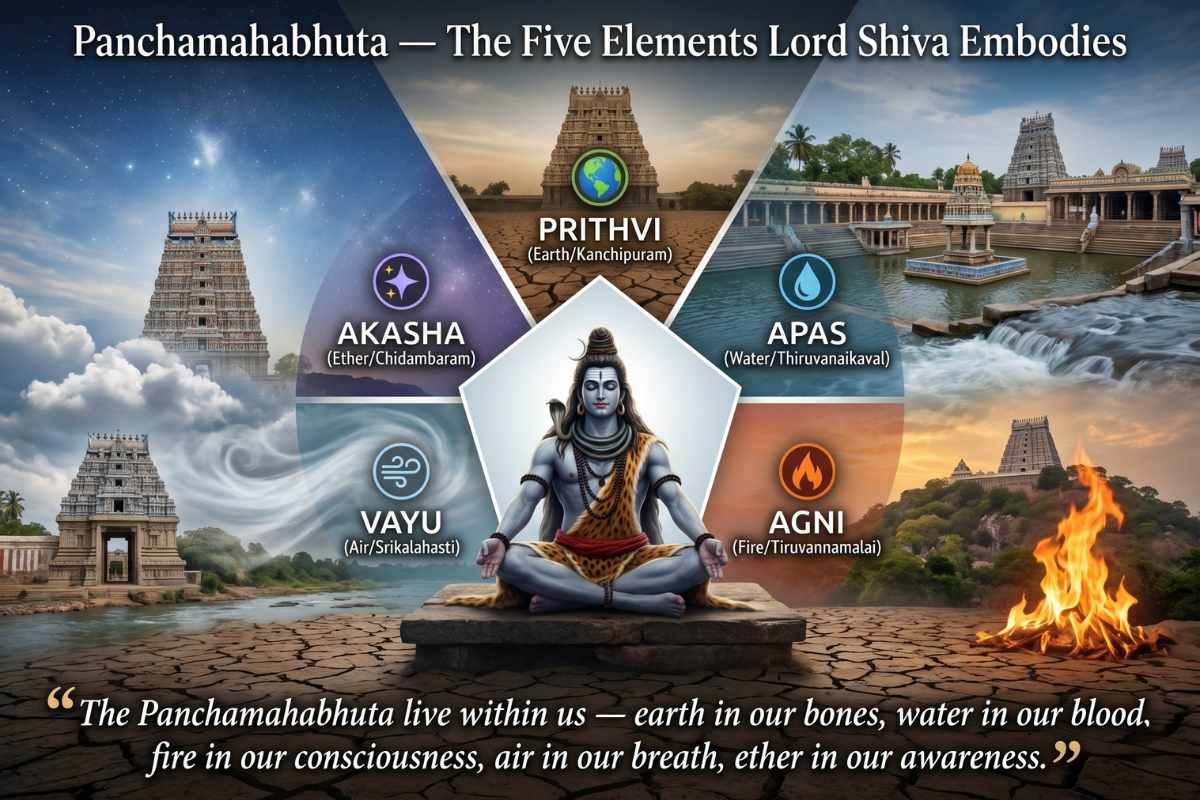
The Panch Bhoota Sthalam tradition rests on one of Shaiva Siddhanta's deepest cosmological insights: that the Divine is not separate from nature, but is the very fabric of it. In Shaiva philosophy (and the Svetasvatara Upanishad), Lord Shiva as Bhootapati (Lord of the Elements) and Ashtamurti (the Eight-Formed Lord-comprising the five elements, the Sun, the Moon, and the individual soul) is the consciousness that animates all five elements simultaneously. Every grain of earth, every drop of water, every flame, every breath of air, and every expanse of space is Shiva. Even the five syllables of the sacred Panchakshara mantra-Na-Ma-Shi-Va-Ya-correspond directly to the five elements: Na (Earth), Ma (Water), Shi (Fire), Va (Air), and Ya (Ether/Space).
| Element & Chakra | Philosophical Significance in Shiva's Cosmic Role |
|---|---|
| Earth (Prithvi) Muladhara Chakra · 'Na' |
Stability, physical form, patience, and sustenance. Shiva as the unshakeable ground of all being-the foundation from which all life rises and to which all returns. |
| Water (Apas / Appu) Svadhishthana Chakra · 'Ma' |
Purification, flow, adaptability, and grace. Shiva as the ever-flowing spring of compassion that cleanses karmic impurities and nurtures life. |
| Fire (Agni / Tejas) Manipura Chakra · 'Shi' |
Transformation, illumination, and Tapas. Shiva as the supreme fire of wisdom (Jnana Agni) that burns away ego and ignorance. |
| Air (Vayu) Anahata Chakra · 'Va' |
Breath, vitality, and invisible presence. Shiva as the universal Prana (life-force) that animates every living creature at every moment. |
| Ether / Space (Akasha) Vishuddhi Chakra · 'Ya' |
Infinite space, pure consciousness (Chit), and the substratum of sacred sound (Nada). Shiva as the boundless sky of awareness in which the cosmos dances. |
3. Temple 1: Ekambareswarar Temple, Kanchipuram (Earth Element - Prithvi)
🌍 Prithvi Lingam (Sand Lingam) · Shiva as Ekambaranathar · Parvati as Elavarkuzhali · Kanchipuram, Tamil Nadu · 72 km from Chennai
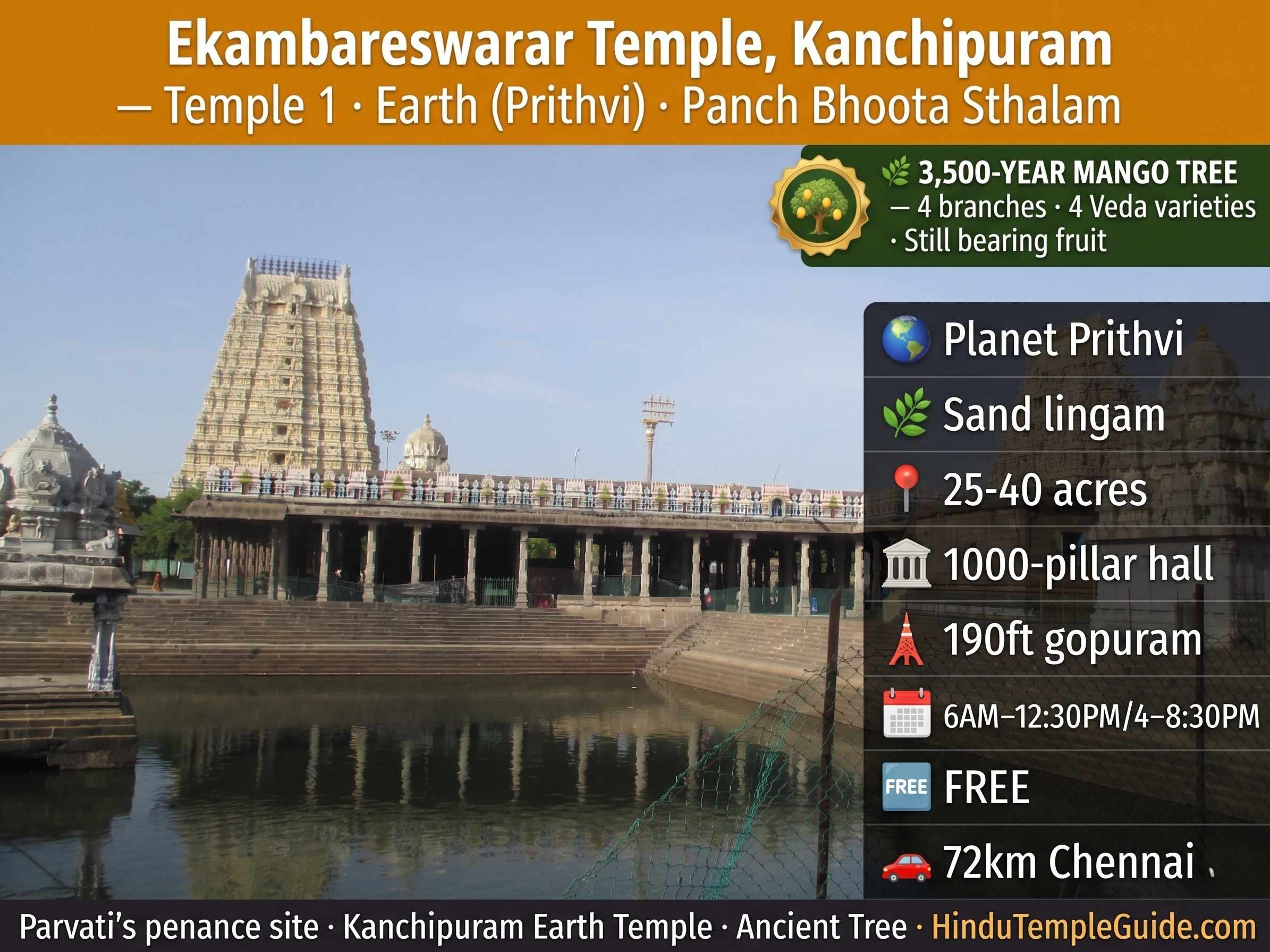
| Element & Lingam | Prithvi (Earth) · Shiva Lingam moulded from sacred earth/sand (Prithvi Lingam)-anointed only with jasmine oil on the base, never water |
| Presiding Deities | Ekambaranathar / Tazhuva Kuzhainthaar ("Lord of the Mango Tree / He Who Melted in Her Embrace") & Elavarkuzhali Amman (worshipped at Kanchi Kamakshi) |
| Temple Complex | Spans 23-25 acres · 5 concentric Prakarams · Pillared halls & 1,008 Shiva Lingams (Sahasralinga) |
| Sacred Sthala Vriksha | 3,500-year-old Mango Tree (Mavadi) whose 4 branches bear 4 different tastes of mangoes representing the 4 Vedas |
| Raja Gopuram | 190-192 feet (58-59m) southern tower built in 1509 CE by Vijayanagara Emperor Krishnadevaraya |
| Key Festival & Solar Alignment | Panguni Uthiram (March-April) celestial wedding · Sun rays fall directly on the Lingam on Ratha Saptami & 19-21 Phalguna |
| Dynastic Patronage | Pallava kings (~600 CE) · Rebuilt and expanded by Imperial Cholas & Vijayanagara rulers |
| Daily Timings | 6:00 AM - 12:30 PM & 4:00 PM - 8:30 PM daily |
| Entry & Distance | FREE · 72 km from Chennai · 2 km from Kanchipuram Railway Station |
Standing in the northern sector (Shiva Kanchi) of Kanchipuram, Arulmigu Ekambareswarar Temple is the supreme shrine of the Earth element. According to the Sthala Purana, when Goddess Parvati playfully covered Lord Shiva's eyes on Mount Kailash, the cosmos was plunged into darkness for a moment-and Shiva directed her to perform penance on Earth at Kanchipuram to expiate the act. Sitting beneath a single ancient mango tree (Eka-Amra-Natha), Parvati moulded a Shiva Lingam out of earth and sand with her own hands and worshipped it with unwavering devotion. To test her resolve, Shiva caused the nearby Vegavati River to overflow its banks and rush toward the sand Lingam. Refusing to let the waters dissolve her beloved Lord, Parvati embraced the sand Lingam tightly against her chest and bangles-whereupon Lord Shiva, moved by her love, softened like warm wax in her arms, earning the Tamil name Tazhuva Kuzhainthaar ("He Who Melted in Her Embrace") and preserving the impressions of her bangles on the Lingam to this day!
Because the Moolavar Lingam is made of unbaked sand and earth (covered in protective silver/kavacham), priests never pour water directly on the Lingam; instead, abhishekam is performed with fragrant jasmine oil (Malligai Chattru) on the pedestal (Avudaiyar) and on the crystal Spatika Lingam. Inside the courtyard stands the sacred 3,500-year-old mango tree, whose four branches represent the Rig, Yajur, Sama, and Atharva Vedas.
4. Temple 2: Jambukeswarar Temple, Thiruvanaikaval (Water Element - Apas)
💧 Appu Lingam (Submerged in Eternal Spring) · Shiva as Jambukeswarar · Parvati as Akilandeswari · 3 km from Srirangam, Tiruchirappalli
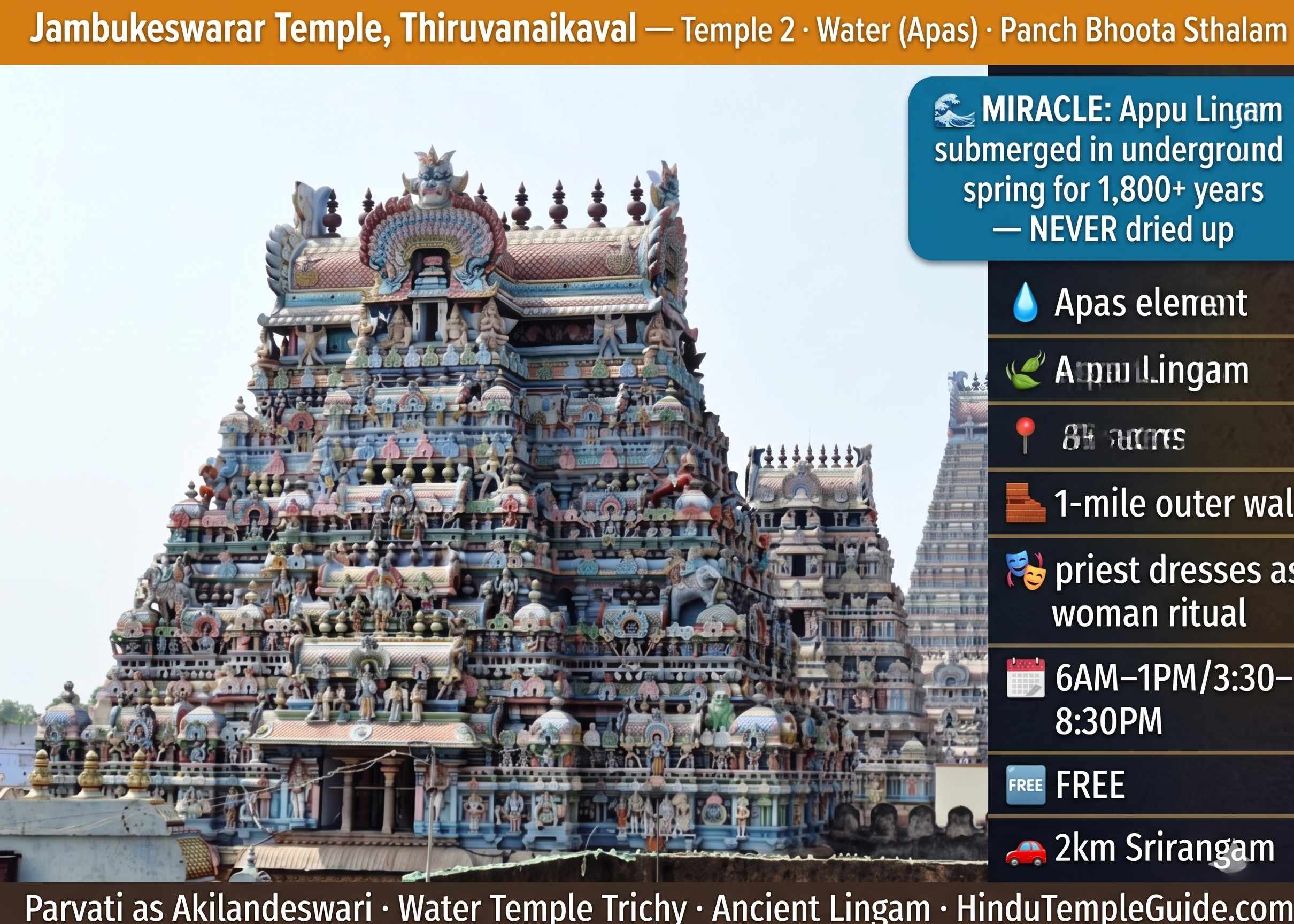
| Element & Lingam | Apas / Appu (Water) · Appu Lingam fashioned from Kaveri water by Goddess Parvati under a white Jambu (rose apple) tree |
| Unique Noon Ritual | During Uchikala Pooja (~12:00 PM), the temple priest dresses in a saree as Goddess Akilandeswari to worship Lord Shiva |
| Name Etymology | Thiru + Aanai (Sacred Elephant) + Kaa (Forest) - where an elephant and a spider (reborn as Early Chola King Kocengannan) worshipped Shiva |
| Vibhuti Prakara | 18-acre complex with 5 concentric enclosures · The massive outer wall (Vibhuti Prakara, 25 ft high) was built by Lord Shiva himself disguised as a holy ash-giver to labourers |
| Adi Shankaracharya's Tatanka | Adi Shankaracharya installed two Sri Chakra ear-ornaments (Tatankas) on Goddess Akilandeswari and a Ganesha shrine directly opposite her to calm her fierce tapas energy |
| Daily Timings | 6:00 AM - 1:00 PM & 3:30 PM - 8:30 PM daily |
| Entry & Distance | FREE · 3 km from Srirangam Ranganathaswamy Temple · 8 km from Tiruchirappalli (Trichy) Junction |
Situated on the sacred island of Srirangam between the Kaveri and Kollidam rivers in Tiruchirappalli, Thiruvanaikaval (Thiruvanaikoil) takes its name from a moving legend of pure devotion. In a forest of white Naaval (Jambu / Java plum) trees, a white elephant (Aanai) used to bathe the Shiva Lingam daily with water carried in its trunk, while a spider wove a canopy of webs overhead to prevent dry leaves from falling on the Lingam. Mistaking the web for dirt, the elephant tore it down each day until the spider crawled into the elephant's trunk and both creatures died in the struggle. Touched by their devotion, Lord Shiva granted liberation to the elephant and caused the spider to be reborn as the great Early Chola monarch Kocengannan (Kochengat Chola, c. 2nd-3rd century CE)-who built 70 Maadakkoyils (elevated temples where elephants cannot climb the narrow sanctum steps) and constructed the sanctum of Jambukeswarar so no elephant could enter it again! Because Shiva taught Parvati supreme wisdom (Upadesa) here as Guru to disciple, no wedding ritual (Tirukalyanam) is performed at Thiruvanaikaval.
5. Temple 3: Annamalaiyar (Arunachaleswarar) Temple, Tiruvannamalai (Fire Element - Agni)
🔥 Agni Lingam (The Hill Itself Is Shiva as Infinite Flame) · Shiva as Arunachaleswarar · Parvati as Unnamalai Amman · 190 km from Chennai
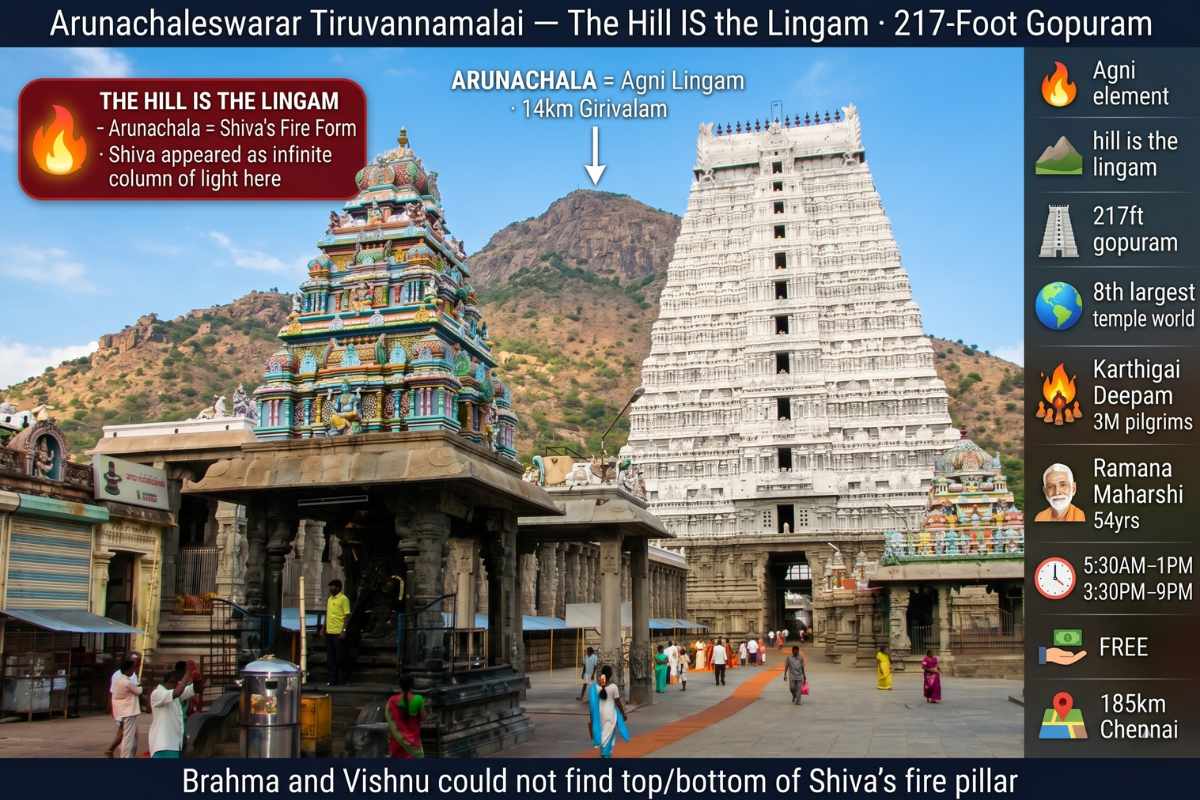
| Element & Origin | Agni / Tejas (Fire) · Where Lord Shiva manifested as an infinite column of fire (Anal-Malai) before Brahma and Vishnu |
| The Sacred Hill | Arunachala Hill (2,668 ft) ITSELF is the Shiva Lingam-cooled from a column of blinding flame into stone so devotees could worship him |
| Temple Scale & Gopurams | 25 acres · 6 concentric Prakarams · 4 cardinal Raja Gopurams (Eastern Rajagopuram rises 217 feet / 66m across 11 storeys) |
| Karthigai Deepam Festival | 3,500 kg of ghee & camphor lit in a 5-foot copper cauldron atop Arunachala peak on Karthigai Purnima (Nov/Dec) · Visible 30 km away · 30+ lakh pilgrims |
| 14-km Girivalam Path | 14-km barefoot circumambulation around Arunachala Hill passing the 8 directional Ashta Lingams (Indra, Agni, Yama, Niruthi, Varuna, Vayu, Kubera & Esanya) |
| Sri Ramana Maharshi | 20th-century Advaita sage lived at Arunachala for 54 years (1896-1950); Sri Ramanasramam, Virupaksha Cave & Skandashram sit on the hill slopes |
| Daily Timings | 5:30 AM - 12:30 PM & 3:30 PM - 9:30 PM daily |
| Entry & Distance | FREE · 190 km from Chennai · 105 km from Pondicherry · 115 km from Kanchipuram |
Arulmigu Annamalaiyar (Arunachaleswarar) Temple at Tiruvannamalai is the most dramatically situated of all five Panch Bhoota Sthalam temples because here, the fire element is not confined to a sanctum-the entire 2,668-foot Arunachala Hill rising directly behind the temple is worshipped as the living Agni Lingam! According to the Shiva Mahapurana and Arunachala Mahatmya, when Lord Brahma and Lord Vishnu debated who was the supreme creator, Lord Shiva appeared between them as an infinite, blinding column of fire (Anadi-Ananta Jyotistambha). Neither Brahma (flying upward as a swan) nor Vishnu (burrowing downward into the earth as a wild boar, Varaha) could find its crown or base. When both gods surrendered their ego and prayed to Shiva to take a merciful form that living beings could behold without being blinded by his cosmic fire, Lord Shiva condensed his fiery light into the red mountain of Arunachala (Annamalai - "The Impassable Mountain of Fire") and enshrined himself at its eastern foot as the self-manifested Arunachaleswarar Lingam.
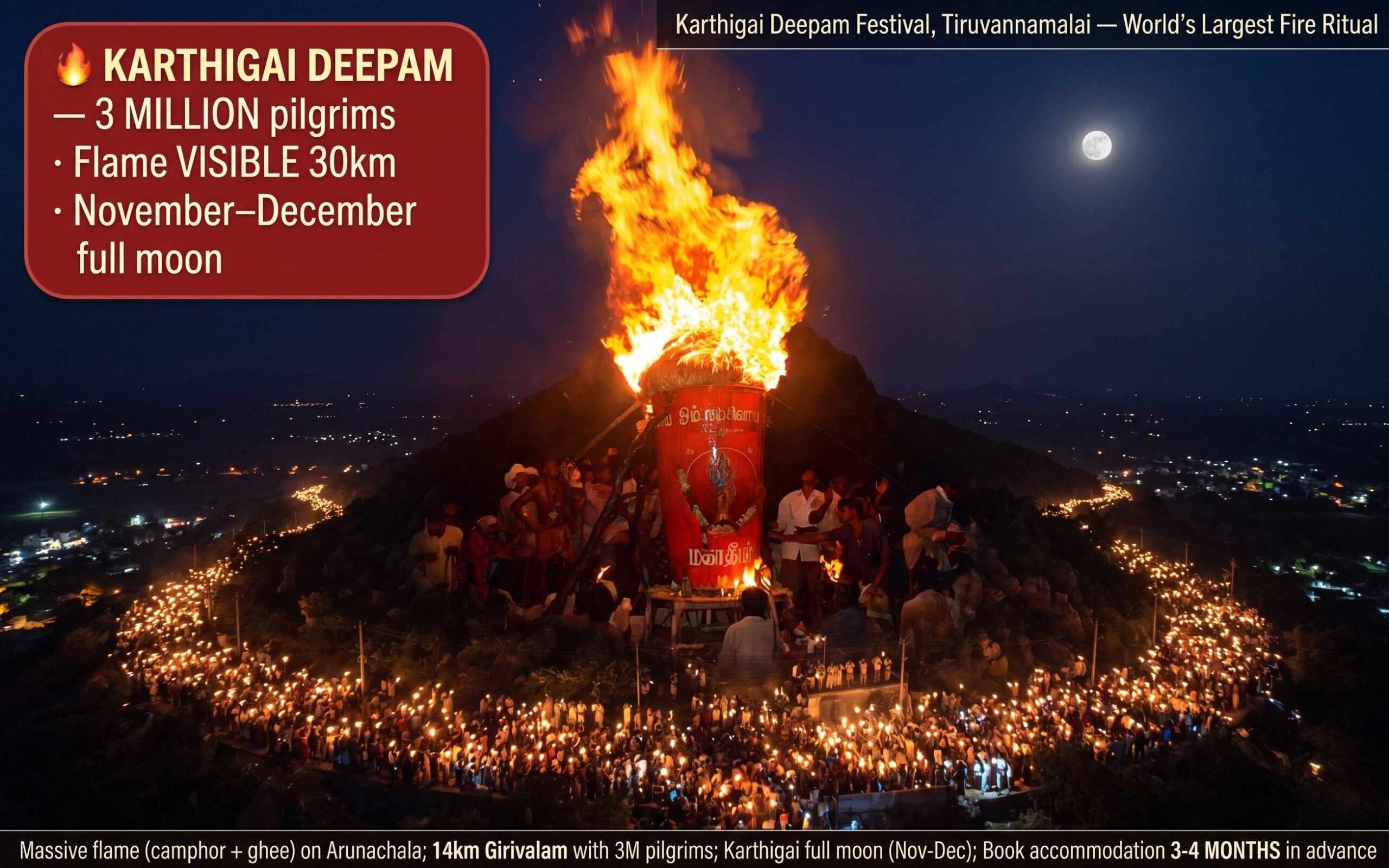
An ancient Sanskrit verse declares: "To be born in Tiruvarur, to die in Kashi, to see Chidambaram, or merely to think of Arunachala (Smaranad Arunachalam) grants liberation!" Every full moon night (Pournami), lakhs of devotees walk the 14-km barefoot Girivalam path around the base of the mountain, stopping at the eight directional Ashta Lingams along the circuit, and during the 10-day Karthigai Deepam Brahmotsavam (November-December), the Bharani Deepam is lit inside the sanctum at 4:00 AM and carried to ignite the Maha Deepam cauldron on the mountain peak at 6:00 PM.
6. Temple 4: Sri Kalahasteeswara Temple, Srikalahasti (Air Element - Vayu)
💨 Vayu Lingam (Flickering Lamp in Sealed Sanctum) · Shiva as Kalahasteeswara · Parvati as Gnana Prasunamba · Srikalahasti, Andhra Pradesh · 36 km from Tirupati
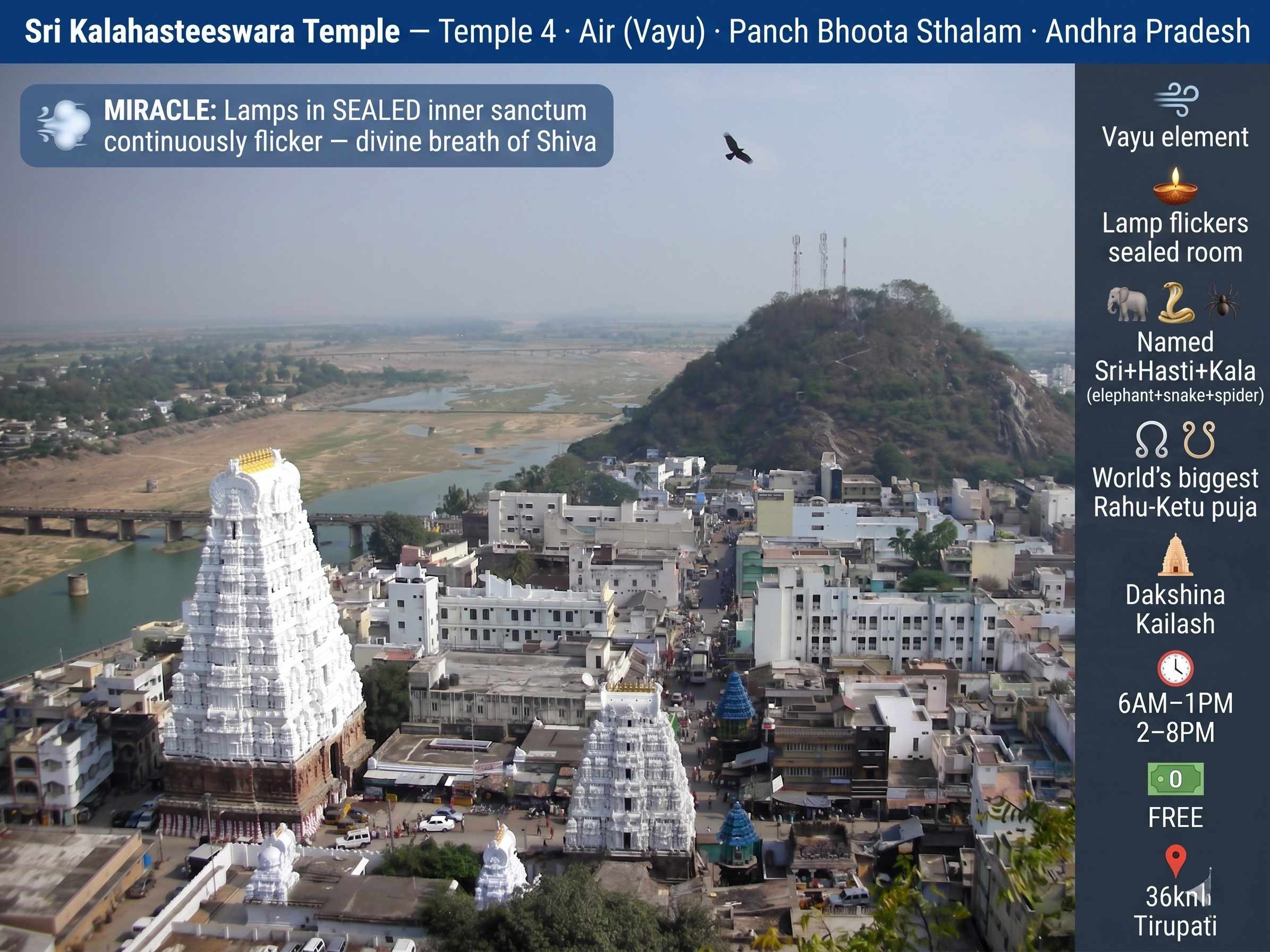
| Element & Lingam | Vayu (Air / Wind) · Self-manifested white stone Karpoora Vayu Lingam (never touched by human hands, even by the priests) |
| The Flickering Lamp Miracle | Inside the windowless inner sanctum, a single oil lamp flame continuously flutters and sways as if in a breeze while all other lamps remain still |
| Sri-Kala-Hasti Etymology | Named after three devoted creatures embodied on the Lingam: Sri (Spider), Kala (Snake/Cobra), and Hasti (Elephant), plus Hunter-Saint Kannappa Nayanar |
| Revered As | 'Dakshina Kailasam' (Kailash of the South) on the banks of the northward-flowing Swarnamukhi River |
| Rahu-Ketu Sarpa Dosha Puja | India's foremost Rahu-Ketu & Kala Sarpa Dosha Nivarana Kshetra (remains open even during solar and lunar eclipses!) |
| Dynastic Patronage | 5th c. Pallavas · 11th c. Chola kings (Kulottunga I & Rajendra I) · 1516 CE 100-pillar hall & gopuram by Krishnadevaraya |
| Daily Timings | 6:00 AM - 9:00 PM daily (Continuous darshan; Rahu-Ketu puja batches run 6:00 AM - 6:00 PM) |
| Entry & Distance | FREE General Darshan (Rahu-Ketu Puja tickets: ₹500 / ₹750 / ₹1,500 / ₹2,500 / ₹5,000) · 36 km from Tirupati · 115 km from Chennai |
Located in Tirupati district of Andhra Pradesh along the eastern bank of the Swarnamukhi River at the foot of the Seshachalam hills, Sri Kalahasteeswara Swamy Temple is the only Panch Bhoota Sthalam outside Tamil Nadu. Here, the invisible element of Air (Vayu) is made visible inside the windowless, air-locked inner Garbhagriha: while several oil lamps burn steadily without movement, one sacred lamp right before the Vayu Lingam flickers and sways continuously as though moved by the unseen breath (Prana) of Lord Shiva himself!
The temple's name-Sri-Kala-Hasti-celebrates three ardent devotees of the animal kingdom whose forms are visible on the self-manifested white Lingam: Sri (a spider) that wove a protective canopy over the Lingam (visible at the base), Kala (a cobra) that placed precious gems on the Lingam (visible in the centre shaft), and Hasti (an elephant) that bathed the Lingam with river water and bilva leaves (its two tusks visible on the sides). Srikalahasti is also the sacred site where the tribal hunter-saint Kannappa Nayanar offered his own eyes to stop blood flowing from the Vayu Lingam-earning a place atop the hill beside the main shrine (Kannappa Konda)-and is famous across India for its Rahu-Ketu Sarpa Dosha Nivarana Puja, because Lord Kalahasteeswara wears the nine planets as a waist-belt and Rahu and Ketu as ornaments.
7. Temple 5: Thillai Nataraja Temple, Chidambaram (Ether / Space Element - Akasha)
🌌 Akasha Lingam (Formless Empty Space) · Shiva as Nataraja (Cosmic Dancer) · Parvati as Sivakamasundari · Chidambaram, Tamil Nadu · 235 km from Chennai
| Element & Three-Fold Worship | Akasha (Ether / Space) · Worshipped in 3 forms inside the Chit Sabha: Sakala (Nataraja murti), Sakala-Nishkala (Chandramouleeshwara crystal Lingam), and Nishkala (formless Akasha space) |
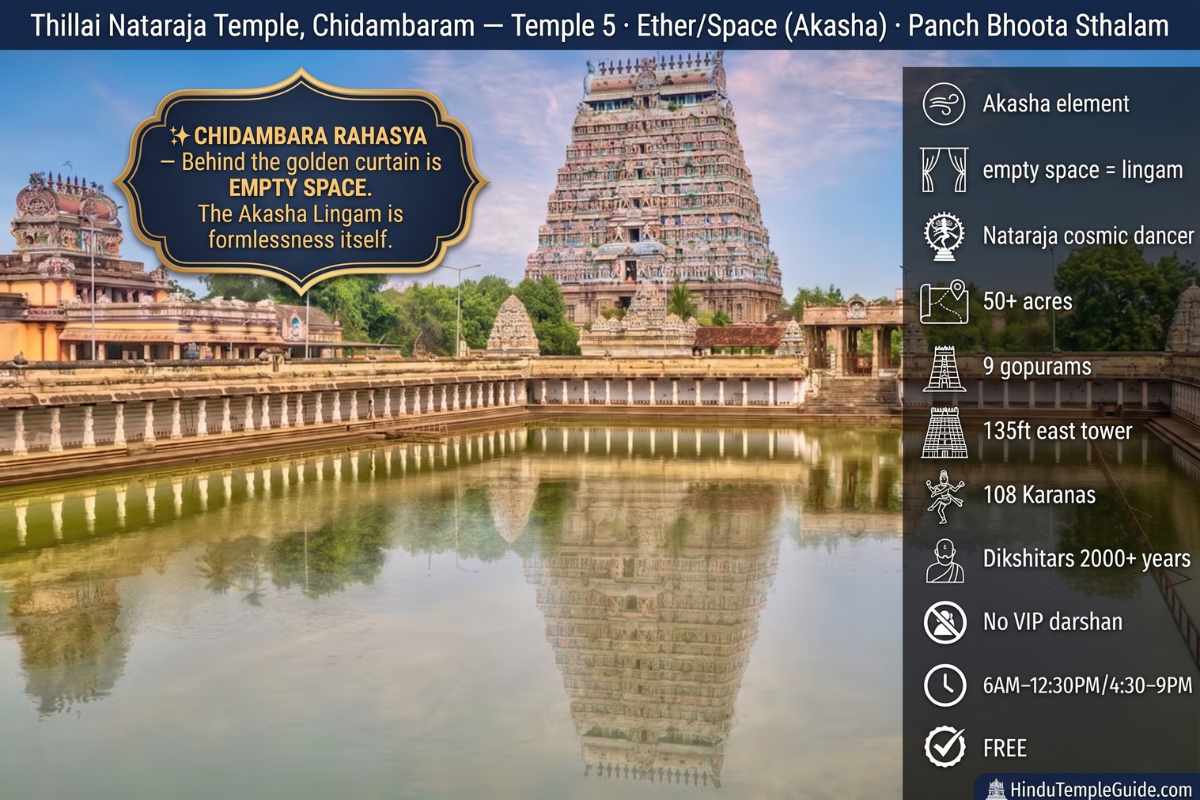
| Chidambara Rahasya | Behind a curtain to the right of Nataraja is empty space hung with golden Vilva (Bilva) leaves-signifying that the ultimate reality is formless consciousness |
| Presiding Deities | Thillai Nataraja (Sabhapati - Lord of the Stage) & Sivakamasundari Amman (plus Lord Govindaraja Perumal Divya Desam in the same complex!) |
| Name Etymology | Chit (Consciousness) + Ambaram (Sky / Space) = "The Sky of Consciousness" (Tamil: Thillai, named after the sacred mangrove forest) |
| Sacred Architecture | 40+ acres · 4 towering 7-tiered Gopurams carved with all 108 Bharatanatyam Karanas · Chit Sabha roof plated with 21,600 gold tiles (human daily breaths) & 72,000 nails (nadis) |
| Hereditary Custodians | Podu Dikshitars (Thillai Vazh Anthanaar)-a Vedic community (originally 3,000, now ~350-400 families) administering the temple for 2,000+ years |
| Equal Access Principle | Zero paid VIP queue tickets-all devotees stand equally before Lord Nataraja inside the Kanaka Sabha |
| Daily Timings | 6:00 AM - 12:00 PM & 5:00 PM - 10:00 PM daily (6 daily Spatika Linga abhishekams) |
| Entry & Distance | FREE · 235 km from Chennai · 65 km from Pondicherry · 75 km from Kumbakonam |
Revered simply as "Koil" ("The Temple") in Tamil Shaiva tradition and as the coronation shrine of the Chola emperors, Thillai Nataraja Temple in Chidambaram is the only Panch Bhoota Sthalam where the primary sanctum deity appears not as a stone Lingam, but as the dynamic bronze murti of Lord Nataraja performing the Ananda Tandava (Dance of Bliss) before sages Patanjali and Vyaghrapada. Every architectural detail of the inner Chit Sabha mirrors the human body (Yogic subtle anatomy): its 9 entrances represent the 9 orifices of the human body, its 64 wooden roof beams represent the 64 arts (Chatushashti Kala), its 21,600 gold roof tiles represent the 21,600 breaths a human takes every 24 hours, and its 72,000 golden nails represent the 72,000 subtle energy channels (Nadis) in the human body, with the sanctum positioned slightly left of centre just like the human heart!
8. The Chidambara Rahasya - The Great Secret of the Ether Temple
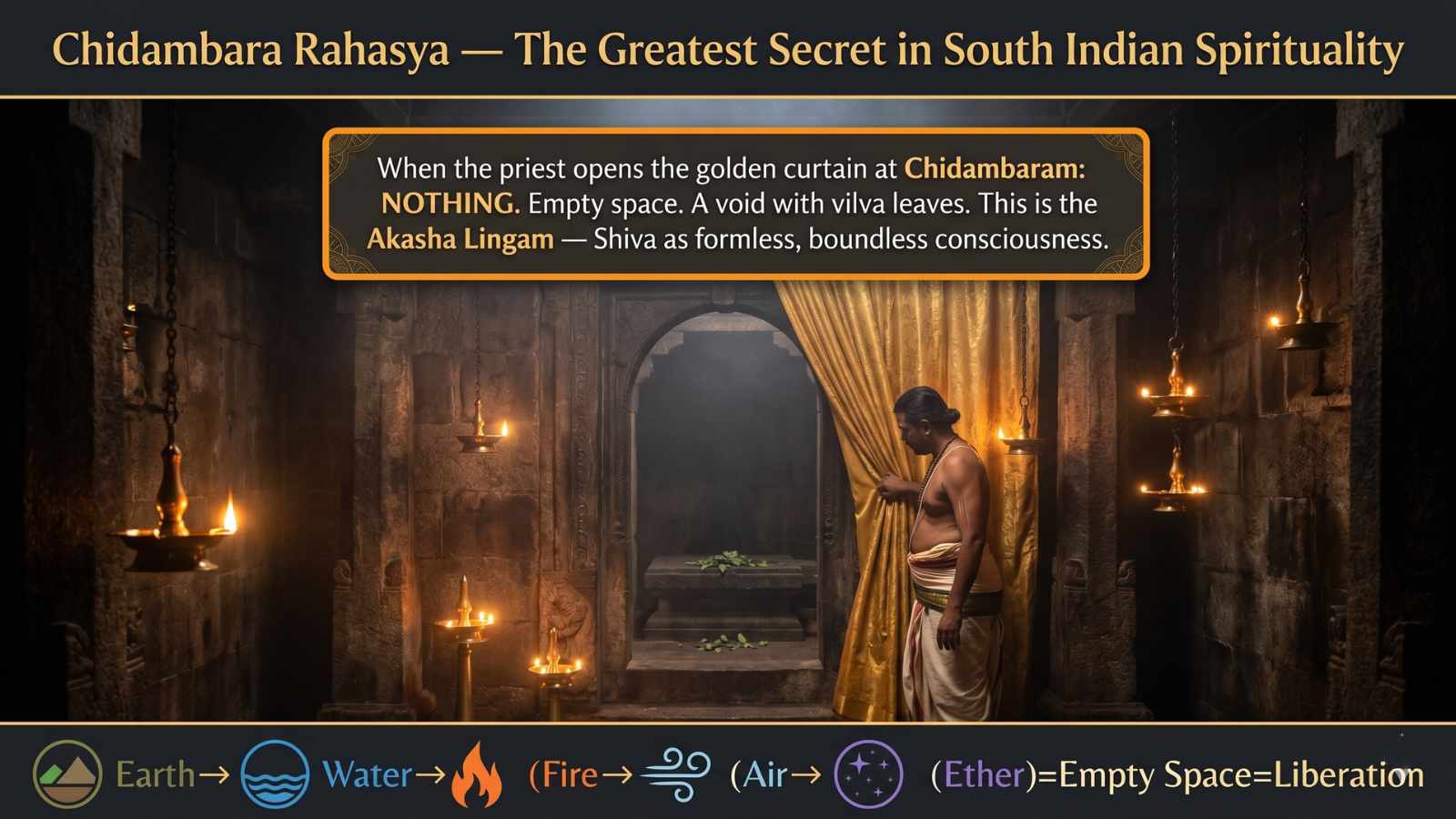
The Chidambara Rahasya is the philosophical culmination of the entire Panch Bhoota Sthalam pilgrimage. Having approached Lord Shiva through his four tangible elemental manifestations-as the solid sand of Kanchipuram, the flowing spring of Thiruvanaikaval, the blazing mountain of Tiruvannamalai, and the invisible breeze of Srikalahasti-the pilgrim arrives at Chidambaram to discover that the most fundamental form of the Supreme is beyond form altogether.
As the 18th-century Carnatic trinity composer Muthuswami Dikshitar celebrated in his famous Panchabhootha Linga Kritis (a set of five Sanskrit compositions dedicated to each of the five elemental Lingams: Chintaya Makanda Mulakandam for Earth, Jambupate Mam Pahi for Water, Arunachalanatham Smarami for Fire, Sri Kalahastisha for Air, and Ananda Natana Prakasham for Ether), the empty space of Chidambaram reveals that the consciousness looking out from within the devotee's own heart (Dahara Akasha) and the infinite space of the cosmos (Chidambara Akasha) are one and the same.
9. Geographic Alignment - All 5 Temples Near the 79°E Longitude Meridian
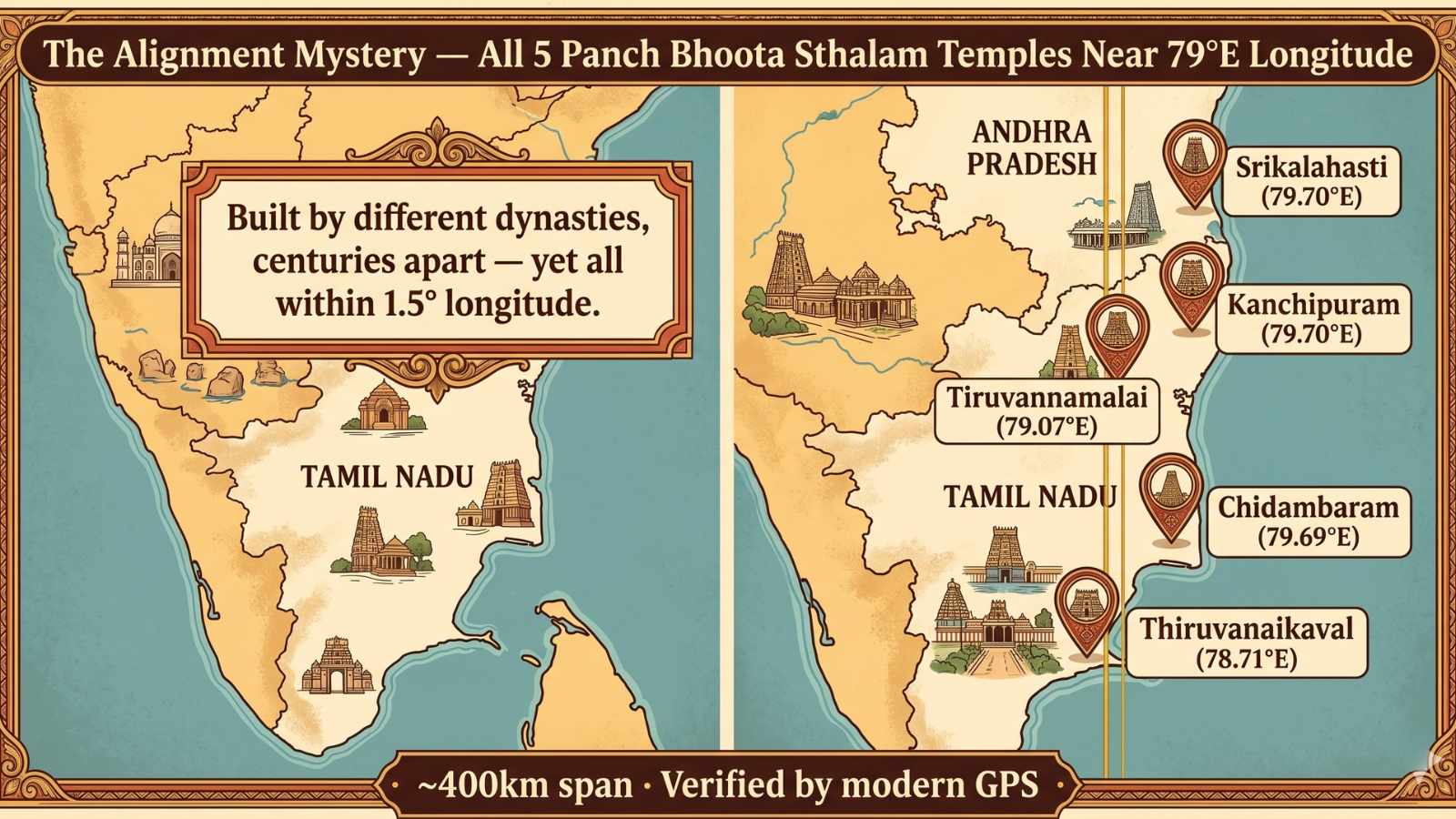
One of the most fascinating geographical features of the Panch Bhoota Sthalam circuit becomes clear when you plot the GPS coordinates of all five temples on a map: all five shrines lie within a narrow 1-degree longitudinal corridor along the 79°E meridian (between 78.71°E and 79.70°E), stretching ~360 km north-to-south from 13.75°N down to 10.85°N. Even more remarkably, three of the five temples-Srikalahasti (79.70°E), Kanchipuram (79.70°E), and Chidambaram (79.69°E)-sit on virtually the exact same longitudinal line (within one-hundredth of a degree!), linking up with northern Jyotirlingas like Kedarnath (79.06°E) along India's ancient Dakshinapatha sacred meridian:
| Temple (North to South) | Latitude | Longitude | Element |
|---|---|---|---|
| 1. Srikalahasti (AP) | 13.75°N (13°44'N) | 79.70°E (79°42'E) | Vayu (Air) |
| 2. Kanchipuram (TN) | 12.85°N (12°50'N) | 79.70°E (79°42'E) | Prithvi (Earth) |
| 3. Tiruvannamalai (TN) | 12.23°N (12°13'N) | 79.07°E (79°04'E) | Agni (Fire) |
| 4. Chidambaram (TN) | 11.40°N (11°23'N) | 79.69°E (79°41'E) | Akasha (Ether/Space) |
| 5. Thiruvanaikaval, Trichy (TN) | 10.85°N (10°51'N) | 78.71°E (78°42'E) | Apas (Water) |
10. Complete Panch Bhoota Sthalam Pilgrimage Circuit - 4-Day Route-Optimised Itinerary
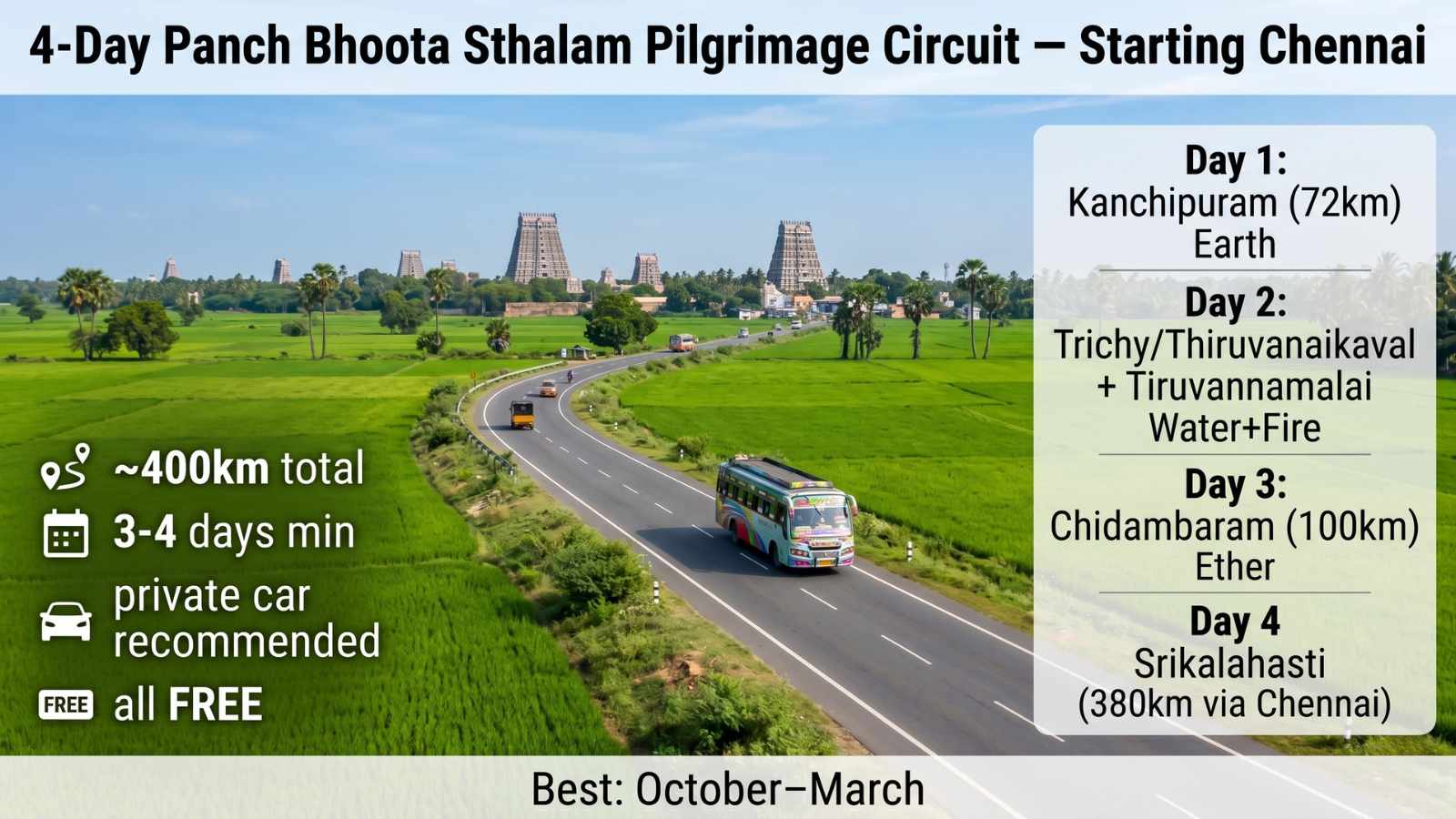
While the north-to-south straight-line distance between Srikalahasti and Thiruvanaikaval is ~360 km, a complete circular road trip starting and ending at Chennai (or Tirupati) covers approximately 950 to 1,050 km of highway driving. Below is the most efficient 4-day route-optimised itinerary that avoids backtracking and respects the 12:30 PM - 4:00 PM afternoon closure at the four Tamil Nadu temples:
| Day | Temple(s) & Element | Route Logistics, Distances & Night Stay |
|---|---|---|
| Day 1 | 1. Kanchipuram (Earth) + 2. Tiruvannamalai (Fire) | Depart Chennai at 5:30 AM (72 km) → Morning darshan at Ekambareswarar Temple (7:30-10:00 AM) + optional Kanchi Kamakshi Amman → Drive 115 km south (2.5 hrs) to Tiruvannamalai → Afternoon/evening darshan at Annamalaiyar Temple & Sri Ramanasramam · Night stay: Tiruvannamalai |
| Day 2 | 3. Thiruvanaikaval, Trichy (Water) | Optional dawn Girivalam at Tiruvannamalai → Drive 195 km south (3.5 hrs via NH-38) to Tiruchirappalli (Trichy) → Witness the 12:00 PM noon priest-in-saree Uchikala Pooja or 4:00 PM darshan at Jambukeswarar Temple, Thiruvanaikaval (and adjacent Srirangam Temple, 3 km away) · Night stay: Trichy or Kumbakonam |
| Day 3 | 4. Chidambaram (Ether / Space) | Drive 165 km northeast from Trichy (via Thanjavur/Kumbakonam) to Chidambaram → Witness the Spatika Linga abhishekam & Chidambara Rahasya darshan at Thillai Nataraja Temple → Afternoon drive up the scenic East Coast Road via Pondicherry (65 km) toward Chennai/Tirupati · Night stay: Pondicherry, Chennai, or Tirupati |
| Day 4 | 5. Srikalahasti (Air) | Drive to Srikalahasti, Andhra Pradesh (115 km north of Chennai / 36 km east of Tirupati) → Witness the flickering Vayu Lingam lamp at Sri Kalahasteeswara Temple & perform Rahu-Ketu puja if desired (note: Srikalahasti stays open all afternoon without closure!) → Return to Tirupati Airport/Station (36 km) or Chennai (115 km) · Panch Bhoota Sthalam Yatra COMPLETE! |
Practical Travel Tips for Your Panch Bhoota Sthalam Yatra
October to March offers pleasant 21-30°C weather across Tamil Nadu and Andhra Pradesh. Avoid April-June midday heat (38-42°C). For Karthigai Deepam (Nov-Dec) or Maha Shivaratri, book hotels 60-90 days ahead.
The 4 Tamil Nadu temples (Kanchipuram, Thiruvanaikaval, Tiruvannamalai, and Chidambaram) close strictly between 12:30/1:00 PM and 3:30/4:00 PM. Schedule your highway driving during those afternoon hours! (Only Srikalahasti remains open all afternoon.)
The classical philosophical progression moves from gross to subtle: Earth → Water → Fire → Air → Ether. On a practical road trip from Chennai, following the geographical loop above saves over 350 km of backtracking.
Traditional Indian attire is strictly enforced: Dhoti/Veshti with angavastram/shirt or formal trousers with shirt (men), and Saree, half-saree, or Salwar Kameez with dupatta (women). Shorts and sleeveless tops are barred.
Official Rahu-Ketu Sarpa Dosha puja tickets (₹500, ₹750, ₹1,500, ₹2,500 & ₹5,000, including silver Naga idols and puja samagri) are available at the official temple counters inside Srikalahasti from 6:00 AM to 6:00 PM.
Photography is permitted in outer courtyards to capture the gopurams, but is strictly prohibited inside all inner sanctums (and inside the Chit Sabha enclosure at Chidambaram and the inner queue at Srikalahasti).
11. FAQs - Panch Bhoota Sthalam (2026-2027)
Have a question about planning your 4-day Panch Bhoota Sthalam road trip from Chennai or Tirupati, combining Srikalahasti with Tirumala Balaji darshan, or visiting Tiruvannamalai for Pournami Girivalam? Send me a message here-I read and reply to every fellow pilgrim personally. - Devendra Khambalkar, Nagpur
Written by Devendra Khambalkar, Nagpur, Maharashtra | Last updated: October 2026. All temple timings, ritual details, and historical records are verified from the Tamil Nadu HR&CE Department (hrce.tn.gov.in), Andhra Pradesh Endowments Department, and Archaeological Survey of India (asi.nic.in). Temple timings may vary during Karthigai Deepam, Panguni Uthiram, Arudra Darshan, and Maha Shivaratri festivals. All five Panch Bhoota Sthalam temples are FREE for general darshan. Om Namah Shivaya!