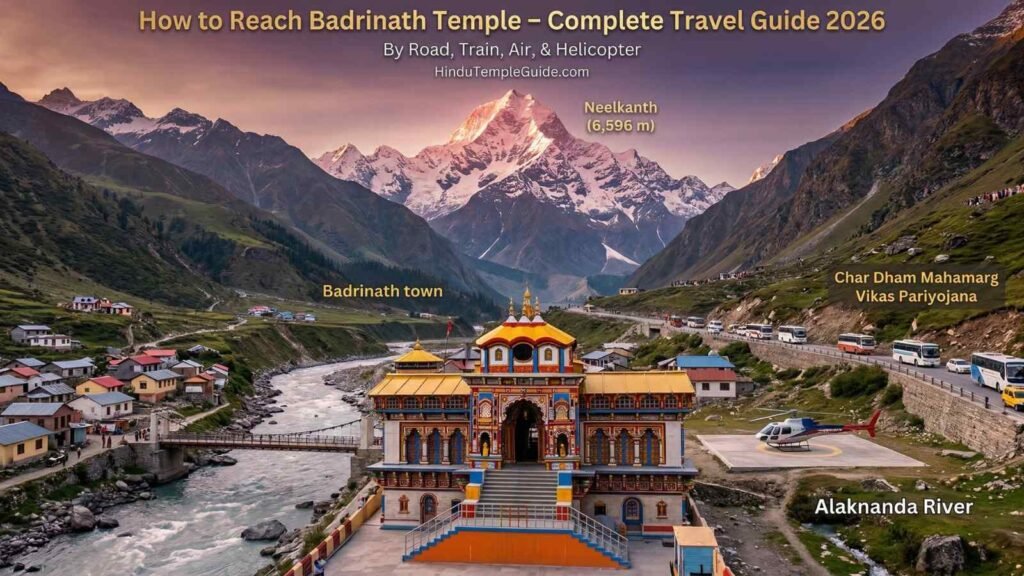
Introduction: My Journey Along the Alaknanda to Badrinath Dham
After the physical test of trekking 16 km to Kedarnath on my Char Dham Yatra, driving up the Alaknanda valley from Rudraprayag and Joshimath into Shri Badrinath Dham felt like entering a different world altogether. Sitting at an altitude of 3,133 metres (10,279 feet) between the Nar and Narayan mountain ranges-with the snow-clad pyramid of Neelkanth Peak towering right behind the colourful সিংহद्वार (Singhdwar) facade-Badrinath is the only shrine in the Himalayan Char Dham where the highway brings you right into the temple town.
Even though no mountain trek is required, planning a smooth journey to Badrinath still takes careful timing around the 300+ km mountain drive from Haridwar/Rishikesh, mandatory Uttarakhand Yatra registration, early-morning Mahabhishek and Tapt Kund dips, and choosing whether to stay in Badrinath town or acclimatize at Joshimath. In this guide, I share the verified 2026 kapat schedule, road, train, flight, and Dehradun charter helicopter options, darshan timings, and practical lessons from my own visit.
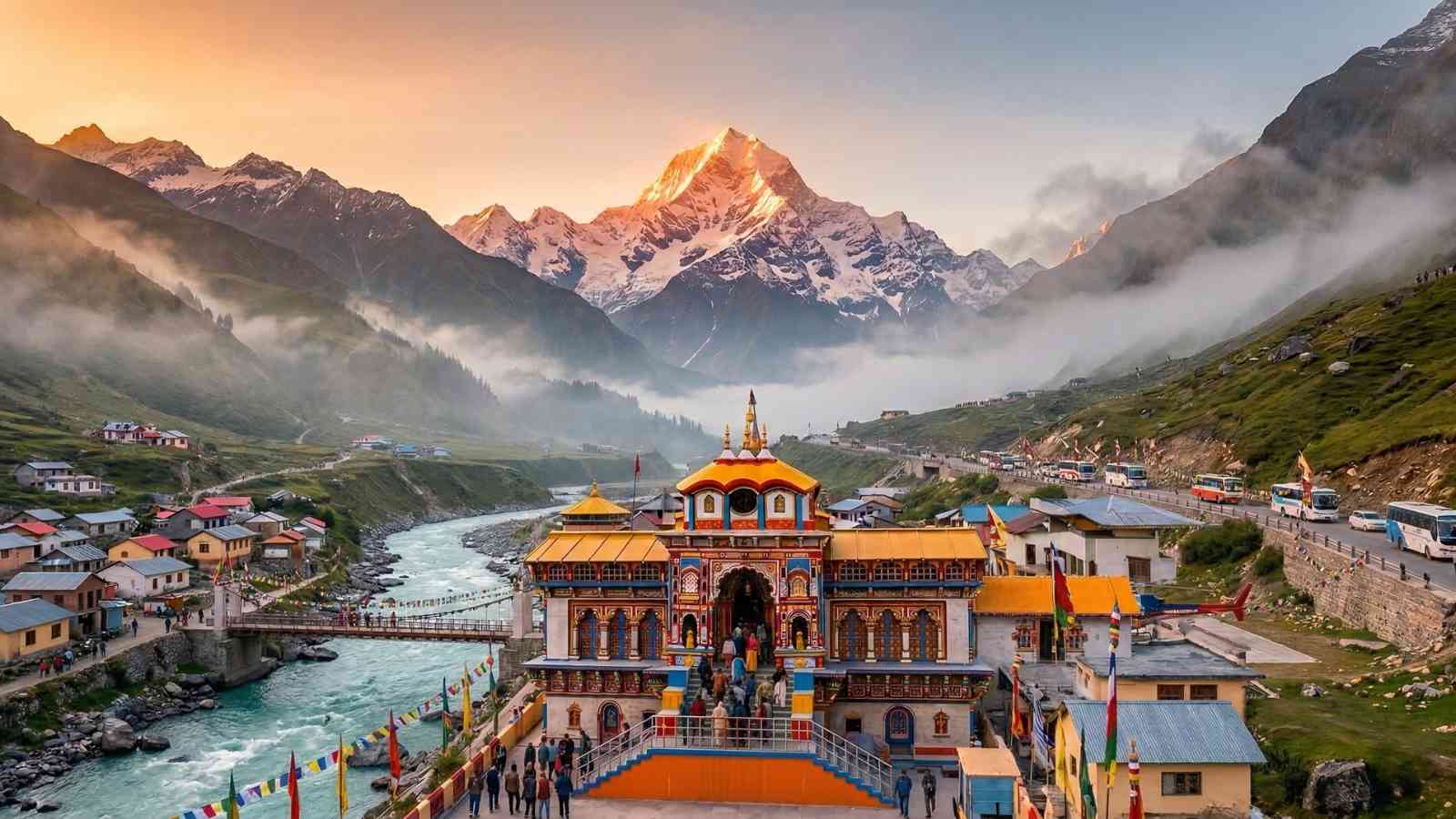
Shri Badrinath Dham illuminated at twilight along the banks of the Alaknanda River beneath Neelkanth Peak.
"When you step out of the steaming waters of Tapt Kund in the freezing pre-dawn air and look up at the golden kalash of Badri Vishal, the fatigue of the 10-hour mountain drive disappears immediately."
Badrinath Temple: History, Significance & Sacred Legend
The Legend of Badri Van and Adi Shankaracharya's Revival
According to the Bhagavata Purana, Skanda Purana, and Mahabharata, Lord Vishnu performed deep penance here in the dual forms of the sages Nara and Narayana for the welfare of all living beings. To shield Lord Vishnu from the harsh Himalayan sun and snow during his meditation, Goddess Lakshmi took the form of a wild berry tree-a Badri (jujube) tree (Badari Taru)-earning the Lord the name Badri विशाल (Badrinarayan) and the valley the name Badri Van.
Inside the Garbha Griha sits the 1-foot-tall self-manifested (Swayambhu) black Shaligram stone murti of Lord Badrinarayan seated in Padmasana (lotus posture) with four arms holding the Shankha (conch) and Chakra in two raised hands while the lower two rest in a meditative mudra on his lap. Tradition holds that in the 8th century CE, Adi Shankaracharya discovered this sacred Shaligram idol inside Narada Kund (a deep pool in the Alaknanda River right below the temple) and enshrined it inside the Garbha Griha beneath the Garud Gufa. The colourful arched Singhdwar facade and gilded roof were later expanded by the rulers of the Garhwal Kingdom and Maharani Ahilyabai Holkar of Indore.
Why Badrinath Holds Unique Importance Across Traditions
Badrinath is the final culmination point of both the Uttarakhand Char Dham Yatra and the all-India Char Dham circuit established by Adi Shankaracharya (alongside Rameswaram, Dwarka, and Jagannath Puri):
- Head of the Panch Badri Circuit: Badrinath (Vishal Badri) is the principal shrine among Uttarakhand's five Badri temples-alongside Yogdhyan Badri (Pandukeshwar), Bhavishya Badri (Subhain), Vridha Badri (Animath), and Adi Badri (near Karnaprayag).
- Northernmost of the 108 Divya Desams: Celebrated in the Tamil verses of the Alvars (Periyalvar and Tirumangai Alvar) as Tiruvadariyashramam, drawing thousands of South Indian Vaishnava devotees every summer.
- The Rawal Tradition from Kerala: Honouring Adi Shankaracharya's lineage, the head priest (Rawal) of Badrinath is always a Namboodiri Brahmin from Kerala, assisted by Garhwali Dimri Brahmins from Dimmar village.
- Brahma Kapal & Tapt Kund: Just outside the temple along the Alaknanda sits Tapt Kund (a natural 45°C thermal sulphur spring) and Brahma Kapal, where offering Pind Daan for ancestors is believed to grant final liberation.
Badrinath Temple Opening & Closing Dates 2026: Kapat Schedule
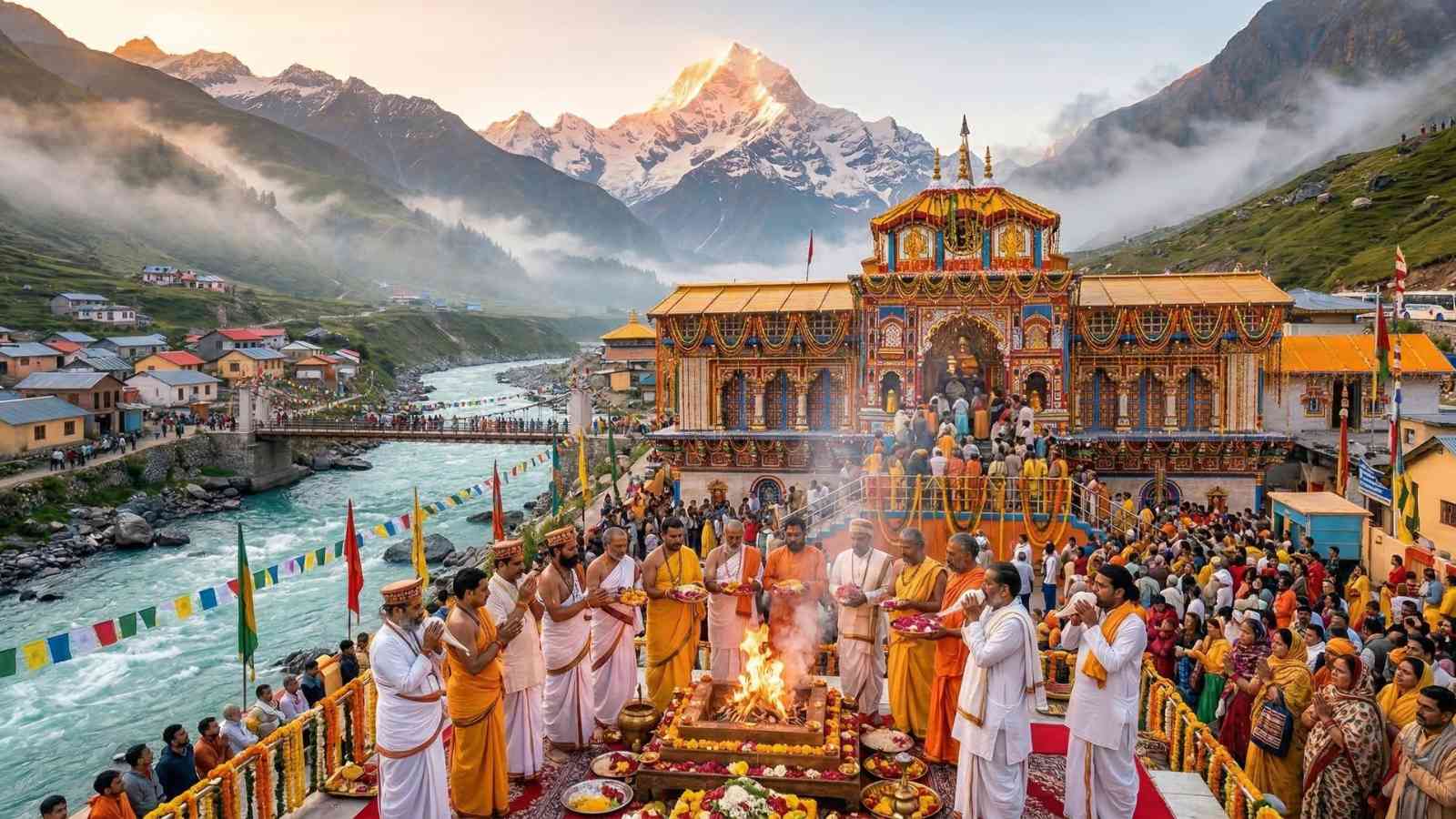
Priests and devotees gathered outside the marigold-decked Singhdwar for the ceremonial Kapat opening of Shri Badrinath Dham.
Every year on Basant Panchami, the royal priests at the court of the Tehri Naresh in Narendra Nagar calculate the auspicious opening muhurat of Badrinath Dham, followed by the sacred Gadu Ghada Tel Kalash Yatra (carrying cold-pressed sesame oil for the Lord's abhishekam). For the 2026 pilgrimage season, the Badrinath-Kedarnath Temple Committee (BKTC) opened the temple doors on 23 April 2026 at 6:15 AM.
Badrinath is always the last of the four dhams to close for winter. The exact closing date is formally announced on Vijayadashami (Dussehra) and falls in mid-November 2026 (expected around 13-20 November 2026) following the five-day Panch Puja closing rituals.
| Event | 2026 Date / Window | Pilgrim Details |
|---|---|---|
| 2026 Kapat Opening | 23 April 2026 (6:15 AM) | Announced on Basant Panchami at Narendra Nagar |
| Summer Peak Window | May - June 2026 | Pleasant daytime weather; highest family footfall |
| Monsoon Caution Window | July - August 2026 | Heavy rain & shooting-stone zones near Lambagarh |
| Autumn Clear-Sky Window | Mid-Sept - October 2026 | Crisp mountain views, shorter darshan queues |
| 2026 Kapat Closing | Mid-November 2026 (~13-20 Nov) | Final date confirmed by BKTC on Vijayadashami |
| Winter Worship Seat | Nov 2026 - April 2027 | Narasimha Temple (Joshimath) & Pandukeshwar |
How to Reach Badrinath Temple: All Travel Options Explained
Because National Highway 7 (formerly NH-58) runs all the way into Badrinath town, you can drive or take a state bus to within 300 metres of the temple courtyard. However, because mountain driving in Uttarakhand is restricted after 8:00 PM, you should always plan an overnight halt on the way up from Haridwar or Rishikesh.
Badrinath Road Distance & Driving Time from Key Hubs
| City / Starting Point | Road Distance | Realistic Driving Time |
|---|---|---|
| New Delhi (Kashmere Gate) | ~525 km | 14-16 hrs (1 night halt required) |
| Haridwar Railway Station | ~318 km | 10-11 hrs |
| Rishikesh (ISBT / Natraj Chowk) | ~294 km | 9-10.5 hrs |
| Dehradun / Jolly Grant Airport (DED) | ~312 - 335 km | 9.5-11 hrs |
| Rudraprayag (Kedarnath-Badrinath Junction) | ~154 km | 5-6 hrs |
| Sonprayag / Guptkashi (via Chopta-Gopeshwar) | ~205 - 225 km | 7-8 hrs |
| Joshimath (Jyotirmath) | ~45 km | 1.5-2 hrs |
1. How to Reach Badrinath by Road (The Panch Prayag Highway)
Driving from Rishikesh to Badrinath along the widened Char Dham All-Weather Highway (NH-7) is one of the most spiritually rewarding road journeys in India because you pass four of Uttarakhand's five sacred river confluences (Panch Prayag) right from your window:
Highway Route: Haridwar → Rishikesh → Devprayag → Srinagar → Rudraprayag → Karnaprayag → Nandaprayag → Pipalkoti → Joshimath → Vishnuprayag → Pandukeshwar → Badrinath
- Direct Morning Buses from Haridwar & Rishikesh: Uttarakhand Transport Corporation (UTC), GMOU, and TGMO Co-operative buses depart Haridwar and Rishikesh ISBT between 4:30 AM and 7:00 AM daily during yatra season (ticket fare: ₹650-₹950 per seat; ~10.5 hours).
- Where to Break the Journey if Driving: If you are travelling with family or coming fromKedarnath (Sonprayag/Guptkashi), break your drive overnight at Rudraprayag, Pipalkoti, or Joshimath so you reach Badrinath fresh in the morning.
- Shared Jeeps & Taxis: Shared Maxx/Bolero jeeps run frequently between Rishikesh, Srinagar, Rudraprayag, and Joshimath, with local shuttles connecting Joshimath to Badrinath (45 km).
2. How to Reach Badrinath by Train
While the Rishikesh-Karnaprayag broad-gauge mountain railway line is currently under construction through tunnel corridors, the nearest operational railheads today are in the foothills:
| Railway Station | Road Distance to Badrinath | Why Choose This Station |
|---|---|---|
| Yog Nagari Rishikesh (YNRK) | ~294 km | Closest railhead; right next to mountain bus stand |
| Haridwar Junction (HW) | ~318 km | Best national connectivity (Vande Bharat, Shatabdi, Rajdhani) |
| Dehradun Terminal (DDN) | ~335 km | Best if taking a Sahastradhara charter helicopter |
| Kotdwar (KTW) | ~310 km | Alternative route via Pauri & Srinagar |
From Haridwar or Rishikesh railway station, you can board an early-morning state bus (₹650-₹950 per seat) or hire a private outstation cab (typically ₹9,000-₹14,000 one way for a full sedan/SUV depending on season).
3. How to Reach Badrinath by Air
The closest commercial airport is Jolly Grant Airport in Dehradun (IATA: DED), situated roughly 20 km from Rishikesh and 312 km by road from Badrinath.
| Airport / Helipad | Distance to Badrinath | Connectivity |
|---|---|---|
| Jolly Grant Airport, Dehradun (DED) | ~312 km by road | Direct flights from Delhi, Mumbai, Bengaluru, Hyderabad & Lucknow |
| Sahastradhara Helipad (Dehradun) | ~55 mins by chopper | Base for Ek-Dham, Do-Dham & Char-Dham charter helicopters |
| Badrinath Helipad | 1 km from temple | Car transfer provided by charter operators to the temple gate |
4. Badrinath Helicopter Service 2026: Charter Packages & Costs
Unlike Kedarnath (which has ₹5,770-₹8,500 short-hop IRCTC shuttles from Phata and Sersi because there is no motorable road), Badrinath is connected directly by highway and therefore does not have a cheap short-hop IRCTC shuttle. Instead, helicopter flights to Badrinath operate as full-service charter packages out of Sahastradhara Helipad in Dehradun:
| Charter Helicopter Package | Duration | Estimated Cost (Per Person) |
|---|---|---|
| Dehradun ↔ Badrinath Same-Day Charter | ~50-60 mins each way (1 day) | ₹90,000 - ₹1,30,000 |
| Do Dham (Kedarnath + Badrinath) ex-Dehradun | Same-day return | ₹1,20,000 - ₹1,45,000 |
| Complete 4 Dham Helicopter Yatra ex-Dehradun | 4 to 5 days | ₹1,90,000 - ₹2,50,000+ |
- Book 60-90 days in advance through DGCA-approved NSOP charter operators for May-June and September-October windows.
- Charter packages include ground car transfer from the Badrinath helipad (1 km away) and assisted darshan coordination.
- For full details on operators and scam warnings, read my Helicopter Booking Guide for Temple Yatra 2026.
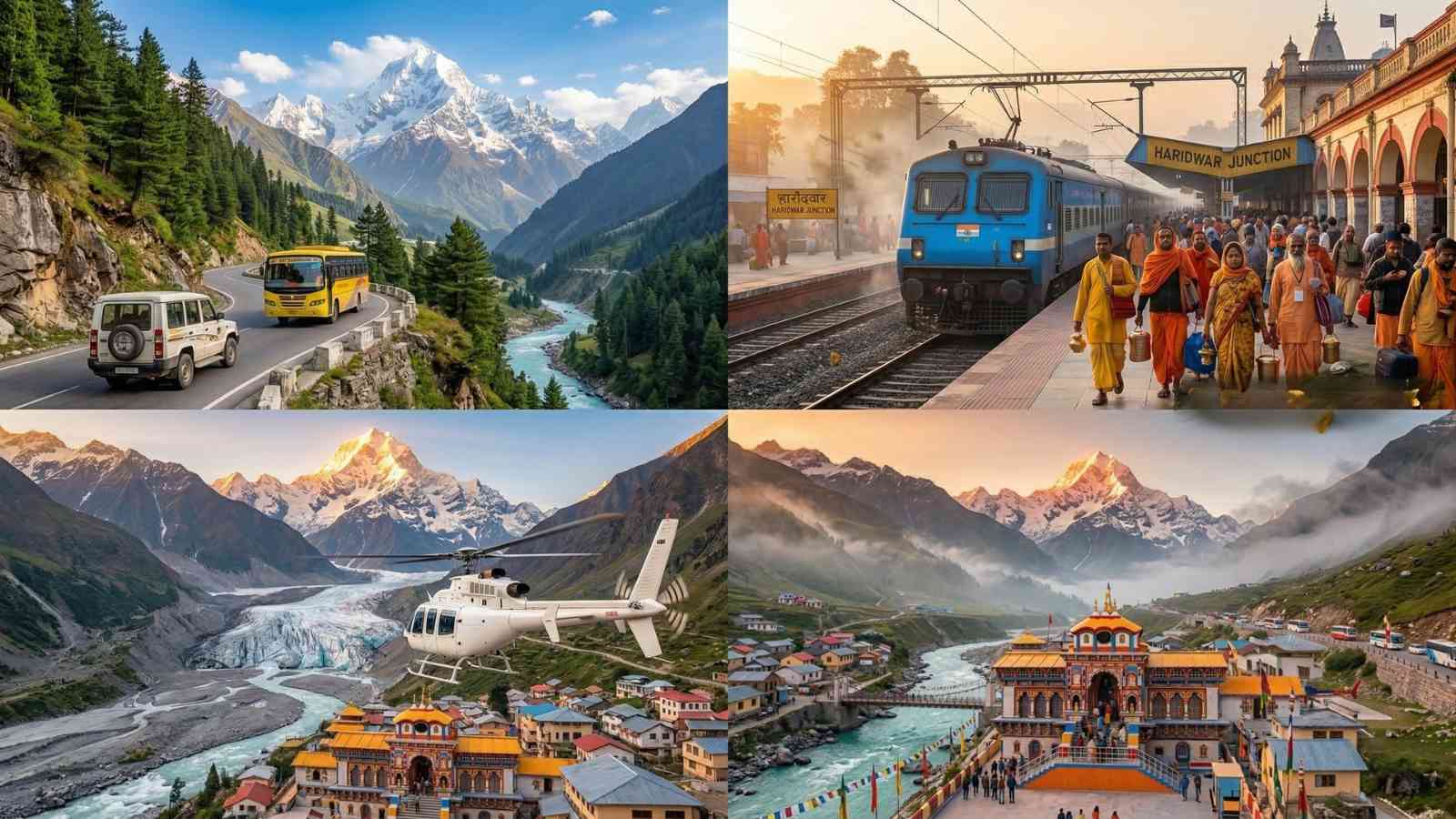
The scenic NH-7 highway winding along the Alaknanda gorge through Joshimath and Vishnuprayag to Badrinath.
Badrinath Yatra Registration 2026: Free & Mandatory
Every devotee travelling to Badrinath must complete Uttarakhand Char Dham Yatra Registration before entering the mountain check-posts. Registration is 100% free of cost (₹0)-never pay any website or agent claiming to charge a registration fee.
How to Register Online in 5 Minutes
- Official Portal: Register online at registrationandtouristcare.uk.gov.in, via the Tourist Care Uttarakhand mobile app, or by sending
Yatraon WhatsApp to +91 8394833833. - Required Documents: Aadhaar Card, Voter ID, or Passport, along with an active mobile number for OTP verification.
- Registration Fee: Completely FREE (₹0) across the official website, app, and physical counters.
- Offline Biometric Counters: Available at Haridwar (near railway station), Rishikesh ISBT, Joshimath, and Pakhi (Chamoli) for travellers who could not register online.
- Verification Checkpoints: Keep a printed copy of your QR Yatra Pass handy-it is scanned at Gauchar/Pakhi on the highway and at the Badrinath darshan token counter.
Badrinath Temple Darshan Timings & Daily Aarti Schedule
If you stay overnight in Badrinath town, wake up at 3:45 AM, take a quick dip in the hot waters of Tapt Kund right below the temple steps, and join the early queue for the 4:30 AM Mahabhishek Puja. Seeing the black Shaligram idol of Lord Badrinarayan bathed in ghee, honey, and panchamrit before being dressed in gold and diamond ornaments is an unforgettable sight.
| Daily Ritual / Puja | Official Timing | What Happens Inside the Sanctum |
|---|---|---|
| Mahabhishek & Abhishek Puja | 4:30 AM - 6:30 AM | Sacred bath of the Shaligram idol (Nirvana Darshan) |
| Morning General Darshan | 7:00 AM - 12:00 PM | Full Alankara (ornamented) darshan open to all devotees |
| Madhyahna Bhog & Afternoon Closure | 12:00 PM - 3:00 PM | Midday meal offering at 12:00 PM; temple closes 1:00-3:00 PM |
| Afternoon & Evening Darshan | 3:00 PM - 9:00 PM | Shorter queues than morning; Special Pujas & Sahasranama |
| Swarna / Kapoor Aarti & Geet Govind Path | 6:30 PM - 8:30 PM | Evening aarti followed by recitation of Jayadeva's Geet Govind |
| Shayan Aarti (Night Closing) | 8:30 PM - 9:00 PM | Floral shringar removed; sandalwood paste applied before closing |
Where to Stay: Badrinath Town vs. Joshimath
Unlike Kedarnath-where accommodation is limited to basic tents and lodges-Badrinath has a wide range of dharamshalas, GMVN guesthouses, and comfortable hotels right in town, plus excellent resorts 45 km lower in Joshimath:
1. Staying Right in Badrinath Town (Best for 4:30 AM Morning & 8:30 PM Shayan Aarti)
- GMVN Devlok Tourist Rest House & Yatri Niwas: Located near the bus stand within walking distance of the temple bridge; book online at gmvnl.in (₹800-₹4,500).
- BKTC Temple Trust Rest Houses: Budget rooms and dormitories managed by the temple committee (badrinath-kedarnath.gov.in).
- Private Hotels & Ashrams (Bholagiri Ashram, Narayan Palace, Sarovar Portico, Snow Crest): Range from ₹1,200 budget rooms to ₹8,000+ heated family suites with geysers and parking.
2. Staying in Joshimath / Pipalkoti (Best for Senior Citizen Acclimatization)
Because Badrinath sits above 10,200 feet where nights are freezing and oxygen is slightly thinner, many families with senior citizens prefer sleeping at Joshimath (1,890 m, 45 km before Badrinath) or Pipalkoti (1,260 m, 77 km before Badrinath), driving up to Badrinath at 6:00 AM for darshan and Mana Village, and returning to lower altitude by evening.
Best Time to Visit Badrinath Temple: Month-by-Month Guide
If your schedule is flexible, mid-September to late October is my personal favourite window for Badrinath: the monsoon landslides are over, the Alaknanda turns a deep emerald green, Neelkanth Peak stands out against cloudless blue skies, and hotel tariffs drop by 30% compared to May-June.
| Months | Temperature | Crowd Level | Pilgrim Verdict |
|---|---|---|---|
| Late April - June | 5°C to 16°C | Very High | ✅ Best for summer family trips |
| July - August | 8°C to 14°C | Low-Moderate | ⚠️ Avoid due to highway landslides |
| Mid-Sept - October | 2°C to 12°C | Moderate | ✅ Best overall (clear skies & fast darshan) |
| Early-Mid November | -5°C to 6°C | Low (High on closing day) | ⚠️ Sub-zero nights; pack heavy woollens |
Sacred Places Around Badrinath You Should Not Miss
Do not leave Badrinath right after temple darshan-set aside 3 hours to drive 3 km north to Mana Village (India's First Village near the Indo-Tibetan border), where the final chapters of the Mahabharata unfolded:
- 1. Mana Village, Vyas Gufa & Ganesh Gufa (3 km from Badrinath): Walk through the stone lanes of Mana to see Vyas Gufa (where Maharishi Ved Vyasa dictated the Mahabharata and Puranas, with layered stone rock formations overhead called Vyasa Pustak) and Ganesh Gufa (where Lord Ganesha transcribed the epic).
- 2. Bhim Pul & Origin of the Saraswati River (Inside Mana Village): A massive natural boulder bridge placed across the thundering Saraswati River gorge by Bhima so Draupadi could cross on their final ascent to Swargarohini.
- 3. Tapt Kund & Narada Kund (Below the Temple Steps): Separate covered bathing enclosures for men and women allow you to bathe in the 45°C natural geothermal sulphur water before entering the temple lane.
- 4. Mata Murti Temple (3 km walk/drive near Mana): Dedicated to the mother of Nara and Narayana; a major fair takes place here every September on Vamana Dwadashi.
- 5. Charan Paduka (3 km meadow hike above Badrinath): A boulder bearing the footprints of Lord Vishnu set in a high alpine meadow with close-up views of Neelkanth Peak.
- 6. Vasudhara Falls (6 km trek beyond Mana Village): A 400-foot waterfall cascading down sheer rock cliffs along the old Swargarohini trail.
- 7. Yogdhyan Badri at Pandukeshwar & Narasimha Temple at Joshimath (On the Return Highway): Stop at Pandukeshwar (24 km below Badrinath, founded by King Pandu) and Narasimha Temple in Joshimath (Lord Badrinarayan's winter seat) on your drive back toward Rudraprayag.
Badrinath Yatra Tips: Do's, Don'ts & What to Pack
Here are the practical ground tips from my own trip that will save you time at the temple plaza and on the highway:
Do's
- Collect your free time-slot token at the Badrinath bus stand / arrival plaza as soon as you reach town so you don't stand in the bridge queue for hours.
- Carry a change of dry clothes and a small towel if taking a dip in the hot sulphur waters of Tapt Kund before darshan.
- Buy Tulsi garlands and roasted chana dal prasad outside the Singhdwar-Tulsi is the most cherished offering to Lord Badrinarayan.
- Cross the Joshimath-Badrinath stretch during daylight hours (between 6:00 AM and 5:00 PM).
Don'ts
- Do not blow conch shells (Shankha) in Badrinath-even inside the temple, priests do not blow the Shankha for acoustic and ecological reasons in the snowbound valley.
- Do not carry leather belts, wallets, cameras, or mobile phones past the Singhdwar security frisking point (free cloakrooms are available outside).
- Do not step directly into Tapt Kund without testing the water temperature first, as the natural spring is very hot (45°C).
- Do not drive in the mountains after dark; police gates at Joshimath and Pandukeshwar close to night traffic around 8:00 PM.
Essential Packing List for Badrinath
- Thermal innerwear, fleece sweater, windproof down jacket, woollen socks, and cap (even in June, icy winds blow off Neelkanth Peak after sunset).
- Original Aadhaar Card + 2 printed copies of your free Uttarakhand Yatra Registration Pass.
- Motion-sickness tablets (Avomine) or ginger candy for the winding mountain bends between Devprayag and Joshimath.
- ₹3,000-₹5,000 in physical cash for prasad, local cabs to Mana Village, and dhabas where UPI connectivity drops.
Frequently Asked Questions (FAQs)
Q1. When did Badrinath Temple open in 2026, and when does it close for winter?
For the 2026 season, the ceremonial doors (kapat) of Shri Badrinath Dham opened on 23 April 2026 at 6:15 AM. The temple remains open through mid-November 2026 (expected closing around 13-20 November 2026, formally announced by BKTC on Vijayadashami). During winter, worship shifts to Narasimha Temple in Joshimath.
Q2. Is there any walking trek required to reach Badrinath Temple?
No trek is required. National Highway 7 goes right into Badrinath town. From the main parking lot and bus stand, the temple entrance (Singhdwar) is a flat 300 to 500 metre paved walk across the Alaknanda bridge, with wheelchair and palki assistance available for senior citizens.
Q3. Is Uttarakhand Yatra registration free or paid for Badrinath?
Registration is 100% free of cost (₹0) and mandatory for every pilgrim. Register online at registrationandtouristcare.uk.gov.in before starting your trip.
Q4. How many days are needed for a Badrinath trip from Haridwar or Rishikesh?
Plan a minimum of 3 to 4 days from Haridwar/Rishikesh: Day 1 drive from Rishikesh to Joshimath/Pipalkoti, Day 2 morning drive to Badrinath for darshan, Mana Village, and evening aarti, and Day 3 return drive to Rishikesh/Haridwar. If combining both Kedarnath and Badrinath (Do Dham by road), allow 5 to 6 days.
Q5. How can I book a special puja (Mahabhishek or Geet Govind Path) at Badrinath?
All official inside-sanctum pujas-including Mahabhishek, Abhishek, Chandi Aarti, and Geet Govind Path-are booked directly through the official Badrinath-Kedarnath Temple Committee website at badrinath-kedarnath.gov.in or at the BKTC booking counter in the temple courtyard.
Q6. How do I book a helicopter to Badrinath?
Because Badrinath is connected by road, helicopter services operate as full charter packages from Sahastradhara Helipad in Dehradun rather than short IRCTC shuttles. Read our complete Helicopter Booking Guide for Temple Yatra 2026 for package rates and operator details.
Conclusion: Jai Badri Vishal - Planning a Peaceful Yatra
Standing across the Alaknanda bridge in the crisp evening air-with the steam rising from Tapt Kund below and the bells of Shayan Aarti echoing against the snow walls of Neelkanth Peak-is one of the most peaceful moments you will experience anywhere in the Himalayas.
Break your road journey comfortably at Rudraprayag or Joshimath, register your free Yatra Pass before leaving home, and save a couple of hours after darshan to walk up to Bhim Pul in Mana Village. If you have any questions about road conditions, bus timings from Rishikesh, or combining Kedarnath with Badrinath, reach out to me here-I read every message personally.
"Jai Badri Vishal · Jai Baba Kedar! May Lord Badrinarayan bless you and your family with peace and safe travels."
- Devendra Khambalkar, Nagpur, Maharashtra
Combining Badrinath With Kedarnath on Your Trip?
Read my first-hand 16 km trek and helicopter guide for Kedarnath Dham before you go.
Explore More First-Hand Yatra Guides on HinduTempleGuide.com
- Kedarnath Temple Travel Guide 2026 - 16 km Trek, Registration & Tips
- Char Dham Yatra 2026 Complete Guide - Dates, Registration & Route
- Helicopter Booking Guide 2026 - Kedarnath, Badrinath & Vaishno Devi
- Tirupati Balaji Temple Guide 2026 - Darshan Types, SED Booking & Timings
- Nagchandreshwar Temple Ujjain - My 24-Hour Nag Panchami Darshan
Written by Devendra Khambalkar, Nagpur, Maharashtra | Last updated: October 2026. Information verified from official Badrinath-Kedarnath Temple Committee (badrinath-kedarnath.gov.in) and Uttarakhand Tourism (registrationandtouristcare.uk.gov.in) announcements.