
Chola Dynasty Temples – Complete Heritage Guide to India’s Greatest Temple Builders: Brihadeeswarar, Gangaikonda Cholapuram & Airavatesvara

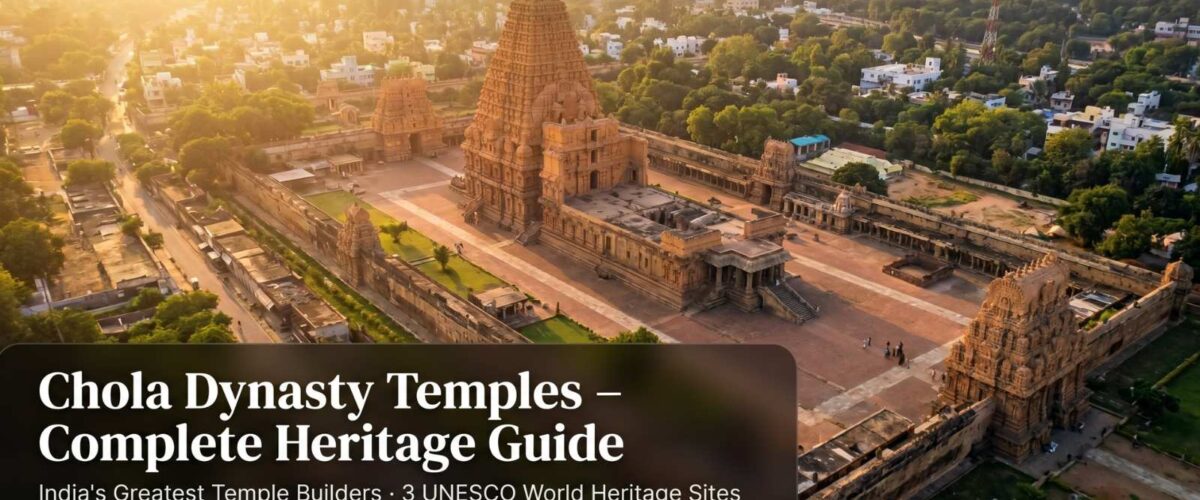
Chola dynasty temples standing a thousand years after the last Chola king walked their corridors are not ruins. They are not museums. They are living, breathing temples where priests perform the same daily rituals that Rajaraja Chola I himself watched over in the year 1010 CE. This is the extraordinary, almost incomprehensible fact at the heart of the Great Living Chola Temples that the world’s most accomplished medieval temple builders created not just architectural masterpieces, but living sacred organisms that have never stopped functioning for a thousand years.
The incense smoke that rises in the sanctum of Brihadeeswarar Temple today rises from the same sacred space where the Chola emperor himself received divine grace. The 80-ton capstone that crowns the Thanjavur vimana was placed there without cranes, without modern machinery by human hands guided by genius and devotion, in the year 1010 CE. Whether you are drawn here by devotion, by history, or by the sheer astonishment of human creative genius at its most magnificent the Chola dynasty temples will transform you. Om Namah Shivaya!
“The Great Chola Temples at Thanjavur, Gangaikondacholapuram and Darasuram represent outstanding creative achievement in the architectural conception of the pure form of the Dravidian type of temple. They are the most outstanding testimony to the development of the architecture of the Chola Empire and Tamil civilization in Southern India.”
UNESCO World Heritage Committee
Quick Navigation
Table of Contents
The Chola Empire – Who Were the World’s Greatest Temple Builders?
The Chola dynasty was one of the longest-ruling and most powerful empires in human history governing South India and parts of Southeast Asia for over four centuries (c. 848–1279 CE) from their capital at Thanjavur on the banks of the Kaveri River. At the peak of their power under Rajaraja Chola I (985–1014 CE) and his son Rajendra Chola I (1014–1044 CE), the Chola Empire stretched across all of peninsular India, Sri Lanka, the Maldives, and even launched military campaigns as far as the Malay Peninsula, Sumatra, and Cambodia making it one of ancient Asia’s most expansive naval empires.
What made the Cholas truly unique was not their military might but their extraordinary patronage of art, architecture, literature, and temple building. In Chola ideology, the king was the representative of Shiva on earth and his temple was the expression of that divine mandate. Therefore, each Chola monarch built his temple not merely as an act of devotion but as a cosmic statement of power, order, and dharma.
| Chola King | Key Achievement & Temple |
|---|---|
| Vijayalaya Chola (848 CE) | Founded the imperial Chola dynasty · Built earliest Chola temples at Thanjavur |
| Aditya Chola I (c. 870–907) | Built temples along Kaveri River · Laid foundation of Chola temple tradition |
| Rajaraja Chola I (985–1014) | Built Brihadeeswarar Temple Thanjavur (1010 CE) greatest Chola achievement |
| Rajendra Chola I (1014–1044) | Conquered up to Ganges · Built Brihadeeswarar Gangaikonda Cholapuram (1035 CE) |
| Rajaraja Chola II (c. 1146–1173) | Built Airavatesvara Temple Darasuram (c. 1166 CE) most ornate of the three |
| Kulottunga Chola III (1178–1218) | Late Chola period · Built Kampaheswarar Temple Kumbakonam |
Chola Temple Architecture – Understanding the Genius of Dravidian Design
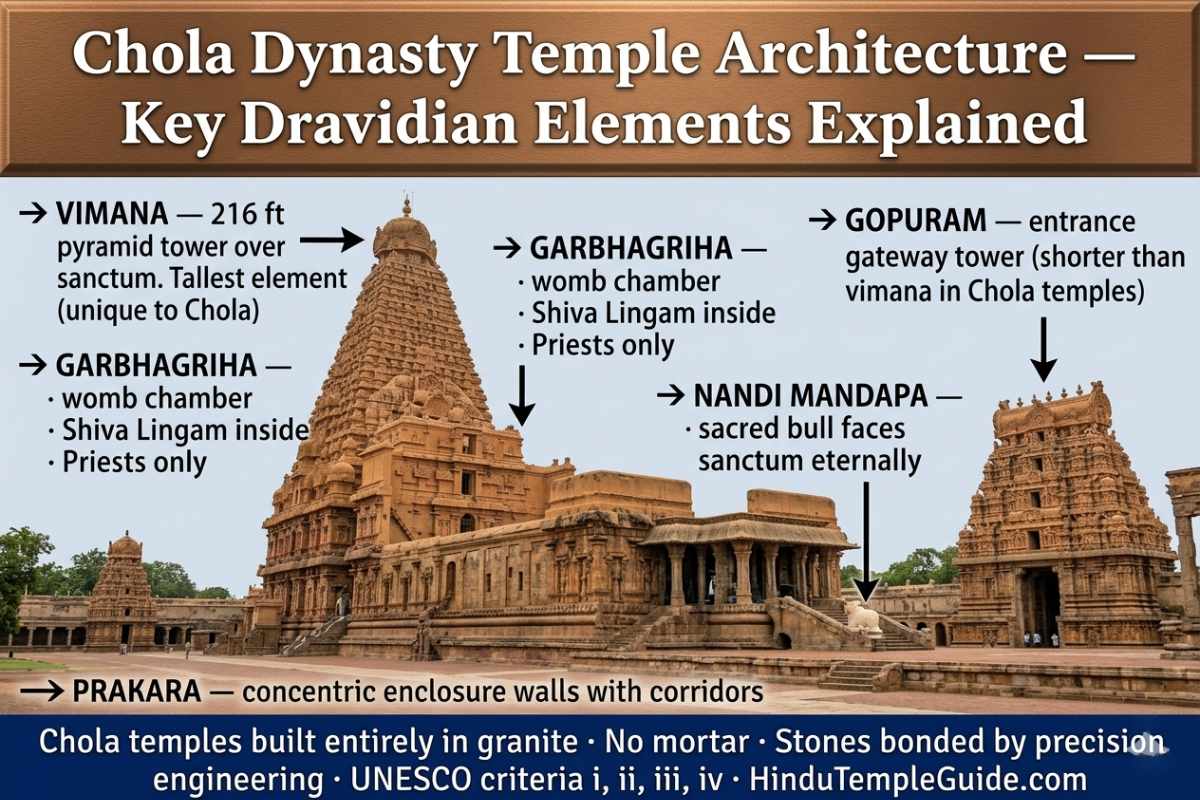
The genius of Chola dynasty temple architecture lies in its ability to embody the entire cosmological order of Hinduism in stone. Unlike other temple traditions where the entrance gopuram is the tallest structure, Chola temples make the vimana above the sanctum the tallest element symbolizing that the deity at the centre is supreme. The vimana is understood as a mountain the sacred Mount Meru rising from earth to heaven, with the deity’s presence at its heart. Every element is governed by precise rules from the ancient texts of Vastu Shastra and Agama Sastra.
Key Chola Architecture Elements
Brihadeeswarar Temple, Thanjavur – The Crown Jewel of Chola Dynasty Temples
Temple 1 · Built by Rajaraja Chola I · Completed 1010 CE · UNESCO World Heritage (1987)
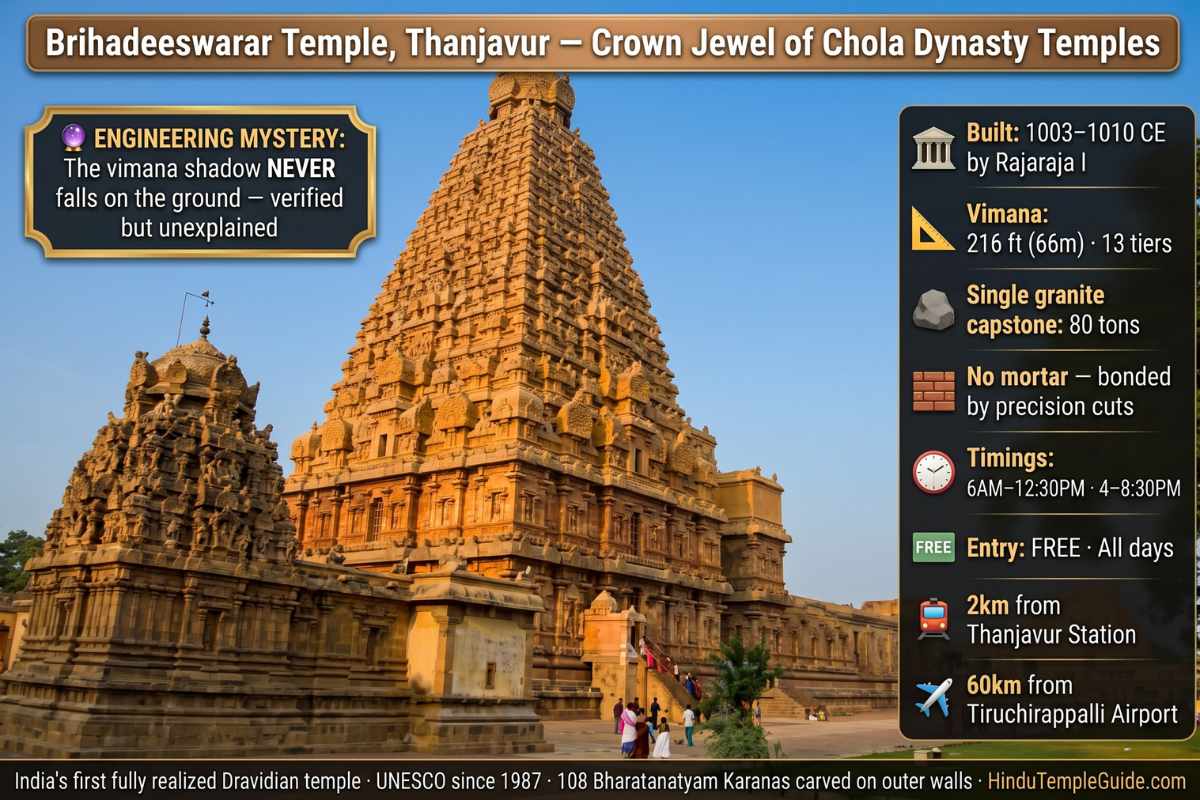
| Also Known As | Big Temple · Peruvudaiyar Kovil · Rajarajeswaram · Dakshina Meru |
| UNESCO Inscription | 1987 · Great Living Chola Temples · Criterion i, ii, iii, iv |
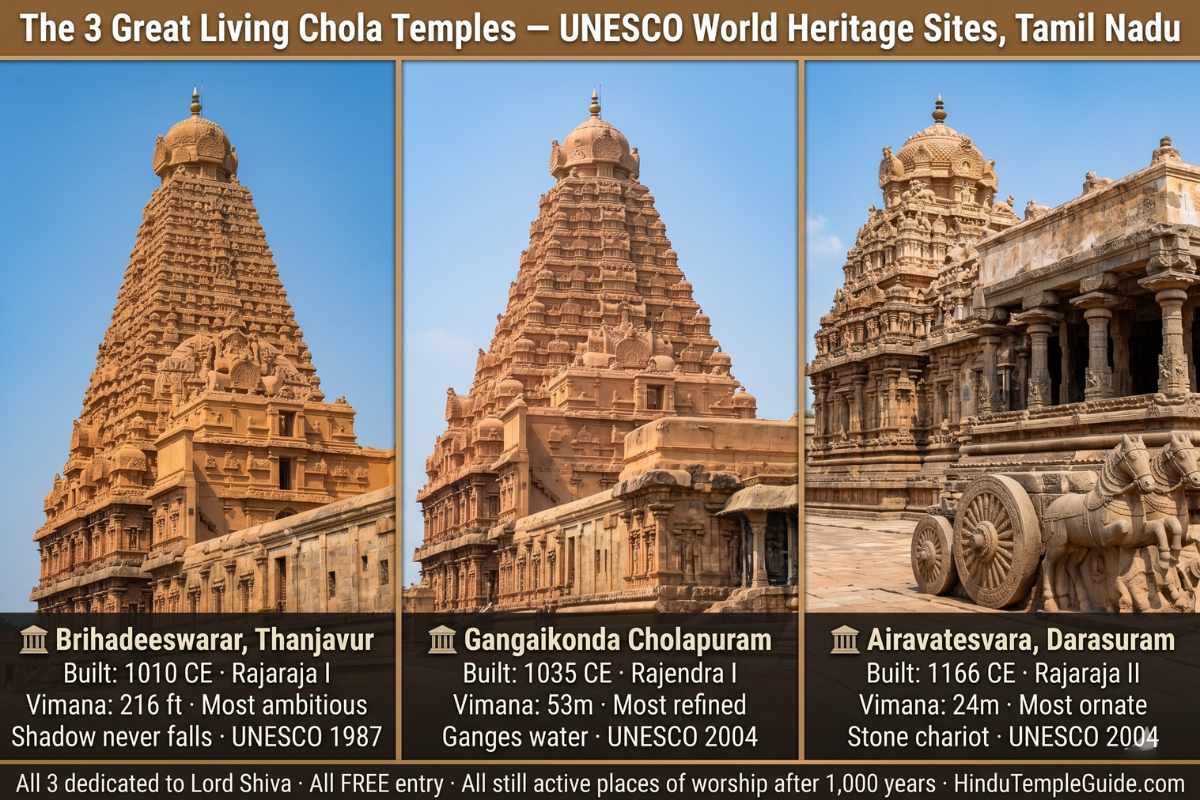
| Vimana Height | 216 feet (66 metres) one of the tallest temple towers in the world |
| Capstone Miracle | Single granite stone weighs 80 tons placed without cranes in 1010 CE |
| Shadow Miracle | Vimana shadow NEVER falls on the ground verified engineering mystery |
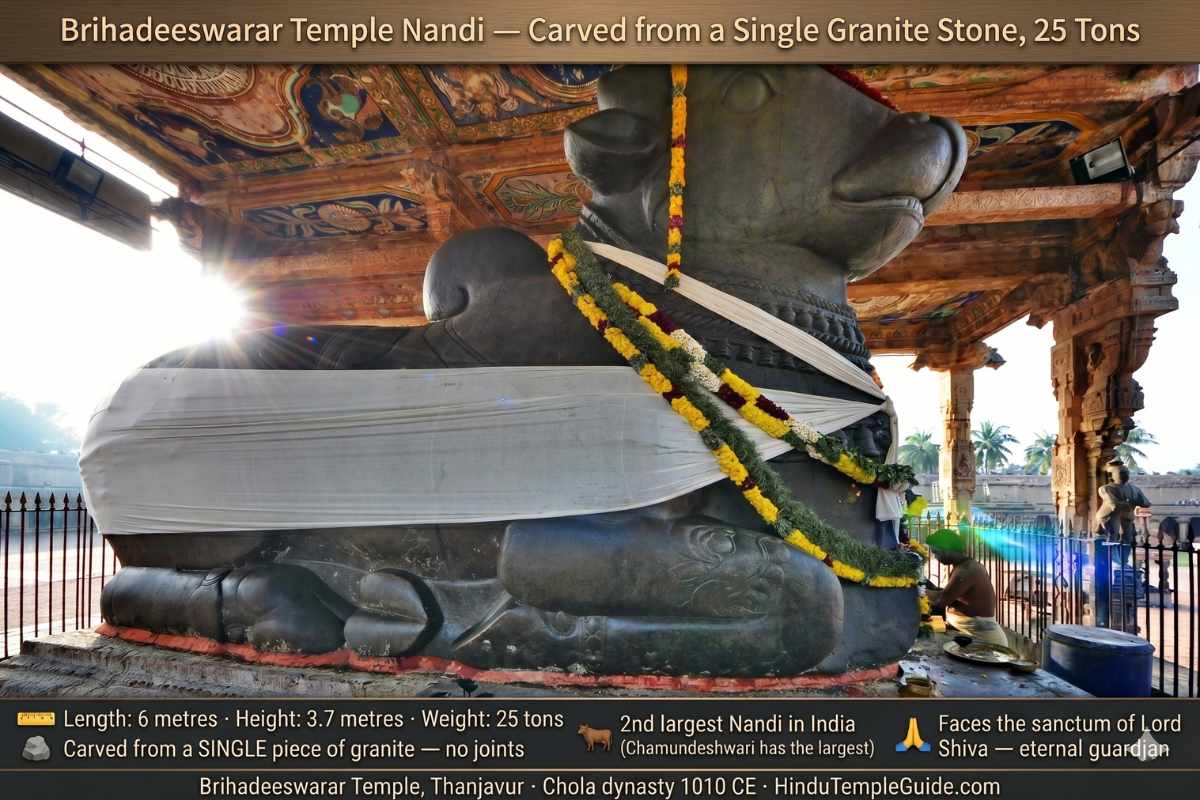
| Nandi Statue | 6 metres long · 25 tons · carved from a single granite stone |
| Temple Timings | 6:00 AM – 12:30 PM · 4:00 PM – 8:30 PM (all days) |
| Entry Fee | FREE for all visitors |
| How to Reach | 2 km from Thanjavur Railway Station · 60 km from Tiruchirappalli Airport |
| Distance from Chennai | ~340 km (5–6 hrs by road or train) |
Brihadeeswarar Temple, Thanjavur is the supreme masterpiece of the Chola dynasty temples completed in 1010 CE after just seven years of construction. At 216 feet (66 metres), the vimana remains one of the tallest temple towers in the world built entirely of granite quarried from distances over 60 km away and assembled without a single drop of mortar. The engineering challenge of placing the 80-ton granite capstone at the summit is believed to have required a 2-kilometre ramp the longest construction ramp in ancient Indian history.
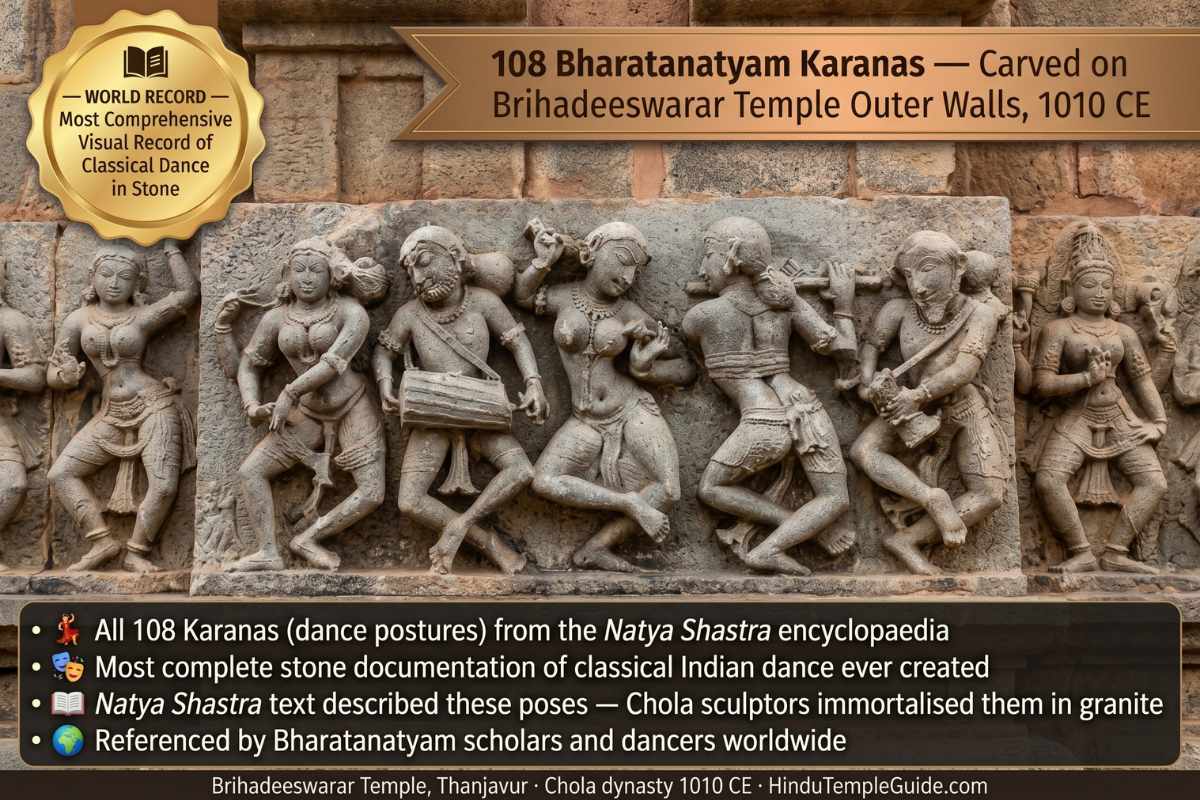
The shadow that never falls is not a legend but a verifiable architectural fact that modern engineers have confirmed and cannot fully explain. Inside the temple, Chola frescoes on the passage walls some of the oldest surviving murals in South India depict Shiva in his cosmic forms, the battles of gods and demons, and the great Chola kings themselves. The outer walls carry all 108 Bharatanatyam Karanas from the Natya Shastra, making Brihadeeswarar Temple the world’s most comprehensive stone record of classical Indian dance.
Brihadeeswarar Temple, Gangaikonda Cholapuram – The Victory Temple
Temple 2 · Built by Rajendra Chola I · Completed 1035 CE · UNESCO World Heritage (2004)
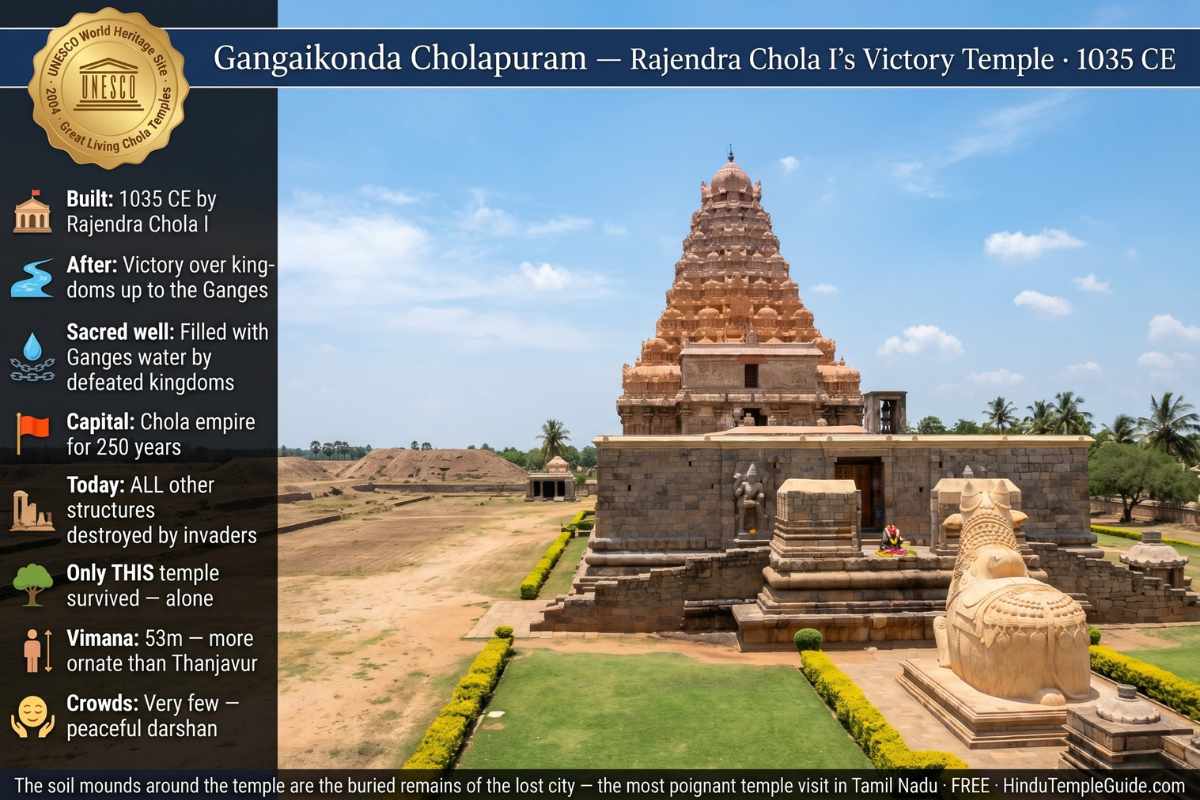
| UNESCO Inscription | 2004 (added as extension of Great Living Chola Temples) |
| Vimana Height | 53 metres graceful curved silhouette, contrasts Thanjavur’s severity |
| Sacred Well | Cholagangam fed by Ganges water carried by conquered kingdoms |
| 6 Dvarapalas | Massive monolithic guardian figures finest in all Chola art |
| Temple Timings | 6:00 AM – 12:00 PM · 4:00 PM – 8:00 PM |
| Entry Fee | FREE · ASI photography: free (handheld camera) |
| Distance from Chennai | ~280 km (via NH81 Chidambaram road) · Nearest: Jayankondam |
If Thanjavur represents the supreme ambition of the Chola dynasty temples, Gangaikonda Cholapuram represents their supreme refinement. Built by Rajendra I after his extraordinary military campaign across India, the temple’s very name encodes its triumphant origin: Gangaikonda Cholapuram means ‘the city of the Chola who conquered the Ganges.’ Rajendra demanded that his defeated adversaries carry pots of Ganga water to the new temple’s sacred well called Cholagangam making it the only temple in South India whose sacred water comes from the Ganges itself.
While Thanjavur stands at the centre of a thriving city, Gangaikonda Cholapuram stands almost alone in a desolate landscape the rest of Rajendra’s grand capital was destroyed by later invasions, leaving this single temple as the only survivor of an entire imperial city. Its relative solitude makes the darshan here uniquely powerful and personal a thousand-year-old granite temple with almost no crowds.
Airavatesvara Temple, Darasuram – The Jewel-Box Chariot Temple
Temple 3 · Built by Rajaraja Chola II · Completed c. 1166 CE · UNESCO World Heritage (2004)
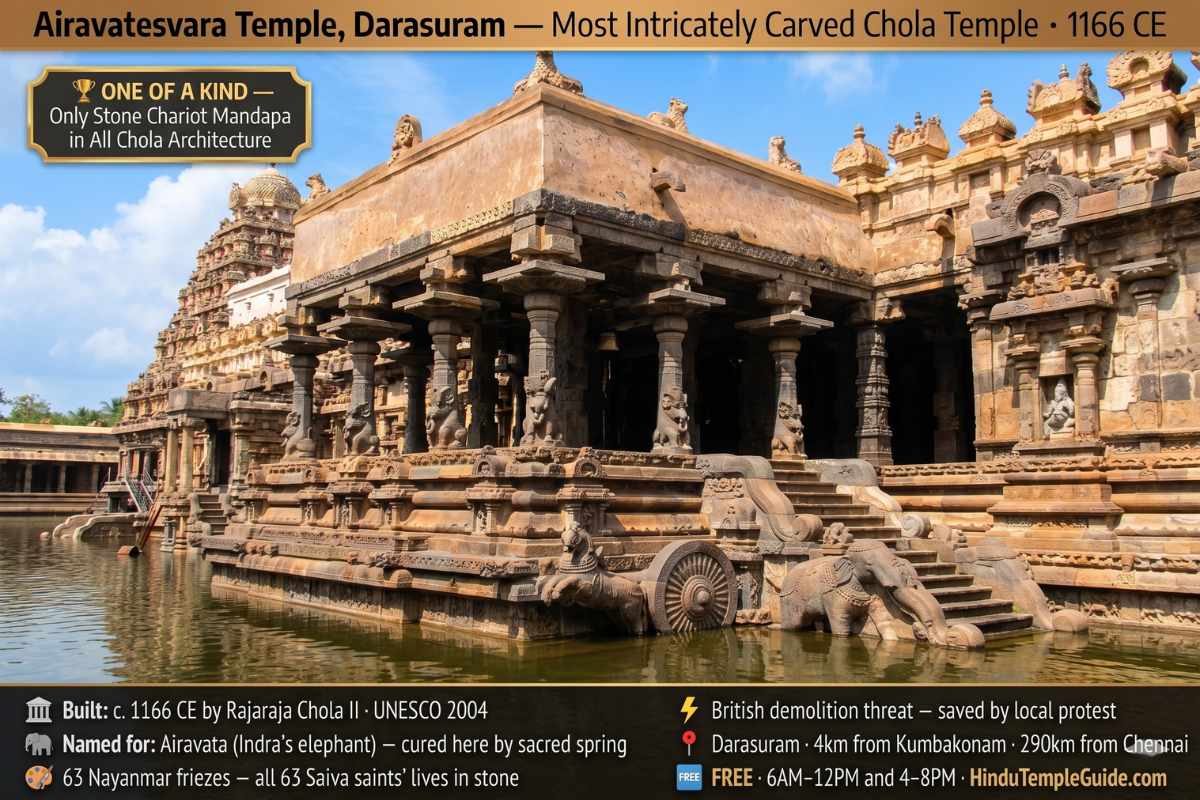
| UNESCO Inscription | 2004 (added as extension of Great Living Chola Temples) |
| Vimana Height | 24 metres smallest of the three, but most intricate carving |
| Unique Feature | Front mandapa designed as a chariot with wheels only in Chola architecture |
| Named After | Airavata Indra’s white elephant cured here by sacred spring water |
| 63 Nayanmars | Miniature friezes depicting all 63 Saiva saint stories unique documentation |
| Temple Timings | 6:00 AM – 12:00 PM · 4:00 PM – 8:00 PM |
| Entry Fee | FREE · ASI photography: free (handheld camera) |
| Location | Darasuram · 4 km from Kumbakonam · 290 km from Chennai |
| Historical Note | A 19th-century British officer ordered its demolition for stones locals protested and saved it |
The Airavatesvara Temple represents the third and final act of the Chola dynasty temples UNESCO trilogy and it is, in the opinion of many art historians, the most breathtaking carving achievement of the three. Where Thanjavur overwhelms with scale and Gangaikonda moves with beauty, Darasuram enchants with intimacy and detail. The unique chariot mandapa the entire front hall designed as a massive stone chariot complete with carved wheels is a formal architectural innovation found nowhere else in Indian temple design. Near-demolished by a British officer in the 19th century saved only by local protest the Airavatesvara Temple today stands as the most vivid testimony to what is permanently irreplaceable once lost.
Other Famous Chola Dynasty Temples Beyond the Three UNESCO Sites
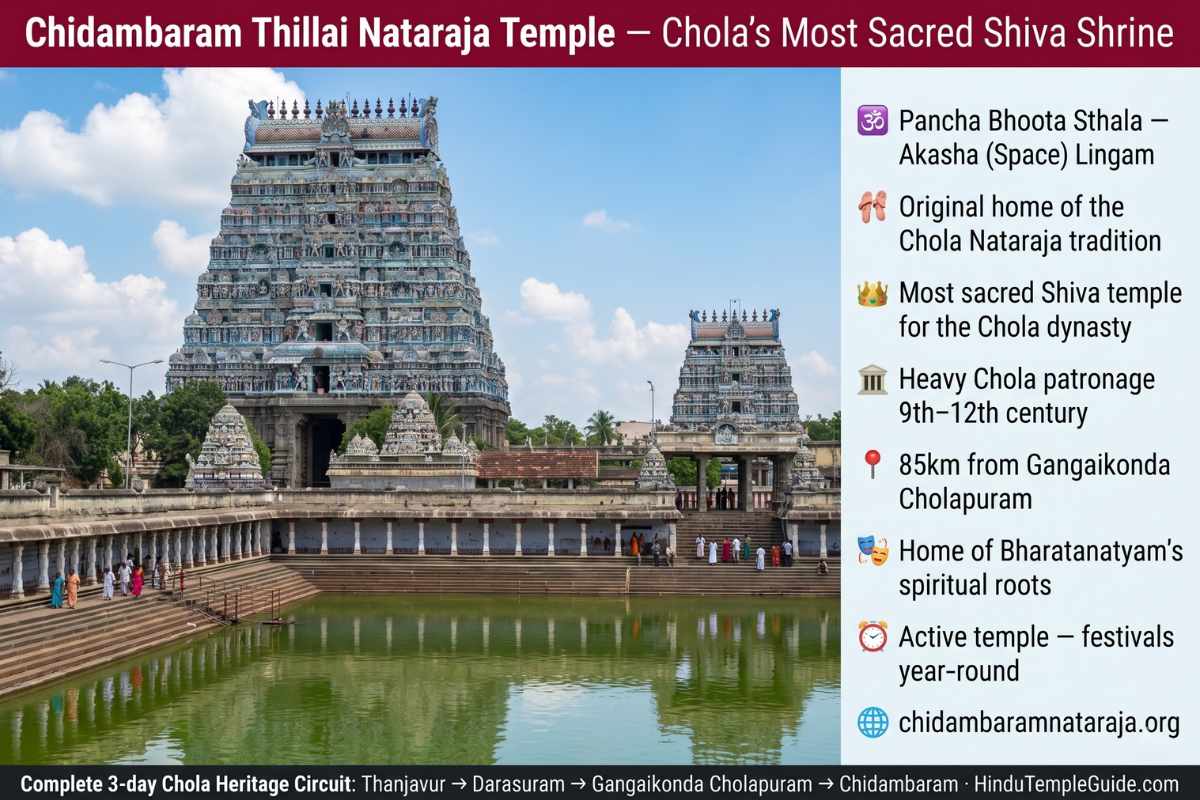
The Chola dynasty built hundreds of temples across South India. Beyond the three UNESCO-designated Great Living Chola Temples, these are the most significant:
| Temple | Location · Period · Key Features |
|---|---|
| Thillai Nataraja Temple (Chidambaram) | Chidambaram, TN · Chola period · Most sacred Shiva temple for Cholas · Home of Chola-period Nataraja · Pancha Bhoota Sthala (space/akasha Lingam) · 9th–12th century heavy patronage |
| Brihadeshwara Temple, Ayyavadi | Near Kumbakonam · 10th century · Early Chola temple showing transition from Pallava to Chola style · Built by Aditya Chola I |
| Kampaheswarar Temple, Kumbakonam | Kumbakonam, TN · 12th century · Built by Kulottunga Chola III · Represents late Chola architectural style · Active living temple |
| Sarangapani Temple, Kumbakonam | Kumbakonam · Chola-Vijayanagara · One of the 108 Divya Desams (Vishnu shrines) · Beautiful Chola-period sculptures |
| Thirukadaiyur Amritaghateswarar | Sirkazhi area, TN · Chola period · Temple where Markandeya defeated Death · Annual Shashtiabdhapoorthi ceremony centre |
| Thiruvalam Chola Temples | Vellore district · Early Chola period · Examples of pre-imperial Chola architecture showing early Dravidian evolution |
Chola Bronze Sculpture – The Nataraja That Changed the World
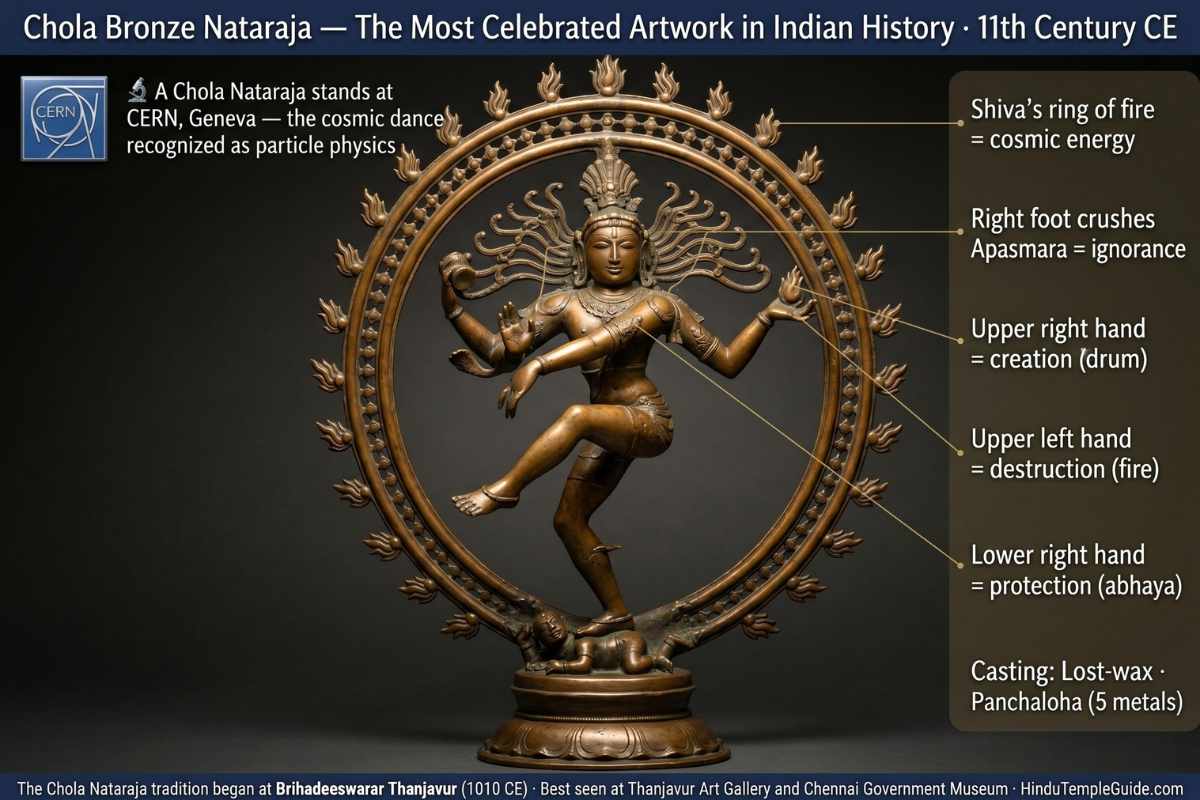
No discussion of Chola dynasty temples is complete without examining the Chola bronze tradition arguably the most significant contribution the Cholas made to world art. Between the 9th and 13th centuries, Chola artists developed a method of lost-wax (cire perdue) bronze casting using Panchaloha (five-metal alloy: gold, silver, copper, brass, iron) that produced sculptures of unparalleled spiritual power and technical perfection. The Chola Nataraja Shiva as the cosmic dancer became the most recognizable and most philosophically profound religious image ever produced in India.
A bronze Nataraja gifted by the Indian government stands at the entrance of CERN (European Organisation for Nuclear Research, Geneva) symbolising that the ancient Chola vision of Shiva’s cosmic dance (Ananda Tandava) and the physicist’s understanding of subatomic particle interactions describe the same fundamental cosmic reality. This is the Chola dynasty’s gift to human civilization still resonating across the world 1,000 years later.
Key Chola Bronze Sculptures
The Chola Heritage Trail – Complete Visitor Guide 2026
Best Time to Visit Chola Dynasty Temples
| Season | Conditions for Visiting Chola Temples |
|---|---|
| Oct–Feb (BEST) | Best weather 22–32°C · Clear skies · Ideal for outdoor temple circuits · Mahamaham festival (Kumbakonam, every 12 years) if applicable |
| March (Good) | Still manageable · Warm afternoons · Brahmotsavam festival at Thanjavur · Less crowded than peak season |
| April–June (Hot) | 35–42°C · Avoid 10 AM – 4 PM outdoors · Carry water · Visit in early morning and evening only |
| July–Sep (Monsoon) | Heavy Tamil Nadu monsoon · Temples may have standing water · Muddy approaches at Darasuram and Gangaikonda · Less ideal |
How to Reach the Chola Heritage Triangle
| Mode / Route | Details |
|---|---|
| By Air | Tiruchirappalli Airport (TRZ) 60 km from Thanjavur · Daily flights from Chennai, Bengaluru, Mumbai, Delhi |
| By Train | Thanjavur Junction 2 km from Brihadeeswarar Temple · Direct trains from Chennai (Vaigai Exp, Kaveri Exp) · 5–6 hrs |
| By Road | Chennai → Thanjavur: 340 km (5–6 hrs) via NH38 · Bengaluru → Thanjavur: 380 km (6–7 hrs) |
| Heritage Circuit | Thanjavur → Darasuram (40 km via Kumbakonam) → Gangaikonda Cholapuram (70 km) → Chidambaram (85 km from Gangaikonda) · All in 2–3 days |
Complete 3-Day Chola Heritage Circuit from Thanjavur
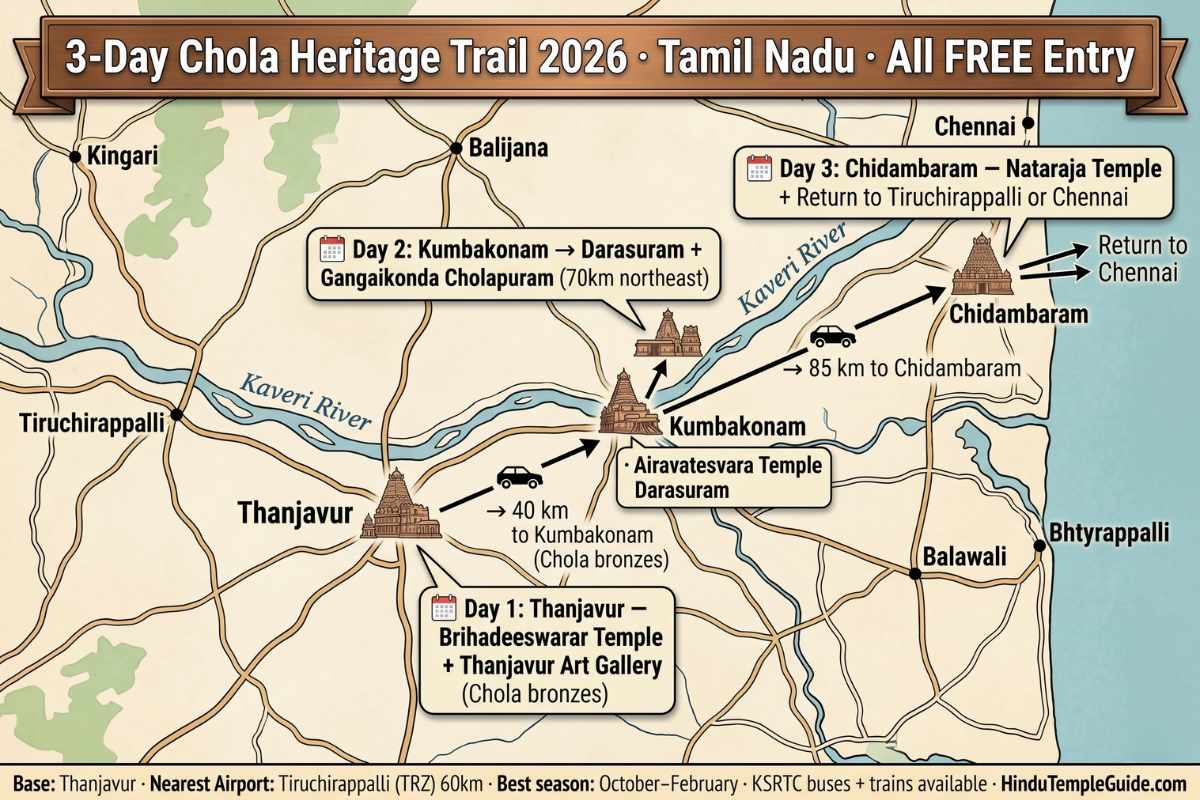
| Day | Location | What to Do |
|---|---|---|
| Day 1 AM | Thanjavur | Brihadeeswarar Temple (2–3 hrs) · Nandi, 108 dance postures, Chola frescoes, inner sanctum darshan · Thanjavur Art Gallery (Chola bronzes) |
| Day 1 PM | Kumbakonam | Drive 40 km · Kampaheswarar Temple · Sarangapani Temple · Kumbakonam Mahamaham tank |
| Day 2 AM | Darasuram | Airavatesvara Temple (2 hrs) · Stone chariot mandapa · 63 Nayanmar friezes · Exquisite carvings |
| Day 2 PM | Gangaikonda | Drive 70 km · Brihadeeswarar Temple · Dvarapalas · Sacred Cholagangam well · Solo darshan experience |
| Day 3 | Chidambaram | Drive 85 km from Gangaikonda · Thillai Nataraja Temple · Chola-period Nataraja darshan · Pancha Bhoota Sthala (akasha) · Return to Tiruchirappalli or Chennai |
FAQs – Chola Dynasty Temples
12 Jyotirlinga in India 2026 – Including Chidambaram Nataraja Connection
18 Shakti Peeth Temples – Complete Guide with Locations & Tips
Top 20 Oldest Temples in India – Chola Heritage Temples Featured
Famous Temples in Karnataka 2026 – Belur Halebidu Hoysala UNESCO
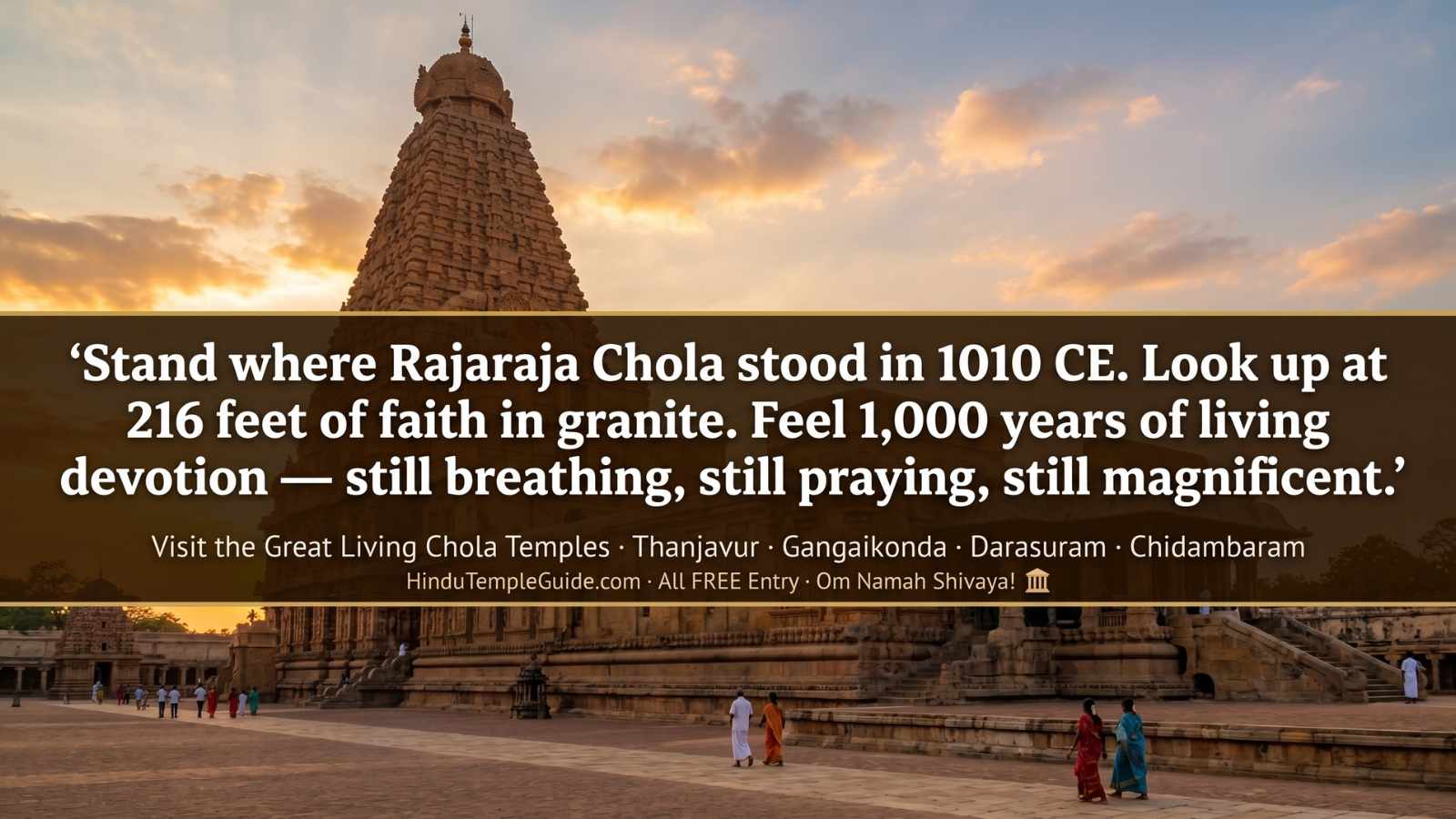
Walk the Stone Corridors of the Chola Empire || Om Namah Shivaya!
Plan your 3-day Chola Heritage Circuit from Thanjavur → Gangaikonda Cholapuram → Darasuram → Chidambaram. The Chola dynasty temples are not a heritage site you visit once and check off a list. They are places that stay with you in the quality of the silence inside the sanctum, in the smile of the carved Nataraja, in the shadow that never falls to the ground.
Sources & Disclaimer: All architectural data, UNESCO designations, temple timings and historical information are verified from ASI (Archaeological Survey of India), UNESCO World Heritage Centre (whc.unesco.org), and Wikipedia sources. Temple timings may vary during festivals and special events. Entry to all three UNESCO Chola temples is FREE. HinduTempleGuide.com is an independent temple guide. Om Namah Shivaya!
2 Comments