
Maha Shivaratri 2026 Complete Guide – Date, Significance, 4 Prahar Timings, Rituals, Fasting Rules & Best Temples to Visit
Maha Shivaratri 2026 — the Great Night of Lord Shiva — is the most sacred, most transformative, and most spiritually charged night in the entire Hindu calendar. Har Har Mahadev! Unlike the colour and celebration of other festivals, Maha Shivaratri 2026 is a night of profound stillness — of fasting, night-long vigil (jagaran), meditation, and Rudrabhishekam — a night when millions of Shiva devotees stay awake until dawn, offering their love and surrender to Bhagwan Mahadev, the Adiyogi, the first yogi, the destroyer of ignorance.
This complete guide covers everything: exact date (February 15, 2026), Nishita Kaal midnight puja (12:09 AM – 1:01 AM), all four Prahar timings, Rudrabhishekam vidhi, sacred mantras, fasting rules, jagaran guide, and the best temples in India for Maha Shivaratri 2026.
Table of Contents – Maha Shivaratri 2026 Complete Guide
- 1What Is Maha Shivaratri 2026? Spiritual Significance & Why This Night Changes Lives
- 2Maha Shivaratri 2026 Date, Tithi & Complete Puja Timings
- 34 Prahar Puja Timings 2026 – What to Offer Each Prahar
- 4The Sacred Legends of Maha Shivaratri – Why Shiva Chose This Night
- 5Rudrabhishekam & Puja Vidhi – Step-by-Step Complete Guide
- 6Sacred Offerings for Shiva – What to Offer & What to Avoid
- 7Shivaratri Mantras – Om Namah Shivaya, Maha Mrityunjaya & More
- 8Maha Shivaratri 2026 Fasting Rules – Vrat Vidhi & Parana Time
- 9Jagaran – The Sacred All-Night Vigil of Maha Shivaratri 2026
- 10Best Temples to Visit for Maha Shivaratri 2026 – Complete Guide
- 11Maha Shivaratri 2027 – Date Preview
- 12FAQs – Maha Shivaratri 2026
What Is Maha Shivaratri 2026? Spiritual Significance & Why This Night Changes Lives
Maha Shivaratri 2026 — from Sanskrit Maha (Great) + Shiva + Ratri (Night) — is the annual festival dedicated to Bhagwan Shiva, the supreme deity of the Shaivite tradition. Unlike almost every other Hindu festival, Maha Shivaratri is a festival of the night: of silence, fasting, night-long wakefulness, and deep inner turning. The Shiva Purana declares this night supremely auspicious — sincere worship on this single night delivers spiritual merit equivalent to a thousand ordinary nights of puja.
According to yogic science, on the night of Maha Shivaratri, the northern hemisphere of Earth naturally aligns to create a powerful surge of energy in the human spiritual system — making it the single most powerful night of the year for awakening, meditation, and inner transformation.
Maha Shivaratri 2026 Date, Tithi & Complete Puja Timings
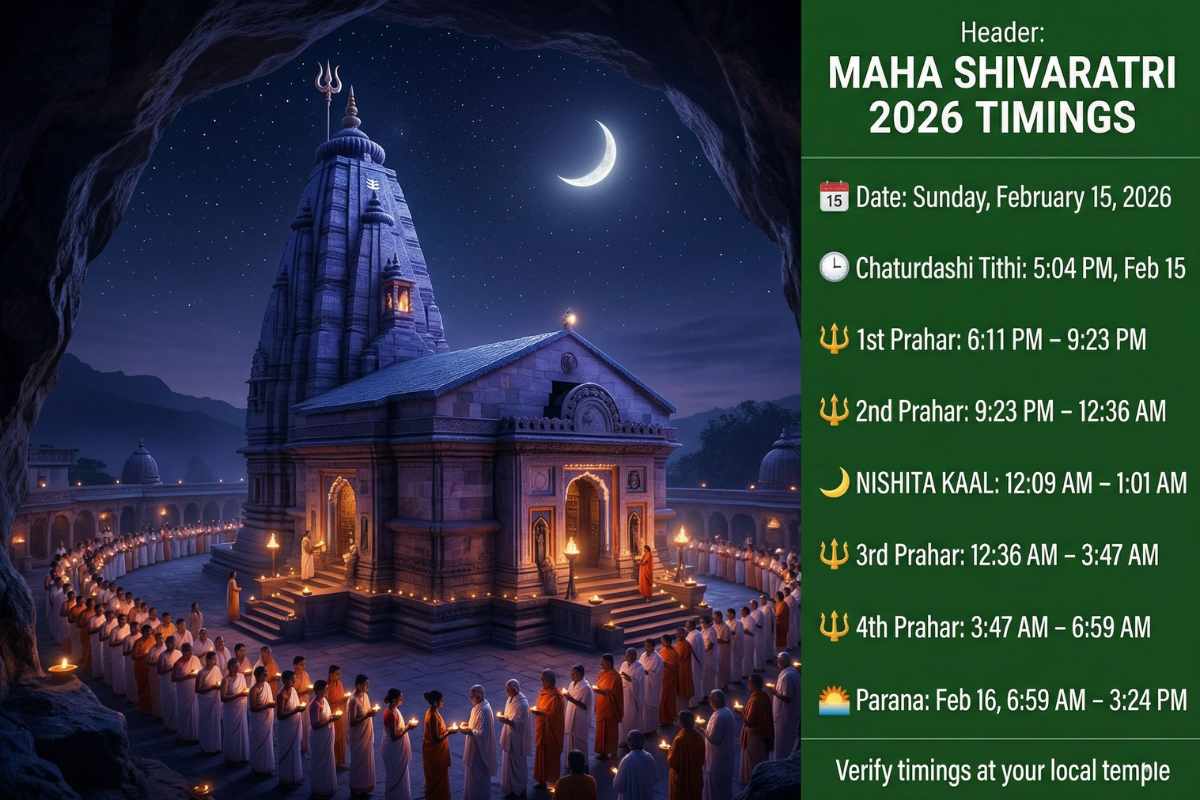
Maha Shivaratri 2026 is on Sunday, February 15, 2026. Chaturdashi Tithi: 5:04 PM Feb 15 – 5:34 PM Feb 16. Nishita Kaal (most auspicious): 12:09 AM – 1:01 AM on Feb 16 (51 minutes). Parana (fast-breaking): 6:59 AM – 3:24 PM on February 16.
| Maha Shivaratri 2026 Key Dates | Date & Time (IST) |
|---|---|
| Maha Shivaratri Date | Sunday, February 15, 2026 |
| Chaturdashi Tithi Begins | 5:04 PM on February 15, 2026 |
| Chaturdashi Tithi Ends | 5:34 PM on February 16, 2026 |
| Nishita Kaal (MOST AUSPICIOUS) | 12:09 AM – 1:01 AM on Feb 16 (51 min) — Set your alarm! |
| 1st Prahar Puja | 6:11 PM – 9:23 PM on February 15 |
| 2nd Prahar Puja | 9:23 PM – 12:36 AM (Feb 15–16) |
| 3rd Prahar Puja (includes Nishita Kaal) | 12:36 AM – 3:47 AM on February 16 |
| 4th Prahar Puja | 3:47 AM – 6:59 AM on February 16 |
| Vrat Parana (Fast-Breaking) | 6:59 AM – 3:24 PM on February 16 |
| Maha Shivaratri 2027 Preview | Saturday, March 6, 2027 |
Maha Shivaratri 2026 Four Prahar Puja Timings – What to Offer Each Prahar
The most spiritually complete way to observe Maha Shivaratri 2026 is to perform Rudrabhishekam in all four Prahars — each offering a different sacred substance. The Shiva Purana prescribes specific offerings for each Prahar:
| Prahar | Timing (IST, Feb 15–16) | Primary Offering | Secondary Offering | Significance |
|---|---|---|---|---|
| 1st Prahar | 6:11 PM – 9:23 PM | Water (Gangajal) | Milk | Purification; invoking Shiva’s presence |
| 2nd Prahar | 9:23 PM – 12:36 AM | Curd (Dahi) | Honey | Prosperity; seeking material blessings |
| 3rd Prahar (Nishita Kaal) |
12:36 AM – 3:47 AM | Ghee | Sugar | MOST POWERFUL — liberation |
| 4th Prahar | 3:47 AM – 6:59 AM | Honey | Panchamrit | Completion; seeking Shiva’s dawn blessing |
The Sacred Legends of Maha Shivaratri – Why Shiva Chose This Night
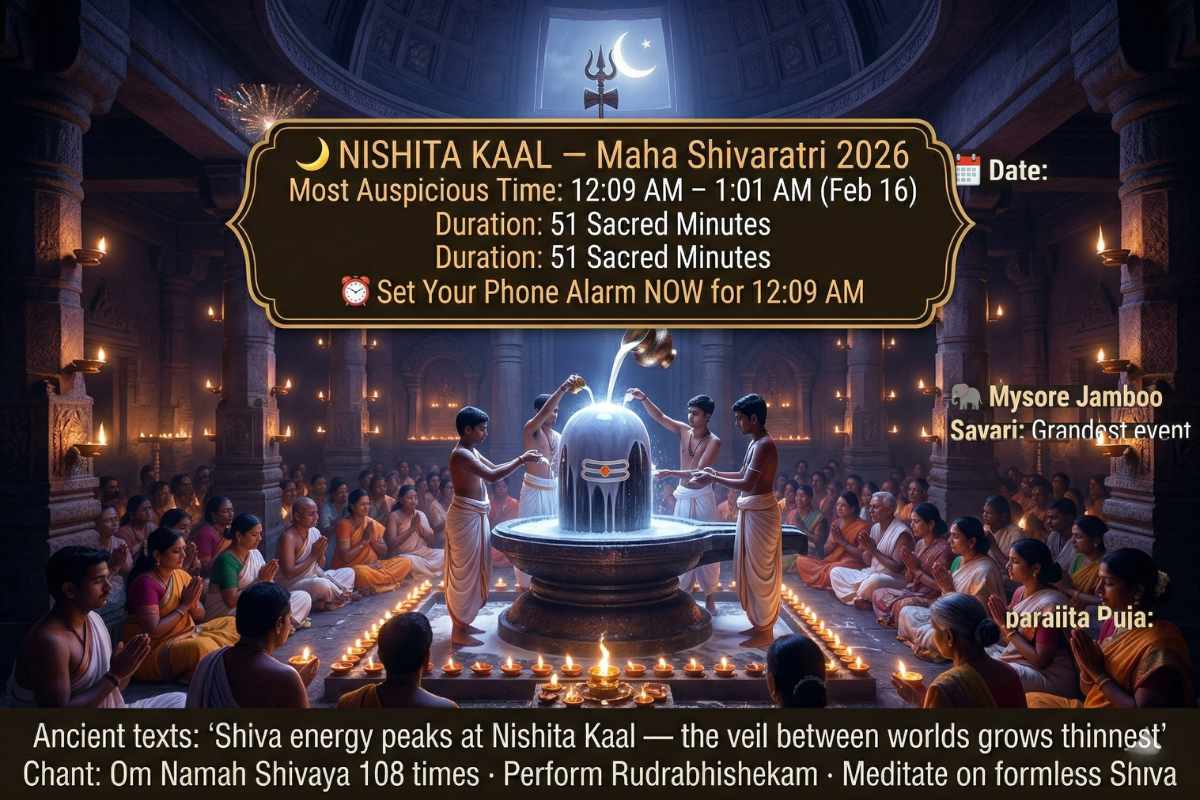
Legend 1: The Jyotirlinga — Shiva as Infinite Light
According to the Shiva Purana, on the night of Maha Shivaratri, an infinite column of blazing light (Jyotirlinga) appeared before Brahma and Vishnu — stretching from earth to sky with no beginning and no end. Neither could find either end. Then Lord Shiva revealed himself — declaring he is Sadashiva, the eternal and infinite. This revelation occurred at Nishita Kaal — the midnight hour. This is why midnight worship is the most powerful.
Legend 2: Neelkanth – Shiva Saves the Universe by Drinking Poison
During the Samudra Manthan, a terrifying poison — Halahala (Kalakuta) — emerged that threatened to annihilate all creation. Lord Shiva drank the Halahala poison to save the universe. Goddess Parvati gripped his throat so the poison would not descend — turning his throat deep blue, giving him the name Neelkanth (the Blue-Throated One). The first Maha Shivaratri jagaran commemorates this supreme act of compassion.
Legend 3: The Divine Marriage of Shiva and Parvati
Parvati performed decades of intense tapasya (penance) to win Shiva as her husband after Sati’s passing. Their divine reunion on the night of Phalguna Krishna Chaturdashi — Maha Shivaratri — represents the cosmic union of Shiva (consciousness) and Shakti (energy) — the fundamental principle of creation itself. This is why unmarried women pray on Maha Shivaratri 2026 for a devoted husband with Shiva’s qualities.
Legend 4: The Hunter and the Bilva Tree
A poor hunter named Lubdhaka spent Maha Shivaratri night in a Bilva tree — unknowingly dropping Bilva leaves onto a Shiva Lingam below, staying awake all night, and performing a perfect puja completely by accident. Shiva blessed him with liberation.
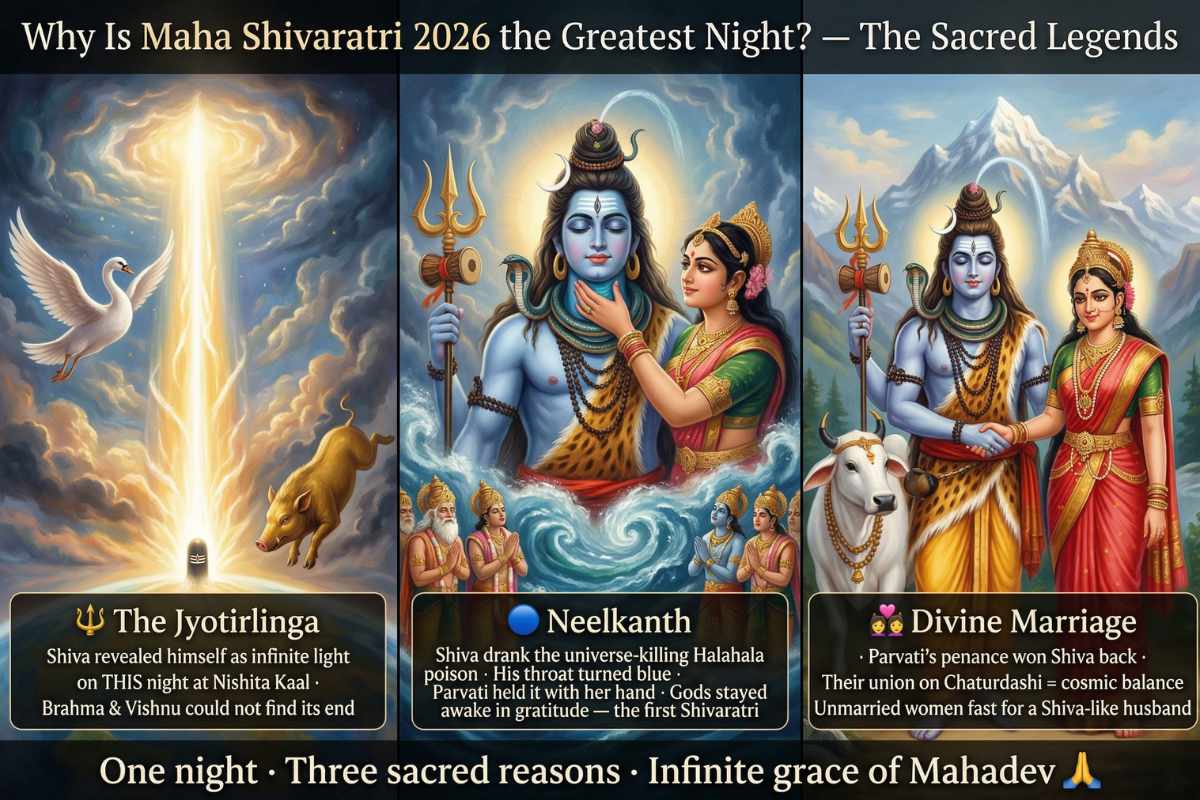
Rudrabhishekam & Puja Vidhi – Step-by-Step Complete Guide for Maha Shivaratri 2026
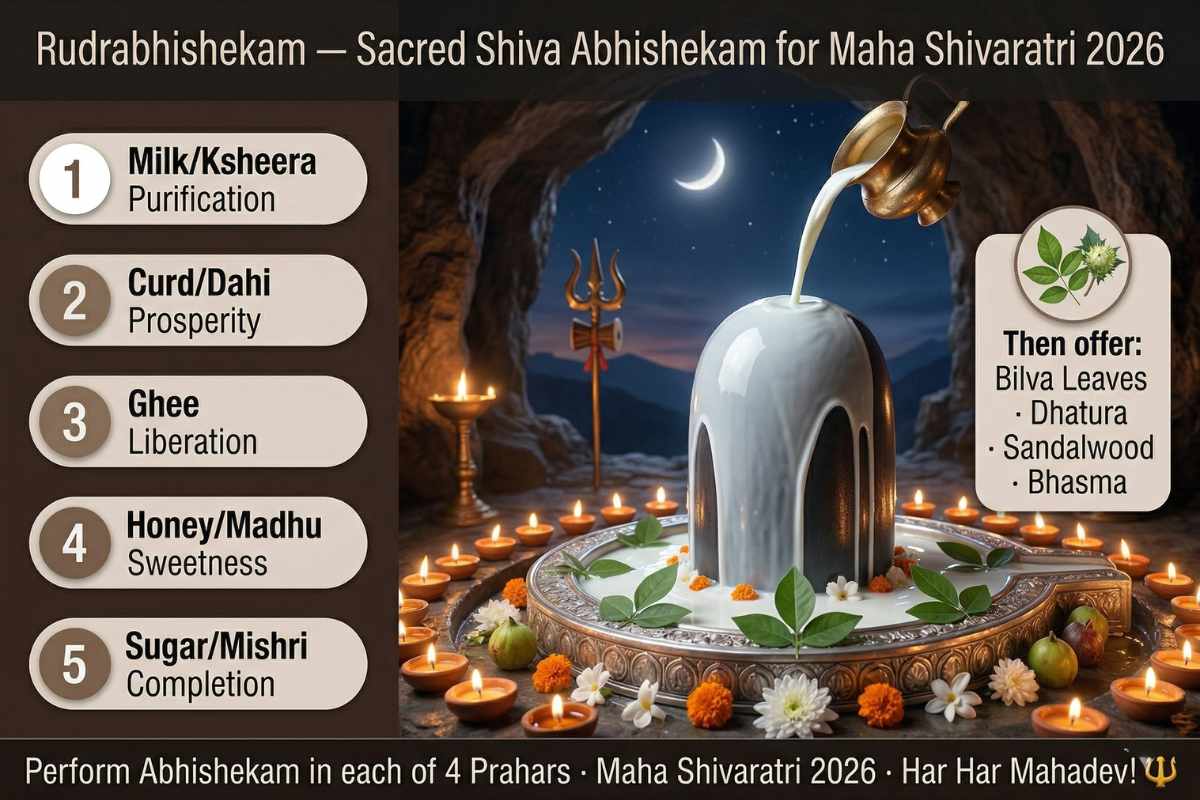
Step-by-Step Rudrabhishekam Sequence
- 1Invoke Ganesha: Begin by chanting ‘Om Gam Ganapataye Namah’ 5 times to remove all obstacles from your worship.
- 2Abhishekam (sacred bath): Pour the prescribed substance slowly over the Shiva Lingam while chanting ‘Om Namah Shivaya’. Sequence: milk → curd → ghee → honey → sugar → final rinse with Gangajal.
- 3Wipe and Dress the Lingam: Gently wipe dry. Apply Bhasma (sacred ash) or chandan paste. Decorate with a flower garland.
- 4Offer Bilva Leaves: The most important offering. Place fresh Bilva (Bel Patra) leaves at the base in groups of 3. Chant: ‘Tridalam Trigunakaaram Trinetram Cha Triyayudham…’
- 5Offer Flowers: White flowers are most dear to Shiva — white lotus, white oleander, white jasmine. Dhatura flowers and bel flowers are also sacred. Never offer Tulsi, Ketaki, or Champa.
- 6Light Dhoop & Deepam: Light incense sticks and the ghee diya. The flame should ideally not go out throughout the night.
- 7Chant Shiva Mantras: Chant ‘Om Namah Shivaya’ 108 times on a rudraksha mala. Recite Shiva Panchakshara Stotram, Sri Rudram, or Lingashtakam for full ritual.
- 8Perform Aarti: Perform Shiva Aarti with a lit camphor or multi-wick diya — ‘Jai Shiv Onkara / Om Jai Shiv Onkara’. Ring the bell throughout.
- 9Offer Prasad: Offer fruits, panchamrit, coconut, batashe, and dry fruits. Distribute to family after puja. Bilva fruit is considered especially auspicious prasad on Maha Shivaratri night.
Sacred Offerings for Shiva – What to Offer & What Shiva Cannot Accept
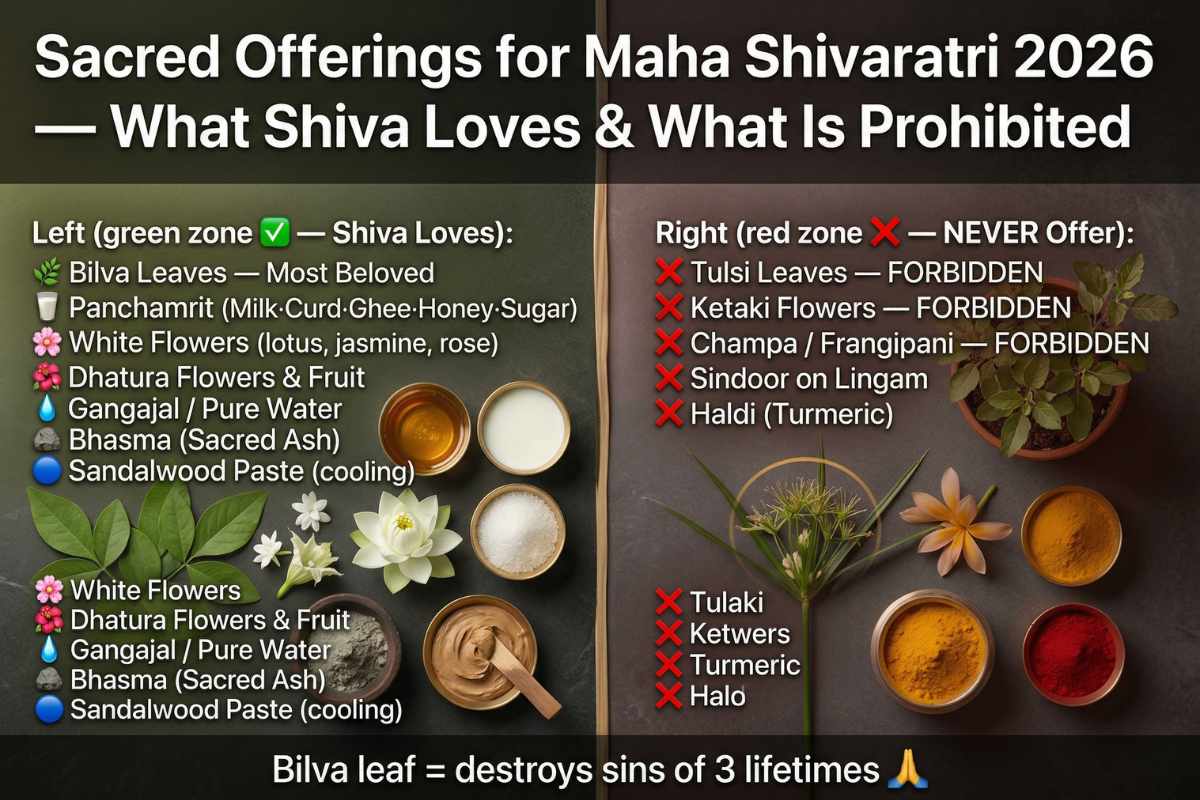
- Bilva (Bel Patra) leaves — his MOST beloved offering
- Milk, curd, ghee, honey, sugar (Panchamrit)
- White flowers — white lotus, rose, jasmine
- Dhatura flowers & fruit (thorn apple)
- Gangajal or clean fresh water
- Sandalwood paste (Chandan)
- Bhasma (sacred ash) — Vibhuti
- Rudraksha garland
- Tulsi (Holy Basil) — forbidden for Shiva
- Ketaki flowers (Umbrella Sedge)
- Champa flowers (Frangipani)
- Sindoor (red vermillion) on Lingam
- Turmeric (Haldi) on Lingam
- Broken rice or broken Bilva leaves
- Any tasted or impure food
- Coconut water directly (varies by tradition)
Shivaratri Mantras 2026 – Om Namah Shivaya, Maha Mrityunjaya & Sacred Stotras
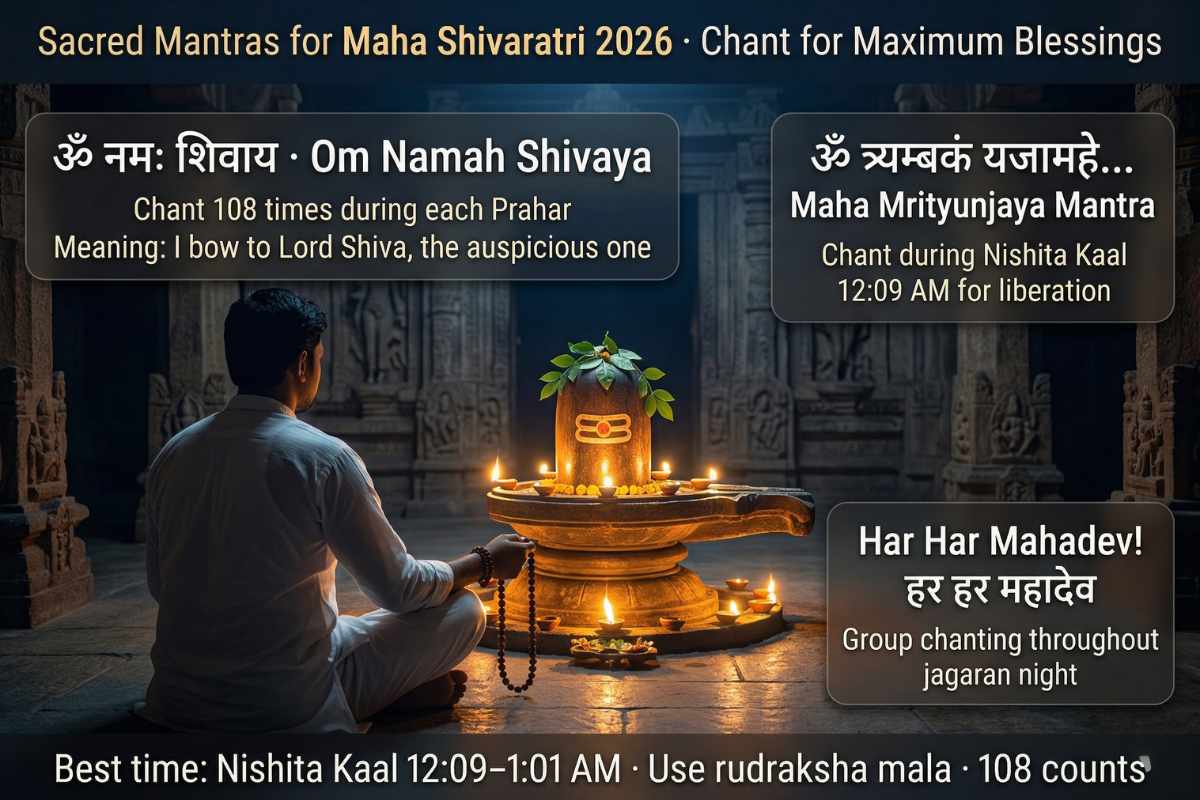
| Mantra | Full Mantra Text | Best Time to Chant |
|---|---|---|
| Panchakshara (5-syllable) | Om Namah Shivaya (ॐ नमः शिवाय) | All 4 Prahars — 108 times minimum each |
| Maha Mrityunjaya | Om Tryambakam Yajamahe Sugandhim Pushtivardhanam, Urvaarukamiva Bandhanan Mrityor Muksheeya Maamritat | Nishita Kaal 12:09–1:01 AM — 108 times ideal |
| Shiva Gayatri | Om Tatpurushaya Vidmahe Mahadevaya Dhimahi Tanno Rudrah Prachodayat | Brahma Muhurta (4:00–6:00 AM) — 108 times |
| Har Har Mahadev | Har Har Mahadev (हर हर महादेव) | Group chanting throughout jagaran night |
| Na-Ma-Shi-Va-Ya | Earth-Water-Fire-Air-Space — five elements of creation | Each syllable with each pour of Abhishekam |
Maha Shivaratri 2026 Fasting Rules – Vrat Vidhi, Foods & Parana Time
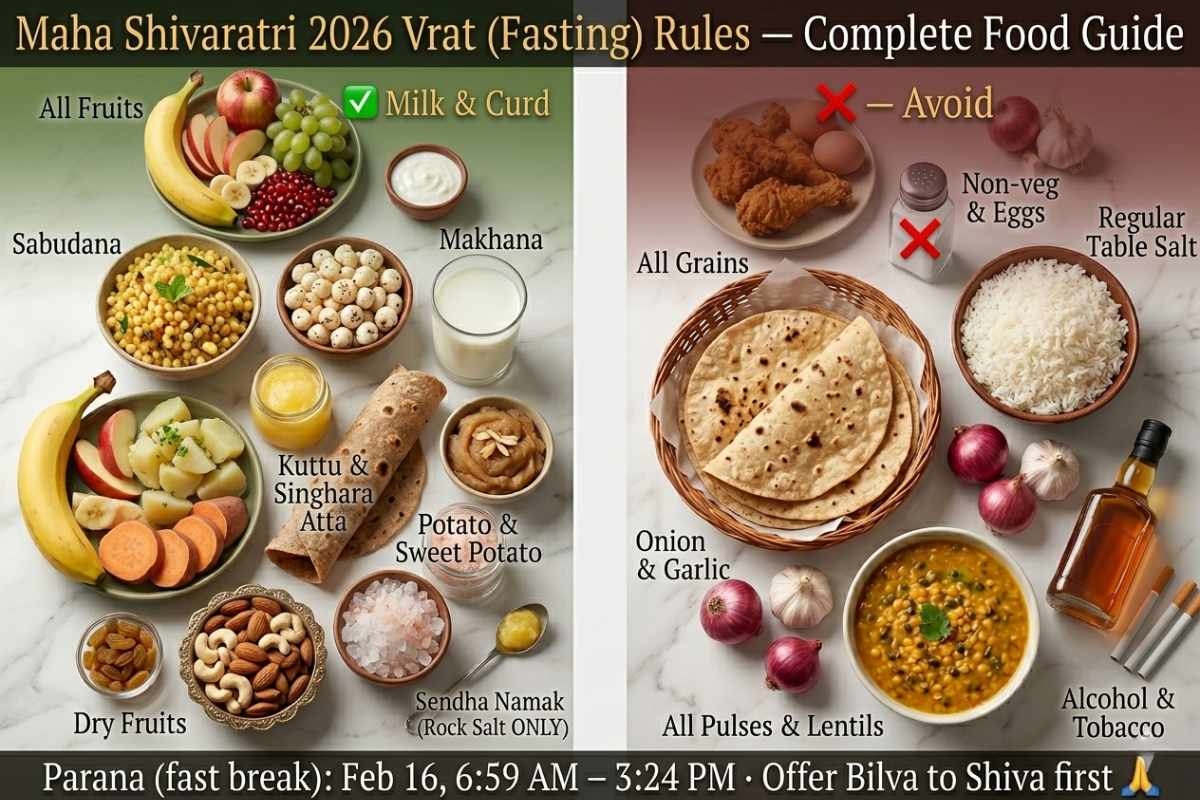
Maha Shivaratri 2026 vrat begins at sunrise on February 15 and ends during Parana on February 16 between 6:59 AM and 3:24 PM. Begin Parana by offering fresh Bilva leaves to Shiva, then take a sip of water or milk with Shiva’s name before eating.
- All fruits — fresh, dried, or juice
- Milk and all milk products
- Sabudana — khichdi or vada
- Makhana (fox nuts)
- Kuttu atta, singhara atta (vrat flours)
- Potato, sweet potato
- Rock salt / sendha namak ONLY
- Dry fruits, curd
- All grains — wheat, rice, maize
- Regular table salt — only sendha namak
- Onion and garlic — strictly prohibited
- Non-vegetarian food including eggs
- All pulses and lentils
- Alcohol and tobacco
- Tulsi (in food) — prohibited in Shiva worship
- Fried snacks with regular salt or spices
Jagaran – The Sacred All-Night Vigil of Maha Shivaratri 2026
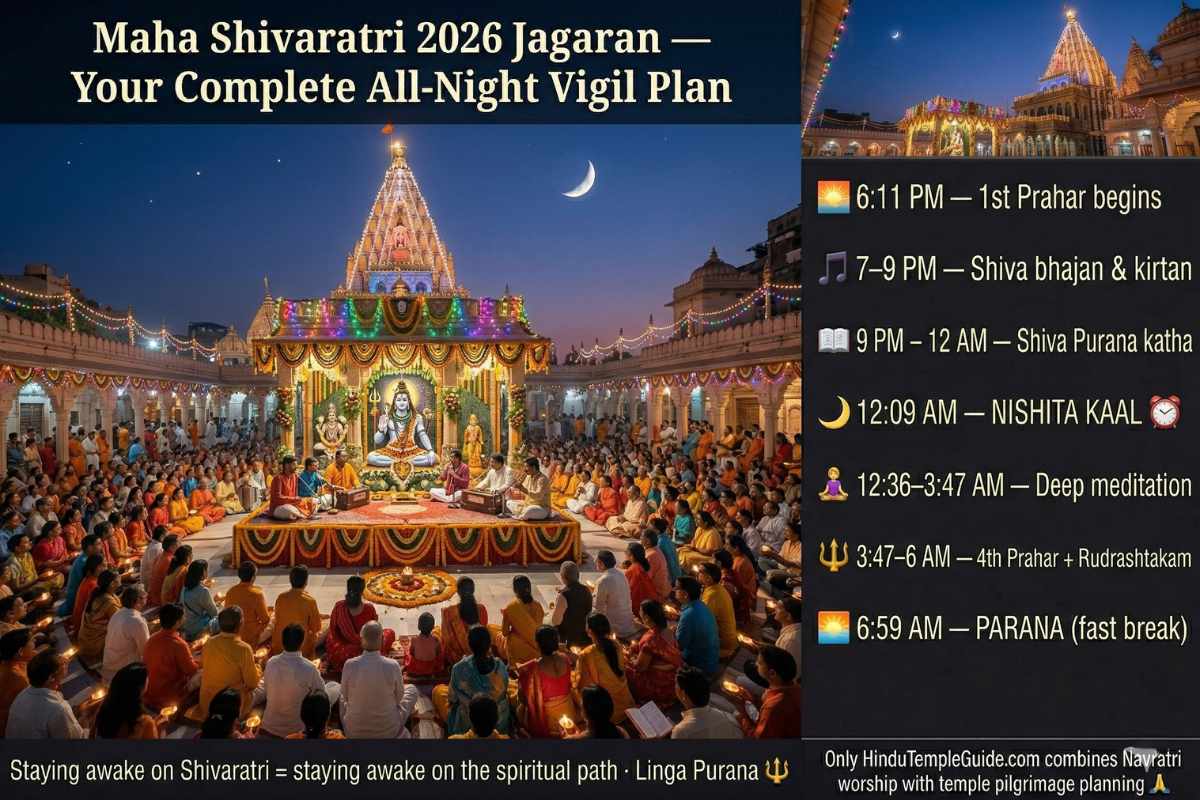
The jagaran — staying awake throughout Maha Shivaratri night — represents spiritual alertness: staying awake on the path of consciousness, never succumbing to the sleep of ignorance (avidya). The Linga Purana explains every hour of wakefulness during this sacred night is equivalent to years of regular spiritual practice.
| Time | Spiritual Activity for Jagaran |
|---|---|
| Sunset – 6:11 PM | Bathe, wear clean white or grey clothes. Set up puja. Begin 1st Prahar Abhishekam. Take Sankalp vow. |
| 6:11 – 9:23 PM | 1st Prahar Rudrabhishekam (water + milk). Chant Om Namah Shivaya 108 times. Listen to Shiva Purana stories. |
| 9:23 PM – 12:36 AM | 2nd Prahar (curd + honey). Group bhajan — Har Har Mahadev. Shiva Chalisa recitation. Lingashtakam chanting. |
| 12:09 – 1:01 AM | NISHITA KAAL — Most Sacred 51 Minutes of the Year. Full Panchamrit Abhishekam. Maha Mrityunjaya Mantra 108 times. Deep meditation on Shiva’s formless infinite light. |
| 12:36 – 3:47 AM | 3rd Prahar (ghee + sugar). Rudrashtakam. Nataraja meditation — visualise Shiva’s cosmic dance. Continue mantra japa. |
| 3:47 – 6:59 AM | 4th Prahar (honey + panchamrit). Brahma Muhurta meditation 4:00–6:00 AM. Shiva Sahasranama. Dawn aarti at sunrise. |
| 6:59 AM onwards | Parana (break fast). Offer final Bilva leaves to Shiva. Rest. The night is complete. Har Har Mahadev! |
Best Temples to Visit for Maha Shivaratri 2026 – Complete Pilgrimage Guide
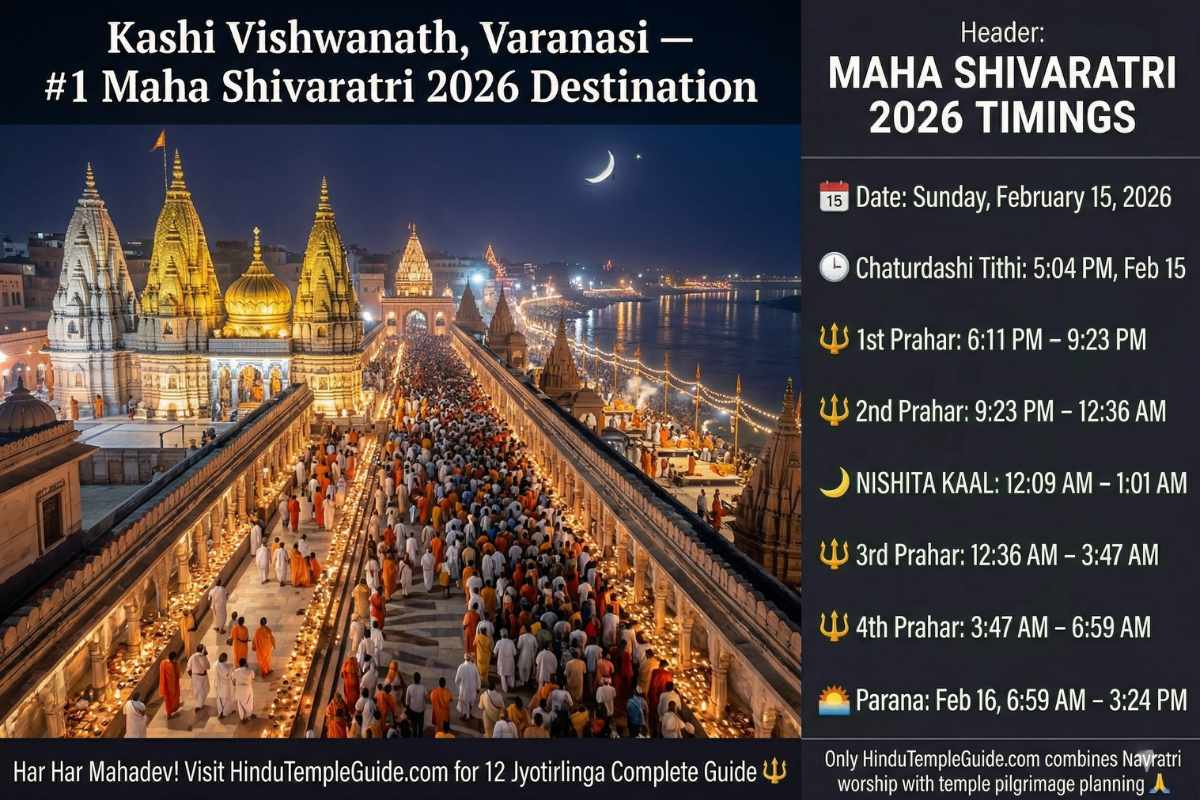
1. Kashi Vishwanath Temple, Varanasi – Most Sacred Maha Shivaratri in India
Kashi Vishwanath — the most sacred Jyotirlinga — becomes a living spiritual furnace on Maha Shivaratri 2026. Over 20 lakh (2 million) devotees flood Varanasi. All-night special Abhishekam is performed continuously. The Ganga Aarti at Dashashwamedh Ghat on Shivaratri night is the most spectacular of the year. Book accommodation 3–4 months in advance.
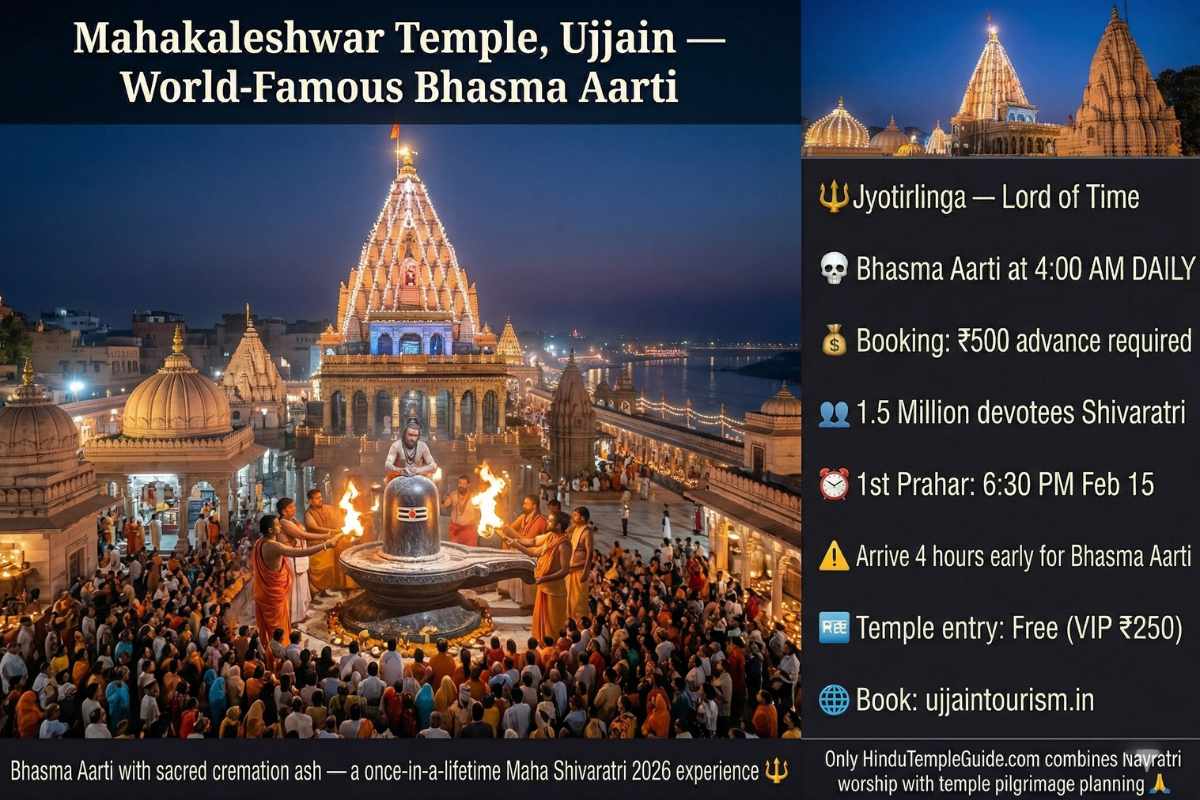
2. Mahakaleshwar Temple, Ujjain – The Famous Bhasma Aarti
Mahakaleshwar Temple hosts the world-famous Bhasma Aarti at 4:00 AM (₹500 advance booking required) using sacred ash from cremation grounds. On Maha Shivaratri 2026, over 15 lakh devotees are expected. This is unlike any other ritual in India — ash from the cremation ground offered to the Lord of Time and Death.
3. Somnath Temple, Gujarat – First Jyotirlinga by the Arabian Sea
Somnath — the first of the 12 Jyotirlingas — celebrates Maha Shivaratri 2026 with spectacular ocean-front Abhishekam and midnight aarti. The experience of watching the sunrise after an all-night Shivaratri vigil by the Arabian Sea at Somnath is described as one of the most profound spiritual moments. Entry: free.
4. Kedarnath Temple – Himalayan Maha Shivaratri
Kedarnath in the Himalayan snowfields — the holiest of the Jyotirlingas — observes Maha Shivaratri 2026 in February, before the summer yatra season begins.
| Temple | Location & What Makes Shivaratri Special |
|---|---|
| Brihadeeswara Temple | Thanjavur, Tamil Nadu — UNESCO World Heritage; unique South Indian Shivaratri Abhishekam |
| Lingaraj Temple | Bhubaneswar, Odisha — one of the largest Shiva temples; spectacular night celebrations |
| Murudeshwar Temple | Karnataka — world’s second tallest Shiva statue; ocean backdrop; spectacular illumination |
| Pashupatinath | Kathmandu, Nepal — most sacred Shiva temple for Nepal-India devotees; night-long worship |
| Tarakeshwar Temple | West Bengal — major Bengal Shivaratri destination; special evening aarti and night puja |
Maha Shivaratri 2027 – Date Preview
FAQs – Maha Shivaratri 2026
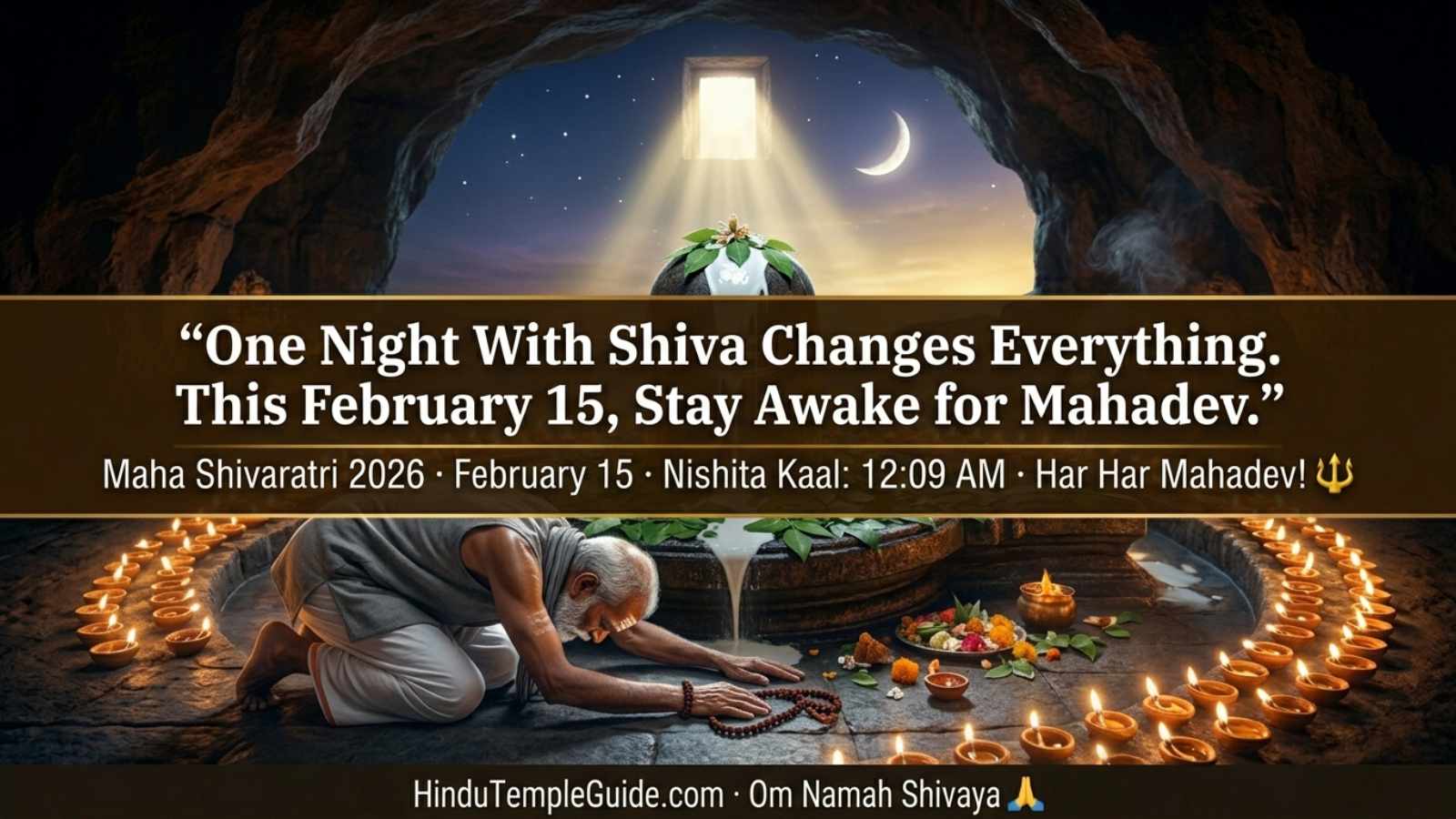
Observe Maha Shivaratri 2026 with Full Devotion!
Set your alarm for 12:09 AM on February 16. Perform your Rudrabhishekam. Stay awake for Mahadev. May Lord Shiva bless you with health, liberation, and his eternal grace. Har Har Mahadev! Om Namah Shivaya!
Disclaimer: Maha Shivaratri 2026 puja timings are based on the Hindu Panchang verified from multiple sources as of February 2026. Timings may vary slightly by geographical location. Always verify with your local Panchang or temple announcement for city-specific timings. HinduTempleGuide.com is not responsible for regional variations. Om Namah Shivaya!
You May Also Like


[…] Jyotirlinga Guide 2026 Navratri 2026 Guide Maha Shivaratri 2026 Char Dham Yatra 2026 Vaishno Devi Yatra […]