Dravidian vs Nagara Temple Architecture – Complete Comparison Guide with Examples 2026


Dravidian vs Nagara temple architecture this magnificent comparison lies at the heart of understanding how the Divine has been expressed in stone across the sacred landscape of India for over two thousand years. Every Hindu temple, whether it rises as a soaring curvilinear Shikhara above the plains of Rajasthan or stands as a towering pyramidal Gopuram above the tank-filled courtyards of Tamil Nadu, is a three-dimensional sacred scripture a cosmos made visible in granite, sandstone, and marble, built according to eternal principles revealed in the ancient texts of Vastu Shastra and Agama Shastra.
This complete guide answers every question from a student preparing for an exam, to a devoted pilgrim seeking to deepen their understanding of the sacred spaces they visit. Temple architecture is not the work of individual artists it is the collective devotion of entire civilisations, dynasties, and generations of shilpis (divine craftsmen) who understood stone as a living medium through which the formless Brahman could take form for the benefit of all devotees.
More temple heritage sites than almost any country on Earth
Nagara, Dravidian, Vesara each a complete civilisational achievement
66m Vimana, no mortar shadow never touches ground at noon
80,000+ individual carvings (UNESCO 2023) greatest sculptural density in the world
Quick Navigation
Table of Contents
What is Hindu Temple Architecture? The Sacred Science of Vastu & Agama
Hindu temple architecture is not merely an art form it is a sacred science (Shilpa Shastra) revealed in ancient Sanskrit texts that describes, in extraordinary detail, how a temple must be designed so that it becomes a living vessel for the Divine. Every proportion, every measurement, every orientation, every sculptural motif has a precise theological meaning and cosmic correspondence. When a devotee walks from the temple entrance to the garbhagriha, they symbolically journey from the outer material world to the innermost centre of the cosmic Self.
Broadly, Indian temple architecture divides into two great traditions Nagara (North Indian) and Dravidian (South Indian) separated roughly by the Vindhya mountain range. Between them arose a beautiful hybrid known as Vesara. All three share the same sacred purpose: to create a home on earth where the Divine may be present, worshipped, and directly experienced by every devotee.
Dravidian vs Nagara – Quick Comparison Table
In a Nagara temple, the tallest structure is the SANCTUM (Shikhara over the deity).
This single key difference explains virtually everything else about the two styles.
| Feature | DRAVIDIAN (South India) | NAGARA (North India) |
|---|---|---|
| Main Tower Style | Pyramidal stepped Gopuram (entrance) / Vimana (sanctum) | Curvilinear beehive Shikhara directly above sanctum |
| Tower Location | Tallest towers at ENTRANCE gates (Gopurams) | Tower directly ABOVE the garbhagriha (sanctum) |
| Temple Plan | Rectangular compound with concentric enclosures | Square or star-shaped (stellate) base plan |
| Enclosure Walls | Multiple concentric Prakaras (walled enclosures) | Usually no large enclosure walls or Prakaras |
| Sacred Tank | Large integral Pushkarini (temple tank) central feature | Tank present but secondary; not the defining feature |
| Top Finial | Octagonal Stupi dome or Kalasha | Amalaka (ribbed disc) + Kalasha (sacred pot) |
| Primary Stone | Granite (hard) plastered & brightly painted | Sandstone / limestone / marble (softer, deeply carved) |
| Colour | Vivid polychrome painted stucco figures on gopurams | Natural warm stone colour occasionally whitewashed |
| Mandapa Style | Thousand-pillared halls; Yali (lion-horse) columns | Open mandapa with balconied porticos; geometric pillars |
| Geographic Region | Tamil Nadu, Karnataka, AP, Kerala | Rajasthan, MP, Gujarat, Odisha, UP, Bihar |
| Principal Dynasties | Pallava, Chola, Pandya, Vijayanagara, Nayaka | Gupta, Chandela, Solanki, Paramara, Eastern Ganga |
| Sub-Shrine Layout | Within Prakaras (walled enclosure zones) | Panchayatana (5 shrines: main + 4 subsidiary) |
| Finest Example | Brihadeeswarar Temple, Thanjavur (UNESCO) | Kandariya Mahadev Temple, Khajuraho (UNESCO) |
Key Parts of a Hindu Temple – Sacred Anatomy Explained
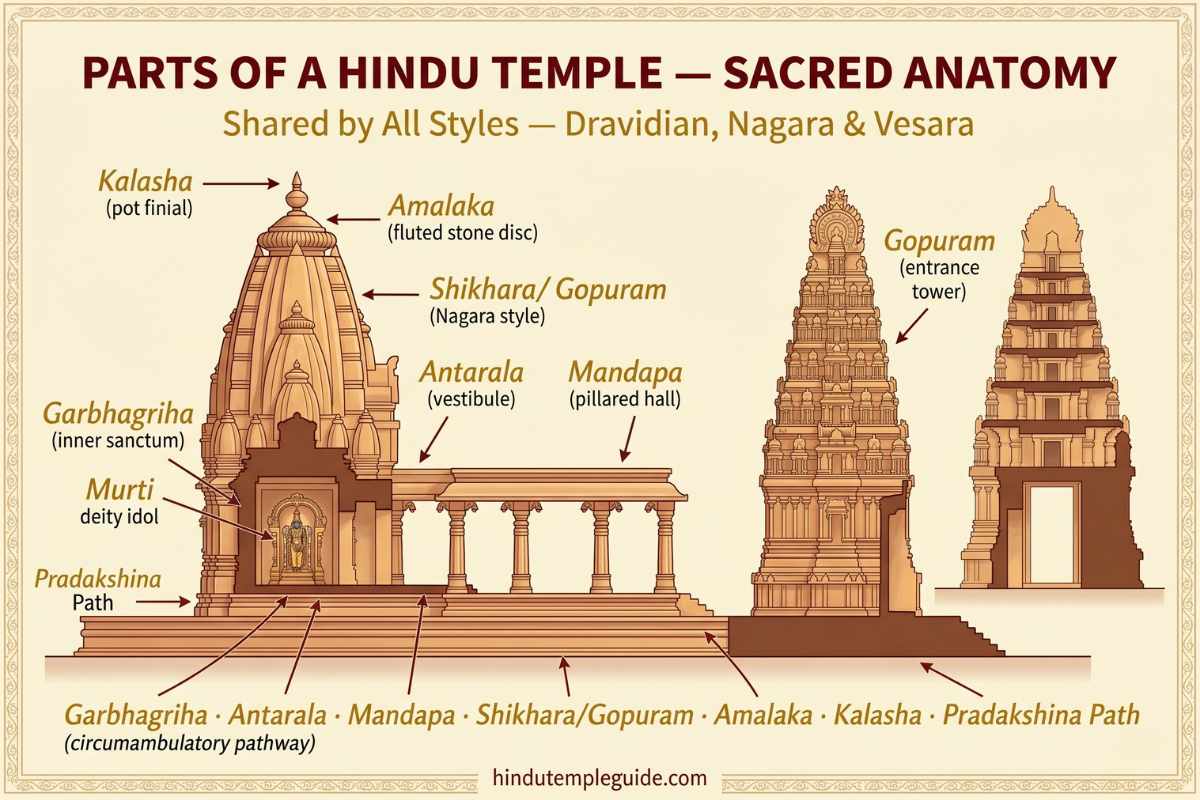
Before understanding the differences between Dravidian and Nagara temple architecture, every reader must be familiar with the shared sacred vocabulary the structural parts common to all Hindu temples. These parts correspond to both cosmic space and the human body in Vedic cosmology:
| Part Name | Sanskrit Meaning | Description & Significance |
|---|---|---|
| Garbhagriha | Womb Chamber | Innermost sanctum housing the main deity. Small, dark, square symbolises the cosmic womb and the Brahmasthana (centre of the universe). Only priests enter. |
| Shikhara / Vimana | Summit / Celestial Vehicle | Tower above garbhagriha. Shikhara in Nagara (curvilinear); Vimana in Dravidian (pyramidal). Represents Mount Meru the cosmic mountain at the universe’s centre. |
| Mandapa | Pillared Hall | The congregation hall where devotees gather. May include Ardha-mandapa (half-hall), Maha-mandapa (great hall), and Nritya-mandapa (dance hall). |
| Antarala | Vestibule / Threshold | Transitional space connecting Mandapa to Garbhagriha. Symbolises the threshold between the outer world and the innermost divine a space for mental preparation. |
| Gopuram | Gateway Tower | Massive entrance tower in Dravidian temples. Marks the sacred precinct boundary. In large complexes, gopurams grow taller at outer walls and shorter near the sanctum. |
| Prakara | Enclosure Wall | Concentric walled enclosures especially in Dravidian temples. Each Prakara may contain subsidiary shrines, tanks, kitchens, and administrative spaces. |
| Amalaka | Ribbed Stone Disc | Ribbed segmented stone disc at the very top of a Nagara Shikhara. Resembles a gooseberry fruit. A definitive identifier of Nagara style absent in Dravidian temples. |
| Kalasha | Sacred Pot / Pinnacle | The topmost finial of every Hindu temple a water pot symbolising abundance and completeness. Found in both Dravidian and Nagara styles. |
| Pradakshina Path | Circumambulation Path | Sacred walkway around the garbhagriha for clockwise circumambulation. Present in all styles; sometimes enclosed (Dravidian) or open (Nagara). |
Dravidian Temple Architecture – The South Indian Sacred Tradition
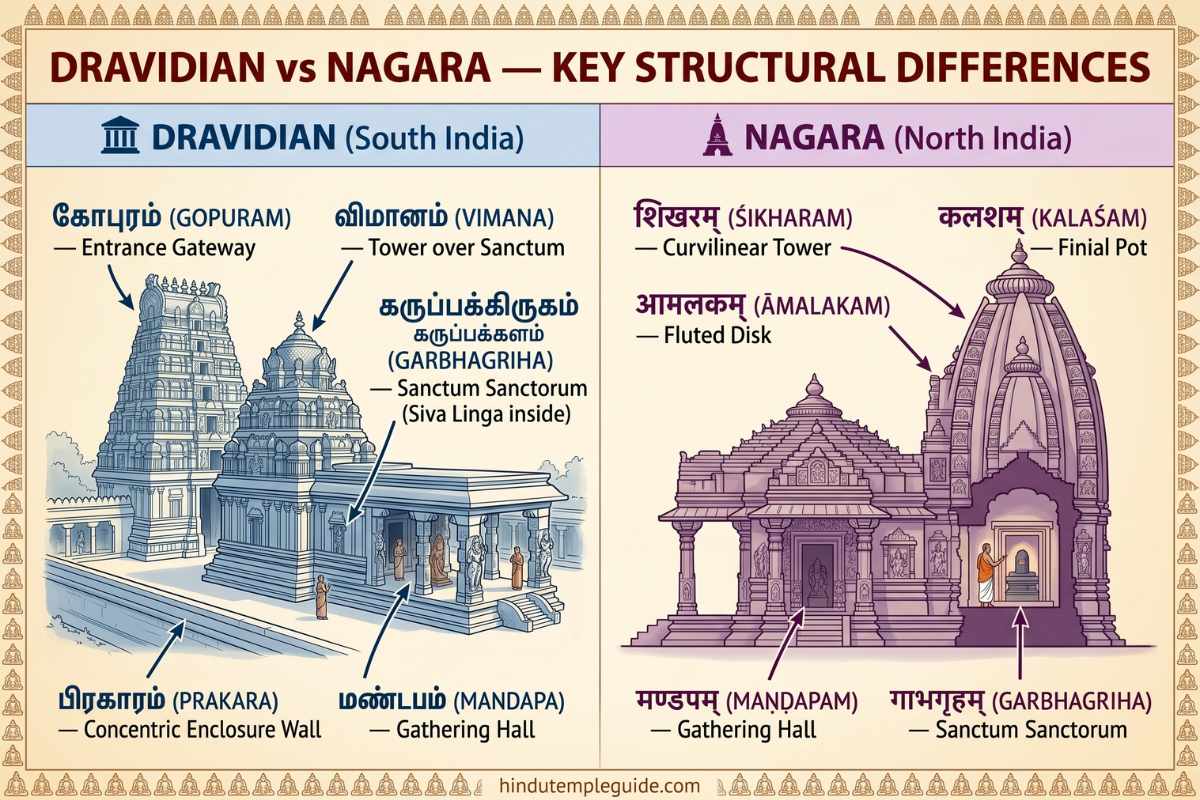
Pyramidal Gopuram · Concentric Prakaras · Temple Tank · South India · Painted Stucco Sculptures
Dravidian temple architecture is the supreme artistic and spiritual achievement of South India a tradition producing some of the most awe-inspiring sacred structures in the entire world. Developed under the Pallavas, Cholas, Pandyas, Chalukyas, and Vijayanagara emperors between the 7th and 17th centuries CE, Dravidian architecture reached its greatest heights in the temples of Tamil Nadu and Karnataka. What immediately strikes any visitor is the overwhelming grandeur of the towering, brightly painted Gopurams massive gateway towers encrusted with hundreds of painted stucco figures representing the full cosmic drama of Hindu mythology compressed into stone and pigment.
Key Features of Dravidian Temple Architecture
| Main Tower | Vimana (pyramidal) over sanctum; Gopuram (taller pyramidal tower) at entrance gates |
| Temple Plan | Rectangular walled compound with multiple concentric Prakara enclosure walls |
| Sacred Tank | Large integral Pushkarini (temple tank) for ritual bathing, float festivals (Teppotsavam), and purification |
| Mandapa Halls | Thousand-pillared halls with Yali (mythical lion-horse) carved columns visual encyclopaedias of Hindu mythology |
| Sculpture Style | Brightly painted stucco figures on gopurams; hard granite inside |
| Primary Stone | Granite (hard stone) plastered with lime and painted in vivid polychrome colours |
| Top Finial | Octagonal Stupi dome or barrel-vaulted Sala roof, then Kalasha |
| Principal Dynasties | Pallava (7th–9th c.) → Chola (9th–12th c.) → Pandya → Vijayanagara → Nayaka (16th–18th c.) |
| Finest Example | Brihadeeswarar Temple, Thanjavur (1010 CE) UNESCO World Heritage, 66m Vimana |
Unique Structural Principles of Dravidian Temples
D1 Brihadeeswarar Temple, Thanjavur Crown of Dravidian Architecture (UNESCO)
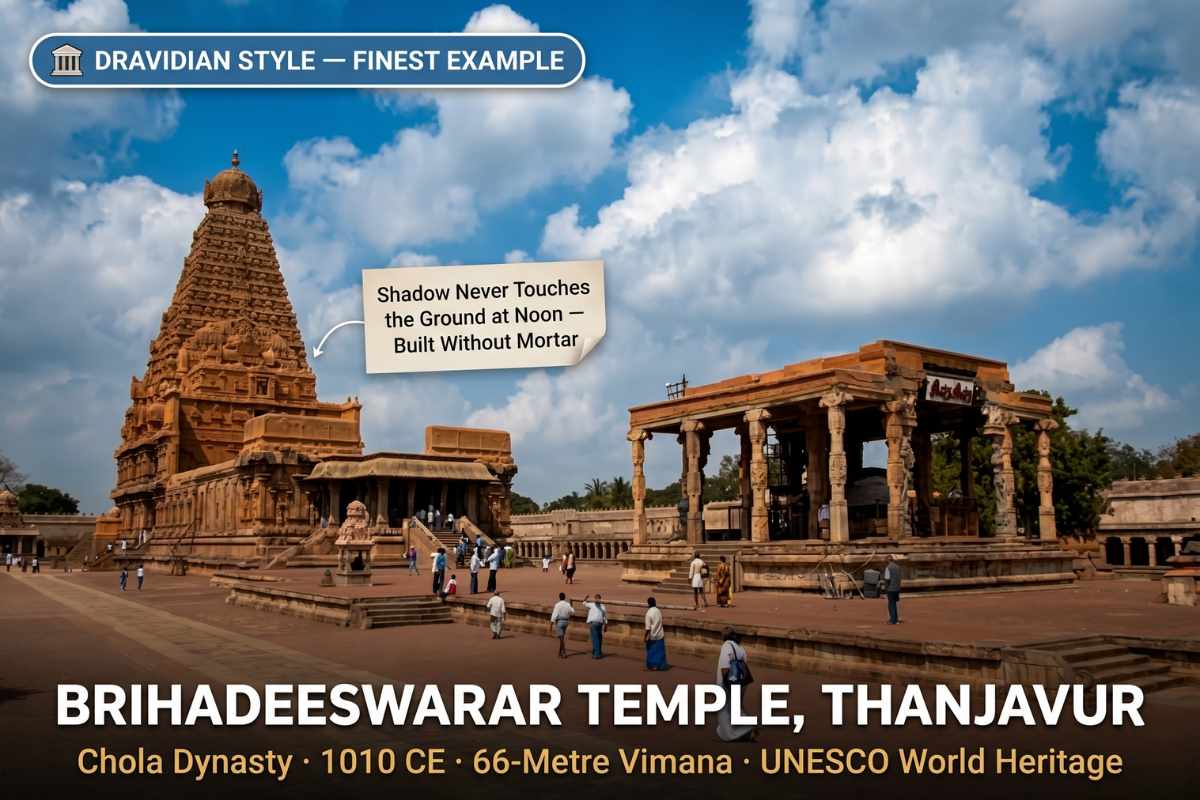
Brihadeeswarar Temple at Thanjavur (1003–1010 CE), built by Emperor Raja Raja Chola I, is the supreme masterpiece of Dravidian architecture. Its 66-metre Vimana built entirely WITHOUT mortar was the tallest temple tower of its era. The 80-tonne capstone at its apex was raised using a 6.44 km earthen ramp. Most remarkably, the Vimana’s shadow never falls on the ground at noon a deliberate design achievement by Chola architects that still astonishes modern engineers. UNESCO World Heritage as part of the Great Living Chola Temples.
| Dynasty | Chola Emperor Raja Raja Chola I |
| Built | 1003–1010 CE |
| Vimana Height | 66 metres tallest of its era, built without mortar |
| Notable Feature | Shadow never touches the ground at noon deliberate Chola engineering |
| UNESCO Status | Yes Great Living Chola Temples (with Gangaikondacholapuram & Airavatesvara) |
D2 Meenakshi Amman Temple, Madurai – Living Wonder with 14 Gopurams
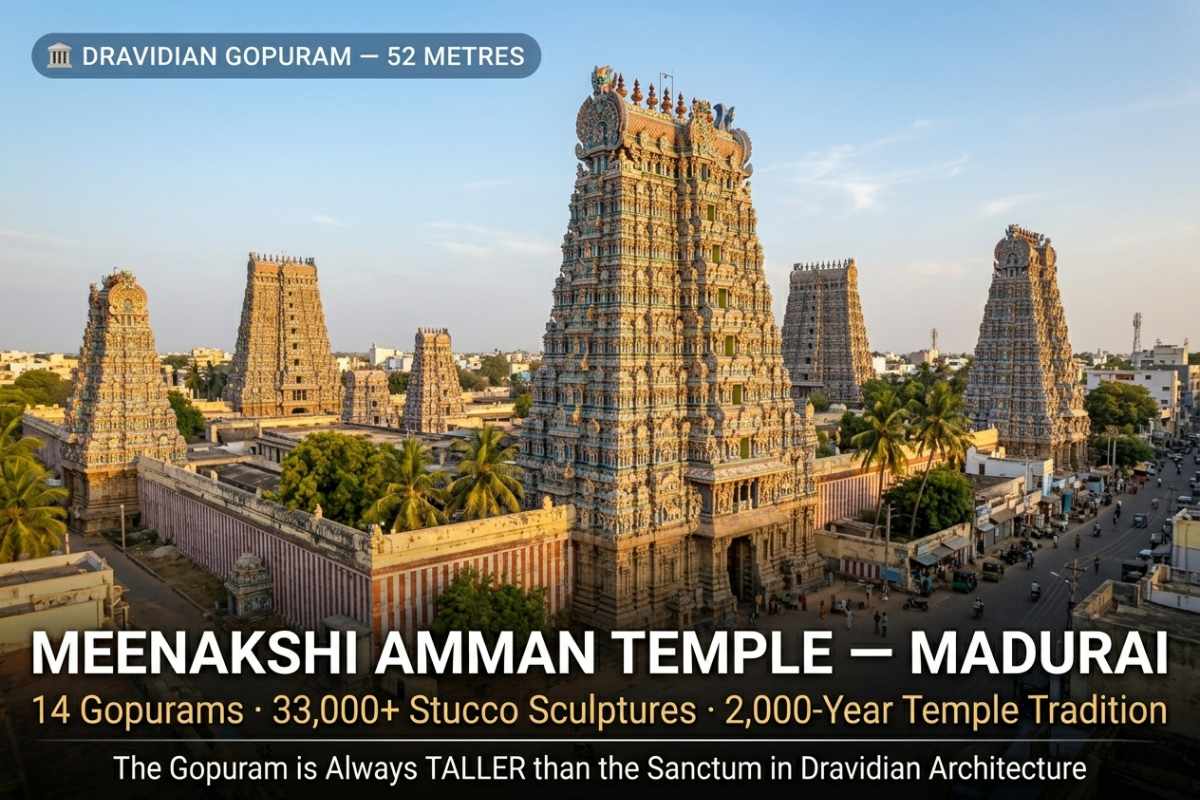
Meenakshi Amman Temple at Madurai is perhaps the most visually overwhelming of all Dravidian temples a sprawling sacred city with 14 gopurams, the tallest at 52 metres, encrusted with over 33,000 painted stucco sculptures. A 2,000-year continuous temple tradition. The Nayaka-period complex (16th–17th c.) with its famous thousand-pillared hall and sacred Porthamarai tank is the finest example of the mature Dravidian style.
All Major Dravidian Temples – Quick Reference
| Temple | Location | Dynasty / Period | Notable Feature |
|---|---|---|---|
| Brihadeeswarar Temple | Thanjavur, TN | Chola (1010 CE) | UNESCO · 66m Vimana · Shadow never falls at noon |
| Meenakshi Amman Temple | Madurai, TN | Nayaka (16th–17th c.) | 14 gopurams · 33,000 sculptures · Living city-temple |
| Ranganathaswamy Temple | Srirangam, TN | Chola–Vijayanagara | Largest Hindu temple complex (156 acres) · 21 gopurams |
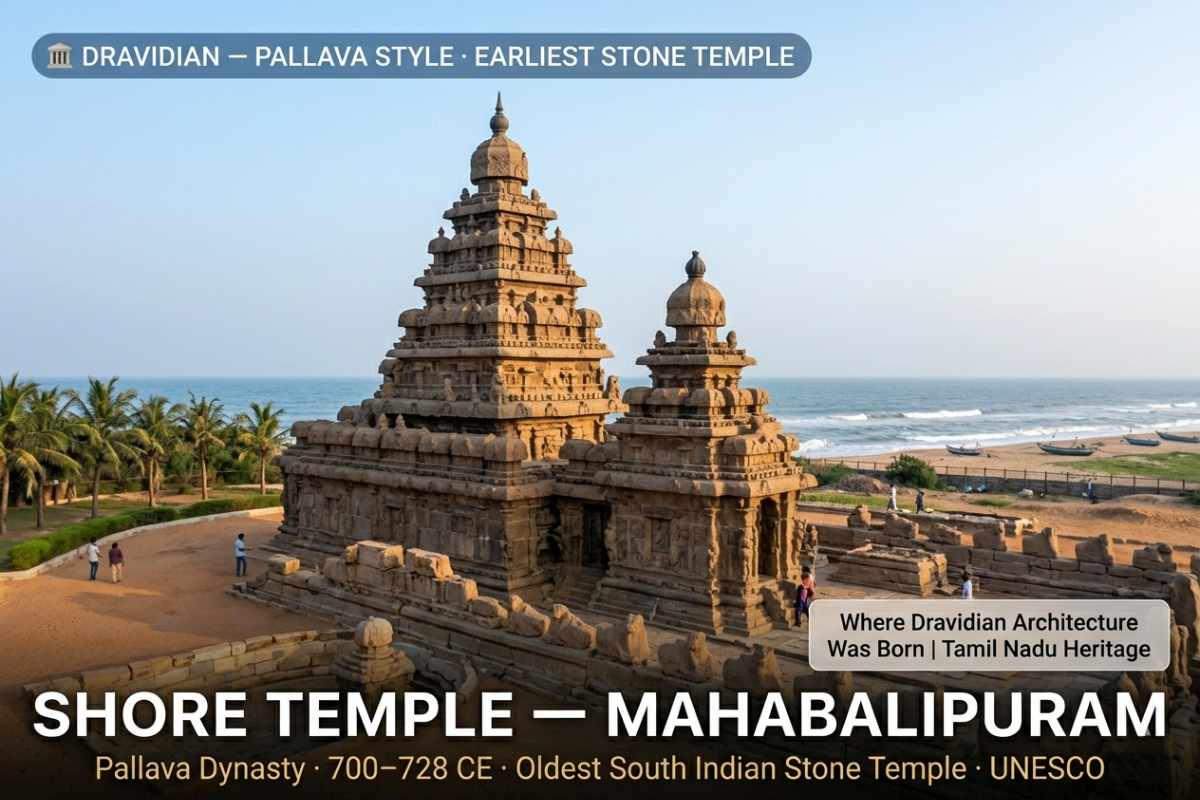
| Shore Temple | Mahabalipuram, TN | Pallava (700–728 CE) | UNESCO · Oldest surviving stone temple in South India |
| Virupaksha Temple | Hampi, Karnataka | Vijayanagara (7th c.+) | UNESCO · Continuously active since 7th century CE |
| Ekambareswarar Temple | Kanchipuram, TN | Pallava–Vijayanagara | Pancha Bhuta Stala (Earth) · 3,500-year-old mango tree |
| Nataraja Temple | Chidambaram, TN | Chola (10th c.) | Pancha Bhuta Stala (Akasha/Space) · Lord Shiva as Nataraja |
Nagara Temple Architecture – The North Indian Sacred Tradition
◆ Curvilinear Shikhara · Square/Stellate Plan · Amalaka Finial · North & Central India · Carved Stone Bands
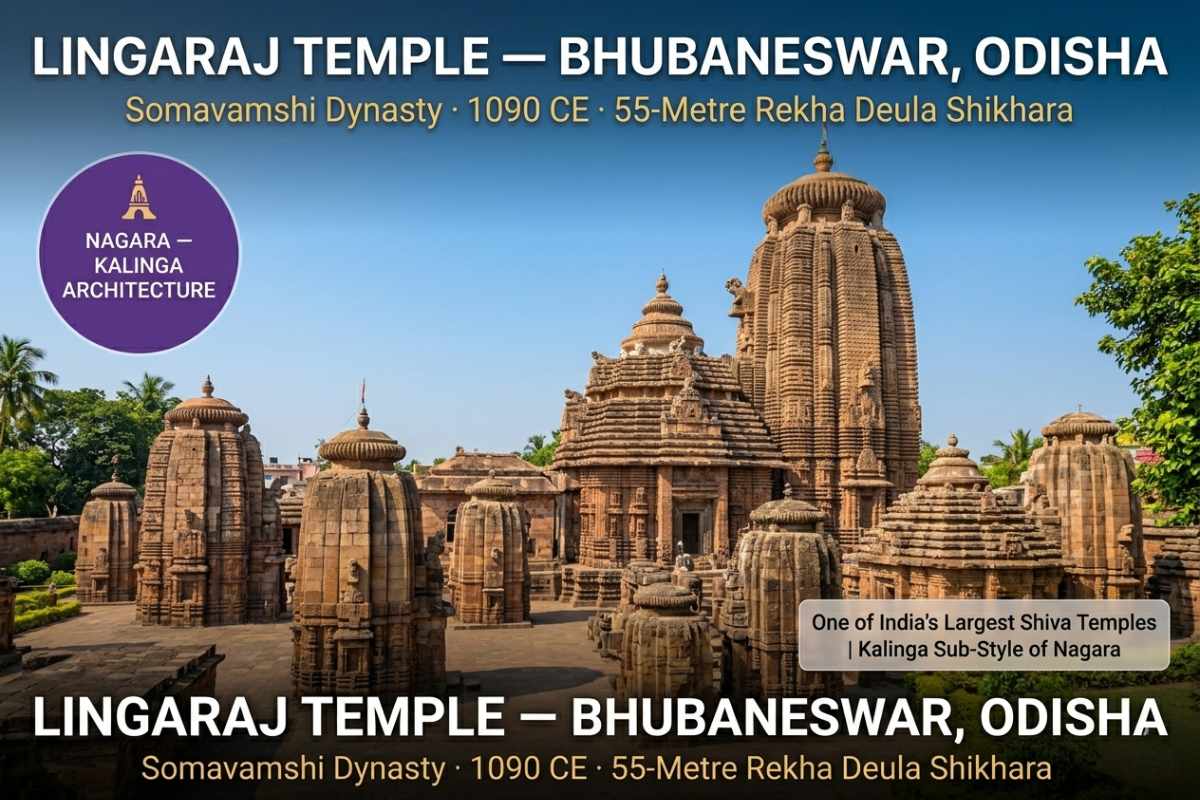
Nagara temple architecture is the sublime visual language of North and Central Indian devotion a style defined by the soaring, sensuous curve of the Shikhara, rising like a mountain peak or an upraised flame from the earth toward the infinite sky. Where Dravidian architecture impresses with horizontal spread and dramatic entrance towers, Nagara architecture concentrates all its spiritual energy in a single act of breathtaking vertical aspiration the Shikhara leaping toward heaven from directly above the garbhagriha where the deity resides. Developing from the Gupta period (4th–6th century CE) through the Chandela, Solanki, and Eastern Ganga dynasties (9th–13th century), Nagara produced the jewels of Khajuraho, Konark, Lingaraj, and Somnath.
✦ Key Features of Nagara Temple Architecture
| Main Tower | Curvilinear Shikhara rising directly above the garbhagriha the temple’s tallest and most dominant feature |
| Temple Plan | Square or stellate (star-shaped) base no large enclosure walls |
| Top Finial | Amalaka (ribbed stone disc) + Kalasha (sacred pot) definitive Nagara identifier |
| Spirelets | Multiple smaller Urushringas (spirelets) on Shikhara surface creating a mountain-cluster visual effect |
| Sub-Shrine Layout | Panchayatana plan: main shrine + 4 subsidiary shrines at corners of a raised platform (Jagati) |
| Sculpture Style | Deeply carved sandstone/marble in horizontal bands Apsaras, Mithunas, Dvarapalas, Devas |
| Principal Dynasties | Gupta (4th–6th c.) → Gurjara-Pratihara → Chandela → Solanki → Eastern Ganga (Odisha) |
| Finest Example | Kandariya Mahadev Temple, Khajuraho, MP (1030 CE) UNESCO World Heritage |
✦ Three Sub-Styles of Nagara Temple Architecture
| Sub-Style | Region | Key Feature | Best Examples |
|---|---|---|---|
| Latina (Rekha Prasada) | Rajasthan, Gujarat, MP, Odisha | Simple single curvilinear Shikhara with continuous vertical bands the purest and most common Nagara form | Lingaraj Temple (Bhubaneswar), Kandariya Mahadev (Khajuraho) |
| Sekhari (Shikhara Cluster) | Rajasthan, Gujarat, Odisha | Main Shikhara surrounded by multiple smaller Urushringas cascading mountain-cluster effect | Dilwara Jain Temples (Rajasthan), Parsvanatha Temple (Khajuraho) |
| Bhumija | MP, Rajasthan | Diamond-lattice grid of miniature spires covering entire Shikhara surface unique to Central India | Udayeshvara Temple (Udaypur, MP), Ambika Mata Temple (Rajasthan) |
N1 Kandariya Mahadev Temple, Khajuraho – Crown of Nagara Architecture (UNESCO)
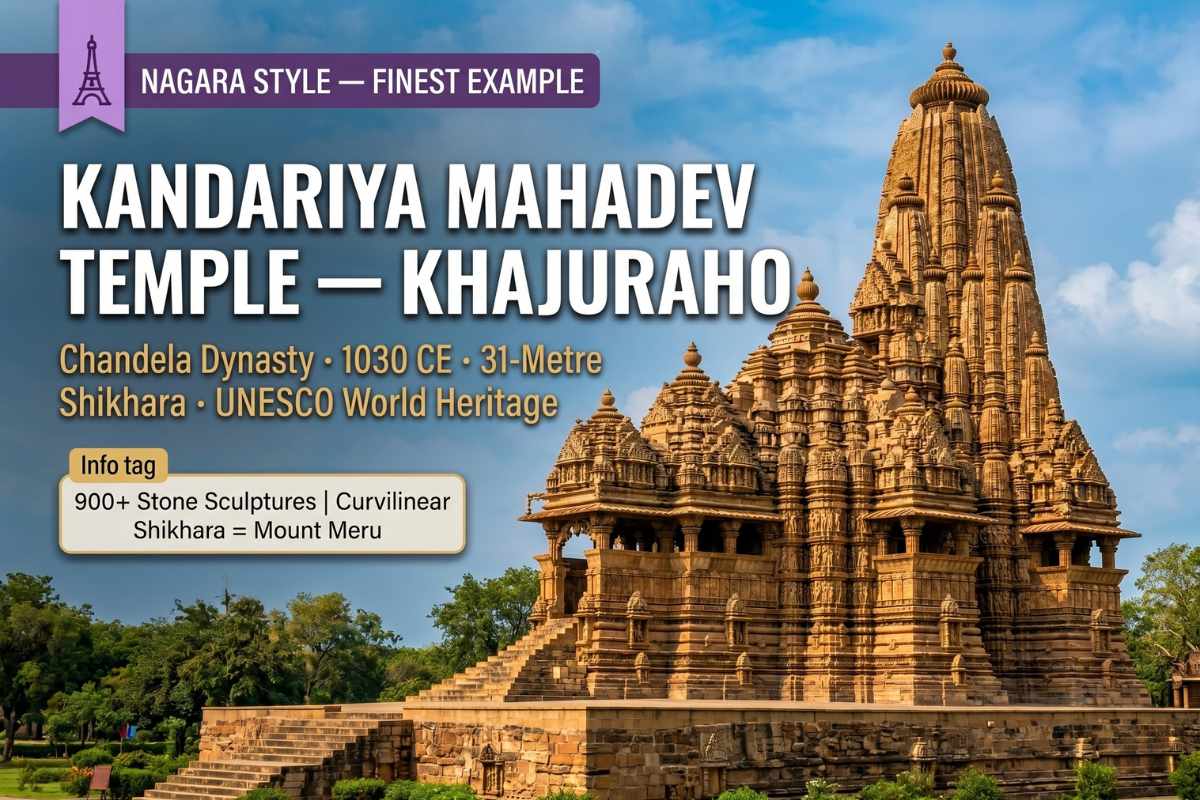
Kandariya Mahadev Temple at Khajuraho (Chandela dynasty, c. 1030 CE) is the ultimate achievement of Nagara architecture a UNESCO World Heritage Site rising 31 metres in a breathtaking cascade of spires, each smaller Urushringa spirelet perfectly echoing and amplifying the ascent of the main Shikhara. The temple is covered in approximately 900 sculptures, including the famous Mithuna (celestial couple) figures that represent the divine union of Purusha and Prakriti a theological statement, not merely a sensual one.
All Major Nagara Temples – Quick Reference
| Temple | Location | Dynasty / Period | Notable Feature |
|---|---|---|---|
| Kandariya Mahadev | Khajuraho, MP | Chandela (c. 1030 CE) | UNESCO · 31m Sekhari Shikhara · 900 sculptures |
| Lingaraj Temple | Bhubaneswar, Odisha | Somavamshi (1090 CE) | Kalinga Nagara · 55m Rekha Deula · India’s largest Shiva temples |
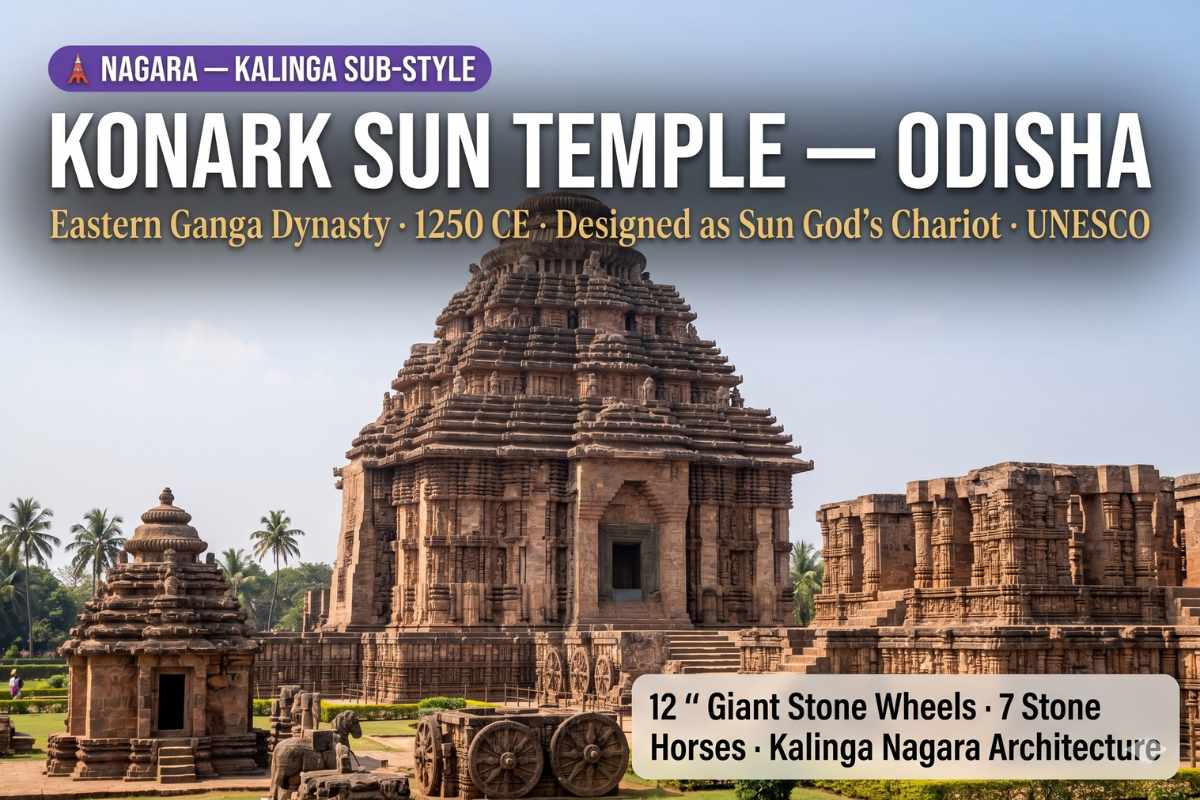
| Konark Sun Temple | Konark, Odisha | Eastern Ganga (1250 CE) | UNESCO · Designed as chariot of Sun God · Kalinga style |
| Somnath Temple | Gujarat | Multiple (rebuilt 1951) | First Jyotirlinga · Chalukya-Nagara · Arabian Sea location |
| Dilwara Jain Temples | Mount Abu, Rajasthan | Solanki (11th–13th c.) | White marble · Most intricate stone carving in all of India |
| Mukteshvara Temple | Bhubaneswar, Odisha | Somavamshi (950 CE) | ‘Gem of Odishan Architecture’ · Exquisite carvings · Torana arch |
| Vishvanath Temple | Khajuraho, MP | Chandela (1002 CE) | UNESCO · Perfectly preserved Latina Nagara Shikhara |
Vesara Architecture – The Beautiful Hybrid Style of the Deccan
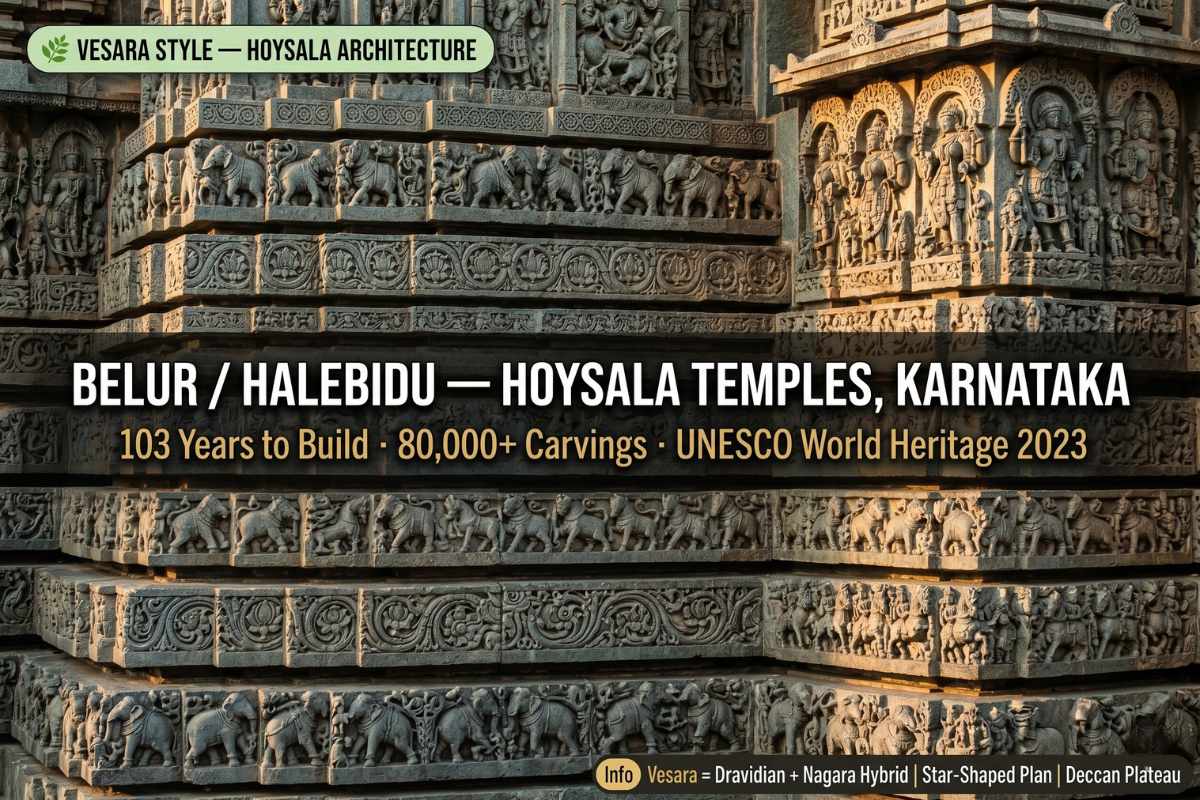
◆ Dravidian + Nagara Hybrid · Star-Shaped Plan · Hoysala Style · Karnataka / Deccan · 6th–13th Century CE
Vesara architecture is the glorious creative synthesis that arose when the artistic energies of North and South India met in the Deccan plateau. The very name Vesara means ‘mule’ in Sanskrit a hybrid between the horse (Nagara) and the donkey (Dravidian) combining the finest elements of both traditions into something entirely new and beautiful. Developed under the Chalukyas, Rashtrakutas, and Hoysalas between the 6th and 13th centuries CE, Vesara produced temples that are among the most extraordinarily detailed sacred structures in the world.
| Tower Style | Combines pyramidal Dravidian elements with curvilinear Nagara a unique stepped-curvilinear fusion |
| Temple Plan | Star-shaped (stellate / 16-pointed) platform the Hoysala innovation; creates dramatic play of light and shadow |
| Pillars | Extraordinarily intricate lathe-turned pillars unique to Hoysala style each pillar a different design |
| Sculpture Density | Continuous horizontal friezes covering the entire exterior 80,000+ carvings at Halebidu (most in the world) |
| Gopurams | Absent or small no massive entrance gateway towers (unlike Dravidian) |
| Principal Dynasties | Early Chalukya (6th–8th c.) → Rashtrakuta → Late Chalukya → Hoysala (11th–13th c.) |
| Finest Examples | Belur Chennakeshava, Halebidu Hoysaleswara, Somnathapura Keshava all UNESCO 2023 |
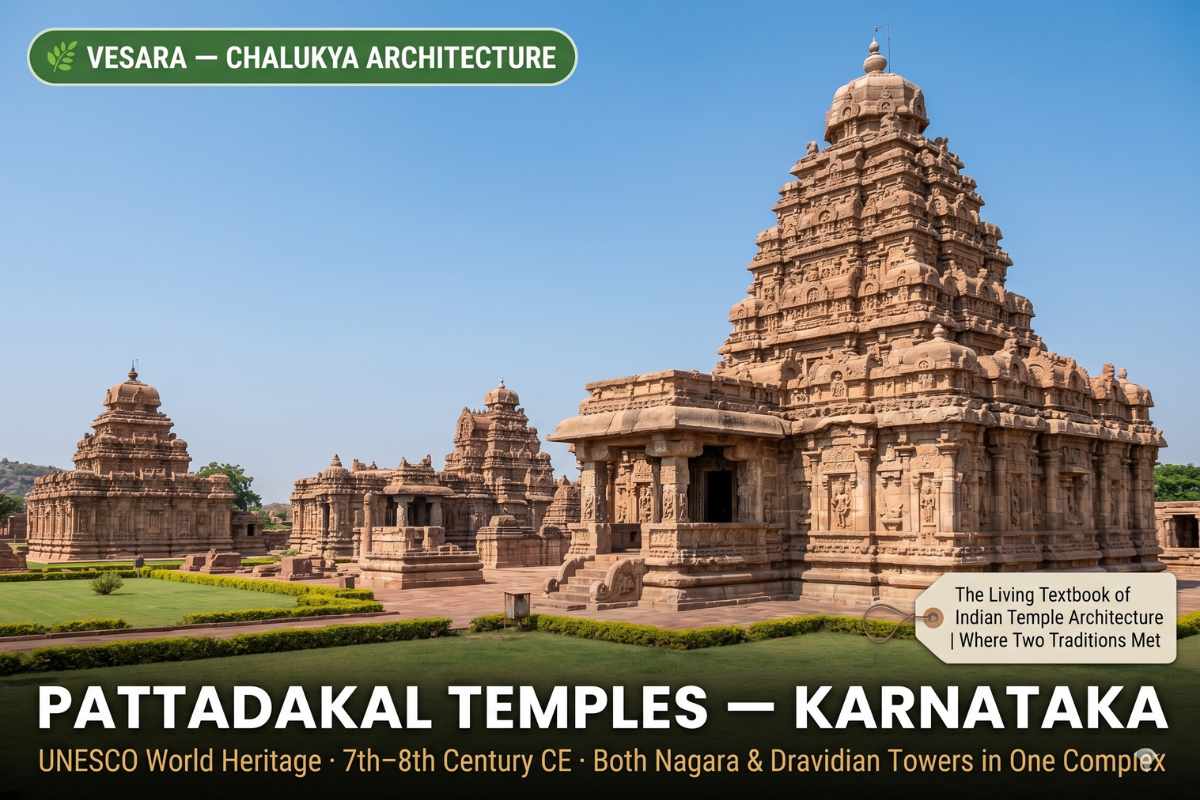
Finest Examples of Vesara Architecture
Gopuram vs Shikhara – The Most Important Difference Explained
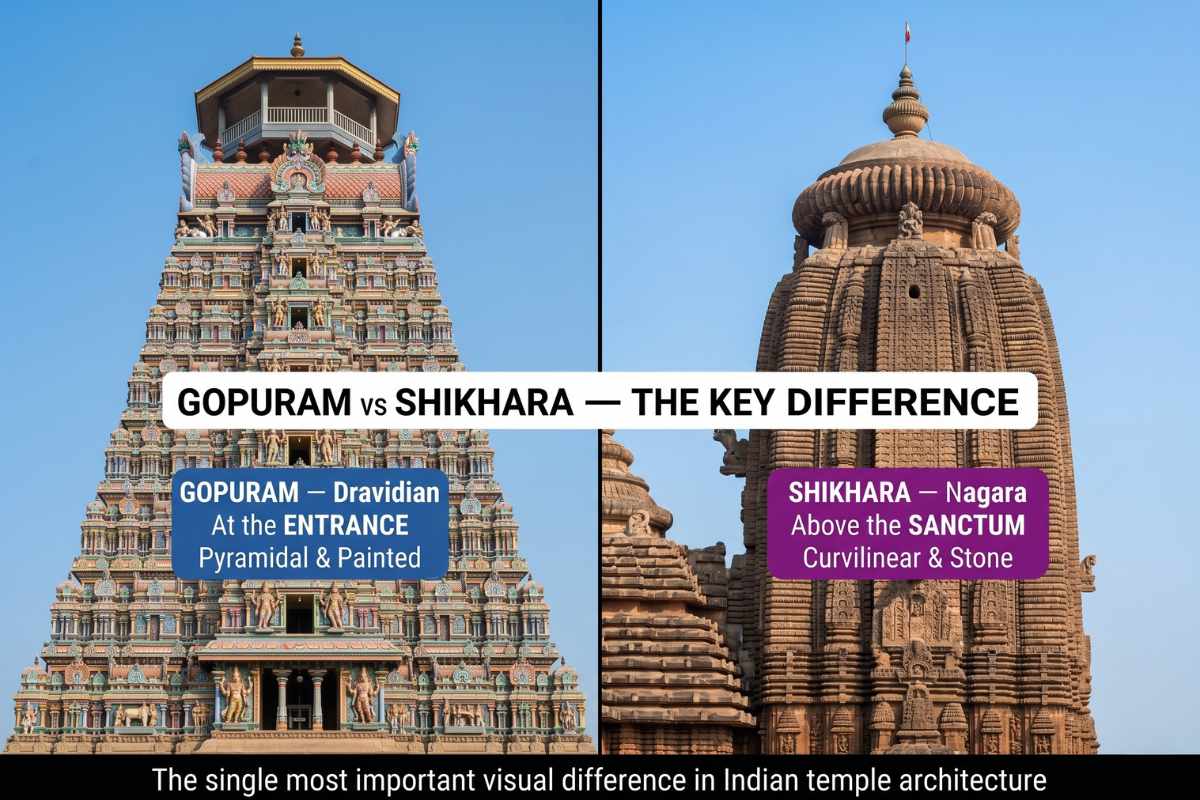
| Point of Difference | GOPURAM (Dravidian) | SHIKHARA (Nagara) |
|---|---|---|
| What it is | Gateway tower at temple entrance | Tower directly above the inner sanctum (garbhagriha) |
| Shape | Pyramidal wide at base, tapering in stepped layers | Curvilinear smooth upward curve like a flame or mountain |
| Location | At the ENTRANCE (Dvara) of enclosure walls | ABOVE the main deity’s chamber |
| Relative Height | Tallest at outer walls; shrinks toward sanctum | Tallest structure in the entire complex |
| Number | Multiple 4, 8, 14, or 21 gopurams per complex | One main Shikhara; smaller ones over subsidiary shrines |
| Decoration | Hundreds of brightly painted stucco figures | Bands of deeply carved stone sculptures |
| Top Element | Octagonal Stupi dome or barrel-vaulted Sala roof | Amalaka (ribbed disc) + Kalasha (sacred pot finial) |
| Theological Meaning | ‘The dramatic invitation Enter, the Divine awaits within’ | ‘The divine proclamation I am here, above the sacred centre’ |
Together they tell the full story of the devotee’s journey from the street to the stars.”
Contemporary interpretation of Agama Shastra symbolism
Deep Comparison – 20 Points: Dravidian vs Nagara Temple Architecture
| # | Feature | Dravidian | Nagara |
|---|---|---|---|
| 1 | Main tower name | Gopuram (entrance) / Vimana (sanctum) | Shikhara |
| 2 | Tower shape | Pyramidal / stepped tiers | Curvilinear / beehive / flame-shaped |
| 3 | Top finial | Octagonal Stupi or Kalasha | Amalaka (ribbed disc) + Kalasha |
| 4 | Temple plan | Rectangular compound | Square or stellate (star-shaped) |
| 5 | Enclosure walls | Multiple Prakaras (concentric) | Usually absent |
| 6 | Temple tank | Large, integral Pushkarini | Secondary feature |
| 7 | Primary stone | Granite (hard) | Sandstone / marble (softer) |
| 8 | Colour | Vivid painted stucco | Natural warm stone colour |
| 9 | Sub-shrine layout | Within Prakaras | Panchayatana (5-shrine) plan |
| 10 | Pillar style | Yali (lion-horse) figurative pillars | Lathe-turned / geometric pillars |
| 11 | Sculpture placement | Mainly on gopurams (painted stucco) | All over Shikhara (carved stone bands) |
| 12 | River orientation | Temple tanks substitute rivers | Often built directly on riverbanks |
| 13 | Mandapa style | Thousand-pillared closed halls | Open mandapa with balconied porticos |
| 14 | Geographic region | South India | North / Central India |
| 15 | Key dynasties | Pallava · Chola · Vijayanagara | Gupta · Chandela · Solanki |
| 16 | UNESCO examples | Brihadeeswarar · Shore Temple · Hampi | Khajuraho · Konark · Pattadakal |
| 17 | Scriptural tradition | Agama Shastra (Shaiva / Vaishnava Agamas) | Vastu Shastra + Shilpa Shastra |
| 18 | Key pilgrimage cities | Madurai · Thanjavur · Kanchipuram | Khajuraho · Bhubaneswar · Modhera |
| 19 | Hybrid style | Vesara architecture (Chalukya + Hoysala) Deccan hybrid of both | |
| 20 | Cosmic symbolism | Gopuram = invitation; Prakaras = cosmos expanding outward | Shikhara = Mount Meru; sanctum = navel of universe |
Dynasty Timeline – Who Built Which Style and When
| Dynasty | Period | Style | Key Temples Built |
|---|---|---|---|
| Gupta Dynasty | 4th–6th c. CE | Early Nagara | Dashavatara Temple (Deogarh) first true Nagara Shikhara |
| Pallava Dynasty | 600–900 CE | Early Dravidian | Shore Temple (Mahabalipuram) · Kailasanathar (Kanchipuram) |
| Early Chalukya | 543–753 CE | Proto-Vesara | Pattadakal (UNESCO) · Badami Cave Temples · Aihole |
| Rashtrakuta | 753–982 CE | Vesara | Kailasa Temple Ellora (rock-cut greatest monolithic temple |
| Chola Dynasty | 850–1279 CE | Classical Dravidian | Brihadeeswarar · Gangaikondacholapuram · Airavatesvara (all UNESCO) |
| Chandela Dynasty | 9th–13th c. | Classical Nagara | Khajuraho Group (UNESCO) Kandariya Mahadev, Vishvanath |
| Solanki Dynasty | 10th–13th c. | Nagara / Maru-Gurjara | Modhera Sun Temple · Somnath · Dilwara Jain Temples |
| Hoysala Dynasty | 11th–13th c. | Mature Vesara | Belur · Halebidu · Somnathapura (all UNESCO 2023) |
| Eastern Ganga | 11th–15th c. | Kalinga Nagara | Konark Sun Temple (UNESCO) · Jagannath Temple Puri |
| Vijayanagara | 1336–1565 CE | Mature Dravidian | Hampi (UNESCO) · Vittala Temple · Hazara Rama Temple |
| Nayaka Dynasty | 16th–18th c. | Late Dravidian | Meenakshi Temple Madurai (expanded) · Chidambaram (expanded) |
Geographic Distribution – Where Each Style is Found in India
| Style | Primary States | Geographic Marker | Dominant Period |
|---|---|---|---|
| DRAVIDIAN | Tamil Nadu · Kerala · Karnataka (south) · Andhra Pradesh · Telangana | South of the Vindhya and Satpura mountain ranges | 7th–18th c. CE |
| NAGARA | Rajasthan · Madhya Pradesh · Gujarat · UP · Bihar · Odisha · Himachal Pradesh | North of the Vindhya range; Gangetic plains and beyond | 5th–13th c. CE |
| VESARA | Karnataka (central) · Maharashtra (Deccan) · Parts of Andhra | The Deccan plateau transitional zone between North and South | 6th–13th c. CE |
FAQs – Dravidian vs Nagara Temple Architecture
Conclusion – Two Styles, One Eternal Divine Truth
Whether you stand before the 66-metre Vimana of the Brihadeeswarar Temple in Thanjavur so perfectly proportioned that its shadow never falls on the ground at noon or gaze upward at the cascading spirelets of the Kandariya Mahadev Temple at Khajuraho in the golden morning light, you are witnessing the same miracle: human devotion transformed into stone, and stone transformed back into the Divine.
Tat Tvam Asi That Thou Art | The Temple Is You
Disclaimer: Information on temple architecture history, dynastic periods, and UNESCO designations is sourced from Archaeological Survey of India (asi.nic.in), UNESCO World Heritage Centre (whc.unesco.org), and peer-reviewed art-history references verified as of April 2026. Temple timings and visitor rules at specific sites may change always verify directly with the respective temple authority or ASI before visiting.