Ram Setu (Adam's Bridge) – Complete Guide to History, Science & Spiritual Significance: The Sacred Bridge of Lord Rama Panch Bhoota Sthalam – Complete Guide to 5 Elements Shiva Temples: Earth, Water, Fire, Air & Ether Chola Dynasty Temples – Complete Heritage Guide to India's Greatest Temple Builders: Brihadeeswarar, Gangaikonda Cholapuram & Airavatesvara Navagraha Temples Tamil Nadu – Complete Guide to All 9 Sacred Planet Temples: Locations, Timings, Offerings & Pilgrimage Route Dravidian vs Nagara Temple Architecture – Complete Comparison Guide with Examples 2026 18 Shakti Peeth Temples – Complete Guide with Names, Locations, Body Parts of Sati & Pilgrimage Tips 2026 Panch Kedar 2026 – Complete Guide to All 5 Sacred Himalayan Shiva Shrines: Kedarnath, Tungnath, Rudranath, Madhyamaheshwar & Kalpeshwar Sapta Puri Complete Guide 2026 – India's 7 Holiest Cities That Grant Moksha
Ram Setu (Adam’s Bridge) – Complete Guide to History, Science & Spiritual Significance: The Sacred Bridge of Lord Rama

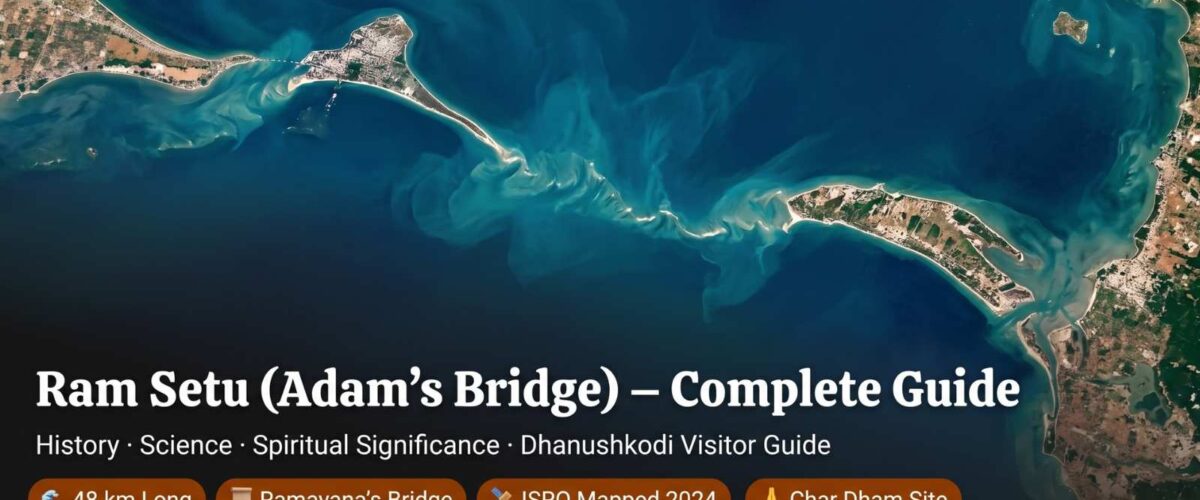
Ram Setu (Adam’s Bridge) – Complete Guide to History, Science & Spiritual Significance: The Sacred Bridge of Lord Rama

✍️ Devendra Khambalkar 📅 May 8, 2026 🕐 Updated May 9, 2026 ⏱ 16 min read 💬 No comments

DK

Written by Devendra Khambalkar

Nagpur, Maharashtra — temple traveller, Rameswaram pilgrim, and Hindu heritage writer

 जय श्री राम

Ram Setu (Adam’s Bridge)

Complete Guide 2026 — Ramayana Story, Science, ISRO Mapping & Visitor Information

48km Limestone Chain · Dhanushkodi · Rameswaram · Char Dham · All FREE · Jai Shri Ram!

 48km Limestone Chain
 ISRO-NASA Mapped 2024
 Valmiki Ramayana
 Char Dham · 12 Jyotirlinga
 FREE Entry

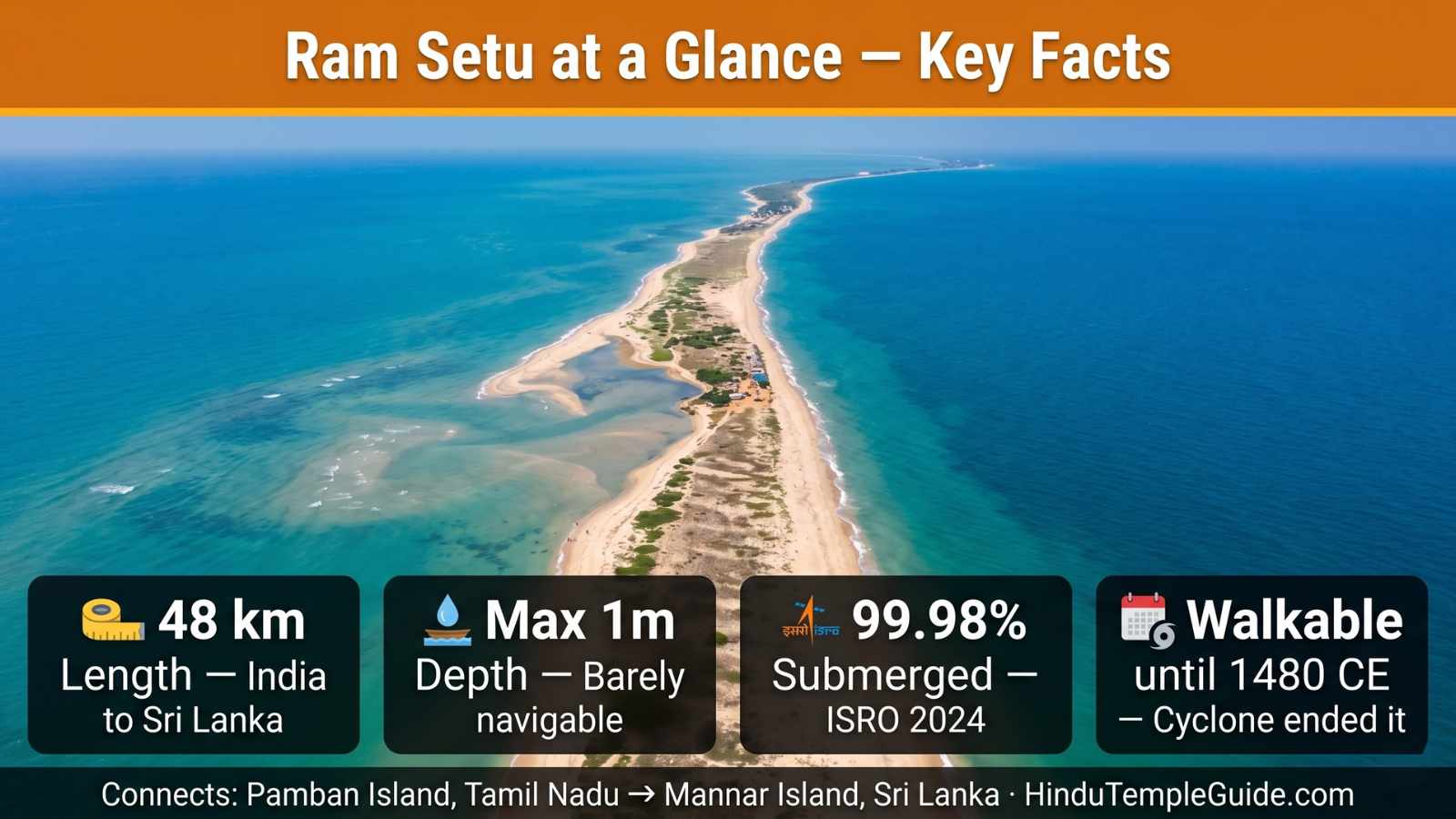
I have visited Rameswaram and stood at Arichal Munai — the southern tip of Dhanushkodi — where the Bay of Bengal and the Gulf of Mannar visibly meet, and Sri Lanka sits on the horizon just 20 km away. That experience is what made me want to write this guide properly. Ram Setu is one of the most extraordinary and most debated structures in human history — simultaneously a geological wonder, a Ramayana sacred site, an international boundary, a contested scientific mystery, and a symbol of faith for over a billion Hindus worldwide. Known in the West as Adam’s Bridge, this 48-kilometre chain of limestone shoals and sandbanks stretches across the shallow waters between Pamban Island in Tamil Nadu and Mannar Island in Sri Lanka. The sea here rarely exceeds 1 metre in depth, and until 1480 CE this remarkable bridge was reportedly passable on foot between India and Sri Lanka.

For devout Hindus, Ram Setu is not primarily a geological formation — it is the physical evidence of the Ramayana. According to Valmiki’s Ramayana, Lord Rama directed his devoted architect Nala and the great Vanara army to build this bridge to rescue Sita from demon king Ravana. This complete guide covers every dimension — the Ramayana narrative, geology, ISRO-NASA 2024 mapping, scientific debates, spiritual pilgrimage experience, and how to see Ram Setu in 2026. Jai Shri Ram!

 Ancient Reference

Ram Setu is mentioned in Valmiki’s Ramayana (verse 2-22-76) as ‘Setubandhanam’ — the construction of a bridge. The sea separating India and Sri Lanka was named ‘Sethusamudram’ (Sea of the Bridge) in ancient times. The 9th-century Persian geographer Ibn Khordadbeh referred to it as ‘Set Bandhai’ (Bridge of the Sea) — confirming it was known and named as a bridge centuries before the colonial renaming to ‘Adam’s Bridge.’

1

Ram Setu Quick Facts 2026

Ram Setu quick facts 48km length 99.98% submerged ISRO 2024 walkable 1480 CE max 1m depth Pamban Island Mannar Island Palk Strait Gulf of Mannar
Ram Setu key facts: 48km long · Maximum 1m depth · 99.98% submerged (ISRO-NASA ICESat-2, 2024) · Historically walkable until 1480 CE. Connects Pamban Island (India) to Mannar Island (Sri Lanka). Jai Shri Ram!
Detail Facts
Other Names Adam’s Bridge · Rama Setu · Setubandha · Nala Setu · Set Bandhai
Length 48 km (30 miles) end to end
Location Between Pamban Island (India) and Mannar Island (Sri Lanka)
Depth Rarely exceeds 1 metre — very shallow waters
Separates Gulf of Mannar (southwest) from Palk Strait (northeast)
Geological Class Natural tombolo — chain of limestone shoals and sandbanks
% Submerged 99.98% submerged (ISRO-NASA ICESat-2 mapping 2024)
Historical Walkers Reportedly walkable until 1480 CE · Cyclone submerged the route
Ramayana Name Setubandhanam (Valmiki Ramayana verse 2-22-76)
Builder in Ramayana Nala (divine architect, son of Vishwakarma) with Vanara army
Best View Point Arichal Munai (tip of Dhanushkodi) — 20 km from Rameswaram · FREE

2

The Ramayana Story — How Lord Rama Built Ram Setu

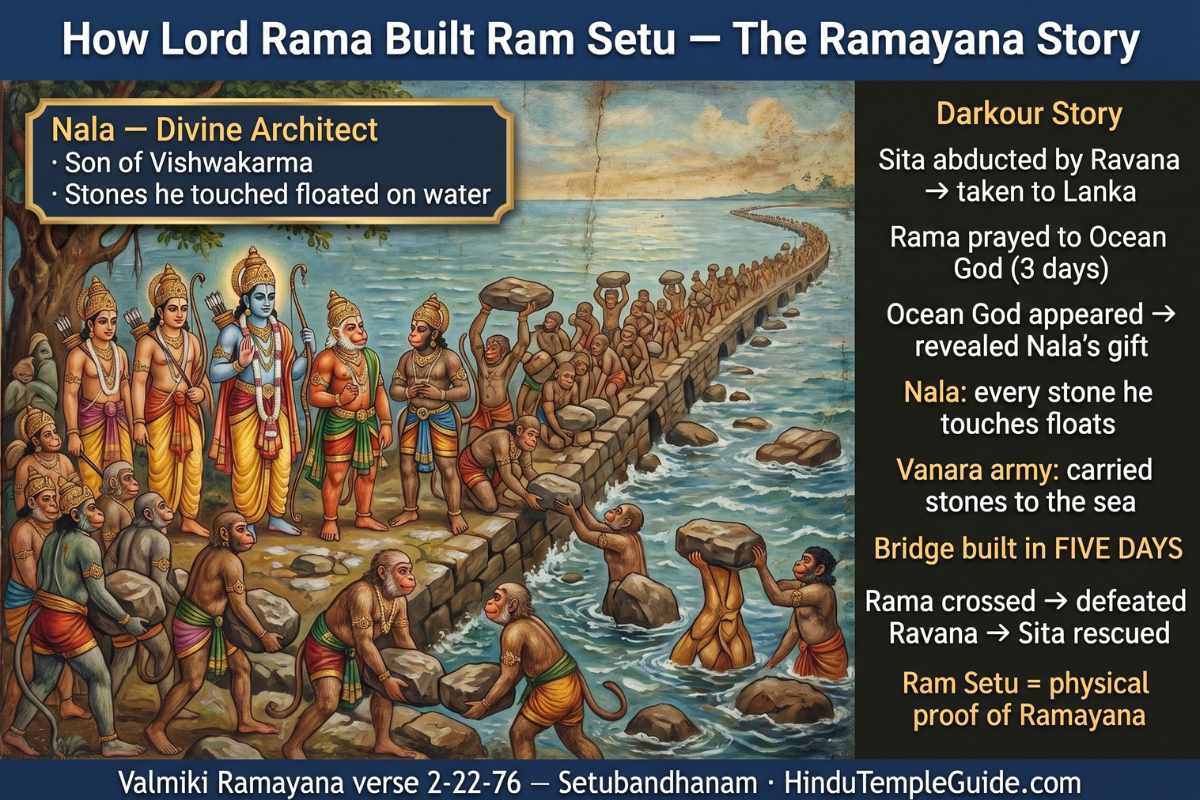
Ram Setu Ramayana story Nala divine architect son Vishwakarma Vanara army floating stones Lord Rama Lanka Sita rescue Setubandhanam Valmiki verse 2-22-76
Ram Setu in the Ramayana: Nala (son of Vishwakarma) led the Vanara army to build the bridge in 5 days. Lord Rama crossed to Lanka, defeated Ravana, and rescued Sita. Jai Shri Ram!

The story of Ram Setu in the Ramayana is one of the most powerful narratives of divine determination, devotion, and engineering genius in all of Hindu scripture. After Sita was abducted by demon king Ravana and taken to Lanka, Rama faced what seemed an impossible challenge. Rama sat on the southern shore in deep meditation — beseeching the Ocean God (Samudra Devata) to part the waters. After three days of prayer and no response, the righteous Rama threatened to dry up the ocean with his divine bow — and at that point, the Ocean God appeared and revealed the solution.

The Ocean God told Rama: “In your army is Nala, son of divine architect Vishwakarma, and he has inherited his father’s genius. Whatever stone he touches will float on water. Let Nala build the bridge.” Under Nala’s architectural direction, the entire Vanara army worked together. The boulders floated upon touching the water. The bridge was completed in just five days. Rama’s army crossed over, Ravana was defeated, Sita was rescued — and Ram Setu became the physical symbol of Rama’s divine determination and the Vanara army’s unconditional devotion. Jai Shri Ram!

Nala — The Divine Architect of Ram Setu: Nala (son of the divine architect Vishwakarma) was blessed that anything he placed in water would float. The Ramanathaswamy Temple records that Ram Setu was above sea level until 1480 CE.

3

Ram Setu in History — Ancient Records & Medieval References

The Ram Setu appears not just in the Ramayana but in a remarkable array of historical, geographic, and religious texts spanning nearly two millennia:

Source & Date Reference to Ram Setu / Adam’s Bridge
Valmiki Ramayana (8th–3rd c. BCE) ‘Setubandhanam’ — bridge construction described in detail across multiple chapters
Mahabharata References to the Setubandha (bridge construction) as a historical event
Ibn Khordadbeh (c. 850 CE) 9th-century Persian geographer refers to it as ‘Set Bandhai’ (Bridge of the Sea)
Al-Biruni (c. 1030 CE) First appearance of ‘Adam’s Bridge’ name — based on Islamic tradition of Adam crossing to India
Marco Polo (13th c.) Mentions the shallow waters and the structure in his travel accounts
Ramanathaswamy Temple records Record the bridge was above sea level until 1480 CE when a cyclone submerged it
Dutch cartographer (1747 CE) Map shows the area as ‘Ramancoil’ (Raman Kovil — Rama’s Temple) — confirming Hindu identity
Sir Arthur Cotton (1823 CE) British survey of Pamban Channel — first systematic modern survey of Ram Setu
Edgar Thurston (1914) Describes the structure as ‘remains of a formerly elevated limestone flat’
Key Historical Context: Ram Setu was known and named before the colonial-era renaming to ‘Adam’s Bridge’ in the 11th century. The Hindu name — Ram Setu or Setubandha — predates ‘Adam’s Bridge’ by at least 1,500+ years in written records. Dutch maps from 1747 CE still label this region ‘Ramancoil’ — confirming the Hindu identity long before colonial renaming.

4

The Science of Ram Setu — Geology, ISRO Mapping & Carbon Dating

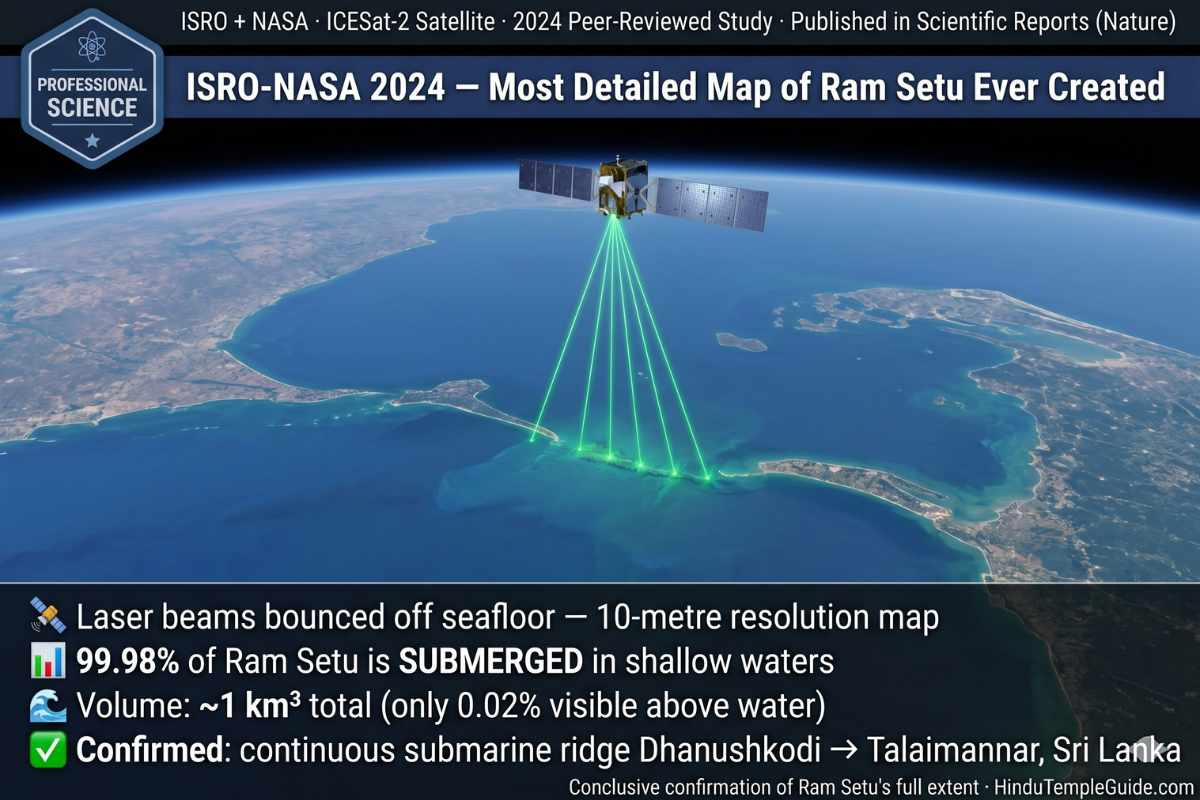
Ram Setu ISRO NASA 2024 ICESat-2 satellite mapping continuous submarine ridge Dhanushkodi Talaimannar 99.98% submerged Scientific Reports journal confirmed
ISRO-NASA 2024: ICESat-2 laser mapped Ram Setu at 10-metre resolution — confirmed as a continuous submarine ridge from Dhanushkodi to Talaimannar. Published in Scientific Reports (Nature journal).
 What does science say about Ram Setu? The mainstream scientific consensus (GSI, ASI, NASA) classifies Ram Setu as a natural geological formation — a ‘tombolo’ formed by wave action, ocean currents, and sand/limestone deposition over thousands of years. In 2024, ISRO and NASA produced the most detailed map ever using ICESat-2 laser data.

 ISRO-NASA 2024 Mapping — Key Findings


99.98% submerged: Only 0.02% is above mean sea level — confirmed underwater


Volume confirmed: Approximately 1 km³


Continuous ridge confirmed: Ram Setu is a definitive continuous submarine ridge from Dhanushkodi to Talaimannar, Sri Lanka


Published in ‘Scientific Reports’ — a peer-reviewed Nature journal. ISRO: “Our research confirms that Adam’s Bridge is a submarine continuation from Dhanushkodi to Talaimannar Island.”
Scientific Question Mainstream Scientific Answer
What is Ram Setu? Natural tombolo — chain of limestone shoals formed by wave action, longshore currents and sand deposition
How old are the sandbanks? ~4,000–5,000 years old (carbon dating of beaches) — formed during post-glacial sea level changes
Were India and Sri Lanka connected? Yes — during the Last Glacial Period (115,000–11,700 years ago), the Palk Strait was dry land
What are the rocks made of? Limestone, sandstone, coral, and calcareous sandstone layers
Was it walkable? Historical records state walkable until a 1480 CE cyclone broke the link
Carbon dating matches Ramayana? Beach carbon dating (~4,000 years) roughly matches some Ramayana date estimates — researcher S.M. Ramasamy (2003): “Its linkage with Ramayana needs to be explored”

5

Ram Setu Man-Made or Natural? — The Great Scientific Debate

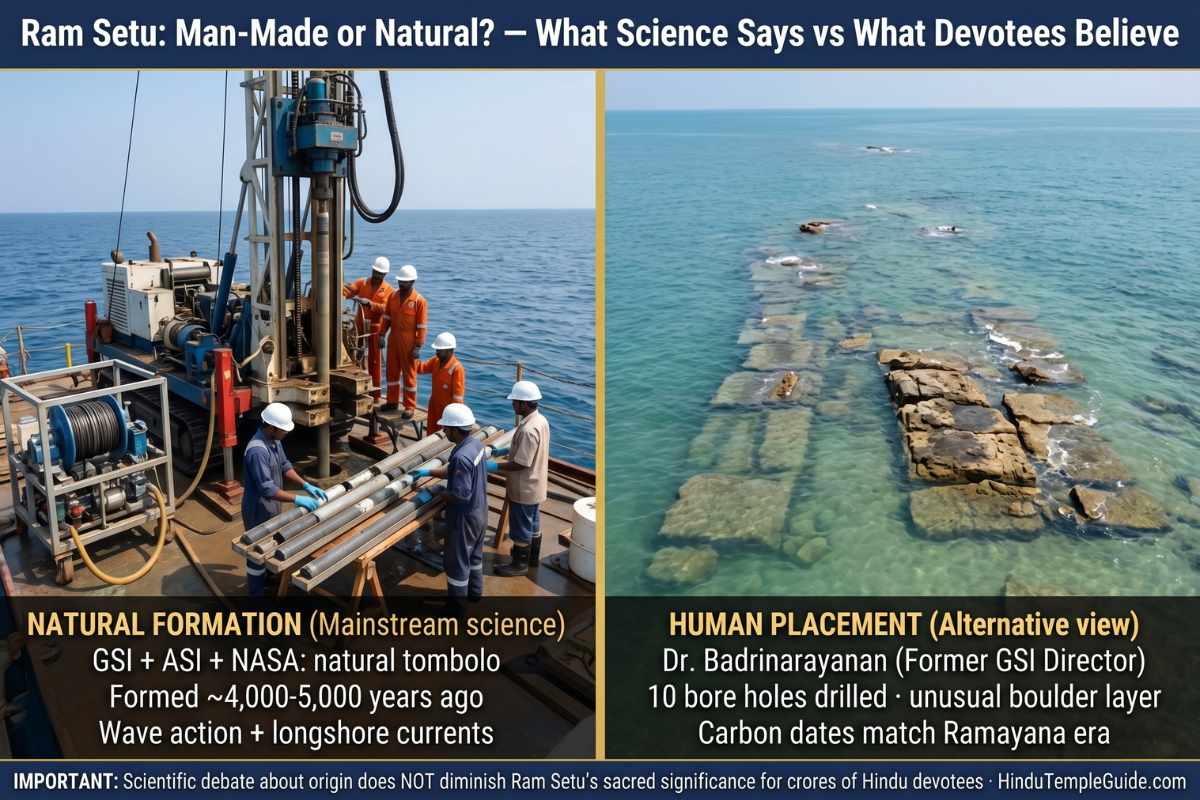
Ram Setu man-made or natural scientific debate GSI NASA ASI natural tombolo Dr Badrinarayanan bore holes limestone shoals carbon dating Ramayana era
Ram Setu man-made or natural? GSI, ASI and NASA classify it as a natural tombolo. Dr. Badrinarayanan (former GSI Director) drilled 10 bore holes and found an unusual boulder layer. The debate remains open.
The Natural Formation Position


GSI: Classifies Ram Setu as entirely natural — wave action, longshore currents and sediment deposition explain the linear formation


ASI (2007): ‘No historical proof of the bridge being built by Rama’ and no evidence of human construction


NASA: “Remote sensing images cannot provide direct information about the origin or age of a chain of islands and certainly cannot determine whether humans were involved”
 The Human Construction Position


Dr. Badrinarayanan (Former GSI Director): Drilled 10 bore holes along Ram Setu’s alignment. Found consistent layer of calcareous sandstone and boulders not typical of marine formations


Carbon dating correlation: The ~4,000–5,000-year date corresponds to a period some researchers associate with a historical Ramayana
Important Context: The scientific debate about whether Ram Setu is natural or human-built does NOT diminish its spiritual significance. For devotees, the physical existence of this limestone bridge in precisely the location described by the Ramayana is itself evidence enough.

6

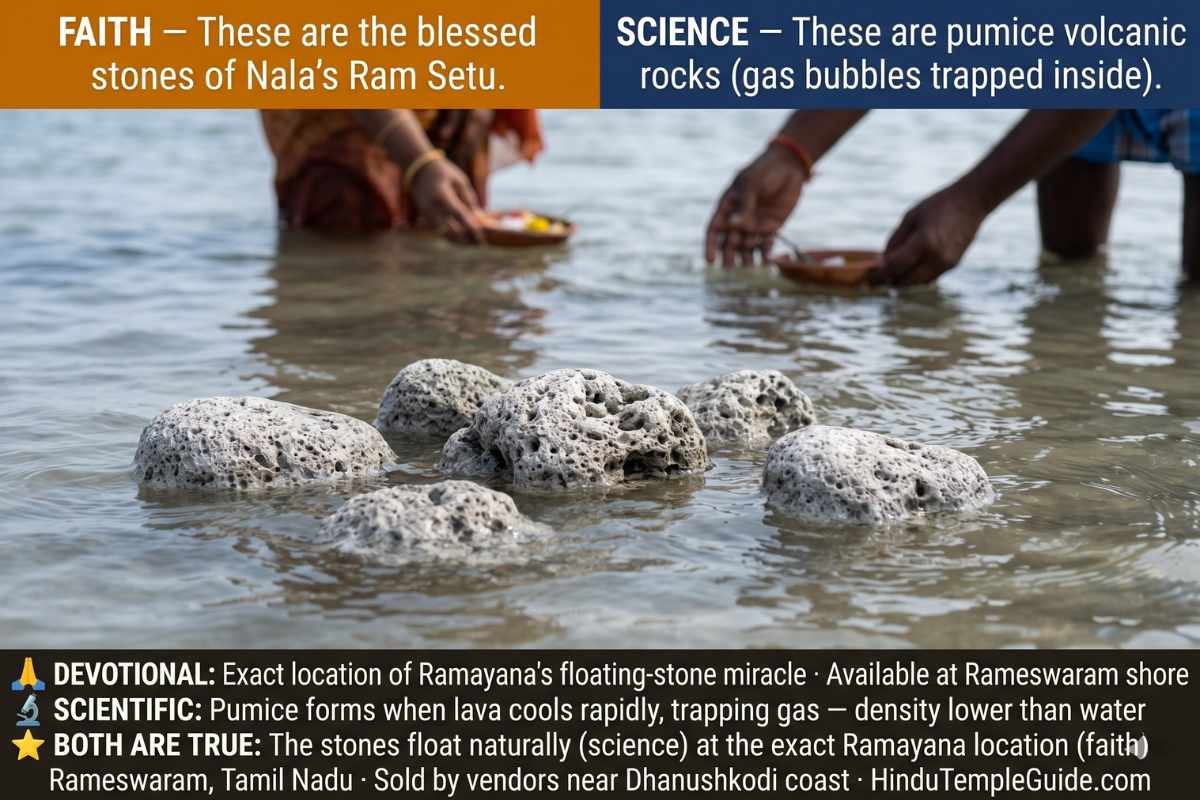
The Floating Stones of Rameswaram — Where Science Meets Faith

Ram Setu floating stones Rameswaram pumice volcanic rock natural gas bubbles Nala Ramayana faith science both true Dhanushkodi shore
The floating stones of Rameswaram: scientifically pumice (volcanic rock with trapped gas bubbles). Spiritually, they float at the exact location where Nala’s blessed stones were placed in the Ramayana.
🪨 Why do the stones near Ram Setu float? The ‘floating stones’ are scientifically pumice — a volcanic rock formed when lava cools rapidly, trapping gas bubbles inside. Pumice is porous; its density is lower than water. However, what makes these stones spiritually significant to millions of Hindus is not the physics but the location — these floating rocks exist precisely at the spot described in the Valmiki Ramayana as where Nala’s blessed stones were used to build the bridge.

For a devotee, the question of why the stones float is less important than the fact that they float — here, at this exact location described in the Ramayana. This is the beautiful convergence of faith and observation that makes Ram Setu one of the most fascinating sacred sites in the world.

7

Spiritual Significance of Ram Setu — Why It Is Sacred

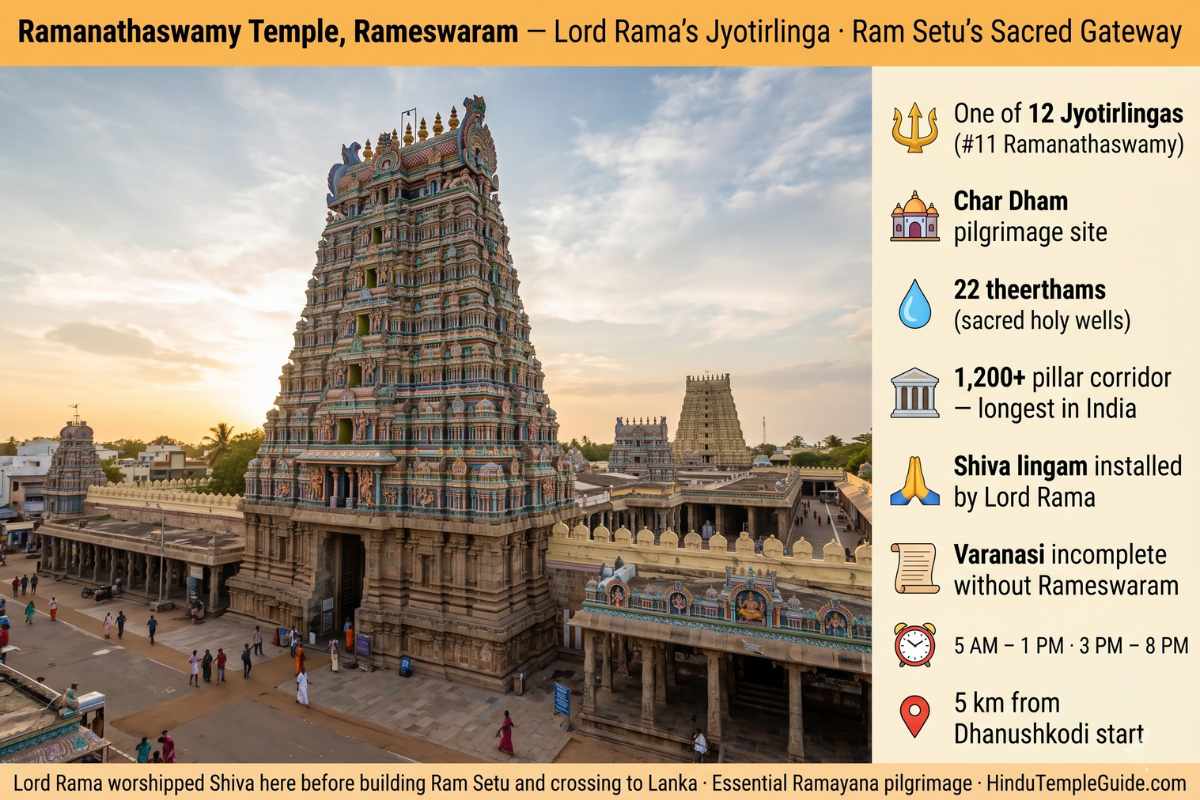
Ramanathaswamy temple Rameswaram 12 Jyotirlinga Char Dham 22 theerthams 1200 pillar corridor Ram Setu sacred gateway Lord Rama Shiva lingam
Ramanathaswamy Temple, Rameswaram — one of 12 Jyotirlingas and a Char Dham site. 22 sacred theerthams · 1,200+ pillar corridor (longest in India). A Varanasi pilgrimage is considered incomplete without Rameswaram.

When I stood at Arichal Munai with the two seas meeting at my feet and Sri Lanka visible on the horizon, I understood in a way no book had explained why this place matters so deeply to so many people. Ram Setu is not an abstract theological concept. It is the physical address of the Ramayana’s most pivotal moment — where Lord Rama’s faith, Hanuman’s devotion, Nala’s genius, and the Vanara army’s selfless labour all converged to achieve the impossible.


Physical proof of the Ramayana: The existence of this 48-km limestone chain precisely where Valmiki’s Ramayana describes the bridge transforms the Ramayana from a spiritual text into a geographical reality.


Sethu Karai — the launch point: 22 km before Rameswaram, traditionally believed to be the point from which Lord Rama supervised the bridge construction.


Dhanushkodi — ‘End of the Bow’: The name means the spot where Lord Rama drew his divine bow to mark the beginning of the bridge. Standing at Arichal Munai is one of the most spiritually charged experiences in India.


Vibhishana’s surrender point: Kothandarama Swamy Temple at Dhanushkodi marks the spot where Ravana’s righteous brother Vibhishana surrendered to Lord Rama.


Rameswaram Char Dham connection: Rameswaram is one of the four sacred Char Dhams and home to the Ramanathaswamy Jyotirlinga (one of 12 Jyotirlingas). A Varanasi pilgrimage is considered incomplete without Rameswaram.


National heritage and identity: Ram Setu is deeply woven into India’s national consciousness — protests against the Sethusamudram Canal Project drew crores of supporters in 2007.

8

The Sethusamudram Shipping Canal Controversy
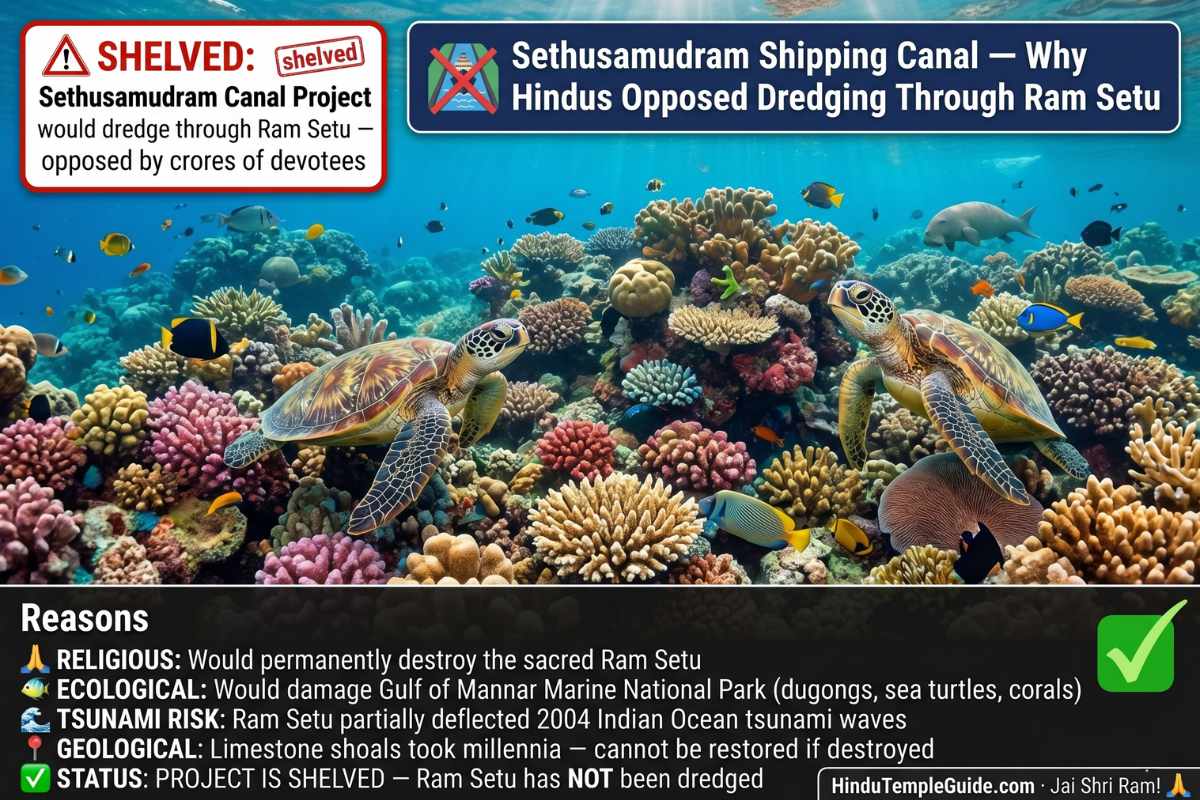
Sethusamudram canal project Ram Setu shelved Gulf of Mannar coral reef marine biodiversity religious ecological opposition shelved status
The Sethusamudram Canal Project (shelved) would have dredged through Ram Setu. Status: SHELVED. Ram Setu is protected.

The most politically charged episode in Ram Setu’s modern history was the Sethusamudram Shipping Canal Project (SSCP) — a proposed canal requiring dredging through the limestone shoals of Ram Setu. When the UPA government approved it in 2005, it triggered one of India’s largest religious protest movements — crores of Hindus marching across India opposing the destruction of Ram Setu.

Arguments Against


Religious: Sacred to crores of Hindus — destroying it would be irreversible desecration


Environmental: Would disrupt Gulf of Mannar Marine National Park — India’s richest coral reef ecosystem


Tsunami risk: Ram Setu partially protected India’s coastline from the 2004 Tsunami
Arguments For


Economic: Would reduce shipping distance and boost Tamil Nadu ports


Current status: Project remains SHELVED. Ram Setu has not been dredged.

9

How to See Ram Setu 2026 — Complete Visitor & Pilgrimage Guide

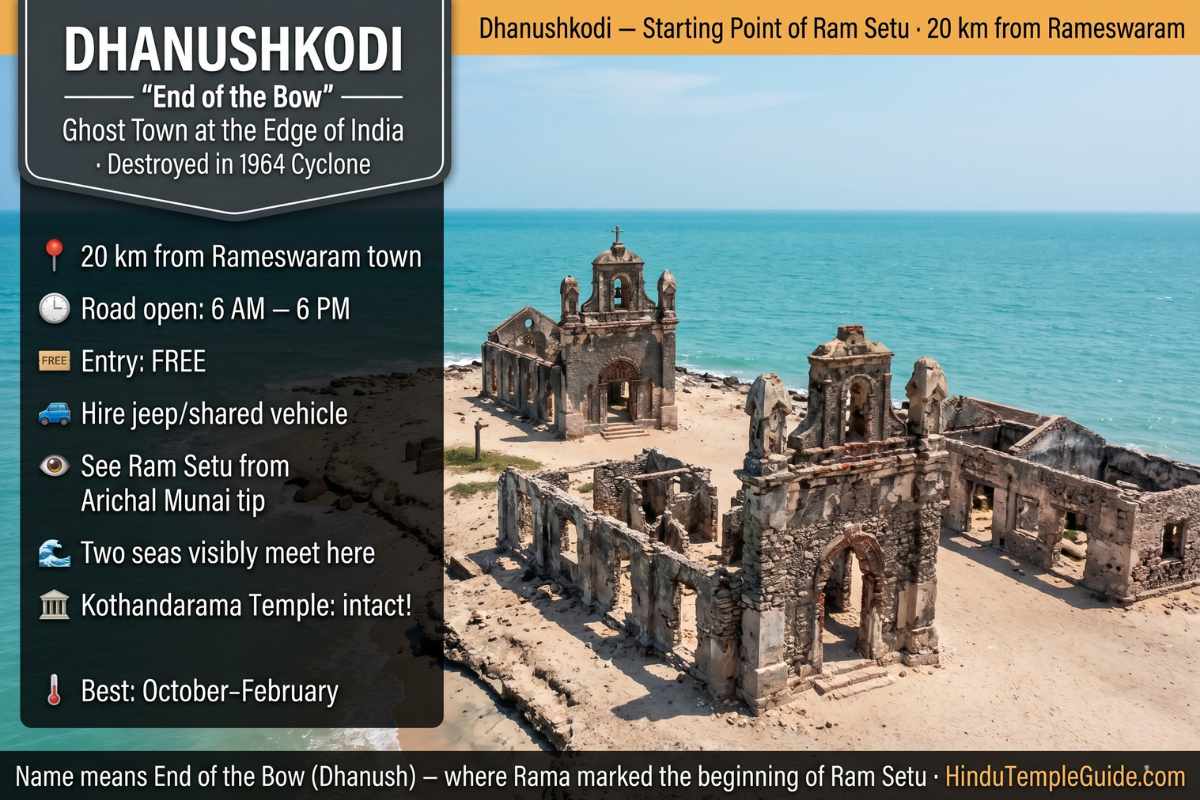
Dhanushkodi ghost town Ram Setu view 1964 cyclone ruins end of bow 20km Rameswaram free 6AM road open two seas Arichal Munai visitor guide
Dhanushkodi — the ghost town at India’s southeastern tip, destroyed in the 1964 cyclone. 20km from Rameswaram. Road open 6AM–6PM. FREE.
How I Visited Ram Setu — and How You Can: From Rameswaram, hire a private jeep or shared vehicle to Arichal Munai — the southern tip of Dhanushkodi, 20 km away. The beach road is open 6 AM to 6 PM only — no vehicles are allowed after that. At the tip, you stand at the meeting point of the Bay of Bengal and the Gulf of Mannar with the start of Ram Setu at your feet and Sri Lanka visible on clear days with binoculars. Entry is FREE. Stay overnight in Rameswaram — there is no accommodation at Dhanushkodi.

Ram Setu Pilgrimage Circuit — What to Visit

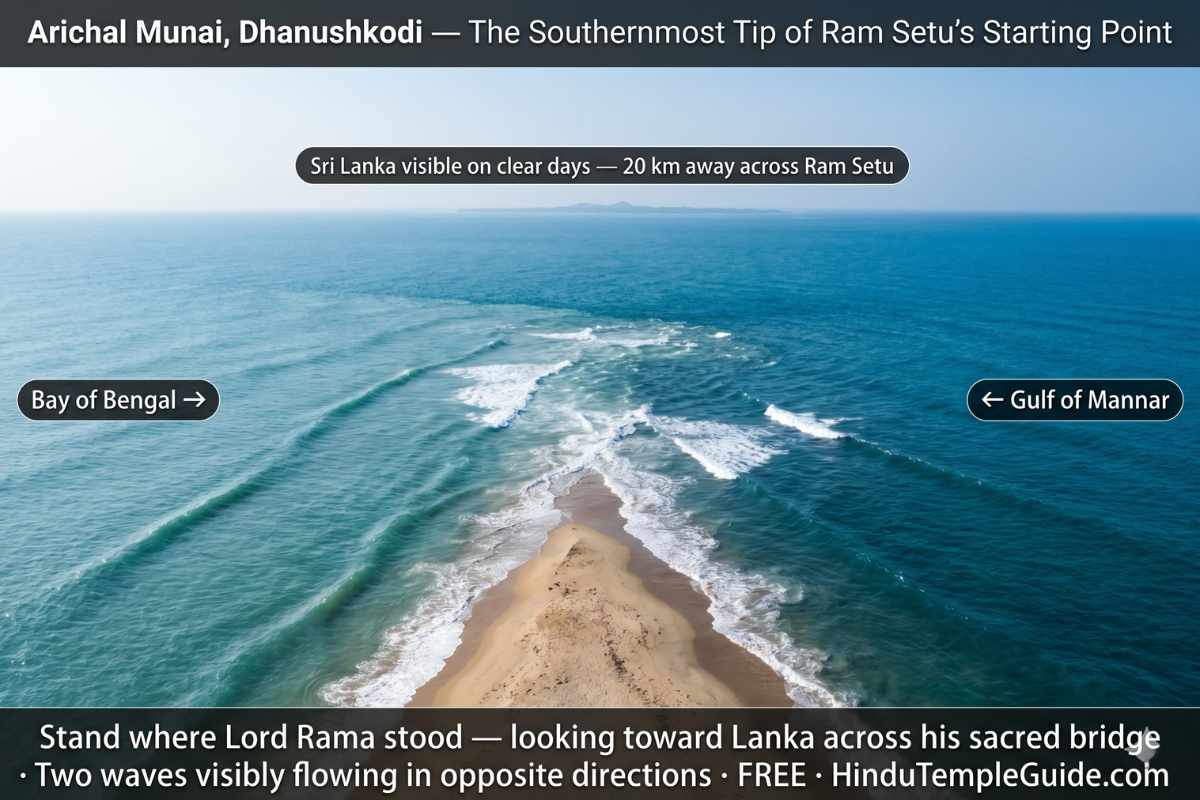
Arichal Munai Dhanushkodi two seas Bay of Bengal Gulf of Mannar meeting Ram Setu start Sri Lanka 20km Lord Rama stood pilgrimage free
Arichal Munai, Dhanushkodi — where the Bay of Bengal and Gulf of Mannar visibly meet. Sri Lanka is ~20km away on clear days. FREE.
Sacred Site Significance & Details
Ramanathaswamy Temple One of 12 Jyotirlingas + Char Dham · 22 theerthams · 1,200+ pillar corridor (longest in India)
Agni Theertham Beach Sacred bathing point · Ritual bath before Ramanathaswamy darshan
Sethu Karai 22 km before Rameswaram · Traditional launch point of Ram Setu
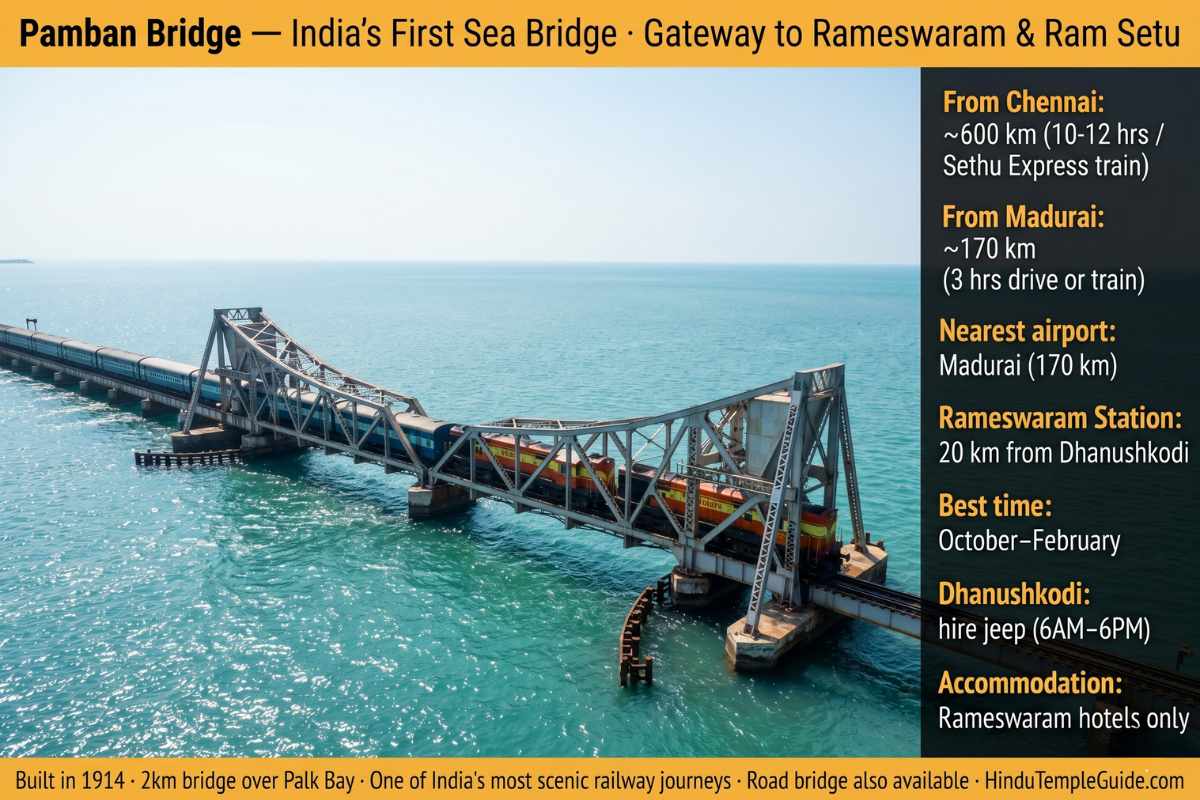
Pamban Bridge India’s first sea bridge (1914) · Gateway to Rameswaram · Spectacular sea views
Dhanushkodi Village 20 km from Rameswaram · Ghost town of 1964 cyclone · Ruins of railway station, church, hospital
Arichal Munai Tip of Dhanushkodi · Two seas meet · Can spot Sri Lanka · Start of Ram Setu
Kothandarama Swamy Temple 18 km from Rameswaram · Site where Vibhishana surrendered to Lord Rama · Survived 1964 cyclone intact
Pamban Bridge Rameswaram gateway Ram Setu how to reach Madurai 170km Chennai 600km Sethu Express train October February best time Dhanushkodi
Pamban Bridge — India’s first sea bridge (1914), the gateway to Rameswaram. From Madurai: 170km. From Chennai: 600km via Sethu Express overnight. Best time: Oct–Feb.

Practical Visitor Information 2026

Best Time to Visit October–February · Pleasant weather 20–30°C · Cool sea breeze
Road to Dhanushkodi Hire jeep from Rameswaram · Beach road open 6 AM–6 PM only
Entry Fee FREE — no entry fee
Nearest Airport Madurai Airport (170 km)
Nearest Railway Rameswaram Railway Station · Sethu Express from Chennai direct overnight
Accommodation In Rameswaram only — range of hotels near Ramanathaswamy Temple
From Chennai ~600 km by road (10–12 hrs) · Sethu Express overnight train
From Madurai ~170 km by road (3 hrs) · Best base for Rameswaram trip

FAQs — Ram Setu 2026

Q1. Did NASA confirm that Ram Setu is man-made?

No. NASA’s official statement: “Remote sensing images or photographs from orbit cannot provide direct information about the origin or age of a chain of islands, and certainly cannot determine whether humans were involved.” NASA’s ICESat-2 data confirms Ram Setu as a continuous submarine ridge — but does not determine its origin as natural or artificial.

Q2. How old is Ram Setu according to science?

Geological carbon dating dates the Ram Setu beach sandbanks to approximately 4,000–5,000 years ago. Researcher S.M. Ramasamy noted: “As the carbon dating of the beaches roughly matches with the dates of the great epic Ramayana, its linkage with Ramayana needs to be explored.”

Q3. Was Ram Setu really walkable between India and Sri Lanka?

Yes — historical records, including records of Ramanathaswamy Temple, state that Ram Setu was above sea level and walkable until 1480 CE, when a cyclone broke the link. The waters today still rarely exceed 1 metre — consistent with a very recently submerged structure.

Q4. Why is Ram Setu called Adam’s Bridge?

The name ‘Adam’s Bridge’ appeared around 1030 CE — based on an Islamic tradition that Adam crossed here from Sri Lanka to India. However, the Hindu name Ram Setu significantly predates this — the 9th-century Persian geographer Ibn Khordadbeh called it Set Bandhai (Bridge of the Sea). Dutch maps from 1747 CE still label this region ‘Ramancoil.’

Q5. Can you walk on Ram Setu today?

No — Ram Setu is 99.98% submerged (ISRO 2024) and not accessible on foot. The closest viewpoint is Arichal Munai at the tip of Dhanushkodi — 20 km from Rameswaram. Road open 6 AM to 6 PM. Entry is free.

Q6. Is visiting Ram Setu and Rameswaram spiritually significant?

Very much so. Rameswaram is part of the Char Dham pilgrimage and home to the Ramanathaswamy Jyotirlinga. A Varanasi pilgrimage is considered incomplete without Rameswaram. The 22 theerthams, Agni Theertham dip, Arichal Munai, and Kothandarama Swamy Temple together form a profound Ramayana experience.

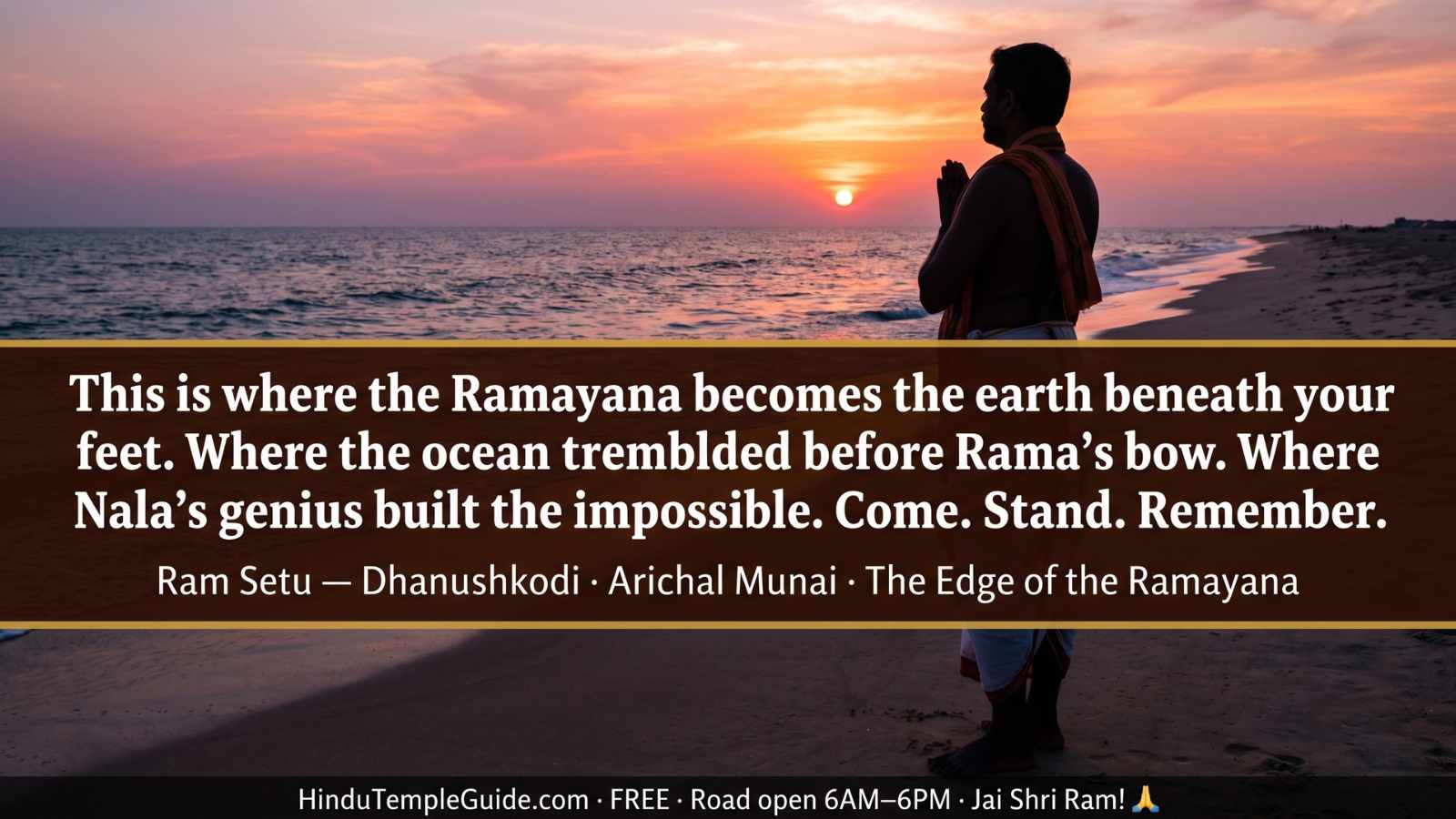
Ram Setu CTA Dhanushkodi Arichal Munai pilgrim sunset Jai Shri Ram Ramayana edge India ocean prayer free 6AM Rameswaram devotee spiritual
Stand at the edge of the Ramayana — Arichal Munai, Dhanushkodi. FREE. Road open 6AM–6PM. Jai Shri Ram!
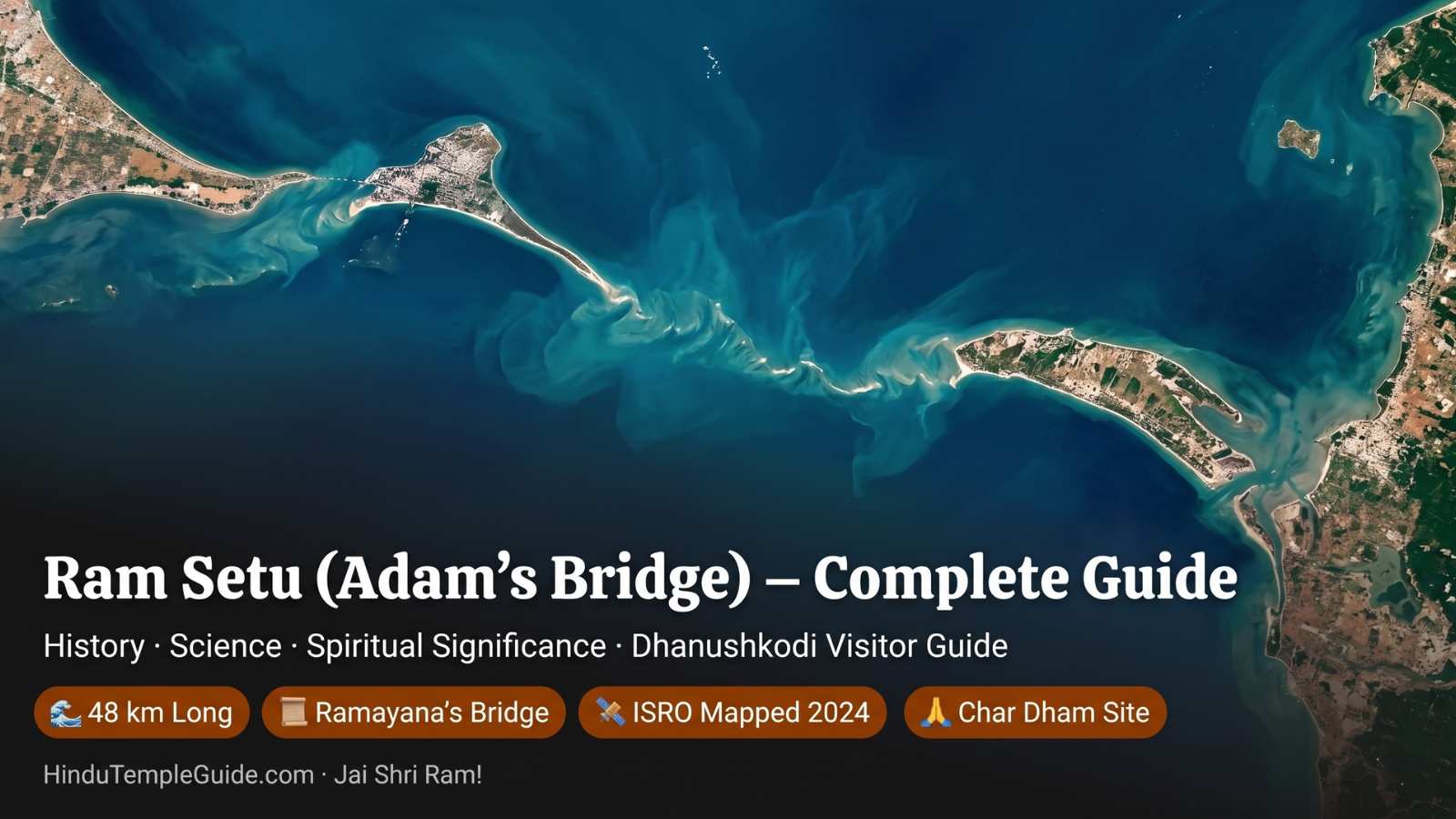
Ram Setu Adams Bridge complete guide history science spiritual significance Ramayana bridge 48km limestone shoals Dhanushkodi Rameswaram ISRO 2024 Jai Shri Ram
Ram Setu — 48-km chain of limestone shoals connecting Pamban Island (Tamil Nadu) to Mannar Island (Sri Lanka). ISRO-NASA mapped 2024. Jai Shri Ram!

Stand at the Edge of the Ramayana || Jai Shri Ram!

I stood at Arichal Munai at sunset with the Bay of Bengal on my left, the Gulf of Mannar on my right, and the start of Ram Setu stretching into the water ahead. I thought about the Ramayana — about Nala’s genius, the Vanara army’s devotion, Rama’s faith. No amount of reading had prepared me for the feeling of standing at the physical address of that story. It is the Ramayana as landscape — and it is impossible to forget.

Plan your Rameswaram and Dhanushkodi pilgrimage. Take the holy bath at Agni Theertham. Receive darshan at Ramanathaswamy Jyotirlinga. Stand at Arichal Munai and look toward Lanka. Ram Setu will leave something in you that no other place in India quite replicates.

Questions about the Rameswaram pilgrimage? Write to me directly — I read every message personally.
— Devendra Khambalkar, Nagpur, Maharashtra

Written by Devendra Khambalkar, Nagpur, Maharashtra | Last updated: April 2026. This guide presents both the spiritual-devotional perspective of Ram Setu as described in the Valmiki Ramayana and the scientific findings of ISRO, GSI, ASI, and NASA with equal respect. The debate about Ram Setu’s natural or human origins remains open. HinduTempleGuide.com respects both the faith of crores of Hindu devotees and the integrity of scientific research. Jai Shri Ram!

← PreviousPanch Bhoota Sthalam – Complete Guide to 5 Elements Shiva Temples: Earth, Water, Fire, Air & Ether

Leave a Comment

Your email will not be published. Required fields are marked *