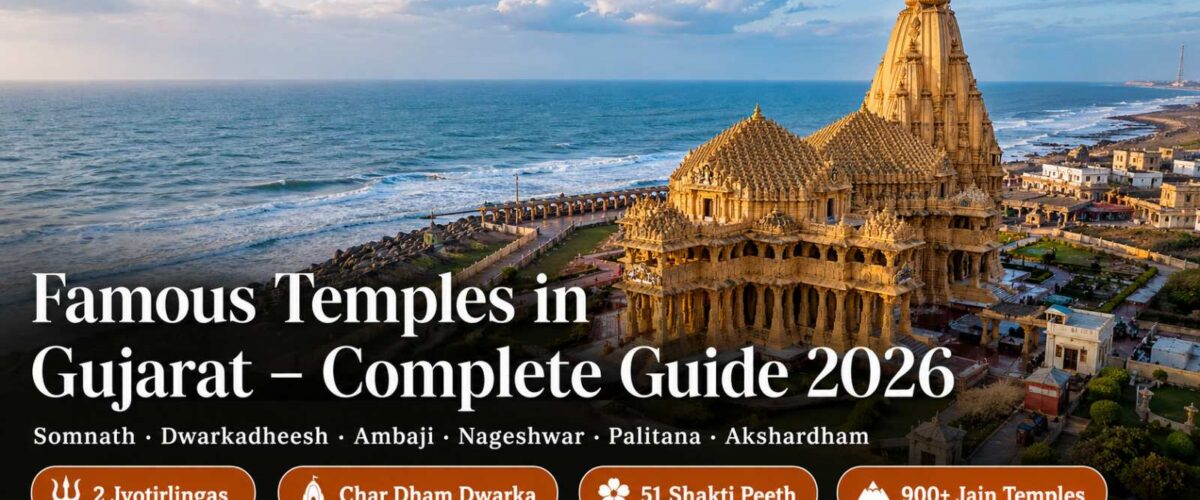
Famous Temples in Gujarat – Somnath, Dwarkadheesh, Ambaji & Complete Pilgrimage Guide 2026

Written by Devendra Khambalkar
Nagpur, Maharashtra personally visited Somnath, Nageshwar, Dwarka and temples across Gujarat
I have personally visited Somnath, Nageshwar, and Dwarka as part of my Gujarat pilgrimage and Gujarat left an impression on me that no other state in India has matched. Famous temples in Gujarat Jai Somnath! Gujarat is one of the most spiritually extraordinary states in all of India. This is the sacred land where Lord Shiva stands as the eternal first Jyotirlinga at Somnath by the Arabian Sea, where Lord Krishna established his divine kingdom at Dwarka one of the four Char Dhams and where Goddess Shakti blesses devotees at the powerful Ambaji Temple, one of the 51 Shakti Peethas. Gujarat is the only state in India that simultaneously holds representatives of all three supreme Hindu pilgrimage classifications.
The famous temples in Gujarat span the full arc of Hindu spiritual tradition from the ancient Chalukya-style grandeur of Somnath (destroyed and rebuilt 6–7 times) to the Nagara architecture perfection of Dwarkadhish, from the unique aniconic Yantra worship at Ambaji to the 900+ Jain temples crowning Shatrunjaya Hill at Palitana, from the astronomical precision of the 1027 CE Modhera Sun Temple to the Guinness World Record Bala Hanuman Temple in Jamnagar where devotees have chanted ‘Shri Ram Jai Ram Jai Jai Ram’ continuously since 1964. This complete guide covers all major temples, timings, fees, itinerary and practical pilgrimage tips. Jai Shri Krishna!
Somnath (#1) & Nageshwar (#10) concentrated in one region of Saurashtra
Dwarka Lord Krishna’s divine kingdom, one of Hinduism’s four most sacred cities
Ambaji where Sati’s heart fell; one of India’s most visited Shakti temples
Palitana 900+ temples on Shatrunjaya Hill, sacred since the age of Adinath
Quick Navigation
Table of Contents
1Gujarat Temple Heritage, Why Most Sacred State
2Somnath Temple, First Jyotirlinga, Eternal Shrine
3Dwarkadhish Temple, Char Dham, Krishna’s Kingdom
4Ambaji Temple, Shakti Peeth, No Idol Worship
5Nageshwar Jyotirlinga 2nd Jyotirlinga of Gujarat
6Akshardham Temple Modern Spiritual Marvel
7Modhera Sun Temple 1,000-Year UNESCO Gem
8Palitana Jain Temples 900+ Temples, Shatrunjaya
9More Famous Temples Bala Hanuman, Becharaji & More
107-Day Pilgrimage Circuit Complete Itinerary 2026
❓FAQs : Famous Temples in Gujarat 2026
Gujarat Temple Heritage – Why Gujarat Is India’s Most Sacred Pilgrimage State

No other state in India carries the same concentration of supreme pilgrimage significance as Gujarat. The famous temples of Gujarat form a unique sacred geography that covers all three pillars of Hindu devotional tradition plus Jainism’s holiest site within a single state’s borders.
Overview of All Major Famous Temples in Gujarat:
| # | Temple | Classification | Location | Timings | Entry |
|---|---|---|---|---|---|
| 1 | Somnath Temple | 1st Jyotirlinga | Prabhas Patan, Veraval | 6:00 AM – 9:00 PM | FREE |
| 2 | Dwarkadhish Temple | Char Dham · Sapta Puri | Dwarka city | 6:30AM–1PM · 5–9PM | FREE |
| 3 | Ambaji Temple | 51 Shakti Peeth | Banaskantha | 6:00 AM – 9:00 PM | FREE |
| 4 | Nageshwar Jyotirlinga | 10th Jyotirlinga | Near Dwarka (18 km) | 6:00 AM – 9:00 PM | FREE |
| 5 | Akshardham Gandhinagar | BAPS Swaminarayan | Gandhinagar (30 km from Ahmedabad) | 9:30AM–6:30PM (Tue–Sun) | FREE (shows paid) |
| 6 | Modhera Sun Temple | UNESCO Heritage (Arch.) | Mehsana (100 km from Ahmedabad) | Sunrise – Sunset | ASI Ticket |
| 7 | Palitana Jain Temples | World’s Holiest Jain Site | Shatrunjaya Hill, Bhavnagar | 6:00 AM – 6:00 PM | Nominal |
Somnath Temple, Prabhas Patan First Jyotirlinga, Eternal Shrine of India
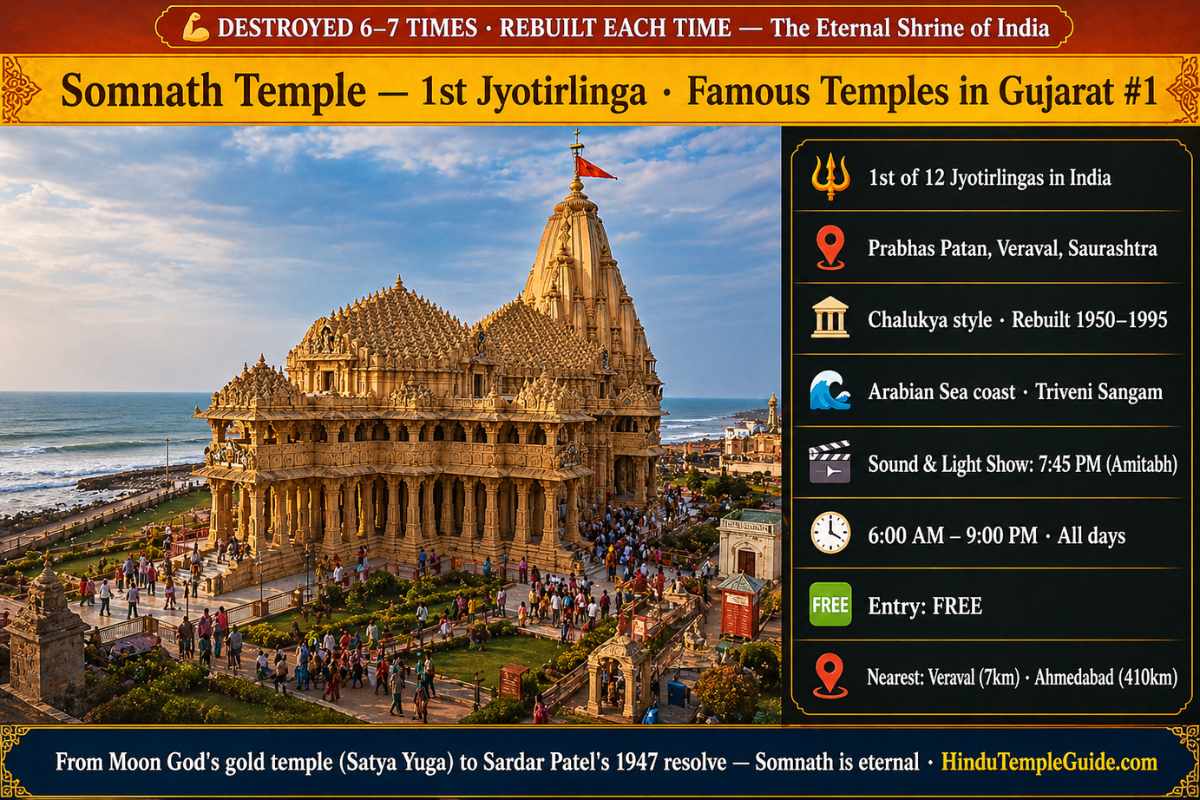
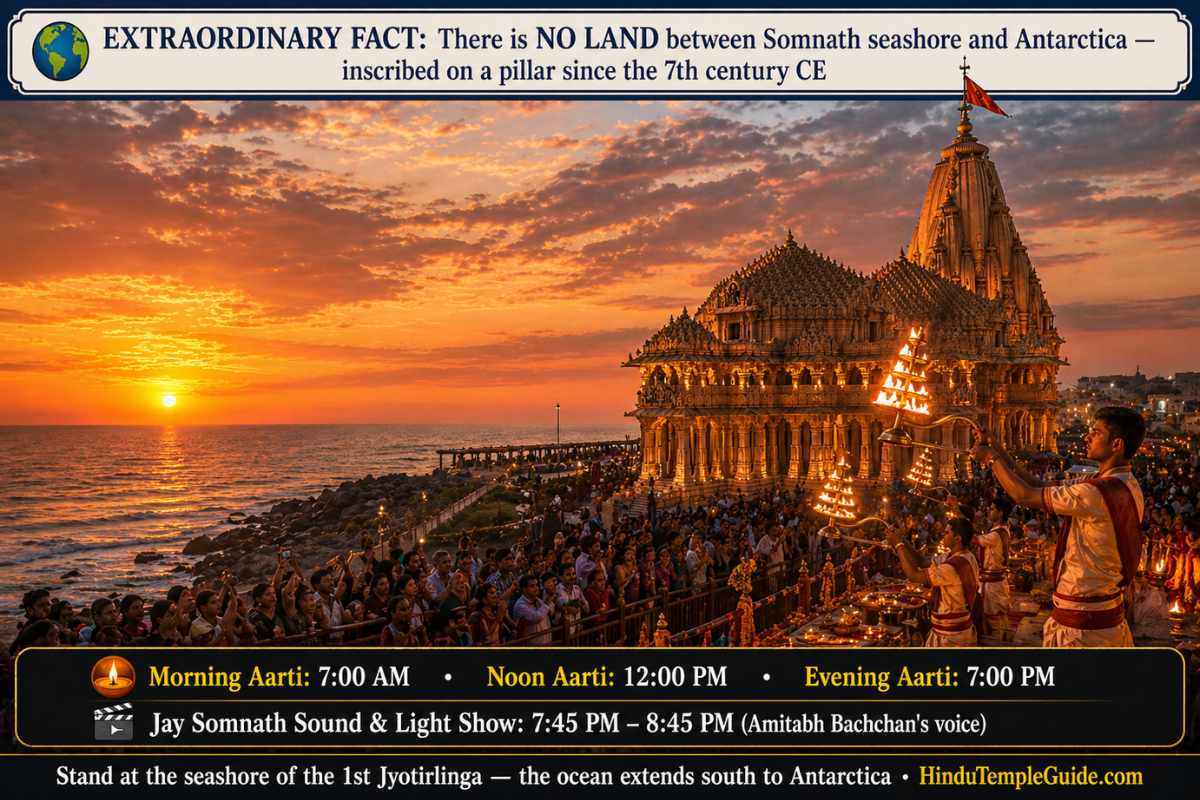
Somnath Temple is the crown jewel of all famous temples in Gujarat and the most deeply emotionally significant Hindu temple in India. The temple sits at the Triveni Sangam the confluence of three rivers: the Kapila, Hiran, and the mythological Saraswati on the Arabian Sea coast. One of its pillars bears an inscription from the 7th century CE stating that there is no land between the seashore of Somnath and the South Pole a straight uninterrupted ocean line to Antarctica. This makes Somnath the meeting point of India and the infinite ocean.
The mythology of Somnath begins with Chandra (the Moon God), cursed by Daksha Prajapati for favouring his wife Rohini. Chandra came to Prabhas Patan, performed intense tapas to Lord Shiva, and Shiva appeared to release him from the curse. In gratitude, Chandra built the original Somnath Temple in gold (Satya Yuga). Ravana rebuilt it in silver (Treta Yuga). Lord Krishna in sandalwood (Dwapara Yuga). King Bhimdev in stone (Kali Yuga). This is why Somnath is called the Eternal Shrine it rises again with every destruction, a symbol of Hindu civilisation’s indestructible resilience.
How Many Times Was Somnath Destroyed and Rebuilt?
| Classification | First (1st) Jyotirlinga among 12 sacred Jyotirlingas of Lord Shiva |
| Location | Prabhas Patan (Triveni Sangam), near Veraval, Saurashtra, Gujarat Arabian Sea coast |
| Architecture | Chalukya-style (Kailash Mahameru Prasad style) rebuilt 1950–1995 by Sompura master architects |
| Timings | 6:00 AM – 9:00 PM (open all days including festivals) |
| Aarti Timings | Morning Aarti: 7:00 AM · Noon Aarti: 12:00 PM · Evening Aarti: 7:00 PM |
| Entry Fee | FREE for darshan · Sound & Light Show: nominal ticket fee |
| Key Festival | Maha Shivaratri massive celebrations · Kartik Purnima |
| Nearby | Triveni Sangam · Bhalka Tirth (where Krishna was struck) · Old Somnath (Ahilyabai Temple, 1783) |
| How to Reach | Train: Somnath/Veraval Station (7 km) · Air: Keshod Airport (57 km) or Diu Airport (85 km) · Road: Ahmedabad (410 km) · Rajkot (200 km) |
Dwarkadhish Temple, Dwarka Char Dham, Lord Krishna’s Divine Kingdom
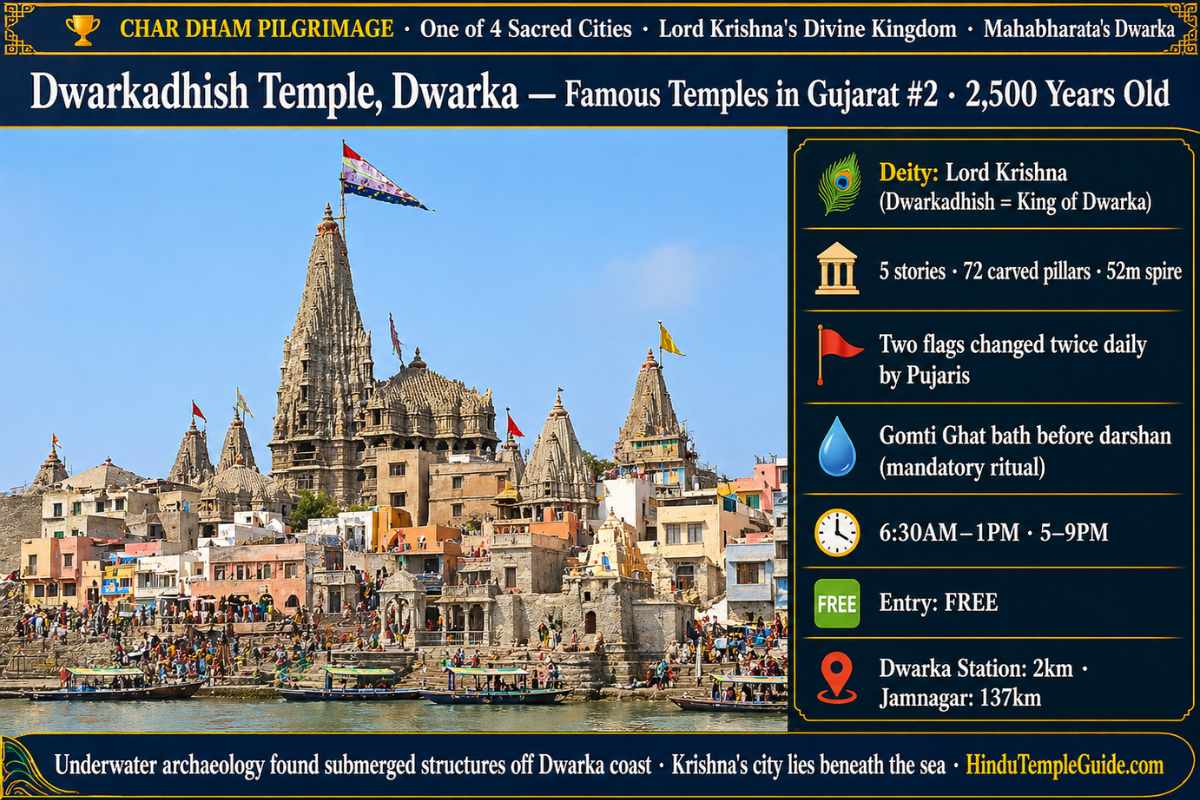
Dwarkadhish Temple, also called Jagat Mandir (Temple of the Universe), stands at the very site where Lord Krishna established his capital city of Dwarka after leaving Mathura a city so magnificent that the Mahabharata describes it as having 900,000 royal palaces, all made of gold and silver. When Lord Krishna departed the earth at Bhalka Tirth (near Somnath), the ocean reclaimed the entire city of Dwarka. The present temple, built approximately 2,500 years ago, stands as the eternal memorial to this divine kingdom.
Pilgrims must first take a holy dip at Gomti Ghat before entering the temple and the experience of approaching the Dwarkadhish shrine after the river bath, hearing the conch shells and temple bells, is described by pilgrims as one of India’s most profound spiritual arrivals. ASI and NIO underwater excavations off Dwarka coast have found submerged structures that some researchers link to the historical Dwarka city.
| Classification | One of the four Char Dhams · One of seven Sapta Puri (sacred cities) · One of Panch Dwaraka |
| Location | Dwarka city, Devbhumi Dwarka district, Gujarat on the banks of Gomti River near the Arabian Sea |
| Architecture | Nagara-style · 5 stories · 72 intricately carved pillars · 52-metre (170 ft) shikhar spire · 9-storey flag |
| Timings | 6:30 AM – 1:00 PM and 5:00 PM – 9:00 PM · Aarti: Mangla, Shringar, Rajbhog, Sandhya |
| Entry Fee | FREE for general darshan |
| Sacred Ritual | Gomti Ghat bath before darshan · Two flags (Dwarka flag: 52 yards) changed twice daily |
| Key Festival | Janmashtami Lord Krishna’s birthday largest celebration in Gujarat |
| How to Reach | Train: Dwarka Station (2 km) · Air: Jamnagar Airport (137 km) · Road: Rajkot (219 km) · Ahmedabad (451 km) |
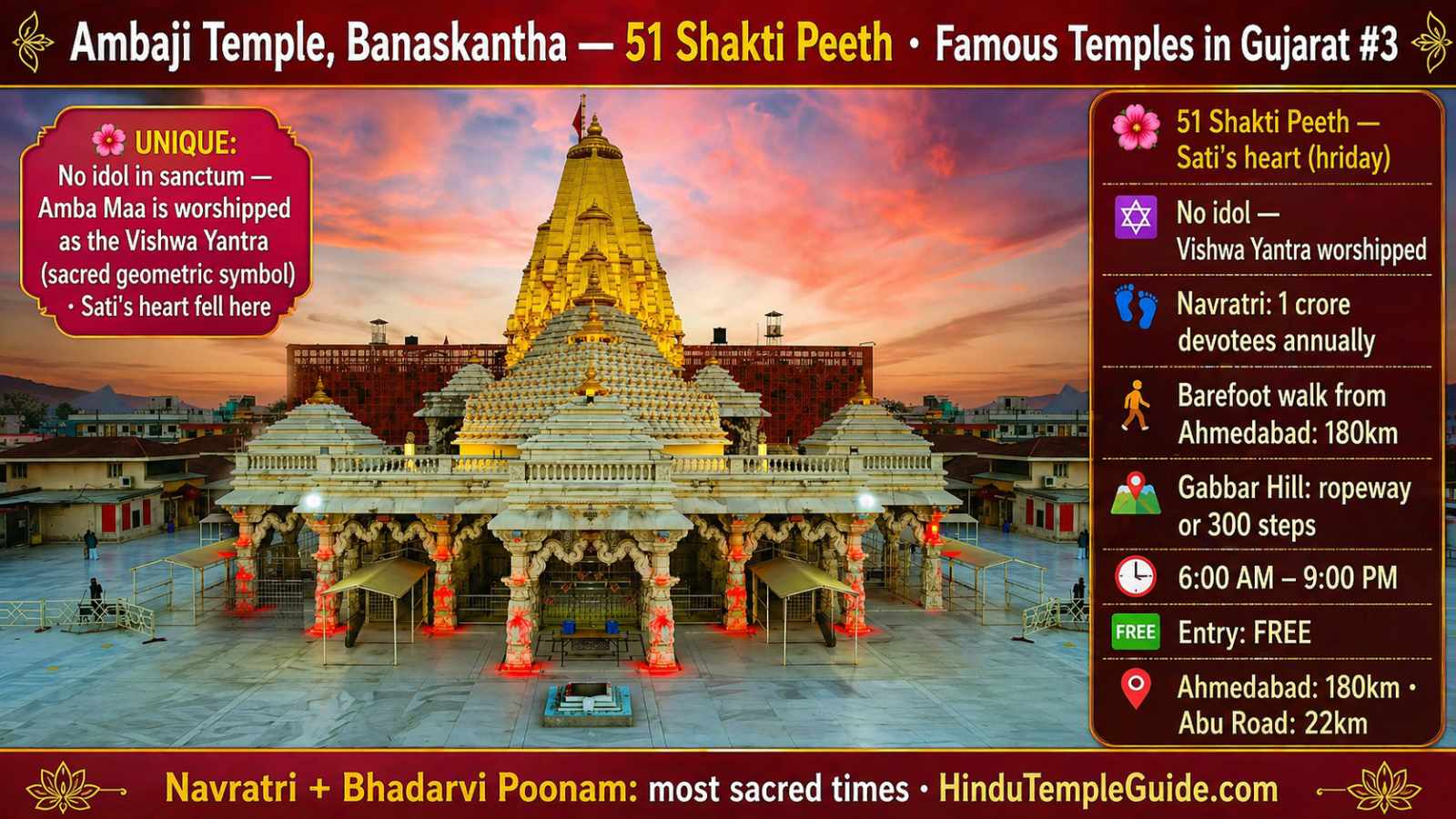
Ambaji Temple, Banaskanth, Shakti Peeth Where the Heart of Sati Fell
Why Does Ambaji Temple Have No Idol? What Is the Yantra?
Ambaji Temple draws devotees not through monumental architecture or sensory spectacle, but through something far more profound: the absolute silence of the formless divine. This makes Ambaji simultaneously one of India’s most visited temples (over 1 crore devotees annually) and one of its most philosophically sophisticated. During Navratri, lakhs of devotees arrive on foot from hundreds of kilometres away many undertaking a barefoot 180-km walk from Ahmedabad to receive the goddess’s blessing. The Navratri celebrations at Ambaji are considered among the most devotionally intense in all of India.
| Classification | One of the 51 Shakti Peethas · Sati’s heart (hriday) is believed to have fallen here |
| Location | Arasur Hill, Ambaji town, Banaskantha District Gujarat–Rajasthan border area |
| Unique Feature | No idol Amba Maa worshipped as Vishwa Yantra (sacred geometric symbol), not a physical form |
| Timings | 6:00 AM – 9:00 PM · Aarti: 6:30 AM, 12:00 PM, 7:00 PM (varies seasonally) |
| Entry Fee | FREE · Special darshan token during major festivals |
| Key Festival | Navratri (9 nights) most sacred · Bhadarvi Poonam fair · Bhadrapad Purnima |
| Gabbar Hill | Accessible by ropeway or 300 steps believed to hold the footprints of Amba Maa |
| How to Reach | Train: Abu Road Station (22 km) · Air: Ahmedabad Airport (180 km) · Road: Ahmedabad (180 km) · Mount Abu (45 km) |
Nageshwar Jyotirlinga, Near Dwarka Gujarat’s 2nd Jyotirlinga, Protection from Poison and Evil
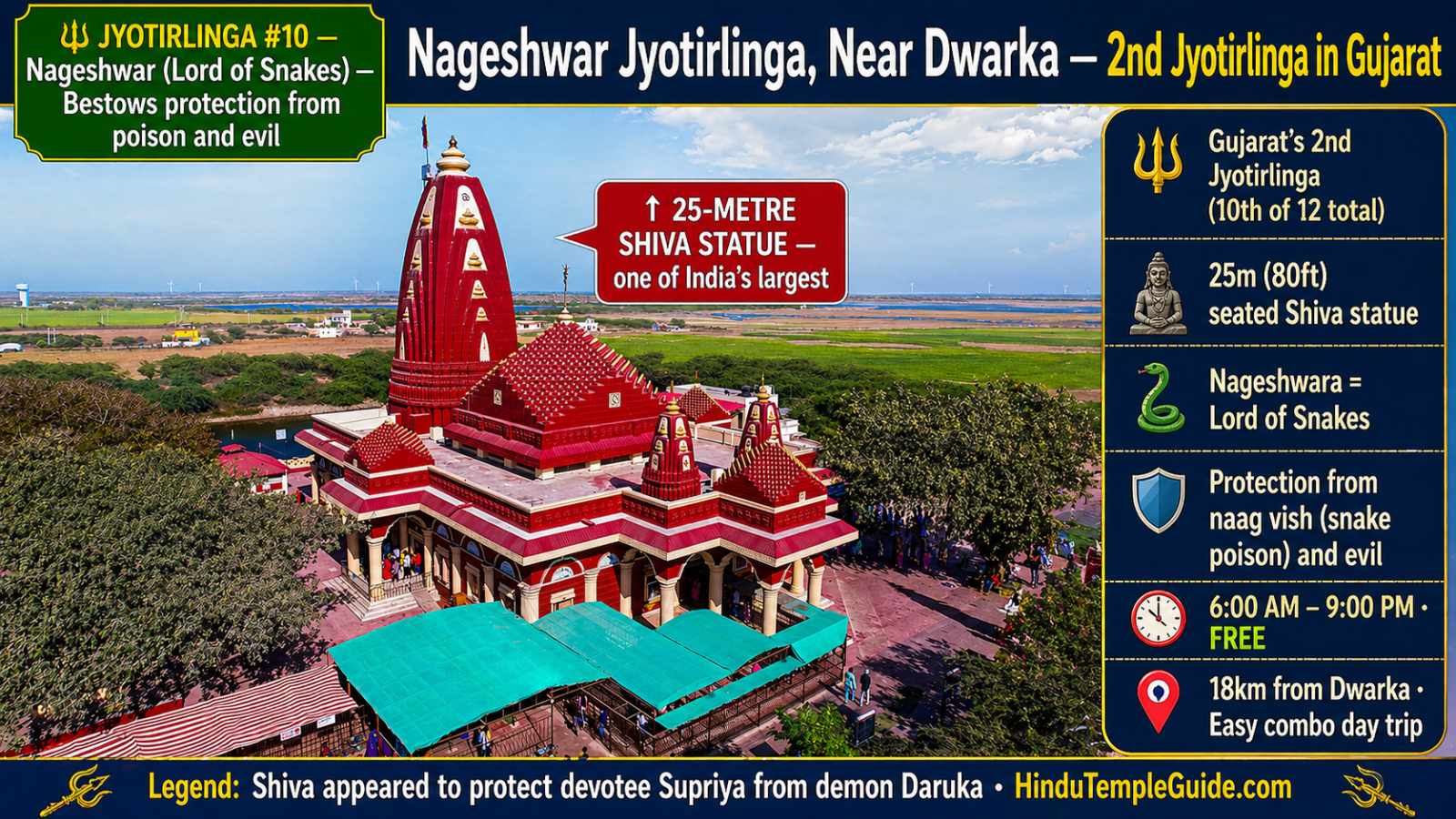
Nageshwar Jyotirlinga is ideally combined with the Dwarkadhish pilgrimage as it lies just 18 km away on the Okhamandal route. Shiva appeared here to protect devotee Supriya from the demon Daruka hence the name Nageshwar (Lord of Serpents) and the belief that darshan here bestows protection from all poisons, evil, and negative forces. The most striking feature of the complex is a 25-metre (80-foot) Padmasana statue of Lord Shiva one of the largest Shiva statues in India visible from a great distance across the flat Saurashtra landscape.
| Classification | One of the 12 Jyotirlingas (10th position; some traditions say 12th) |
| Legend | Shiva appeared here to protect devotee Supriya from demon Daruka grants protection from poison (nagavish) and evil |
| Unique Feature | 25-metre (80-foot) Padmasana Shiva statue one of the largest in India, visible from great distance |
| Timings | 6:00 AM – 12:30 PM · 5:00 PM – 9:00 PM |
| Entry Fee | FREE |
| How to Reach | 18 km from Dwarka on the Okhamandal route · Best combined with Dwarkadhish + Beyt Dwarka in one day trip |
Akshardham Temple, Gandhinagar, Modern Spiritual Marvel of Gujarat
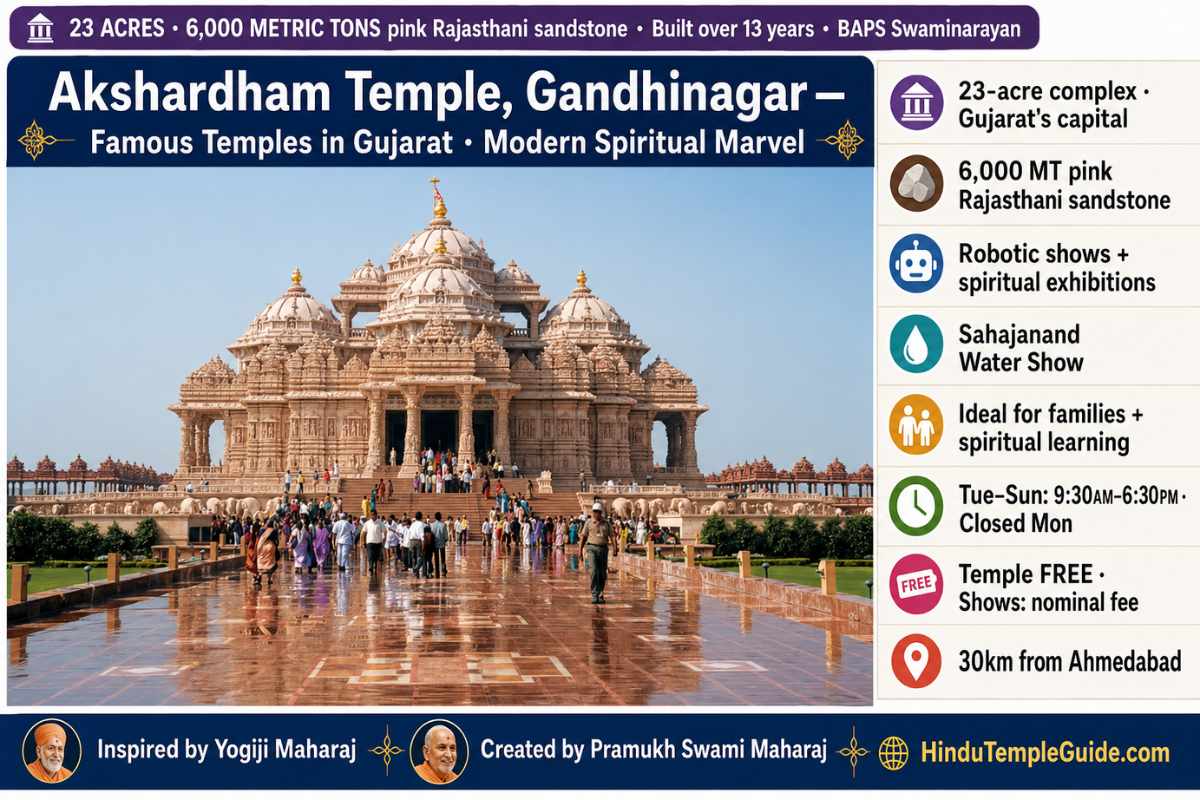
Akshardham Gandhinagar is one of the most family-friendly and visually stunning famous temples in Gujarat a 23-acre spiritual complex built over 13 years using 6,000 metric tons of pink Rajasthani sandstone, without the use of steel in the main temple structure. Built by the BAPS Swaminarayan Sanstha under the inspiration of Pramukh Swami Maharaj, it houses intricate carvings, life-size robotic cultural shows depicting the life of Swaminarayan, and a spectacular evening Sahajanand Water Show. The temple is dedicated to Sahjanand Swami (Swaminarayan) and houses a gold-leafed murti of divine proportions.
| Dedicated To | Swaminarayan (Sahjanand Swami) · BAPS Swaminarayan tradition |
| Built By | BAPS Swaminarayan Sanstha · Inspired by Yogiji Maharaj · Built under Pramukh Swami Maharaj · 13 years construction |
| Size | 23-acre complex · 6,000 metric tons of pink Rajasthani sandstone · Intricate hand-carved exterior |
| Attractions | Robotic cultural shows · Sahajanand Water Show · Spiritual exhibitions · Gardens · Sacred Lake |
| Timings | Tuesday to Sunday: 9:30 AM – 6:30 PM · Closed Mondays |
| Entry Fee | FREE for temple darshan · Water show and exhibitions: nominal fee |
| Location | Sector 20, Gandhinagar (capital of Gujarat) · 30 km from Ahmedabad city |
Modhera Sun Temple 1,000-Year-Old UNESCO Archaeological Masterpiece
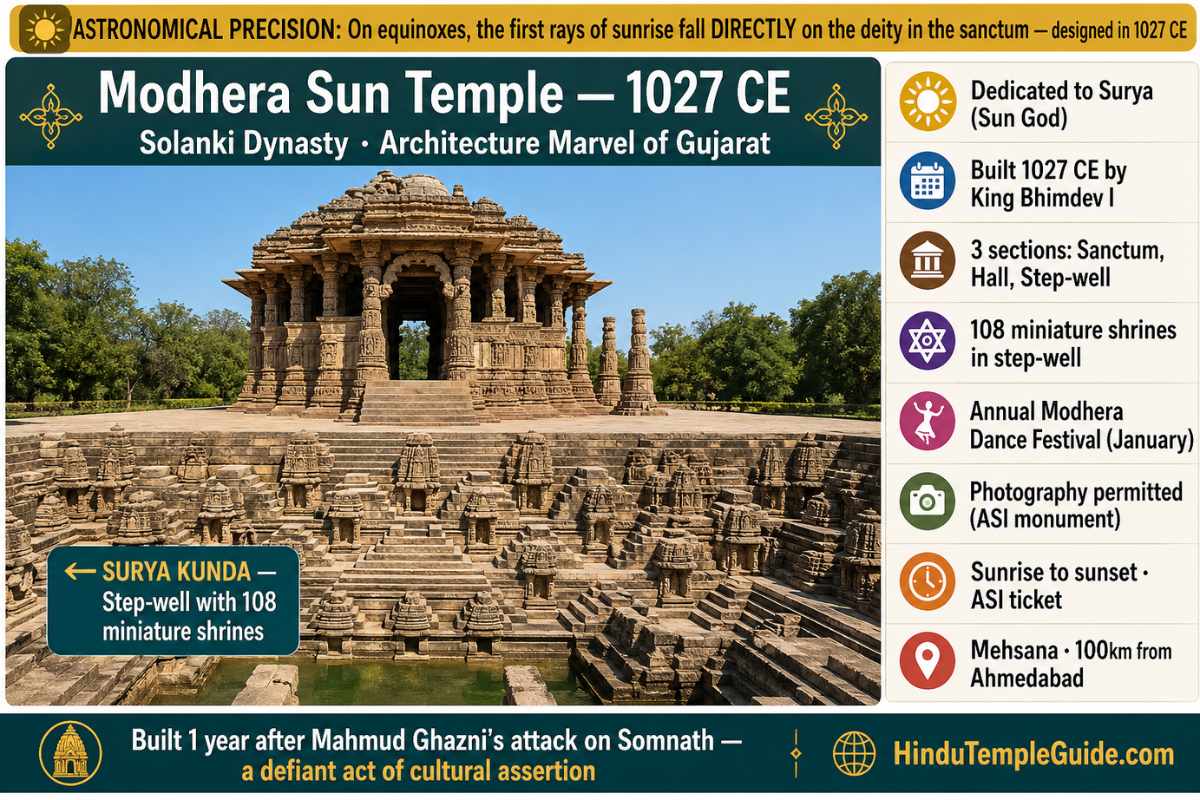
The Modhera Sun Temple is one of the most architecturally breathtaking of all famous temples in Gujarat yet almost entirely absent from standard pilgrimage guides because it is maintained as an ASI monument rather than an active place of worship. Built in 1027 CE by King Bhimdev I (Bhima I) of the Chaulukya (Solanki) dynasty a year after Mahmud of Ghazni’s attack on Somnath the temple was an act of defiant cultural assertion through extraordinary craft and astronomical engineering.
The temple is designed with precise solar alignment: on both equinoxes (March 21 and September 21) and at winter solstice, the first rays of sunrise fall directly through the doorways and illuminate the deity in the sanctum a feat of astronomical precision achieved entirely through architectural design in 1027 CE. The Surya Kunda step-well with 108 miniature shrines on its steps is one of the most beautiful architectural water bodies in all of India.
| Built | 1027 CE · King Bhimdev I · Chaulukya (Solanki) dynasty |
| Unique Feature | Solar alignment: on equinoxes, the first rays of sun fall directly on the deity in the sanctum |
| Architecture | Three sections: Gudhamandapa (sanctum) · Sabhamandapa (assembly hall) · Surya Kunda (108 miniature shrines in step-well) |
| Key Festival | Uttarardh Mahotsav (Modhera Dance Festival) held annually every January under the stars |
| Status | ASI protected monument · Not an active worship site · Photography permitted |
| Timings | Sunrise to Sunset daily · ASI ticket required |
| How to Reach | Modhera village, Mehsana district · 100 km from Ahmedabad · Nearest railway: Mehsana (25 km) |
Palitana Jain Temples, Bhavnagar, 900+ Temples on Shatrunjaya Hill
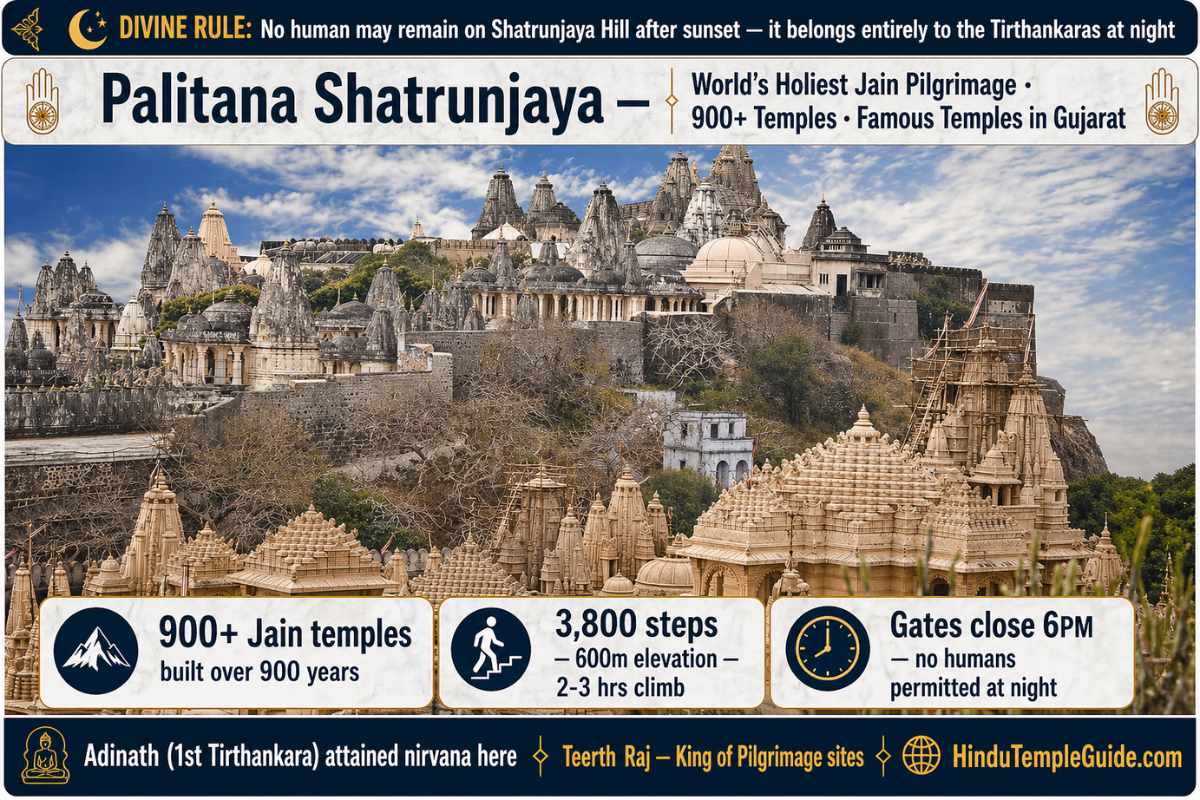
Among the famous temples in Gujarat, Palitana stands utterly apart it is Jain, and it is the most sacred pilgrimage destination in all of Jainism worldwide. The Shatrunjaya Hill at Palitana is crowned by over 900 Jain temples built over a continuous period of 900 years, dating from the 11th century CE onward. No human being is permitted to remain on the hill after sunset making it a purely divine space that belongs entirely to the Tirthankaras at night.
The 3,800-step ascent (approximately 600 metres elevation) takes 2–3 hours and is one of the most physically and spiritually demanding pilgrimages in India. Adinath (Rishabhanatha, the first of the 24 Tirthankaras) is believed to have attained moksha on this hill making it the most sacred spot in the entire Jain universe. Every Jain considers the Shatrunjaya pilgrimage (Yatra) as a mandatory spiritual achievement at least once in a lifetime.
| Number of Temples | 900+ Jain temples on Shatrunjaya Hill · Built continuously over 900+ years |
| Significance | Holiest Jain pilgrimage site in the world · Adinath (1st Tirthankara) attained nirvana here |
| The Climb | 3,800 steps · ~600m elevation · 2–3 hours ascent · Dolis (palanquins) available for elderly |
| Night Rule | NO humans permitted after sunset hill belongs to the divine · Gates close at 6 PM sharp |
| Timings | 6:00 AM – 6:00 PM (hill access) · Closed: Mondays, Paryushana, Kartik Purnima |
| Entry Fee | Nominal entry fee per person |
| How to Reach | Palitana, Bhavnagar District · 52 km from Bhavnagar · By Train: Palitana Station · By Air: Bhavnagar Airport |
More Famous Temples in Gujarat, Rukmini Devi, Bala Hanuman, Becharaji & More
9.1 Rukmini Devi Temple, Dwarka Lord Krishna’s Chief Queen
Rukmini Devi Temple is located just 2 km from the Dwarkadhish Temple and is dedicated to Lord Krishna’s beloved consort Rukmini an incarnation of Goddess Mahalakshmi. The temple dates to the 12th century CE and features extraordinary sculptural richness inside and out. According to legend, the sage Durvasa cursed Rukmini to live separated from Krishna for 12 years after she broke a fast which is why her temple stands apart from Dwarkadhish. The beautifully carved exterior with scenes from her legend is considered some of the finest medieval Gujarati sculpture.
9.2 Bala Hanuman Temple, Jamnagar Guinness World Record Continuous Chanting
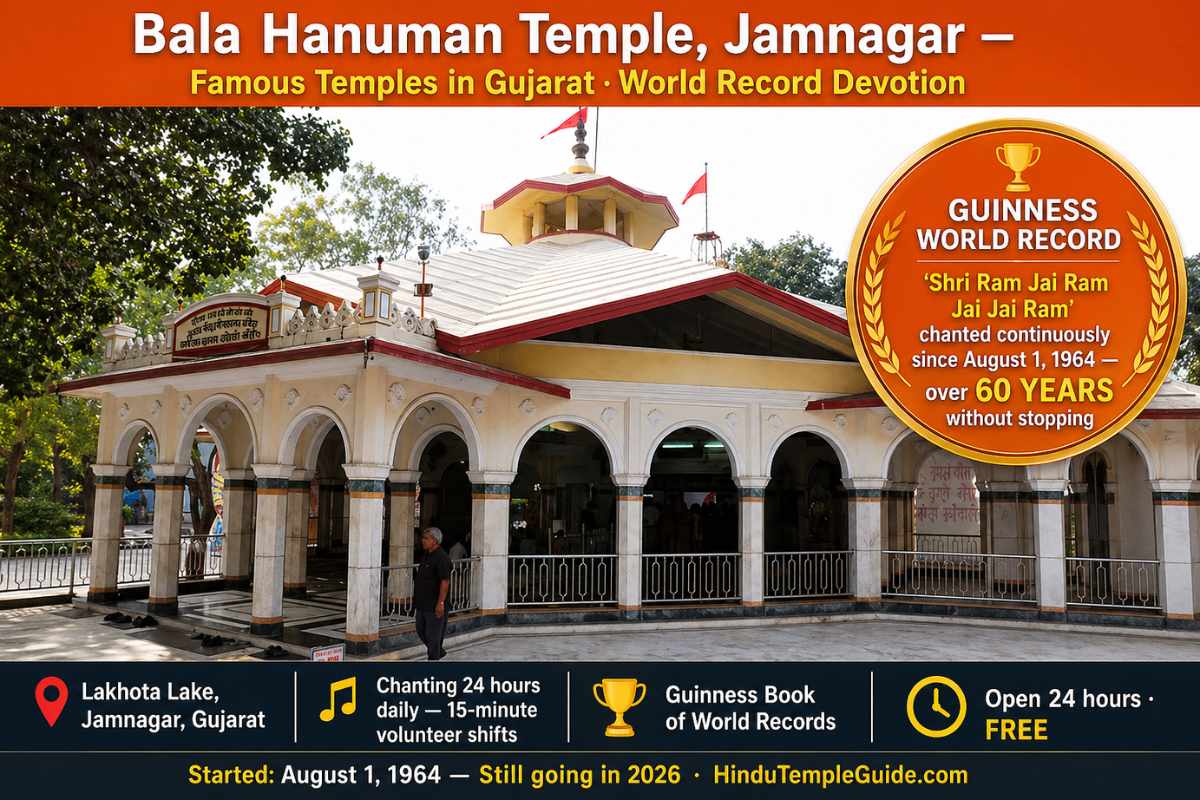
The Bala Hanuman Temple on the banks of Lakhota Lake in Jamnagar holds a distinction unlike any other temple in Gujarat: since August 1, 1964, devotees have been chanting “Shri Ram Jai Ram Jai Jai Ram” continuously without interruption a chanting session that has lasted over 60 years without a single break and earned the temple a place in the Guinness Book of World Records for the longest-running continuous devotional chanting. Volunteer devotees take 15-minute shifts around the clock to ensure the chant never stops, day or night, through all festivals, seasons, and years.
9.3 Becharaji Bahuchar Mata Temple Goddess of Courage and Fertility
Becharaji Temple, dedicated to Goddess Bahuchar Mata an avatar of Amba Maa is one of Gujarat’s most beloved Shakti temples, located in Becharaji, Mehsana district. Bahuchar Mata is particularly sacred as the patron deity of the Kinnar (transgender/hijra) community, who travel from across India to seek her blessings. The temple draws enormous crowds during Navratri and Diwali. The presiding deity is depicted riding a rooster, holding a trident and a copy of the Ramayan a unique iconography found nowhere else in Gujarat’s temple tradition.
9.4 Shamlaji Temple (Vishnuji Mandir) Ancient Vaishnavite Pilgrimage in the Aravalli Hills
Shamlaji Temple in the Aravalli Hills, Sabarkantha district, is one of Gujarat’s most ancient Vishnu temples dedicated to Lord Vishnu (Gadhadhara/Shamlaji) in a rare black stone form. Archaeological finds from the temple site date to the 2nd–5th centuries CE, making it one of Gujarat’s oldest active temple complexes. The river Meshwo flows at the base of the hill. The annual Kartik Purnima fair (held on the full moon of Kartik, October–November) draws hundreds of thousands of pilgrims and is one of the largest traditional fairs in Gujarat.
7-Day Gujarat Temple Pilgrimage Circuit Complete Itinerary 2026
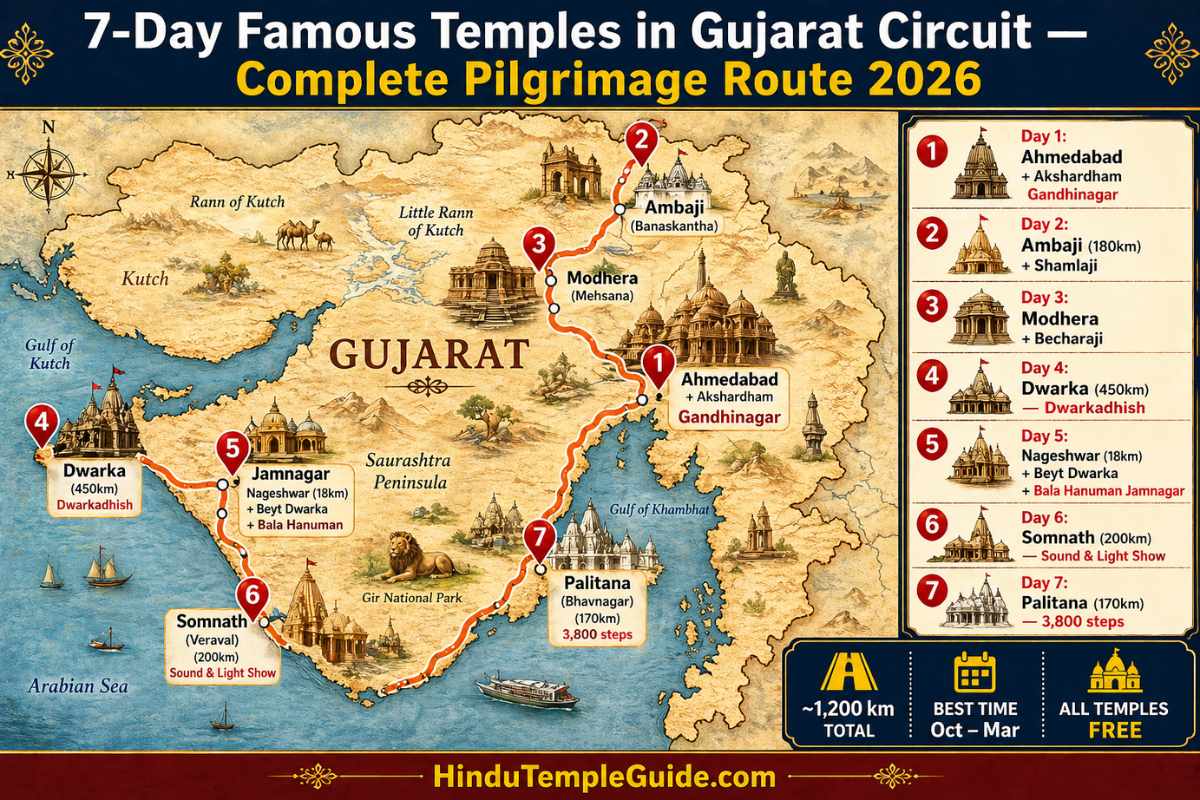
The complete famous temples of Gujarat can be covered in a 5–7 day circuit starting and ending at Ahmedabad. The itinerary below is optimised for minimum driving, maximum darshan, and logical geographic flow:
| Day | Temple(s) | Details & Driving |
|---|---|---|
| Day 1 | Ahmedabad Base | Arrive Ahmedabad · Visit Akshardham Gandhinagar (30 km) · Swaminarayan Mandir Kalupur (city centre) · Rest |
| Day 2 | Ambaji + Shamlaji | Ahmedabad → Ambaji Temple (180 km) · Darshan + Gabbar Hill ropeway · Continue to Shamlaji (60 km) · Night stay Ambaji or Palanpur |
| Day 3 | Modhera + Becharaji | Palanpur → Modhera Sun Temple (100 km) · 2–3 hrs · → Becharaji Bahuchar Mata (25 km) · Night stay Mehsana or Ahmedabad |
| Day 4 | Dwarka | Ahmedabad → Dwarka (450 km) · Dwarkadhish Temple darshan at Mangla Aarti · Gomti Ghat bath · Rukmini Devi Temple · Night stay Dwarka |
| Day 5 | Nageshwar + Beyt Dwarka + Jamnagar | Nageshwar Jyotirlinga (18 km from Dwarka) · Beyt Dwarka island (boat, 30 min) · Drive → Jamnagar · Bala Hanuman Temple Lakhota Lake · Night Jamnagar |
| Day 6 | Somnath | Jamnagar → Somnath (200 km) · Somnath Temple darshan + Triveni Sangam + Bhalka Tirth · Jay Somnath Sound & Light Show (7:45 PM) · Night Somnath/Veraval |
| Day 7 | Palitana + Return | Somnath → Palitana (170 km) · Climb 3,800 steps before noon · Descend by 5:30 PM · Return to Bhavnagar → Ahmedabad (200 km) for departure |
Pleasant 15°C–28°C · All temples accessible · Navratri, Diwali, Maha Shivaratri windows · Palitana climb comfortable
40°C+ in Saurashtra and Kutch · Extreme heat at open-air temples · Palitana climb dangerous
Monsoon · Dwarka rough seas · Palitana slippery · Ambaji Navratri (Sept–Oct) is peak
Navratri (Ambaji) · Janmashtami (Dwarka) · Maha Shivaratri (Somnath) · Modhera Dance Festival (Jan)
FAQs : Famous Temples in Gujarat 2026
Char Dham Yatra 2026 – Complete Guide (Dwarka is One of Four Char Dhams)
18 Shakti Peeth Complete Guide – Ambaji is One of 51 Shakti Peethas
Navratri 2026 Complete Guide – Best Shakti Temples to Visit Including Ambaji
Famous Temples in Karnataka 2026 – Top 10 Complete Guide
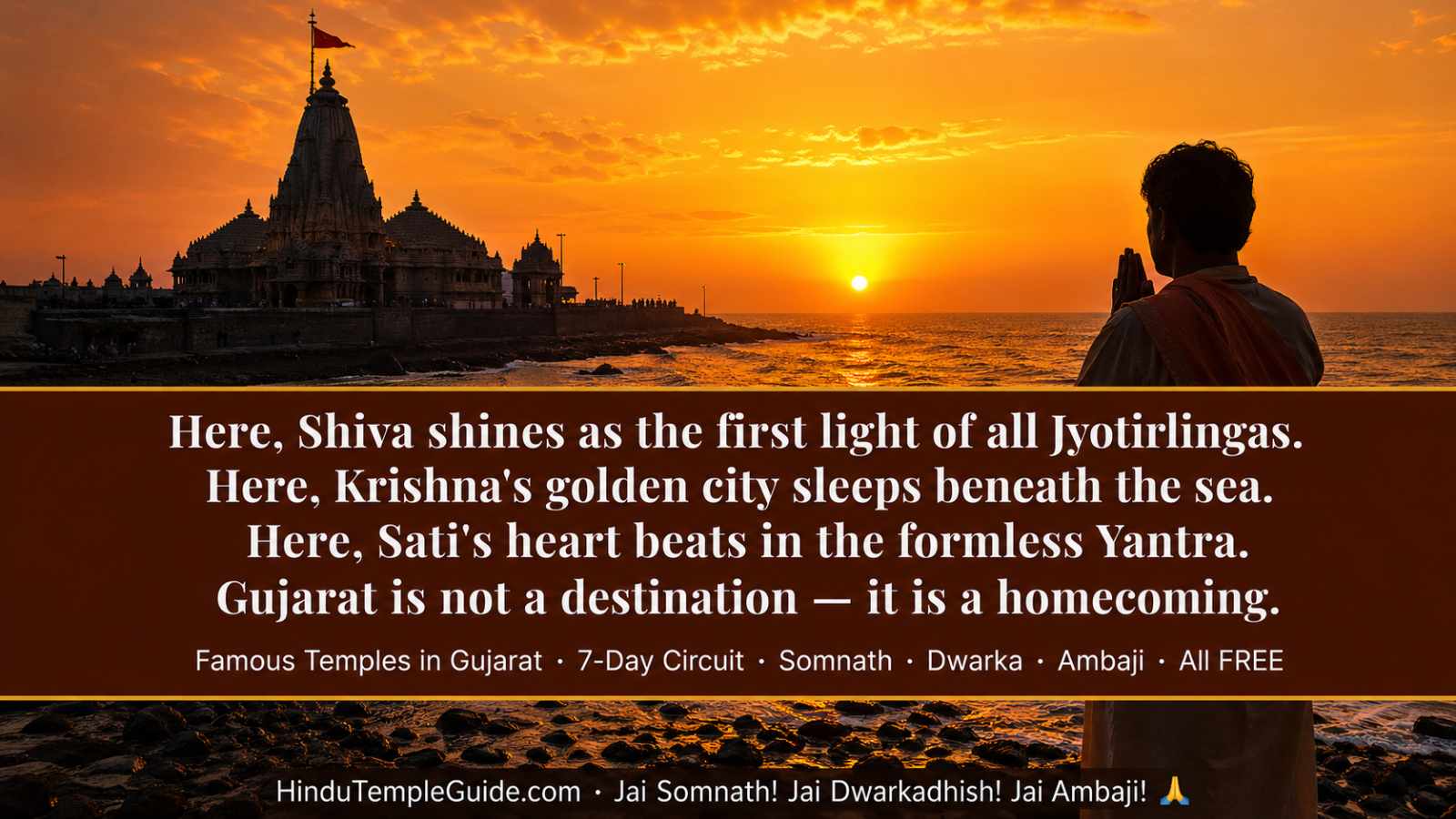
Begin Your Gujarat Temple Pilgrimage Shiva’s First Light, Krishna’s Kingdom & Shakti’s Heart
Start at Somnath. Walk to Dwarka. Climb Shatrunjaya. Let Amba Maa find you. Jai Somnath! Jai Dwarkadhish! Jai Ambaji! Jai Shri Krishna!
Devendra Khambalkar, Nagpur, Maharashtra |
Questions? Write to me directly I read every message personally.
Sources & Disclaimer: Information verified from official Gujarat Tourism (gujarattourism.com), Shree Somnath Trust (somnath.org), ASI records, and official temple websites. Temple timings are approximate as of 2026 and may vary during festivals or by government order. All major famous temples in Gujarat are FREE for general darshan. Always verify timings directly with individual temples before visiting. HinduTempleGuide.com is an independent pilgrimage guide. Jai Somnath! Jai Shri Krishna! Jai Ambaji!