
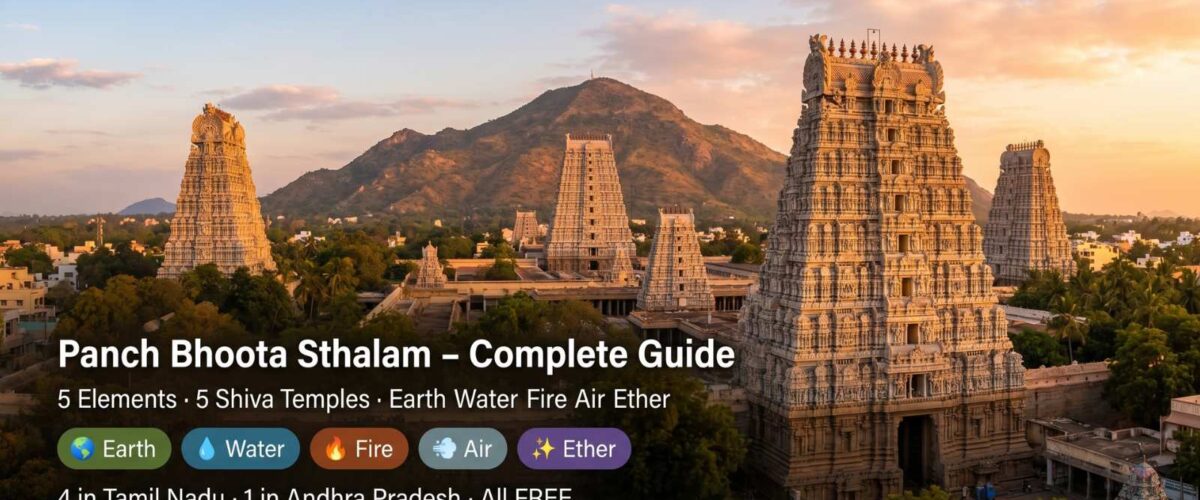
Panch Bhoota Sthalam – Complete Guide to 5 Elements Shiva Temples: Earth, Water, Fire, Air & Ether
Panch Bhoota Sthalam these five sacred temples represent the most profound and cosmically ambitious conception in all of Hindu sacred architecture: the idea that Lord Shiva is not merely a deity worshipped in a temple, but the living force within the five elements that constitute all of creation the earth beneath our feet, the water in our blood, the fire of our consciousness, the breath of our lungs, and the infinite space of our awareness. The Pancha Bhoota Sthalams are the five sacred sites where these elemental forms of Shiva are enshrined, worshipped, and experienced. They are not merely temples; they are cosmic laboratories where the devotee stands in direct contact with the five elements through Lord Shiva’s divine grace.
Whether you approach these temples as a devotee, a student of Hindu philosophy, or a heritage traveller the Panch Bhoota Sthalam pilgrimage is one of the most transformative journeys in South India. Om Namah Shivaya!
The five prime elements are: Prithvi (Earth – solidity, form), Apas/Jalam (Water – purification, flow), Agni/Tejas (Fire – transformation, light), Vayu (Air – breath, vitality), and Akasha (Ether/Space – consciousness, the infinite). All physical existence including the human body is a composition of these five elements. The Panch Bhoota Sthalams are where Lord Shiva manifests AS these elements.
Quick Navigation
Table of Contents
Panch Bhoota Sthalam – All 5 Element Temples at a Glance
| # | Element | Temple Name | Location | Timings | Unique Feature |
|---|---|---|---|---|---|
| 1 | Earth (Prithvi) | Ekambareswarar Temple | Kanchipuram, TN | 6AM–12:30PM · 4–8:30PM | 3,500-yr mango tree · 1,000-pillar hall |
| 2 | Water (Apas) | Jambukeswarar Temple | Thiruvanaikaval, TN | 6AM–1PM · 3:30–8:30PM | Lingam submerged in eternal spring · Priest dresses as woman |
| 3 | Fire (Agni) | Annamalaiyar / Arunachaleswarar | Tiruvannamalai, TN | 5:30AM–1PM · 3:30–9PM | 217-ft gopuram · Hill IS the Lingam · Karthigai Deepam: 3M pilgrims |
| 4 | Air (Vayu) | Sri Kalahasteeswara Temple | Srikalahasti, AP | 6AM–1PM · 2–8PM | Lamp flickers in sealed sanctum · Rahu-Ketu puja capital |
| 5 | Ether (Akasha) | Thillai Nataraja Temple | Chidambaram, TN | 6AM–12:30PM · 4:30–9PM | Chidambara Rahasya (empty space) · Nataraja · 108 Karanas |
The Philosophical Significance – Shiva as the Five Elements
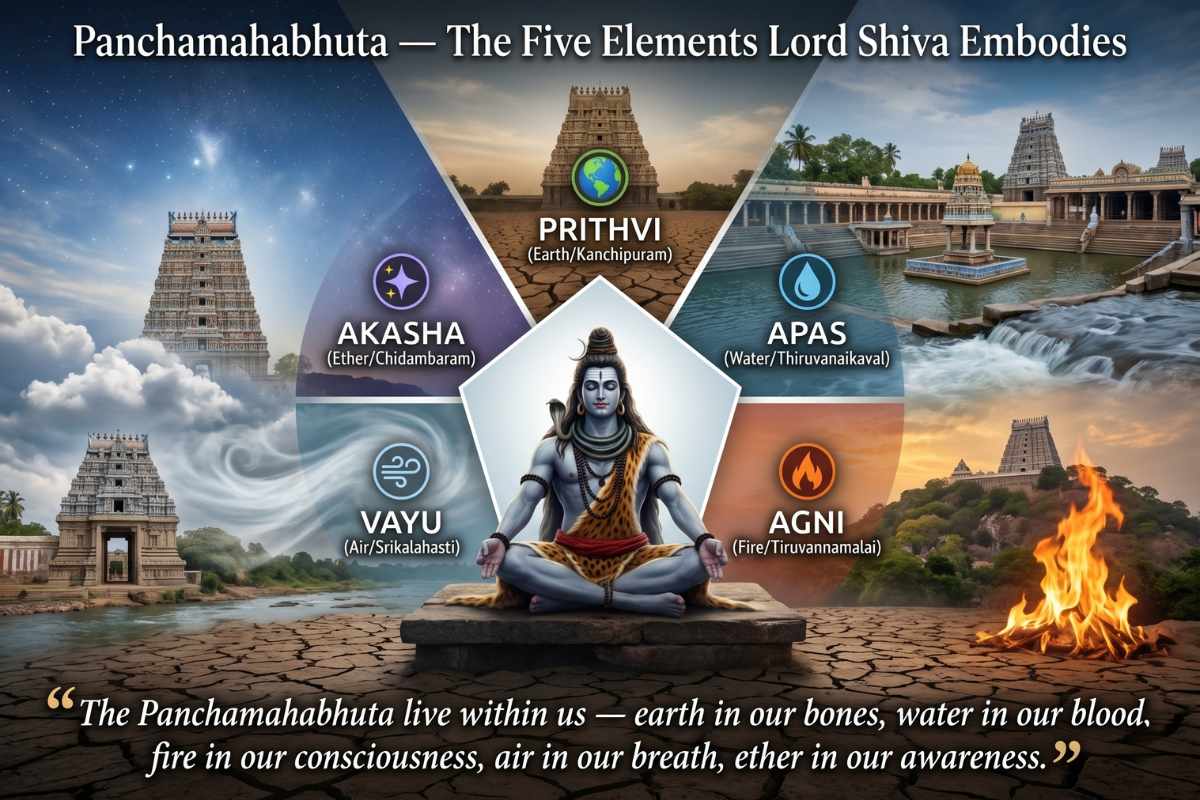
The Panch Bhoota Sthalam tradition rests on one of Hinduism’s most profound cosmological insights: that the divine is not separate from nature but is expressed through it. In Shaiva philosophy, Lord Shiva as Bhootapati (Lord of the Elements) is the consciousness that animates all five elements simultaneously. He is not merely a god who created the elements: he is the elements. Every grain of earth, every drop of water, every flame, every breath of air, every expanse of space is Shiva. The five Pancha Bhoota Lingas are therefore actual concentrations of elemental divine energy places where the boundary between Shiva and the element dissolves completely.
| Element | Philosophical Significance in Shiva’s Cosmic Role |
|---|---|
| Earth (Prithvi) | Stability, physical form, sustenance. Shiva as the ground of all being the foundation from which all creation rises and to which all returns |
| Water (Apas) | Purification, flow, emotional depth. Shiva as the purifying force that cleanses karma and enables the soul’s journey toward liberation |
| Fire (Agni) | Transformation, illumination, tapas. Shiva as the divine fire that burns away ignorance, transmutes karma, and illuminates consciousness |
| Air (Vayu) | Breath, vitality, movement. Shiva as the Prana (life-force) that animates all living beings without which consciousness cannot function in physical form |
| Ether (Akasha) | Infinite space, pure consciousness, the substratum of all sound (Nada). Shiva as the boundless Chit in which all creation arises and dissolves |
Temple 1 : Ekambareswarar Temple, Kanchipuram (Earth Element)
Prithvi Lingam (sand never hardens) · Shiva as Ekambaranathar · Kanchipuram, Tamil Nadu · 72km from Chennai
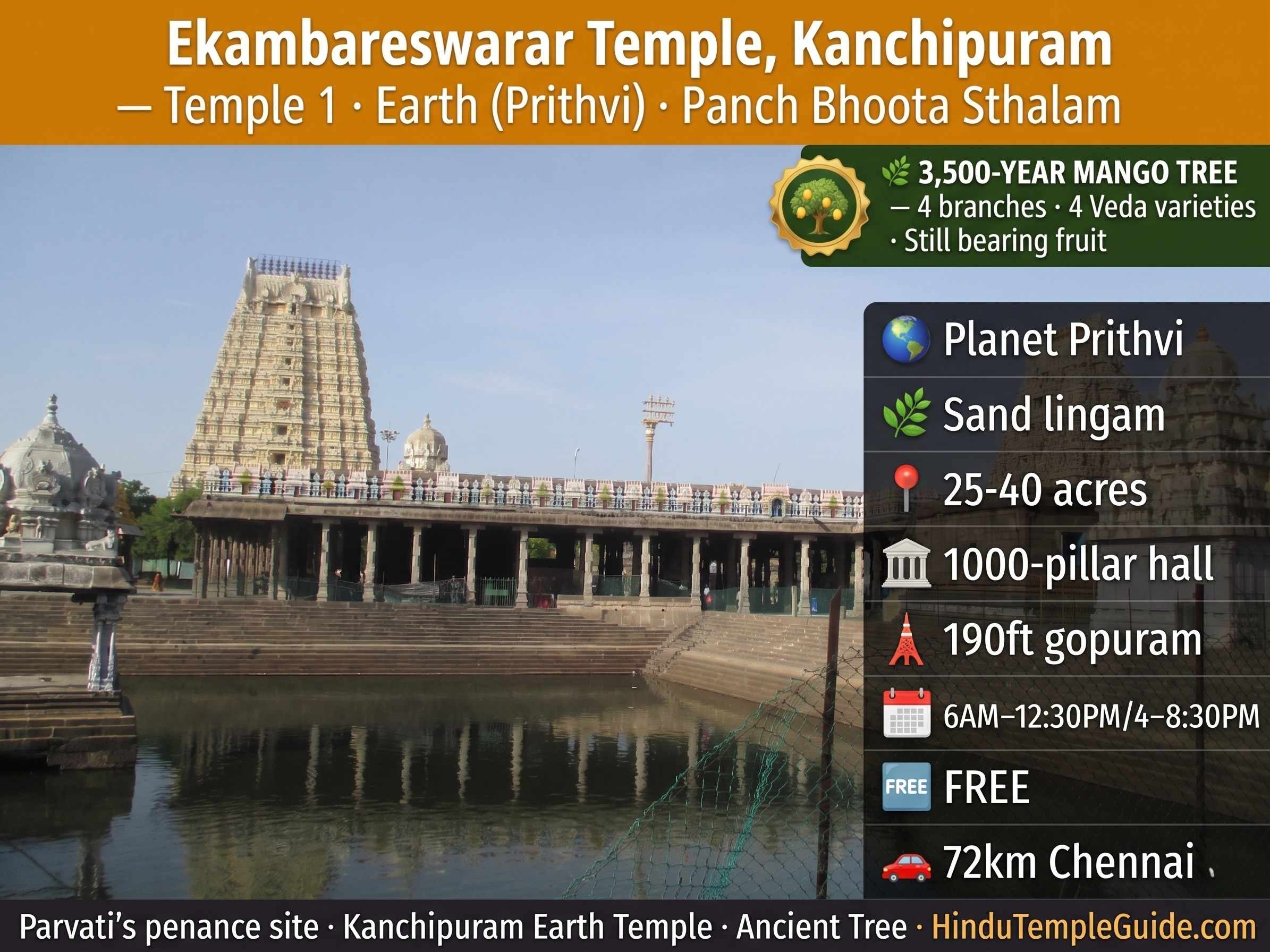
| Element | Prithvi (Earth) · Shiva Lingam made of sand never hardens |
| Shiva Name | Ekambaranathar (‘Lord of the Single Mango Tree’) · Parvati as Elavarkuzhali |
| Temple Size | 25–40 acres · 10th largest Hindu temple in India · 1,000-pillar hall (1,008 pillars) |
| Sacred Tree | 3,500-year-old mango tree 4 branches, 4 different mango varieties = 4 Vedas |
| Rajagopuram | 190 feet (58m) built by Vijayanagara King Krishnadevaraya |
| Key Festival | Panguni Uthiram (March–April) divine wedding of Shiva and Parvati |
| Built by | Pallava kings (~600 CE) · Expanded by Cholas, Adi Shankaracharya, Vijayanagara kings |
| Timings | 6:00 AM – 12:30 PM · 4:00 PM – 8:30 PM · All days |
| Entry / Distance | FREE · 72km from Chennai · 5km from Kanchipuram railway station |
Ekambareswarar Temple, Kanchipuram, is the temple of Earth. The divine Lingam here is crafted from sand (Prithvi Lingam) a Lingam that is never hardened and never fired. The legend: Goddess Parvati was cursed by Shiva for playfully covering his eyes, plunging the world into darkness. She came to Kanchipuram, performed intense penance, and created a Lingam from sand under a single mango tree. When the Vegavati River flooded, Parvati embraced the sand Lingam with her own body to protect it. Shiva, moved beyond measure by her devotion, melted into her embrace giving him the name Tazhuva Kuzhainthaar (He who melted in Her embrace).
The 3,500-year-old mango tree still stands in the temple complex today its four branches producing four distinct varieties of mangoes corresponding to the four Vedas. The 1,008-pillar hall is a marvel of Chola and Vijayanagara craftsmanship, and the 190-foot rajagopuram built by Krishnadevaraya remains one of Tamil Nadu’s most impressive temple towers.
Temple 2 : Jambukeswarar Temple, Thiruvanaikaval (Water Element)
Appu Lingam (water submerged in eternal spring) · Shiva as Jambukeshwara · Parvati as Akilandeswari · 2km from Srirangam, Trichy
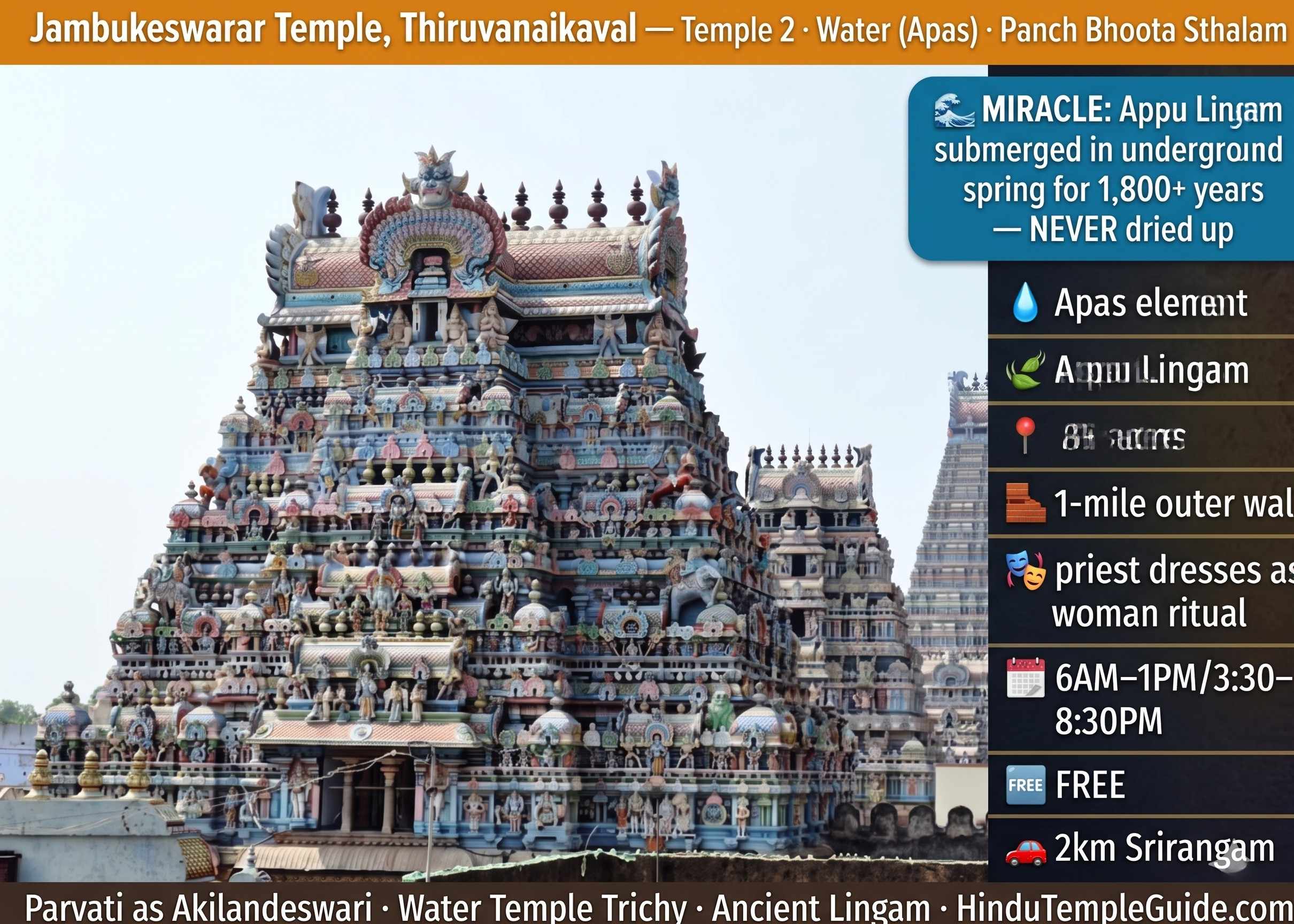
| Element | Apas/Jalam (Water) · Lingam submerged in underground Kaveri spring that never dries |
| Unique Ritual | Uchi Kala Pooja: priest dresses as woman Akilandeswari performing puja to Shiva |
| Temple Size | Over 18 acres · 13th largest temple in India · 5 concentric enclosures |
| Vibudi Prakara | Outer wall extends 1 mile · 25 feet high · 2 feet thick · Chola-era masterpiece |
| Legend | Parvati/Akilandeswari fashioned Appu Lingam from Kaveri water · Shiva taught her Shiva Gnana (supreme knowledge) |
| Timings | 6:00 AM – 1:00 PM · 3:30 PM – 8:30 PM · All days |
| Entry / Distance | FREE · 2 km from Srirangam · 10 km from Tiruchirappalli city |
The water element carries the profound spiritual significance of purification through devotion and the receptivity that makes divine knowledge possible. According to legend, Goddess Parvati came to a Jambu (rose apple) forest and performed intense tapas, fashioning a Lingam from the waters of the sacred Kaveri. She worshipped this water Lingam until Lord Shiva appeared and taught her Shiva Gnana the supreme knowledge of liberation.
Temple 3 : Annamalaiyar Temple, Tiruvannamalai (Fire Element)
Agni Lingam (fire/light Shiva as infinite column of flame) · Shiva as Arunachaleswarar · Parvati as Unnamalai Amman · Tiruvannamalai, Tamil Nadu · 185km from Chennai
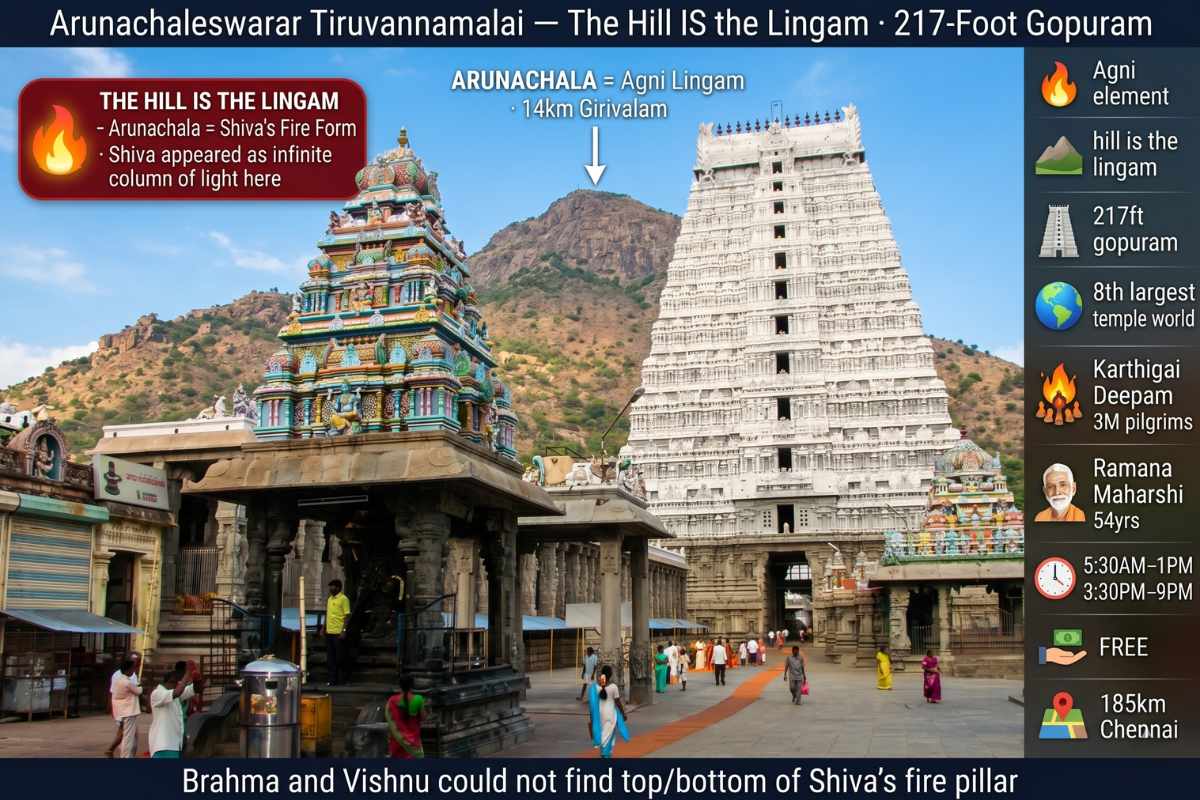
| Element | Agni/Tejas (Fire) · Shiva appeared as infinite column of fire (Jyotir Lingam) |
| ⭐ Sacred Hill | Arunachala Hill (2,668 ft) the hill ITSELF is the lingam, worshipped as Agni Swarupa of Shiva |
| Temple Size | 25 acres · 8th largest Hindu temple in the world · 4 gopurams |
| Eastern Gopuram | 217 feet (66m) 11 storeys one of the tallest gopurams in India |
| Karthigai Deepam | Massive flame on Arunachala Hill visible 30km away · 3 million pilgrims perform Girivalam |
| Girivalam | 14-km circumambulation of Arunachala Hill one of South India’s most powerful spiritual practices |
| Sri Ramana Maharshi | Great 20th-century sage lived at Arunachala’s foot for 54 years declared it the most sacred mountain in the world |
| Timings | 5:30 AM – 1:00 PM · 3:30 PM – 9:00 PM · All days |
| Entry / Distance | FREE · 185km from Chennai · 100km from Pondicherry |
Annamalaiyar Temple, Tiruvannamalai is the most dramatically situated of all the Panch Bhoota Sthalam temples because here, the fire element is not represented by a lingam inside a sanctum: the entire Arunachala Hill is the Lingam. The ancient legend tells that during a cosmic dispute between Brahma and Vishnu over who was supreme, Shiva appeared as an infinite column of light (Jyoti Lingam) whose top and bottom could not be found. Brahma flew to the top as a swan failed. Vishnu dug into the earth as a boar failed. Both surrendered. Shiva then appeared at Tiruvannamalai as the fire hill making this the site of Shiva’s most cosmic self-revelation.
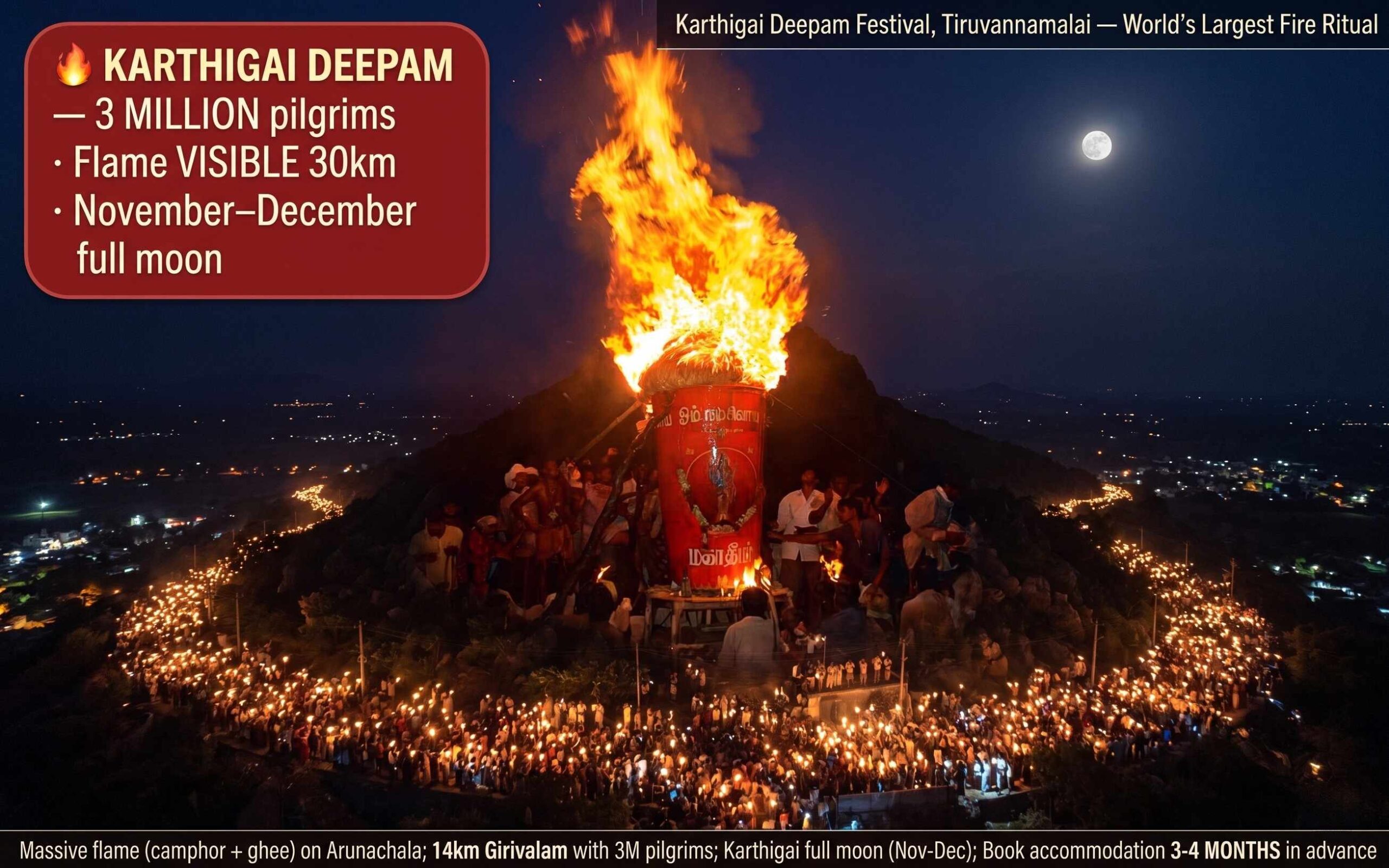
The Karthigai Deepam festival on the full moon of Tamil month Karthigai (November–December) is the annual culmination: a massive flame is lit atop Arunachala Hill using tonnes of camphor and ghee, visible from 30 kilometres, while over 3 million pilgrims perform the 14-km Girivalam. The great sage Sri Ramana Maharshi declared Arunachala the most sacred mountain in the world and lived at its foot for 54 years his ashram (Sri Ramanasramam) remains an active spiritual centre today.
Temple 4 : Sri Kalahasteeswara Temple, Srikalahasti (Air Element)
Vayu Lingam (air flame breathes, cobweb waves) · Shiva as Kalahasteeswara · Parvati as Gnana Prasunamba · Srikalahasti, Andhra Pradesh · 36km from Tirupati
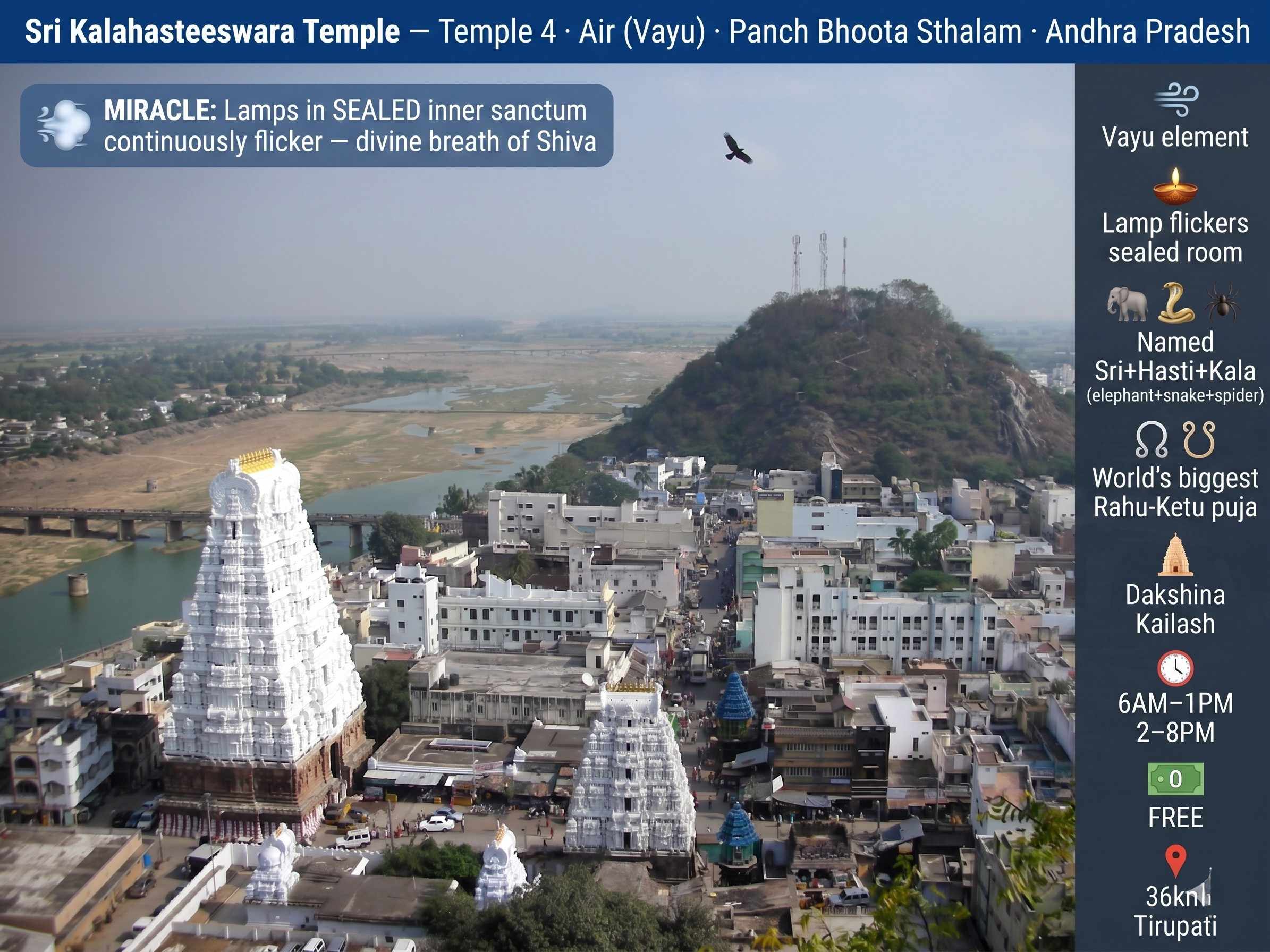
| Element | Vayu (Air) · The Shivalingam vibrates when no wind blows the divine breath of Shiva |
| Lamp Miracle | Lamps in the inner sanctum continuously flicker even when the chamber is completely sealed the most dramatic proof of the air element |
| Temple Name | Kalahasteeswara from spider (Kala), snake (Hasti/Sarpa), elephant (Sri) three devoted animal worshippers |
| Kailash of South | Called ‘Dakshina Kailash’ one of the holiest Shiva pilgrimage sites |
| Famous For | India’s most famous Rahu-Ketu puja centre thousands perform this puja daily for dosha relief |
| Built / Renovated | 11th century CE by Rajendra Chola I · Later by Krishnadevaraya (Vijayanagara) |
| Timings | 6:00 AM – 1:00 PM · 2:00 PM – 8:00 PM · All days |
| Entry / Distance | FREE · Rahu-Ketu puja: paid ticket · 36km from Tirupati · 120km from Chennai |
Sri Kalahasteeswara Temple is the only temple outside Tamil Nadu in the Panch Bhoota Sthalam. The Vayu Lingam demonstrates the air element: the lamps in the inner sanctum continuously flutter and bow as if in a breeze, even when the chamber is completely sealed. The temple’s name comes from three devoted animal worshippers: Sri (the elephant), Kala (the spider), and Hasti/Sarpa (the snake) who worshipped the Shivalingam with such pure devotion that Shiva granted them liberation. Today, Sri Kalahasti is also India’s most famous centre for Rahu-Ketu puja thousands travel specifically for this ritual, making Kalahasti one of the busiest pilgrimage destinations in Andhra Pradesh.
Temple 5 : Thillai Nataraja Temple, Chidambaram (Ether/Space Element)
Akasha Lingam (ether formless empty space) · Shiva as Nataraja (Cosmic Dancer) · Parvati as Shivakamasundari · Chidambaram, Tamil Nadu · 220km from Chennai
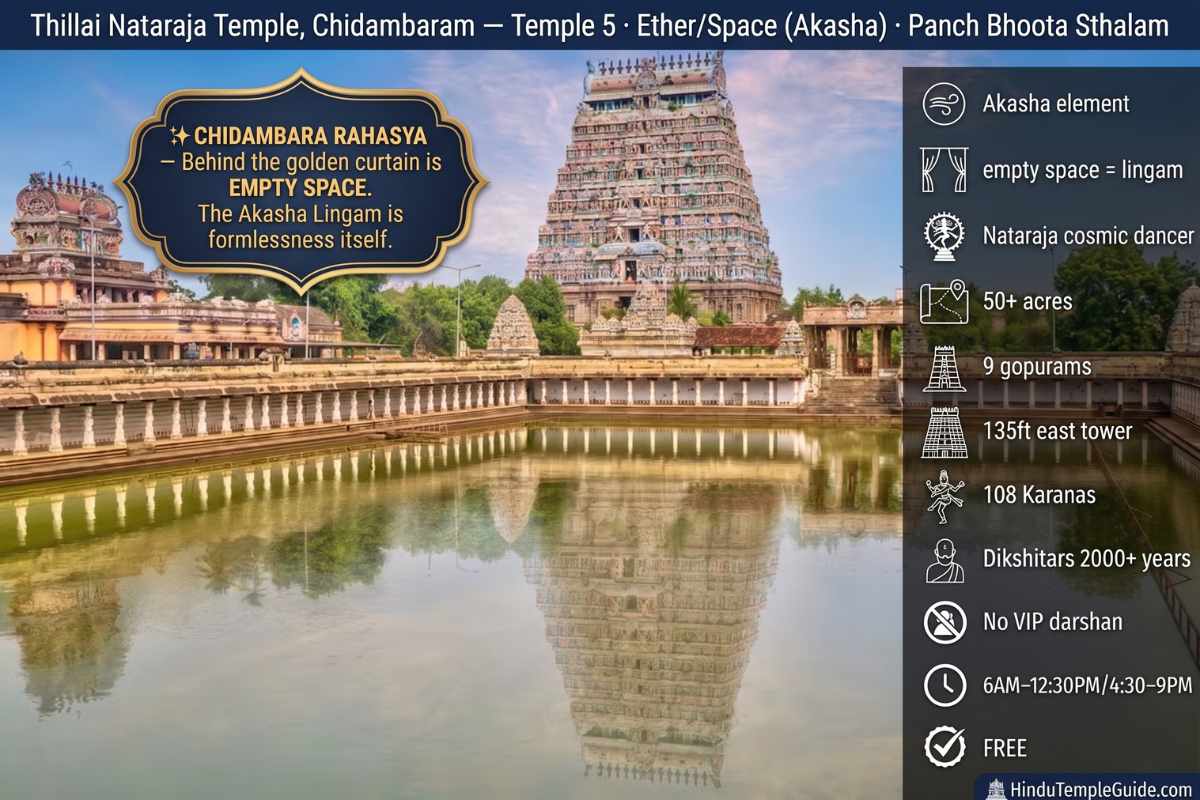
| Element | Akasha (Ether/Space) · The Akasha Lingam is EMPTY SPACE the formless Shiva |
| Chidambara Rahasya | Behind a golden curtai empty space with vilva leaves revealed only during special pujas |
| Shiva Name | Nataraja (Lord of Cosmic Dance) · Only Panch Bhoota Sthalam where Shiva appears in anthropomorphic form |
| Name Meaning | Chidambaram = Chit (consciousness) + Ambaram (sky/space) = Sky of Consciousness |
| Temple Area | Over 50 acres · 9 gopurams · 108 Bharatanatyam Karanas carved on gopurams |
| Maintained by | Thillai Dikshitars hereditary Brahmin community managing temple for 2,000+ years |
| VIP Darshan | NO VIP darshan all devotees stand equally before Nataraja (egalitarian principle) |
| Timings | 6:00 AM – 12:30 PM · 4:30 PM – 9:00 PM · All days |
| Entry / Distance | FREE · 220km from Chennai · 80km from Trichy |
The Chidambara Rahasya : The Great Secret of the Ether Temple
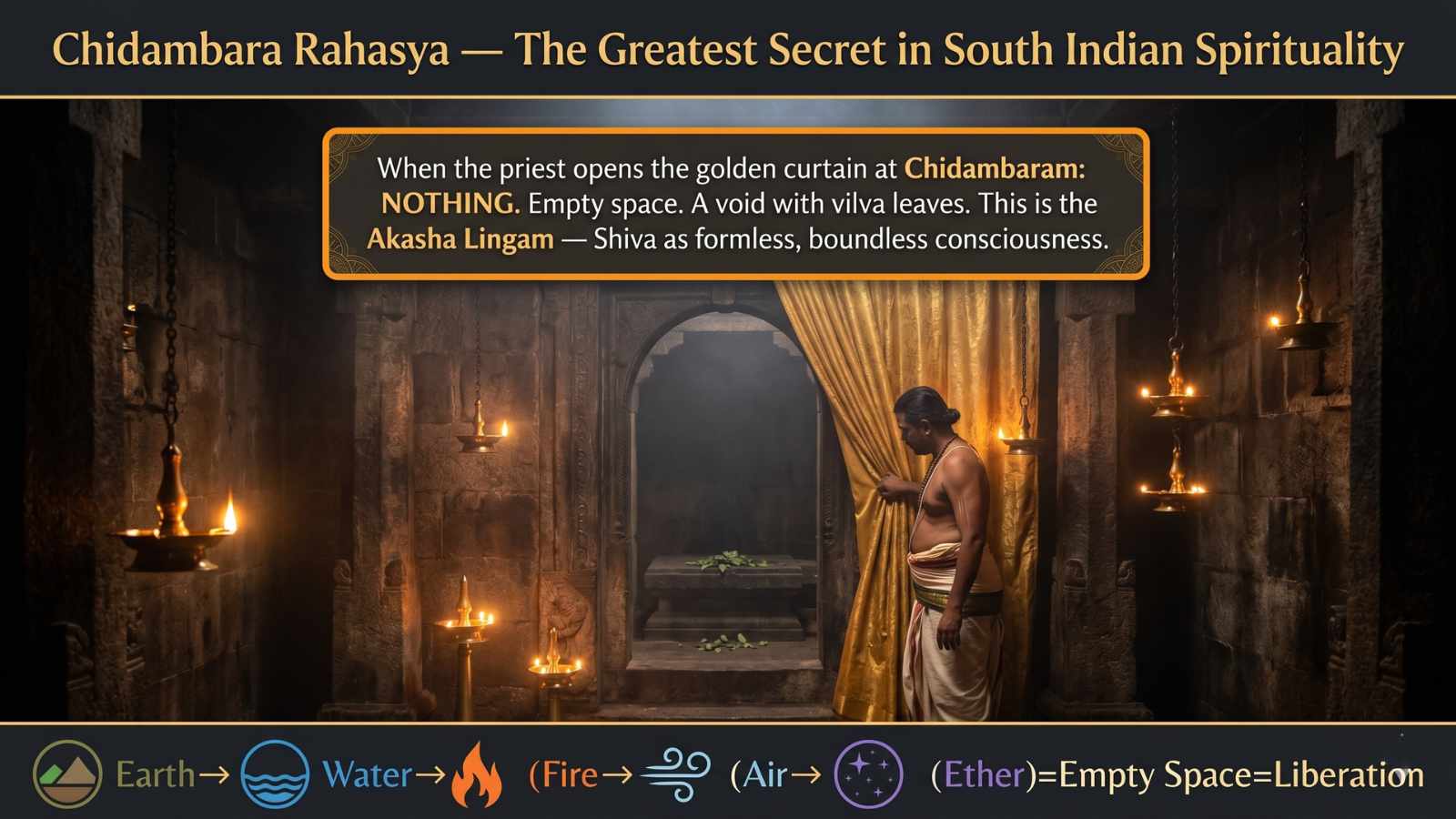
The Chidambara Rahasya is the culmination of the entire Panch Bhoota Sthalam pilgrimage and perhaps the most philosophically sophisticated moment in any temple tradition anywhere in the world. Having approached Shiva in his four elemental forms as the solid earth of Kanchipuram, the flowing water of Thiruvanaikaval, the blazing fire of Tiruvannamalai, the moving air of Kalahasti the devotee arrives at Chidambaram and discovers that the most fundamental form of Shiva is no form at all.
The empty space behind the curtain is a teaching that words cannot fully convey: Shiva is not any of the elements alone, but the consciousness in which all elements arise, play, and dissolve. As Muthuswami Dikshitar composed in his Panchabhoothalinga Kriti: “Chidambaresam Bhajami I worship the Lord of the Sky of Consciousness” identifying the true Lingam of Chidambaram as consciousness itself.
Geographic Alignment : All 5 Temples on the Same Longitude (79°E)
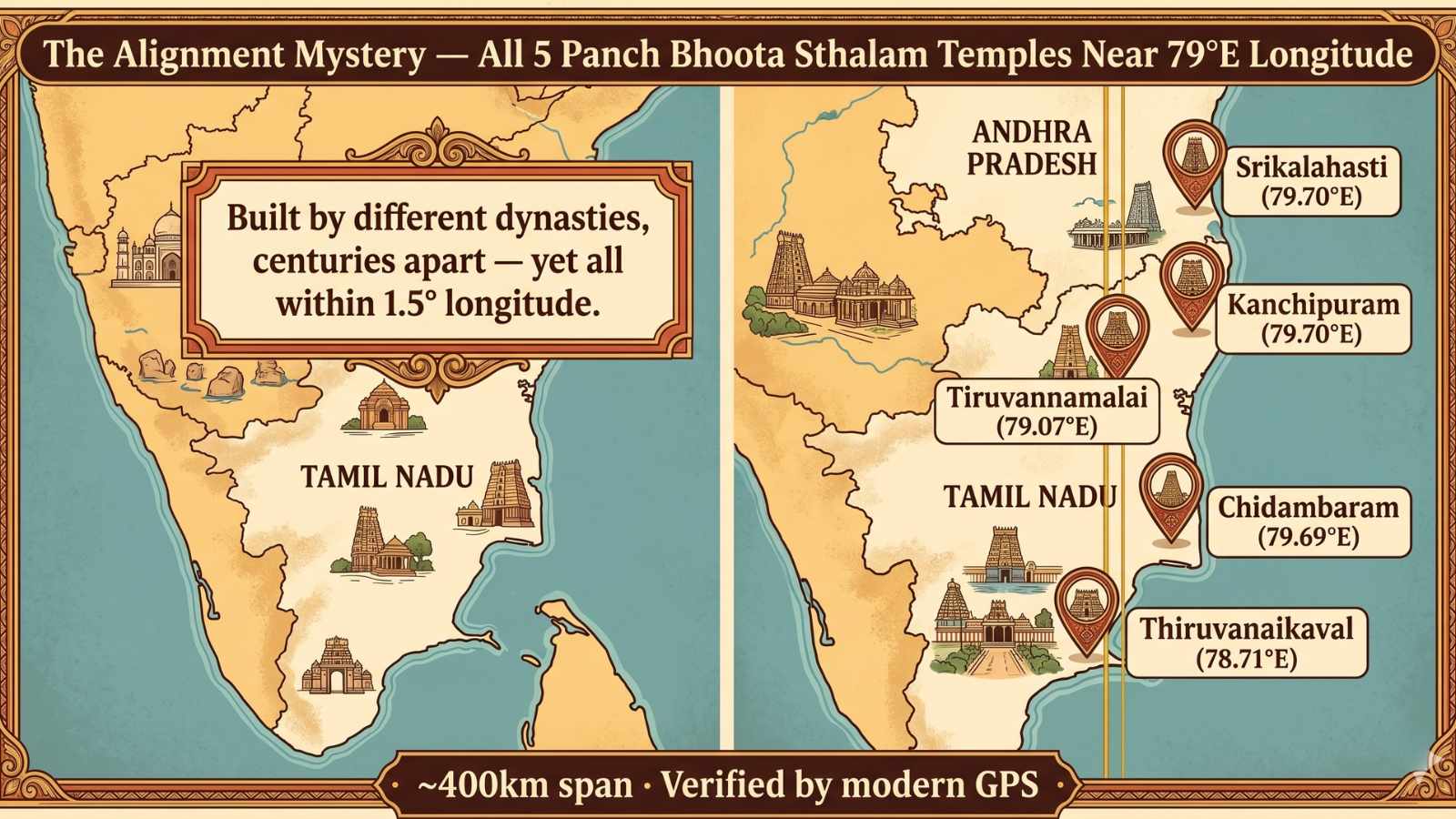
One of the most astonishing features of the Panch Bhoota Sthalam is only apparent after modern cartographic analysis: all five temples lie remarkably close to the 79°E longitude, between 10°N and 14°N latitude despite being built by different dynasties (Pallava, Chola, Vijayanagara, and Kakatiyas) across centuries. The maximum longitudinal variation between all five temples is less than 1.5 degrees an extraordinary alignment for temples built centuries apart without modern surveying equipment.
| Temple | Latitude | Longitude | Element |
|---|---|---|---|
| Chidambaram | 11.40°N | 79.69°E | Akasha (Ether/Space) |
| Tiruvannamalai | 12.23°N | 79.07°E | Agni (Fire) |
| Thiruvanaikaval | 10.85°N | 78.71°E | Apas (Water) |
| Kanchipuram | 12.85°N | 79.70°E | Prithvi (Earth) |
| Srikalahasti | 13.75°N | 79.70°E | Vayu (Air) |
Complete Panch Bhoota Sthalam Pilgrimage Circuit – 4-Day Itinerary
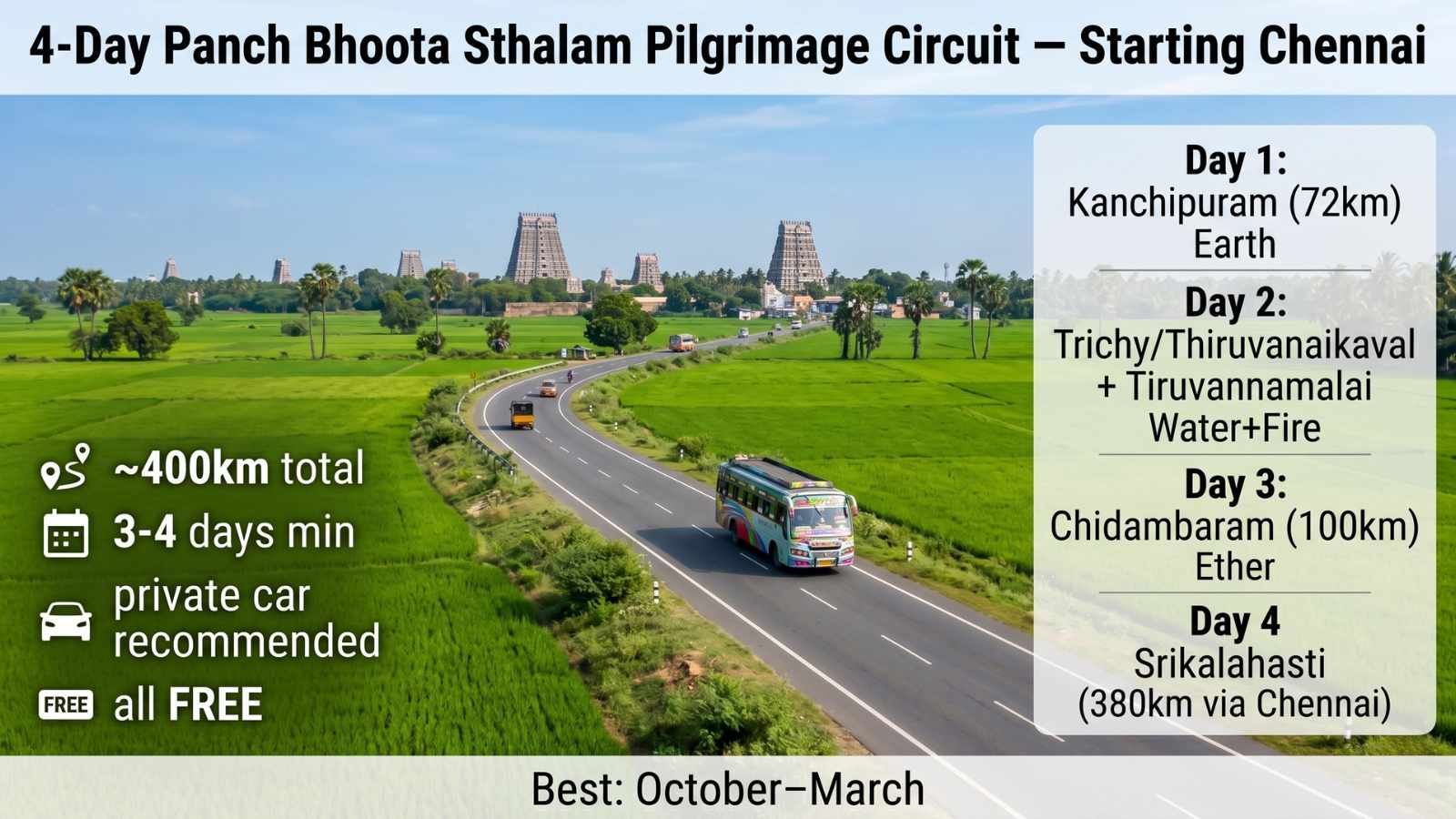
The complete Panch Bhoota Sthalam circuit can be completed in 4 days starting from Chennai or Tirupati. Here is the optimal route:
| Day | Temple(s) | Route Details |
|---|---|---|
| Day 1 | Kanchipuram (Earth) | Depart Chennai (72 km) · Ekambareswarar Temple (3–4 hrs) · See 3,500-year mango tree + 1,000-pillar hall · Optional: Kamakshi Amman Shakti Peeth · Night stay Kanchipuram or Chennai |
| Day 2 | Water + Fire | Kanchipuram → Trichy (310 km) · Jambukeswarar Thiruvanaikaval (2 hrs) · Drive to Tiruvannamalai (105 km) · Arunachaleswarar Temple (2–3 hrs) · Optional: evening Girivalam or Ramana Maharshi Ashram · Night stay Tiruvannamalai |
| Day 3 | Chidambaram (Ether) | Tiruvannamalai → Chidambaram (100 km) · Nataraja Temple (3 hrs) · Experience Chidambara Rahasya during special puja · 108 Bharatanatyam Karanas on gopuram · Night stay Chidambaram or Pondicherry |
| Day 4 | Srikalahasti (Air) | Chidambaram → Srikalahasti via Tirupati (380 km) · Sri Kalahasteeswara Temple (2–3 hrs) · Rahu-Ketu puja if required · Return to Tirupati (36 km) or Chennai (155 km) · Panch Bhoota Sthalam COMPLETE! |
Practical Travel Tips for Panch Bhoota Sthalam Circuit
October–March cool weather, manageable crowds. Avoid April–June heat (35–42°C). Karthigai Deepam (Nov–Dec) is spectacular but draws 3M pilgrims book 3–4 months ahead.
Hire a self-drive car from Chennai or join an organized tour. All temples connected by NH highways. Kanchipuram, Trichy, Tiruvannamalai also well-connected by train from Chennai.
Traditional: Earth → Water → Fire → Air → Ether. Practical from Chennai: Kanchipuram → Trichy → Tiruvannamalai → Chidambaram → Srikalahasti. Order secondary to devotion.
Traditional attire required in all five temples. Men: dhoti or formal trousers + shirt. Women: saree or salwar kameez. Chidambaram (Dikshitars): particularly strict.
Only temple in Andhra Pradesh. Combine with Tirupati visit (36 km). Rahu-Ketu puja requires advance booking check official temple website for timings and queue management.
Generally permitted in outer areas. Strictly NOT permitted inside sanctums at Ekambareswarar, Arunachaleswarar. At Chidambaram, photography anywhere inside is prohibited respect this deeply sacred tradition.
FAQs : Panch Bhoota Sthalam
Chola Dynasty Temples – Complete UNESCO Heritage Guide (Built Several Panch Bhoota Temples)
Temples in Tamil Nadu 2026 – Top 15 Including Panch Bhoota Circuit
12 Jyotirlinga in India 2026 – Kalahasteeswara & Arunachaleswarar Connections
18 Shakti Peeth – Kamakshi Kanchipuram is near Ekambareswarar (Earth Temple)
Walk the Five Elements of Creation || Om Namah Shivaya!
This is the pilgrimage the Nayanar saints sang about in the Tevaram. This is what Muthuswami Dikshitar captured in his Panchabhoothalinga Kritis. This is what 1,400 years of Tamil Shaiva devotion points toward. Begin your Panch Bhoota Sthalam yatra.
Om Namah Shivaya!
Sources & Disclaimer: All information verified from Wikipedia (Pancha Bhuta Sthalam article), ASI records, Tamil Nadu HR&CE Department, and Andhra Pradesh Endowments Department. Temple timings are approximate and may vary during festivals. All five Panch Bhoota Sthalam temples are FREE for general darshan. HinduTempleGuide.com is an independent pilgrimage guide. Om Namah Shivaya!
You May Also Like

Leave a Comment
Your email will not be published. Required fields are marked *