
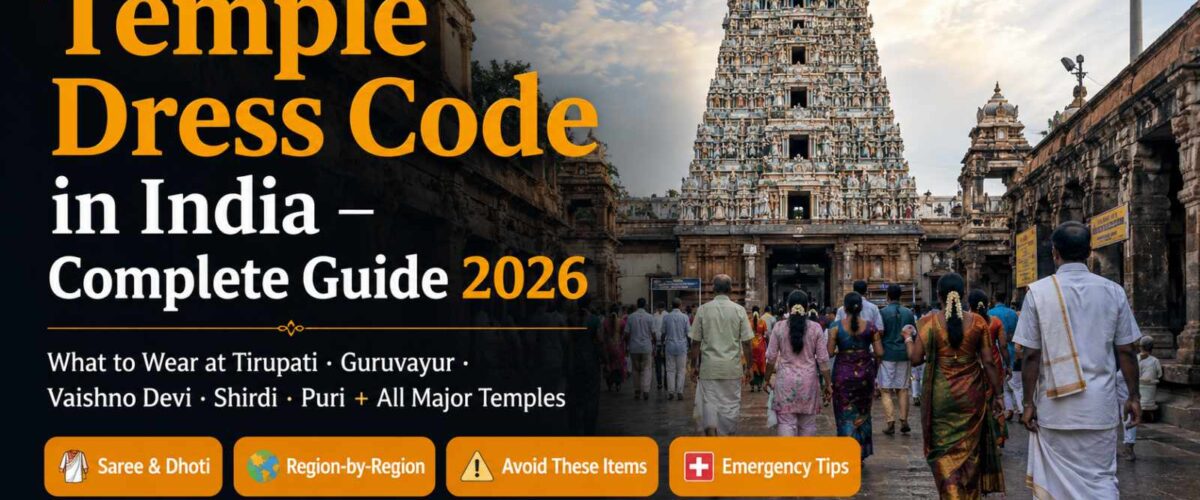
Temple Dress Code in India – Complete Guide for All Major Temples (Men & Women)
Written by Devendra Khambalkar
Nagpur, Maharashtra — personally visited 50+ temples including Guruvayur, Tirupati, Vaishno Devi, Somnath and completed Char Dham Yatra
What is the dress code for temples in India?
The general temple dress code in India requires: (1) Cover shoulders, chest, and knees — no tank tops, shorts, or mini-skirts for anyone. (2) Prefer traditional Indian clothing: saree or salwar kameez for women; dhoti/kurta or full trousers with shirt for men. (3) No tight or see-through clothes. (4) Remove footwear before entering. (5) South Indian temples have stricter rules — Guruvayur (Kerala) requires mundu for men and saree/salwar for women, no jeans. Tirupati requires full sleeves and traditional attire. North Indian temples like Shirdi and Vaishno Devi are relatively relaxed. Jeans are generally acceptable at North Indian temples if paired with a long kurta, but are often discouraged at strict South Indian temples.
I still remember the morning I stood at the entrance of the Guruvayur Temple in Kerala — temple dress code in India was the last thing I had thought about before that trip. I was wearing comfortable jeans and a full-sleeved shirt, feeling confident I had dressed ‘respectfully.’ The guard at the entrance politely pointed me back. No entry. My jeans, however modest, were simply not acceptable here. I had to change into a dhoti (mundu) available for rent near the temple — and honestly? Once I draped that simple white cotton cloth and walked into the magnificent inner sanctum, something shifted. The clothing was no longer a constraint. It became a ritual. It became humility made visible.
That experience changed how I think about temple dress code in India completely. The rules aren’t arbitrary inconveniences — they are ancient, deliberate preparations for the sacred encounter that awaits inside. Over years of visiting over 50 temples across India — from Tirupati’s chaotic morning queues to the whisper-quiet sanctum of Padmanabhaswamy, from the pilgrim streams of Vaishno Devi to the philosophical silence of Chidambaram — I have learned, sometimes the hard way, exactly what to wear and what not to. This complete guide to temple dress code in India is everything I wish someone had told me before my first big temple journey. Let it save you from the embarrassment I experienced — and more importantly, let it help you arrive dressed for the divine encounter.
From My Visit: At Tirupati, I saw a gentleman turned away from the darshan queue despite waiting 4 hours — he was wearing bermuda shorts. The staff were apologetic but firm. He had to walk back to the dharamshala, change, and rejoin. Don’t let this happen to you. Read this guide before you pack.
Table of Contents
- Why Temple Dress Code Exists — More Than Just Rules
- Universal Temple Dress Code Rules (All Temples, All India)
- Temple Dress Code for Women — Complete Guide
- Temple Dress Code for Men — Complete Guide
- Temple-by-Temple Dress Code — Major Temples of India
- Region-Wise Temple Dress Code — South vs North vs East vs West
- Colours to Wear (and Avoid) to Indian Temples
- What NOT to Carry Inside Temples
- Emergency Clothing Tips — What If You Arrive Unprepared
- FAQs — Temple Dress Code in India
1. Why Temple Dress Code Exists — More Than Just Rules
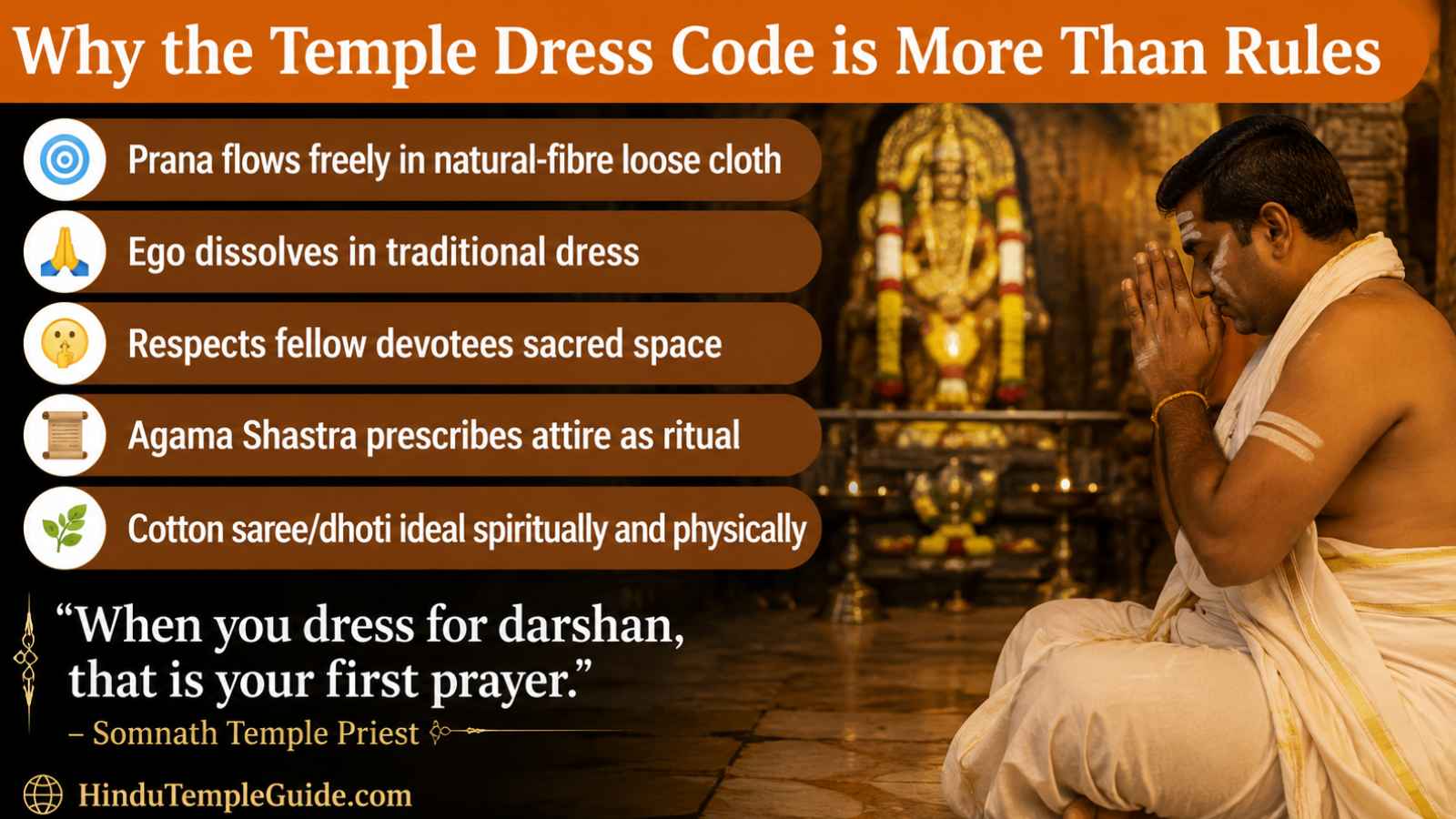
Before getting into the specifics, I want to share something that shifted my perspective during a conversation with a temple priest at Somnath. He said: “The temple is not a museum or a marketplace. It is a living energy field. What you wear is the first offering you make before you even touch the threshold.” That sentence stayed with me. Here is why the dress code matters:
- Prana flow: According to yogic philosophy, loose, natural-fibre clothing allows Prana (life energy) to circulate freely through the body. Tight jeans, synthetic fabrics, and constrictive clothing literally block the energetic reception of the divine darshan. Traditional clothes like dhoti and saree, made of cotton, are specifically designed for this purpose.
- Ego dissolution: Flashy, branded, or revealing clothing asserts the individual ego. Traditional dress — the same saree or dhoti worn by millions before you — dissolves individuality into the collective devotion. You stop being ‘you’ and become simply a devotee.
- Respect for others: Temples are places of concentrated faith for thousands of people simultaneously. Inappropriate clothing disturbs the meditative state of fellow devotees and disrespects the sacred atmosphere others have travelled far to access.
- Temple sanctity: Ancient Agama Shastra texts prescribe specific dress codes as part of the ritual framework that keeps the deity’s energy consecrated. Violating the dress code is considered a disruption of this sacred protocol.
- Seasonal + hygienic: Natural fibres like cotton and silk absorb sweat better, are cooler in temple environments, and dry more quickly after bathing at sacred ghats. They are also easier to remove and re-wear after floor-sitting and prostrations.
2. Universal Temple Dress Code Rules — These Apply Everywhere
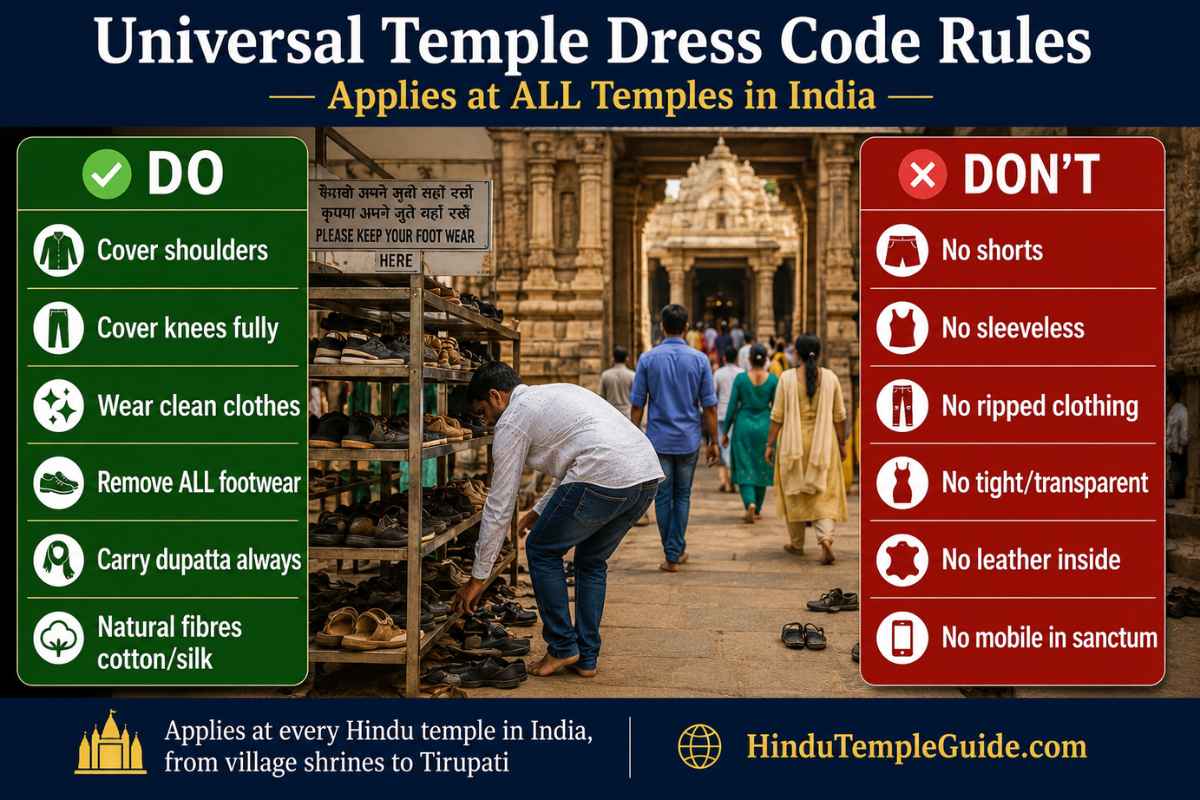
Whatever temple you are visiting, whatever state you are in — these rules apply universally across India:
| Rule | Why It Matters |
|---|---|
| ✓ Cover shoulders | Bare shoulders are considered immodest in temple tradition — affects both men and women |
| ✓ Cover knees fully | Shorts of any length are inappropriate. Trousers, saree, salwar, or ankle-length skirts only |
| ✓ No tight/transparent clothes | Body-hugging or sheer clothes are seen as distracting and disrespectful in a sacred space |
| ✓ Remove footwear | Remove shoes AND socks at the designated area. Socks are permitted inside many modern temples |
| ✓ Clean, washed clothes | Worn-yesterday or soiled clothes are considered ritually impure (ashudh) |
| ✓ No leather items on body | Leather belts, jackets, purses — all must be left outside or in cloakrooms |
| ✓ Head covering (where required) | Mandatory at Sikh Gurdwaras; recommended at dargahs; customary for women at many South Indian temples |
| ✗ No shorts | Never acceptable at any traditional Hindu temple, regardless of length |
| ✗ No sleeveless tops | Sleeveless kurtas, tank tops, spaghetti straps — not acceptable in most temples |
| ✗ No ripped/distressed clothing | Ripped jeans or torn fabric are explicitly prohibited — most famously at Puri Jagannath from January 2024 |
| ✗ No Western-only outfits at strict temples | Jeans + T-shirt not acceptable at Guruvayur, Padmanabhaswamy, Tirupati sanctum, and many South Indian temples |
From My Visit: I was at Vaishno Devi during a winter trek and worried about my thermal layers under traditional clothes. I discovered a practical tip: wear your thermals underneath a salwar kameez or a loose kurta. You stay warm, you stay appropriate. The temple staff at the bhawan won’t even know you have four layers underneath!
3. Temple Dress Code for Women — Complete Guide
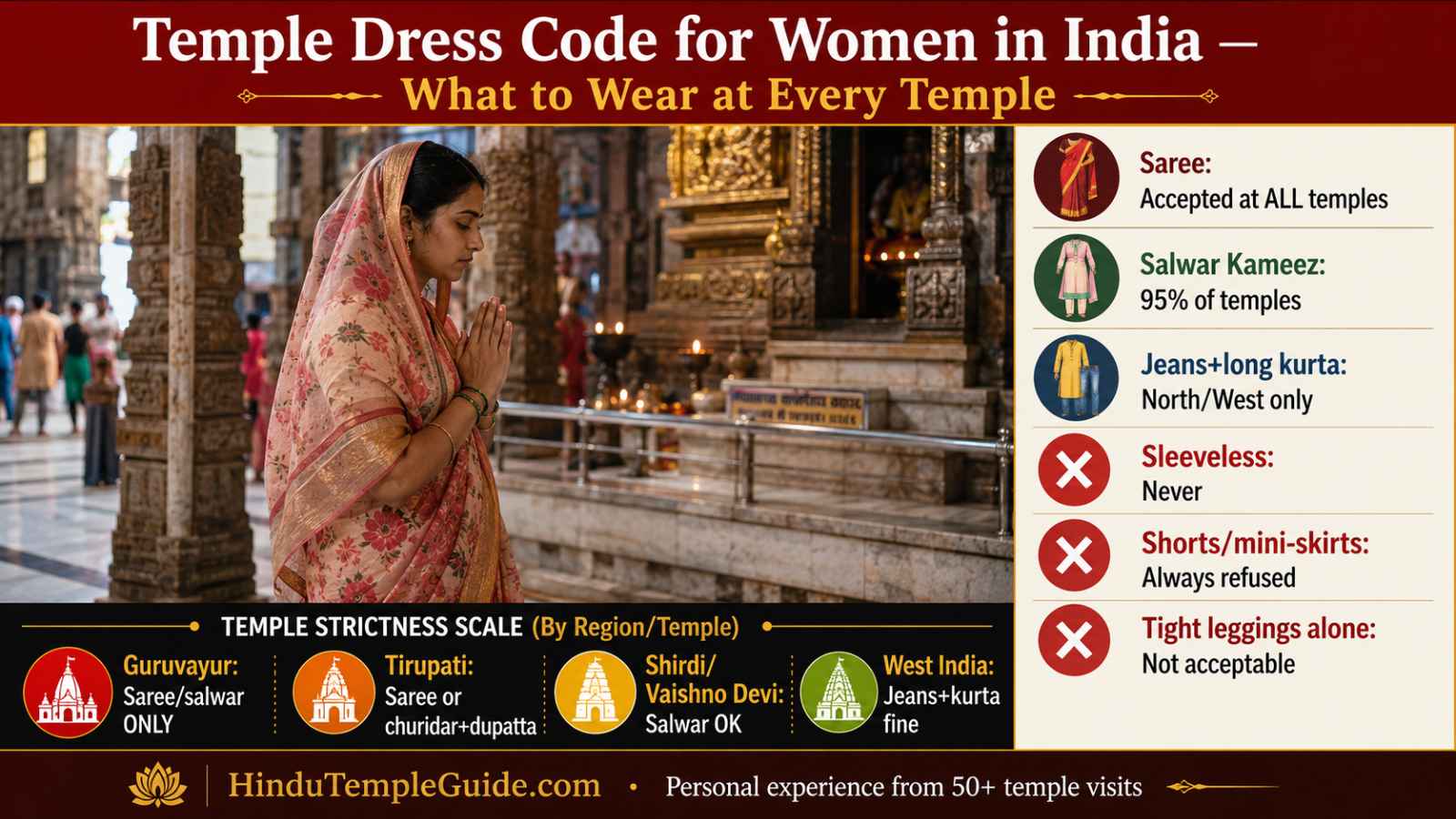
What should women wear to temples in India?
Women visiting Hindu temples should wear: (1) Saree — the most universally accepted and safest choice at all temples including the strictest ones. (2) Salwar kameez (churidar) with dupatta — acceptable at almost all temples except the most orthodox South Indian ones. What to avoid: sleeveless tops, shorts, mini-skirts, tight jeans (especially South Indian temples), low-cut or transparent blouses, crop tops. At Guruvayur (Kerala), jeans are not allowed even with a kurta. At Tirupati, saree/half-saree or churidar with dupatta is required. Leggings alone (without a long kurta covering the hips) are not acceptable anywhere.
Recommended Outfits for Women — By Temple Strictness
| Temple Category | Ideal Choice | Acceptable | Not Acceptable |
|---|---|---|---|
| Strict South Indian (Guruvayur, Padmanabhaswamy) | Saree (preferred) | Salwar kameez with dupatta | Jeans, shorts, leggings alone, sleeveless |
| Major South Indian (Tirupati, Meenakshi) | Saree or half-saree | Churidar with dupatta | T-shirts, shorts, Western casual |
| Major North Indian (Vaishno Devi, Shirdi) | Salwar kameez | Jeans + long kurta (knee-length) | Shorts, sleeveless, ripped jeans |
| East Indian (Puri Jagannath) | Saree or salwar kameez | Long modest dress | Shorts, ripped jeans, skirts, T-shirts |
| General North/West (Somnath, Dwarka) | Salwar kameez | Jeans + long kurta, long skirt | Shorts, sleeveless, crop tops |
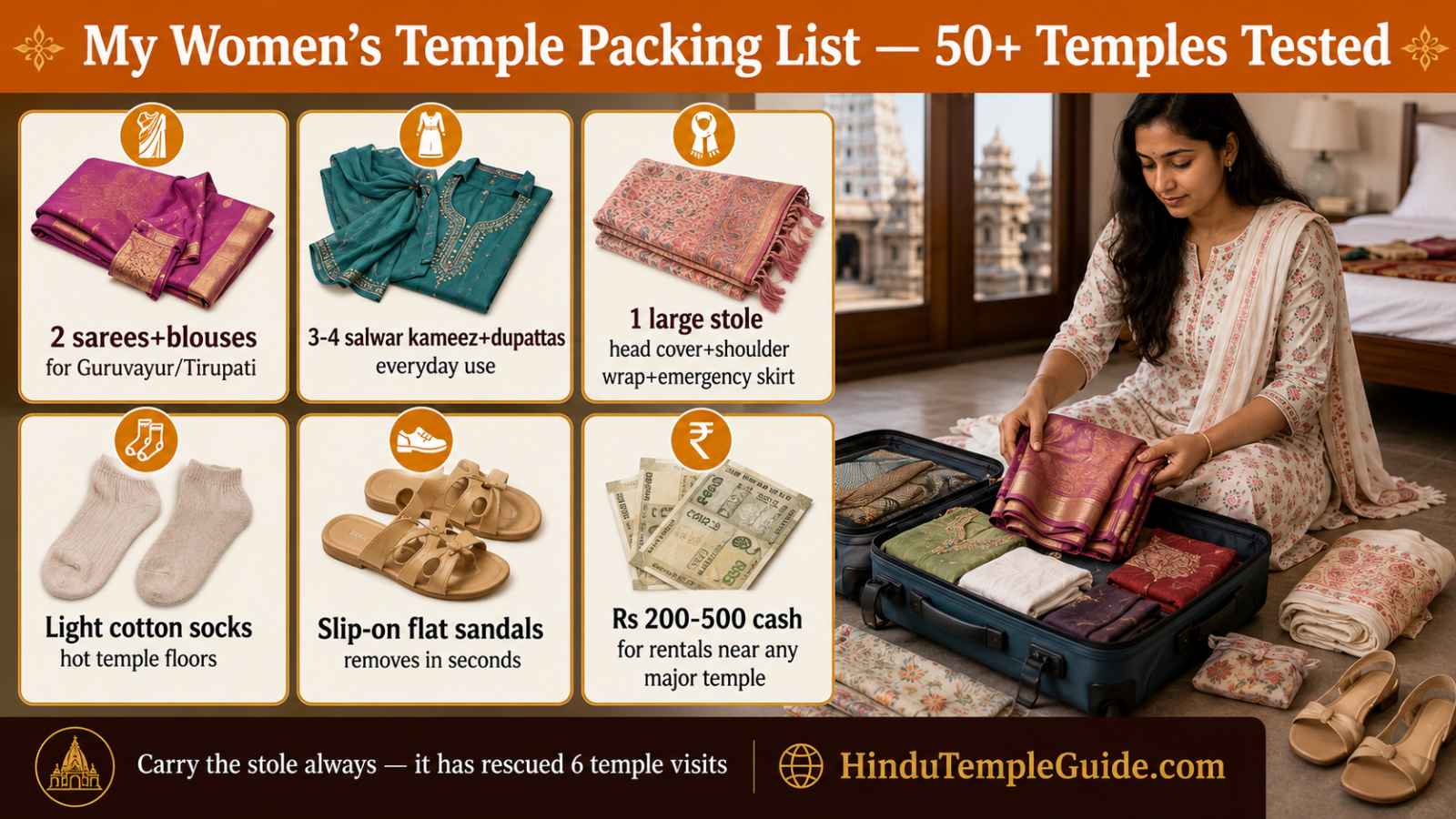
My Personal Packing List for Women on a Temple Tour
- 2 sarees with blouses + petticoat — for the strictest temples (Guruvayur, Padmanabhaswamy, Tirupati). Cotton or silk work best.
- 3–4 salwar kameez sets with dupattas — your everyday temple outfit across North India. Comfortable, traditional, completely acceptable.
- 1–2 long kurtas (knee-length or below) + palazzo or churidar — for a modern-traditional balance at relaxed temples.
- A large stole/dupatta — always carry one. It becomes a head covering, a shoulder wrap, or a waist wrap in an emergency.
- Light cotton socks — temple floors can be scorching in summer. Allowed inside most modern temples.
- Flat slip-on footwear only — sandals you can remove in seconds. Never laces or complex buckles that delay the queue.
From My Visit: At the Meenakshi Temple in Madurai, I arrived in a long kurta and leggings thinking I was fine. The guard asked me to get a waist cloth (available free at the temple) to wrap around my hips because leggings were considered form-fitting. Lesson: carry a large stole that can double as a lower-body wrap. It has saved me three times.
4. Temple Dress Code for Men — Complete Guide
What should men wear to temples in India?
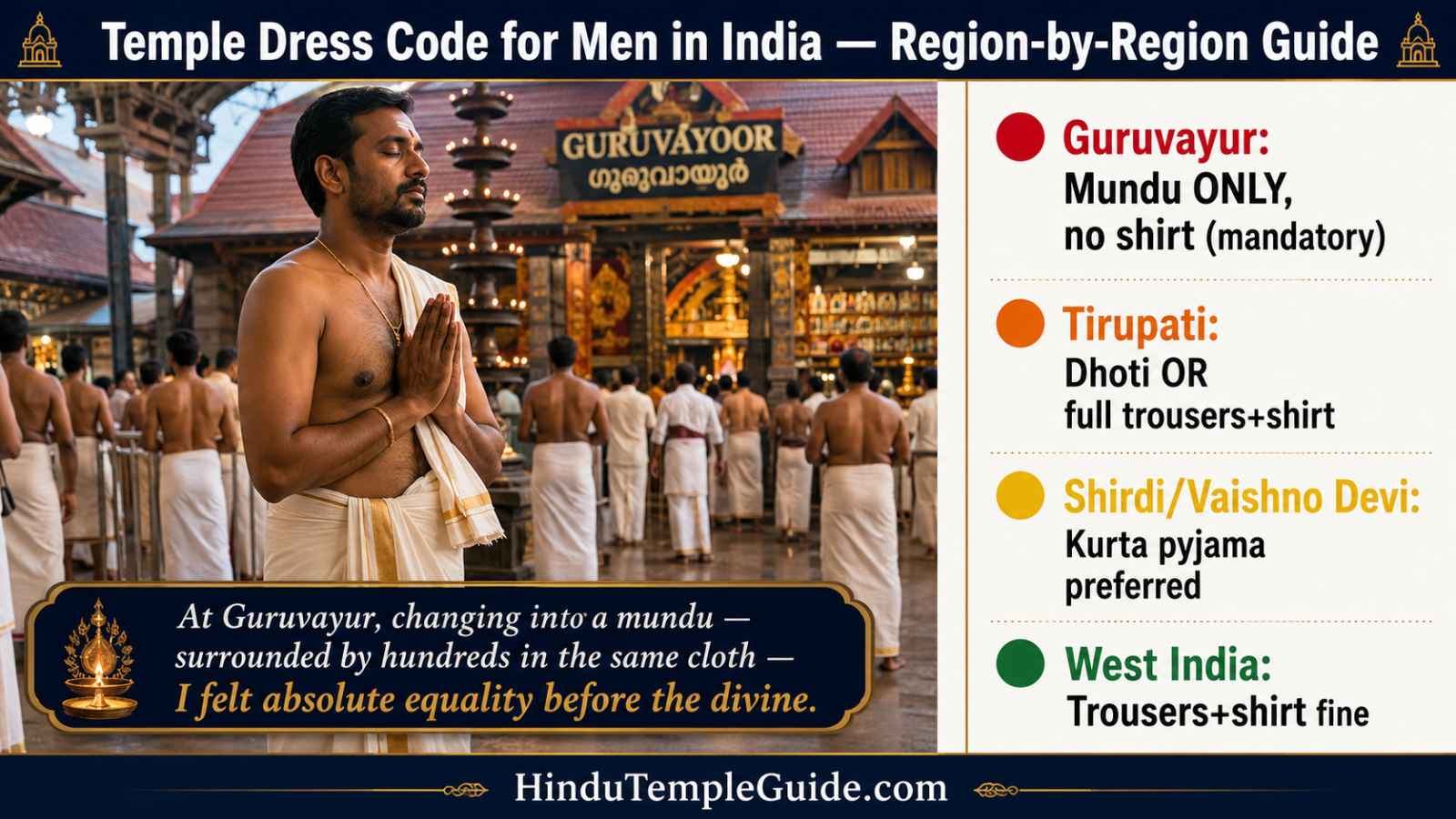
Men visiting Hindu temples should wear: (1) Dhoti/veshti — the most universally respected and accepted traditional lower garment. At Guruvayur Kerala, a mundu (white/cream dhoti) without shirt is mandatory. (2) Kurta + pyjama or full trousers — widely accepted across North India. (3) Full-length trousers + full-sleeve shirt — acceptable at Tirupati, Vaishno Devi, Shirdi, and most North/West Indian temples. What to avoid: shorts of any length, sleeveless vests/banyans, ripped jeans, half-pants, bermudas, printed lungis, and at Guruvayur — shirts are also not allowed (bare chest with mundu only).
Recommended Outfits for Men — By Temple Strictness
| Temple Category | Ideal Choice | Acceptable | Not Acceptable |
|---|---|---|---|
| Strict South Indian (Guruvayur) | Mundu (plain white/cream dhoti) · no shirt | Angavastram (cloth) over bare chest | Shirts, T-shirts, jeans, pants, shorts, printed lungi |
| Major South Indian (Tirupati, Meenakshi) | Dhoti + angavastram | Full trousers + shirt (preferably full-sleeve) | Shorts, half-sleeve vests, jeans alone |
| Major North Indian (Vaishno Devi, Shirdi) | Kurta pyjama | Full trousers + shirt, jeans + kurta | Shorts, banyans, sleeveless |
| East Indian (Puri Jagannath) | Dhoti + kurta | Trousers + shirt | Shorts, ripped jeans, bermudas |
| General temples (Somnath, Dwarka) | Kurta pyjama | Trousers + shirt, jeans + long kurta | Shorts, sleeveless, torn clothes |
From My Visit — Guruvayur: I arrived in neat trousers and a full-sleeve shirt. Politely turned away. I had to go to the dhoti rental stall near the entrance, pay a small amount (around Rs 20), drape the mundu in Kerala style with help from a kind local, and walk back in — this time bare-chested. It felt strange for about thirty seconds. Then, surrounded by hundreds of other men in the same simple cotton cloth, with the sound of the conch echoing from the inner sanctum, I felt something rare: absolute equality before the divine.
5. Temple-by-Temple Dress Code — India’s Major Temples
Dress code rules vary significantly from temple to temple. Here is the complete temple-specific guide based on my personal visits and verified official rules:
5.1 Tirupati Balaji (Sri Venkateswara) Temple, Andhra Pradesh
| Women | Men | |
|---|---|---|
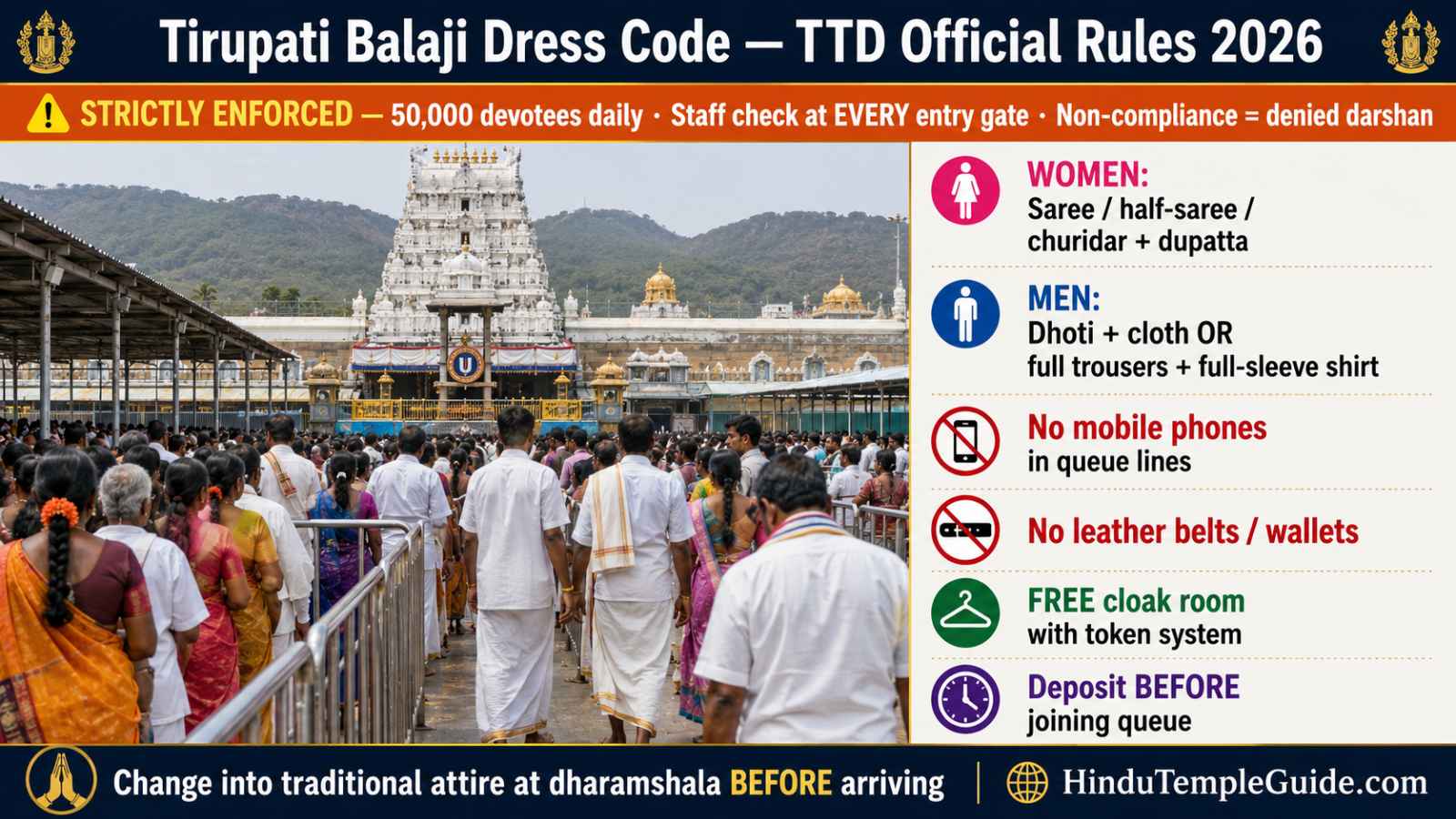
| Mandatory | Saree, half-saree, churidar/salwar kameez with dupatta | Dhoti + upper cloth (angavastram), OR full trousers + full-sleeve shirt |
| Prohibited | Western casual, shorts, mini-skirts, sleeveless, tight clothing | Shorts, sleeveless vests, half-pants, ripped jeans |
| Mobile phones | NOT allowed inside queue lines or sanctum — deposit at FREE cloakroom | |
| Leather | No leather belts, wallets, or purses inside | |
| Enforcement | STRICT — staff check at entry. 50,000+ visitors daily. Be prepared to be turned back. | |
From My Visit: The TTD has a cloakroom where you can deposit your mobile, bags, and leather items for free with a token. Do this BEFORE joining the queue — otherwise you lose your queue position.
5.2 Guruvayur Temple, Kerala — India’s Strictest Temple Dress Code
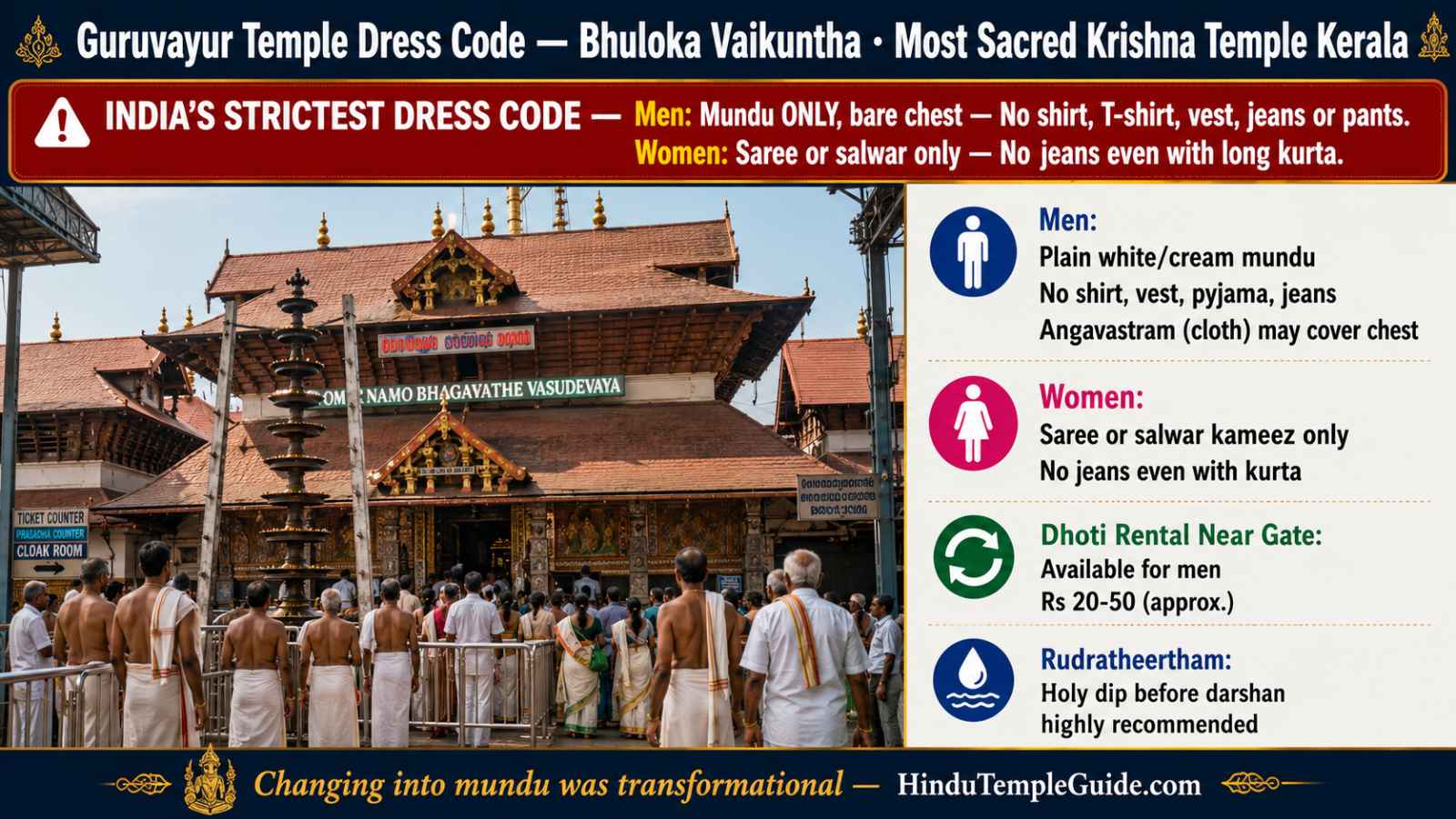
STRICTEST DRESS CODE IN INDIA: Men MUST wear mundu (plain white or cream cotton dhoti) and are NOT allowed to wear shirts, T-shirts, or vests of any kind. Women MUST wear saree or salwar kameez — jeans are strictly not allowed even if modest.
| Women | Men | |
|---|---|---|
| Mandatory | Saree or salwar kameez. No jeans even with kurta. | Plain white/cream mundu (dhoti). No shirt or vest of any kind. |
| Permitted extras | Angavastram (shoulder cloth) optional | Angavastram (small cloth) may cover chest |
| Rental available | Sarees for rent near temple entrance | Dhotis for rent near entrance — Rs 20–50 |
5.3 Vaishno Devi Temple, Jammu & Kashmir
The Vaishno Devi dress code is relatively relaxed — a blessing given the challenging 14-km trek to the bhawan.
- Women: Salwar kameez preferred. Jeans with a long kurta (knee-length minimum) are acceptable. No shorts or sleeveless.
- Men: Kurta pyjama preferred. Full trousers with shirt acceptable. No shorts.
- Winter note: Temperature can drop to -5°C. Wear thermals underneath your traditional attire — guards understand layering for warmth.
From My Visit: My trek to Vaishno Devi in January was genuinely cold — I wore thermal base layers under a kurta pyjama. At the bhawan, I removed my boots and walked in socks. The shrine board provides hot water to wash feet before the sanctum. Carry a warm shawl — you will need it when you sit for prasad outside. Jai Mata Di!
5.4 Shirdi Sai Baba Temple, Maharashtra
- Women: Salwar kameez strongly preferred. Modest jeans + full-sleeve top acceptable. No shorts, sleeveless, or revealing clothes.
- Men: Kurta pyjama or full trousers with shirt. Jeans acceptable. No shorts or sleeveless.
- Important: Check sai.org.in for updated dress code guidelines before visiting.
5.5 Puri Jagannath Temple, Odisha
From January 1, 2024, Puri Jagannath Temple implemented a formal dress code for all devotees:
- Prohibited: Shorts, ripped jeans, mini-skirts, T-shirts, Western casual.
- Men: Dhoti/gamcha or full traditional wear.
- Women: Saree or salwar kameez.
NON-HINDU WARNING: Non-Hindus (foreign nationals) are NOT permitted inside the main Jagannath Temple. This rule is strictly enforced.
5.6 Siddhivinayak Temple, Mumbai & Maharashtra Urban Temples
- Women: Saree or salwar kameez preferred. Modest jeans + long kurti acceptable. No shorts, no sleeveless.
- Men: Kurta or full trousers with shirt. Jeans + kurta fine.
- Practical note: No cameras, bags, or large metallic items. Mobile phones permitted only in outer temple areas, not inside the sanctum.
6. Region-Wise Temple Dress Code — South vs North vs East vs West
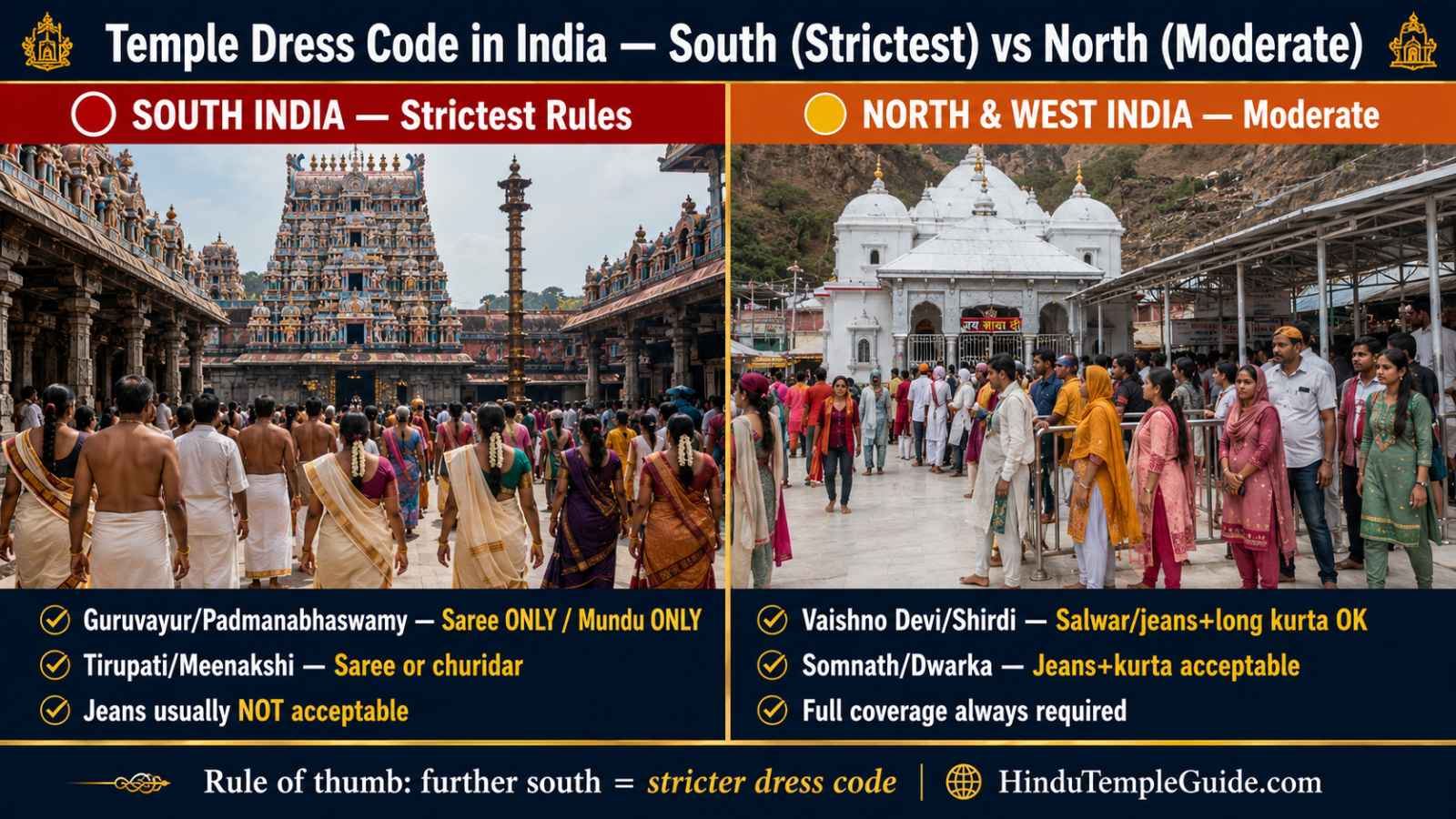
| Region | Strictness | Women: Recommended | Men: Recommended |
|---|---|---|---|
| South India (Tamil Nadu, Kerala, Andhra) | Strictest | Saree (mandatory at strictest) · Salwar kameez · No jeans at strict temples | Dhoti/veshti (mandatory at Guruvayur) · Full trousers + shirt · No shorts |
| North India (UP, Rajasthan, Punjab, HP) | Moderate | Salwar kameez preferred · Jeans + long kurta often acceptable · No shorts/sleeveless | Kurta pyjama preferred · Trousers + shirt · Jeans + kurta often fine |
| East India (Odisha, West Bengal) | Moderate | Salwar kameez or saree · No shorts/skirts/ripped jeans | Dhoti + kurta preferred · Full trousers + shirt acceptable |
| West India (Maharashtra, Gujarat) | Relaxed | Salwar kameez · Jeans + long kurta fine at most · No shorts/sleeveless | Kurta or trousers+shirt · Jeans + kurta acceptable |
| Jammu & Kashmir (Vaishno Devi, Amarnath) | Relaxed | Salwar kameez or comfortable trek wear · No shorts | Comfortable full-coverage trek wear · No shorts |
7. Temple Colours — What to Wear and What to Avoid
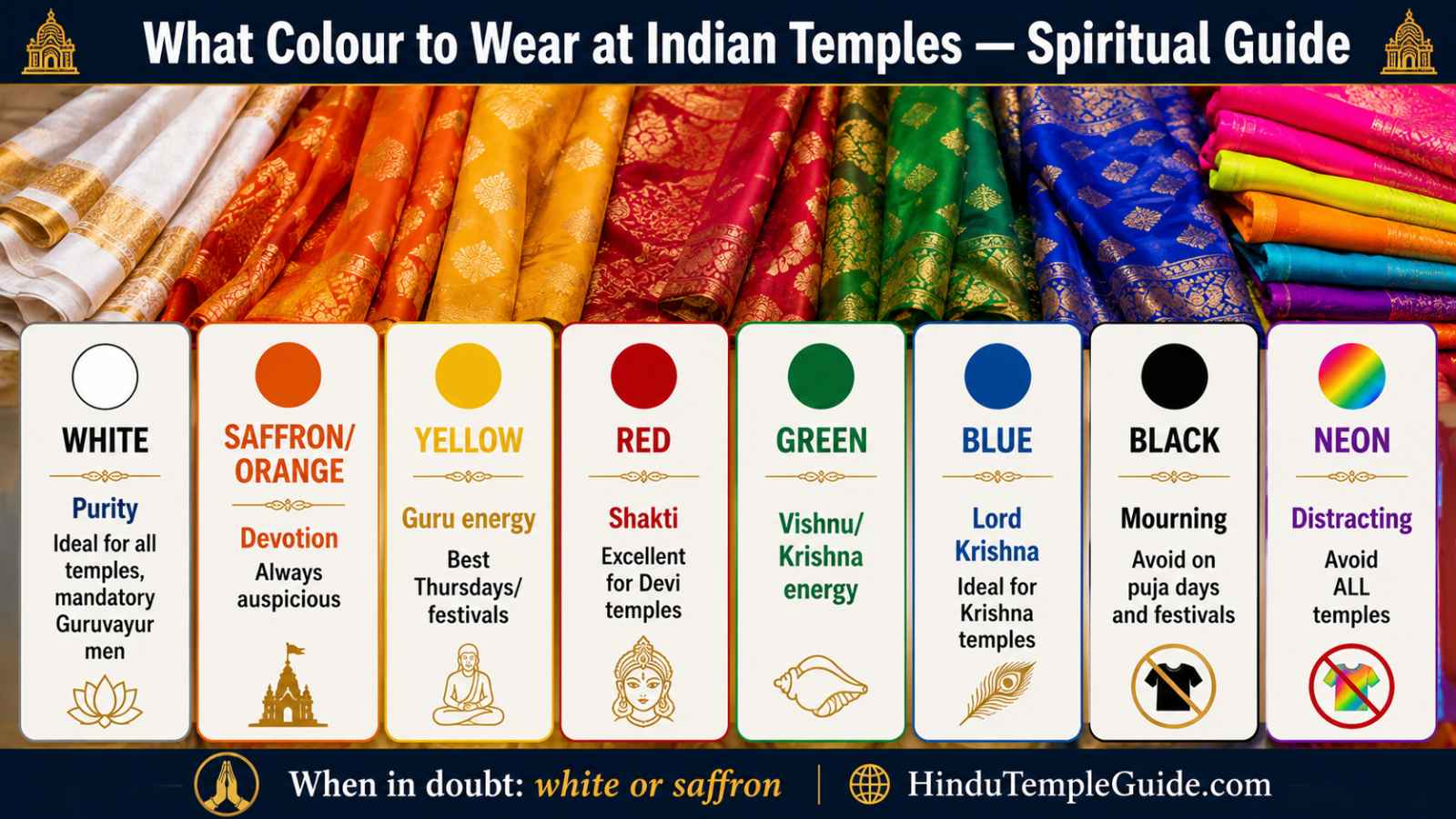
In my experience visiting 50+ temples, colour choice is not just aesthetic — it is spiritually significant:
| Colour | Significance | When to Wear / Avoid |
|---|---|---|
| White | Purity, peace, sattvic energy | Ideal for all temples · Mandatory at Guruvayur for men |
| Saffron/Orange | Devotion, spiritual fire | Highly auspicious · Excellent for all temple visits |
| Yellow | Auspiciousness, Guru energy | Excellent during festivals, especially on Thursdays |
| Red | Shakti, energy, auspiciousness | Excellent at Shakti temples (Ambaji, Vaishno Devi, Kamakhya) |
| Green | Nature, Vishnu/Krishna energy | Good for Vishnu and Krishna temples. Muted greens preferred |
| Blue | Krishna, calm, divine | Appropriate for Vaishnava temples |
| Black | Associated with mourning or Shani | Generally avoided during major puja days and festivals |
| Neon/bright synthetic | Distracting, associated with fashion | Best avoided at all temples |
8. What NOT to Carry Inside Major Temples
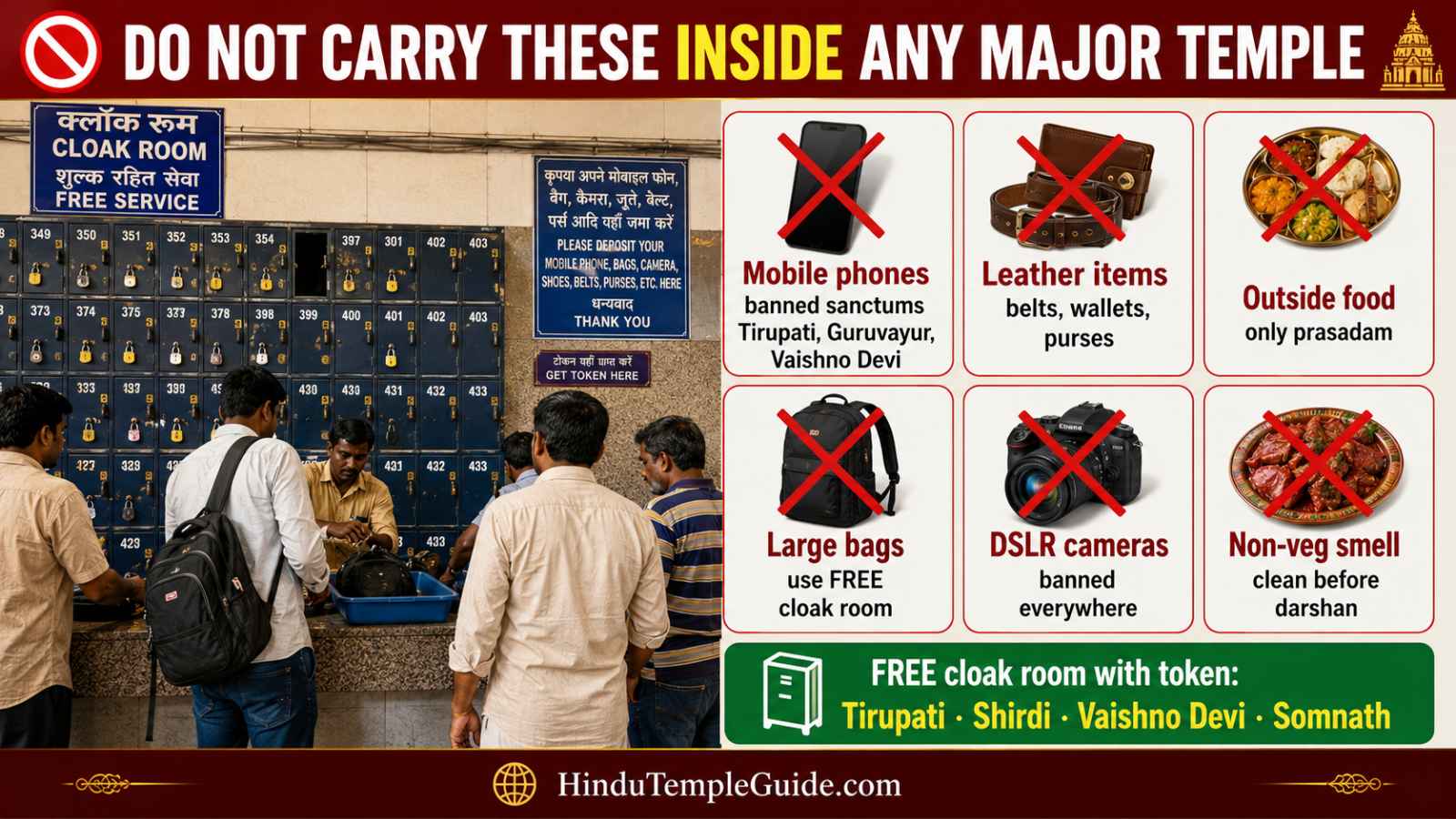
Temple dress code isn’t just about what you wear — it is also about what you bring. This is the section people most often overlook:
- Mobile phones: Photography is STRICTLY prohibited inside sanctums at almost all major temples. Tirupati, Guruvayur, Chidambaram, Padmanabhaswamy, and Vaishno Devi inner sanctum — NO mobile phones. Use the cloakroom.
- Leather items: Leather belts, leather wallets, leather purses — must be left outside or at cloakrooms. This includes leather shoes and bags.
- Food and water bottles: Most major temples prohibit bringing outside food. Purchase prasadam at the temple. Water bottles are usually accepted at entry but not inside the sanctum.
- Large bags/backpacks: Deposit at the free cloakroom. Security checks at Tirupati, Shirdi, Vaishno Devi, and Puri are thorough.
- Cameras/DSLRs: Professional cameras are strictly prohibited everywhere. Phone cameras are usually permitted only in outer temple areas, never in sanctums.
- Non-vegetarian food/smell: Arriving at a temple having consumed non-vegetarian food — especially at Vaishno Devi, Guruvayur, or Tirupati — is considered ritually inappropriate. Many pilgrims observe a day’s abstinence before major darshans.
9. Emergency Clothing Tips — Arrived Unprepared? Here Is What To Do
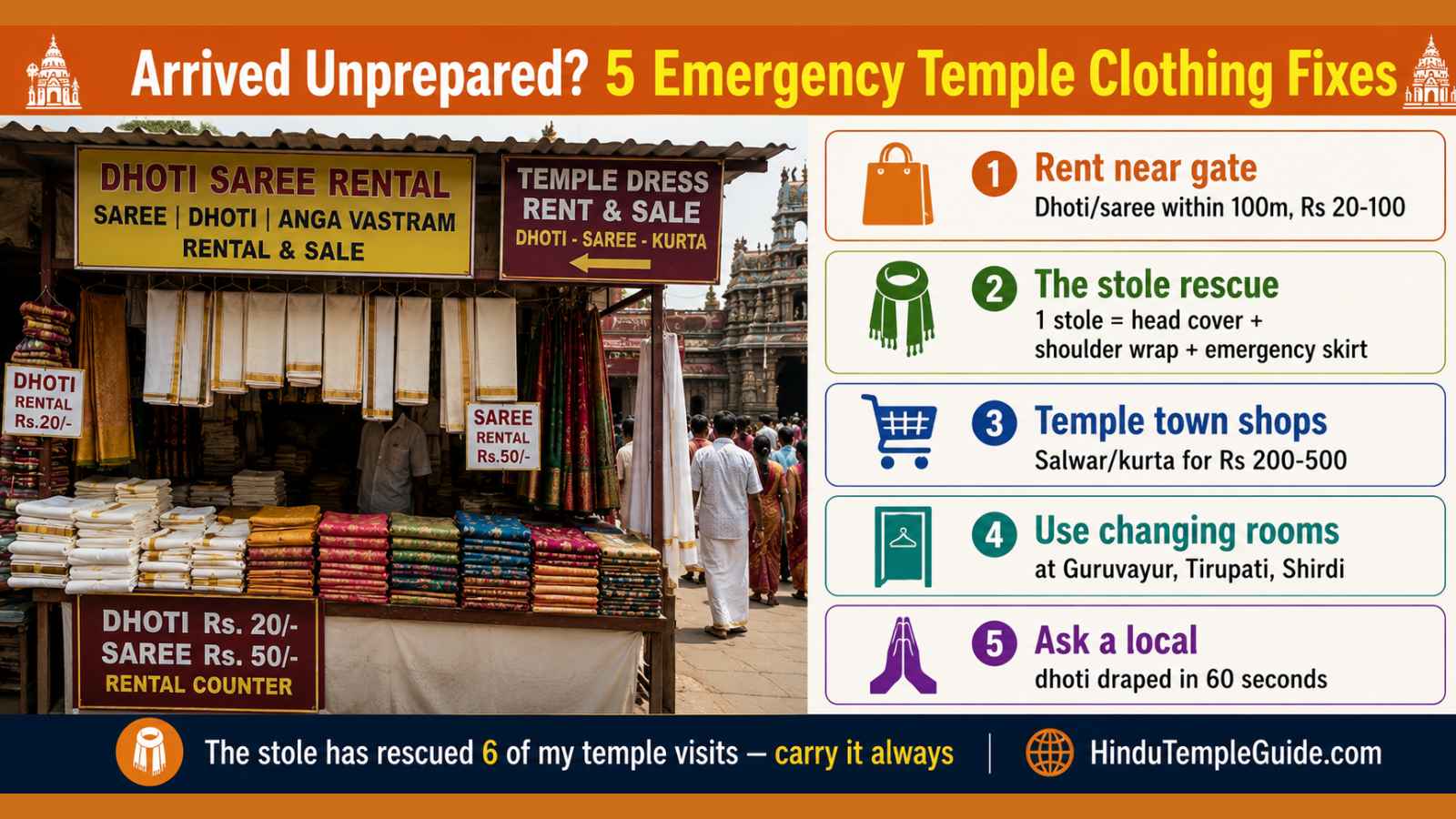
I have been caught out more than once with wrong temple clothing. Here is what actually works:
- Rent near the gate: Most major temples (Guruvayur, Tirupati, Puri, Vaishno Devi bhawan) have dhoti/saree rental stalls within 100 metres of the entrance. Prices: Rs 20–100. Always carry cash specifically for this.
- Buy from nearby shops: Temple towns always have clothing shops. A plain cotton salwar kameez or kurta costs Rs 200–500 and becomes your emergency temple kit.
- The stole rescue: Carry a large cotton/silk stole (dupatta) at all times. It can wrap around the waist as a skirt, cover the shoulders and head, or serve as a temporary lower wrap. This single item has rescued my temple visits at least six times.
- Changing rooms: Guruvayur, Tirupati, and Shirdi all have changing facilities near the entrance. Use them — locals who live near these temples are remarkably gracious about helping.
- The dhoti hack for men: Never worn a dhoti before? Ask any nearby male devotee or a temple assistant — they will help you drape it in under a minute.
From My Visit: At Padmanabhaswamy Temple in Thiruvananthapuram, I saw a foreign tourist couple arrive in jeans and T-shirts. They were politely redirected. They spent 20 minutes at a nearby shop — she in a yellow salwar kameez, he in a white dhoti. When they emerged from the sanctum an hour later, both were visibly moved. The clothing change was part of the transformation. This is exactly what the dress code is for.
10. FAQs — Temple Dress Code in India
Q1. Can I wear jeans to a temple in India?
It depends on the temple. Jeans are acceptable at many North and West Indian temples (Vaishno Devi, Shirdi, Somnath, Dwarka) when paired with a long kurta that covers the hips. However, jeans are strictly not allowed at Guruvayur (Kerala), certain Tamil Nadu temples, and are discouraged at Tirupati. At Puri Jagannath, ripped jeans are explicitly banned. The safest rule: if visiting any traditional Hindu temple, replace jeans with a salwar kameez or churidar. If you insist on jeans, pair with a knee-length kurta, keep the fit loose, and always carry a dupatta.
Q2. What is the dress code for temples in South India specifically?
South Indian temples have India’s strictest dress codes. The strictest is Guruvayur (men: mundu only, no shirt; women: saree or salwar, no jeans). Tirupati requires saree/half-saree/churidar for women and dhoti or full trousers+full-sleeve shirt for men — strictly enforced at 50,000 visitors daily. Generally, for any South Indian temple, wear a saree or salwar kameez (women) or dhoti/veshti or full trousers with shirt (men). Jeans, shorts, T-shirts, and sleeveless clothing are likely to get you turned away.
Q3. Do women need to cover their heads at Hindu temples?
Head covering is not universally mandatory at Hindu temples, unlike Sikh Gurdwaras (where it is absolutely required for everyone). However, covering the head is customary and respectful at many South Indian and Shaiva temples, especially during special puja sessions. Carrying a dupatta or stole that can serve as a head covering is the practical solution — use it when entering the inner sanctum or during aarti.
Q4. What should foreign tourists wear to Indian temples?
Foreign tourists are expected to follow the same temple dress code as Indian devotees — no exceptions are made for cultural unfamiliarity. Additionally, non-Hindus are not permitted inside the main sanctum of several temples including Puri Jagannath Temple and Padmanabhaswamy Temple. Sarees are available for hire near most major temples, and wearing one is genuinely recommended — it is the most accepted, most respectful, and most culturally immersive choice for any visitor.
Q5. Is there a dress code at Sabarimala Temple for Lord Ayyappa?
Yes — Sabarimala has one of India’s most distinctive temple dress codes. Devotees are required to wear specific clothing during the 41-day Mandala Deeksham vow period — specifically a blue or black lungi/mundu, the traditional Ayyappa pilgrim attire, along with the Tulasi or Rudraksha mala. The dress code and entry rules at Sabarimala are governed by the Travancore Devaswom Board — always check the official board website for current rules before planning a visit.
Q6. Are there different rules during festivals?
Yes — most temples enforce dress codes more strictly during major festivals like Navratri, Maha Shivaratri, Janmashtami, and Karthigai Deepam when crowds are massive and sanctity is paramount. Yellow clothing is auspicious on Thursdays and Ganesh Chaturthi; red is traditional at Navratri; white is preferred on Pradosham and Ekadashi days. Arriving in traditional Indian clothing during festivals is not merely respectful — it is the key to the most authentic, immersive darshan experience India has to offer.
Dress With Devotion — And the Temple Will Open Its Heart to You
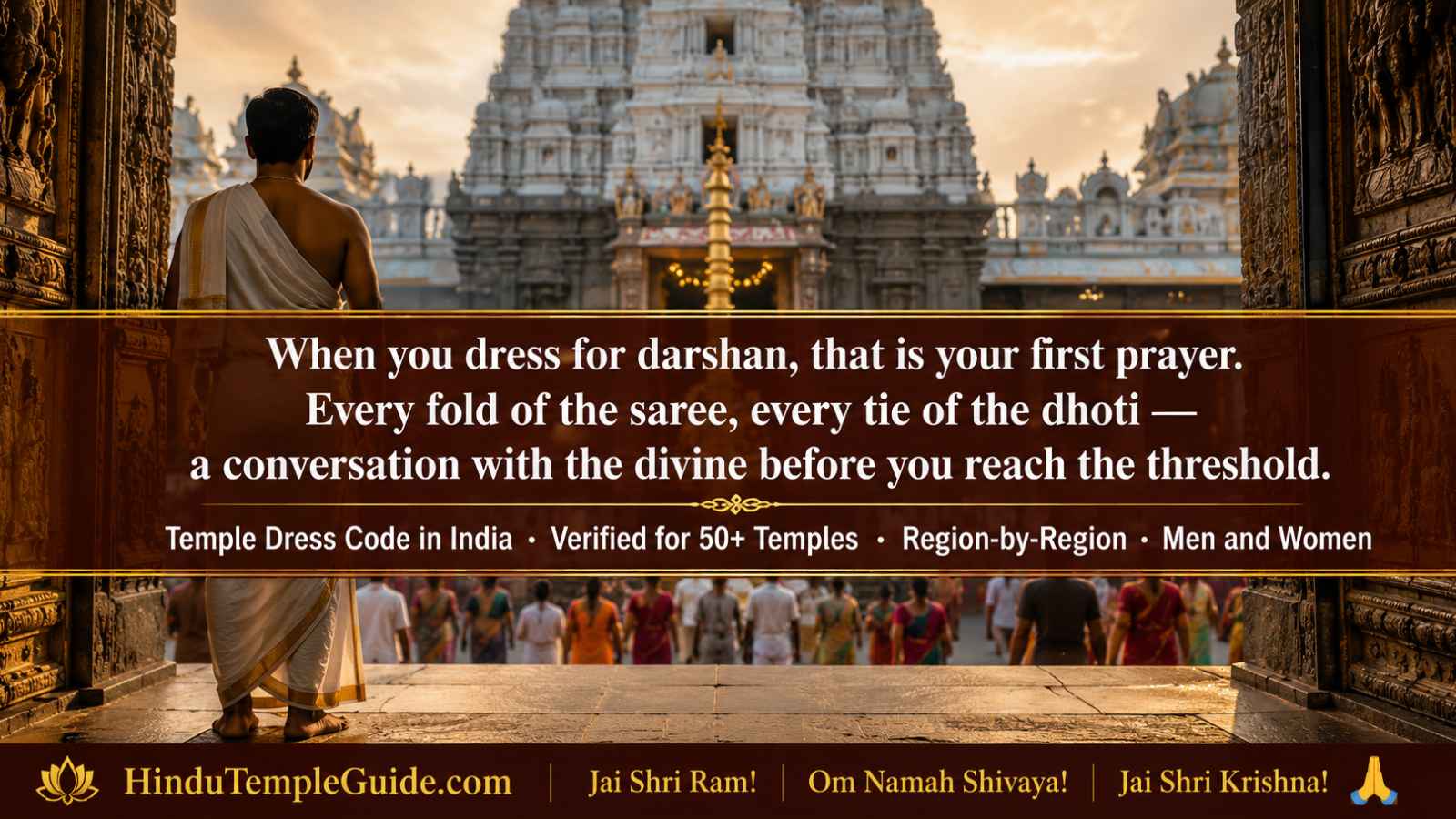
I once asked an elderly priest at Somnath why the dress code matters so much. He smiled and said: “Beta, when you get dressed for darshan, that is your first prayer. Every fold of the saree, every tie of the dhoti — that is your conversation with the deity before you even reach the sanctum.” I have never forgotten that.
The temple dress code in India is not about restriction — it is about preparation. It is about arriving at the divine threshold having already done the inner work that outer preparation represents. Your clothes are your intention made visible. Wear them with devotion, and the temple will meet you where you are.
If you have questions about what to wear at a specific temple, feel free to reach out directly — I read every message personally.
Jai Shri Ram! Om Namah Shivaya! Jai Shri Krishna!
— Devendra Khambalkar, Nagpur, Maharashtra
Plan Your Temple Visit — Read These Guides Next
Be prepared before you go — check timings, registration and travel info.
More Temple Planning Guides on HinduTempleGuide.com
Written by Devendra Khambalkar, Nagpur, Maharashtra | Last updated: April 2026. Sources: Tirupati TTD official (tirumala.org), Guruvayur Devaswom (guruvayurdevaswom.in), Shirdi Saibaba Sansthan (sai.org.in), official temple websites. Personal experiences are the author’s own. Temple rules may change — always verify on official temple websites before visiting.
You May Also Like



Leave a Comment
Your email will not be published. Required fields are marked *