
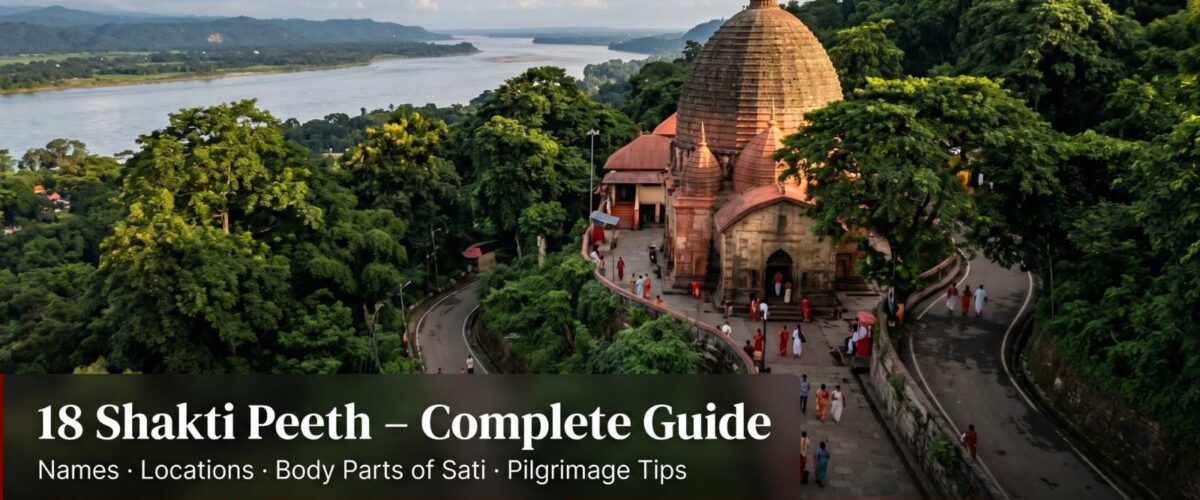
18 Shakti Peeth Temples – Complete Guide with Names, Locations, Body Parts of Sati & Pilgrimage Tips 2026
18 Shakti Peeth — Jai Mata Di! — these are not merely temples. They are the most powerful, most ancient, and most emotionally profound sacred spaces in the entire universe of the divine feminine. They are the places where the body of Goddess Sati herself became the earth — where the Supreme Mother, in her love for Lord Shiva, sacrificed herself, and where Lord Vishnu’s Sudarshana Chakra cut her body into sacred pieces that fell across the Indian subcontinent and beyond.
At every spot where a piece of Sati’s divine body touched the ground, the earth became charged with her Shakti — and a temple arose. These are the 18 Maha Shakti Peethas — the Astadasha Shakti Peetha — identified and codified by Adi Shankaracharya himself in his sacred Ashtadasha Shakti Pitha Stotram. This complete guide covers every essential detail for devotees and pilgrims — the complete Stotram, the divine origin story, all 18 temple names with locations, the three most sacred Peethas, detailed pilgrimage information for the most visited temples, and essential travel tips. Jai Mata Di!
Adi Shankaracharya’s definitive list — gold-standard for most pilgrims
Corresponds to the 51 letters of Sanskrit alphabet — most widely accepted full count
From the Brahmanda Purana — extended sacred list
Certain Puranic traditions — all 18 Maha Peethas are included in every larger list
Quick Navigation
Table of Contents
1Divine Story — Daksha Yajna & Birth of Peethas
2Adi Shankaracharya’s Stotram
3Complete List — All 18 Shakti Peeth
43 Most Sacred Peethas — Cosmic Triad
56 Most Visited Temples — Detailed Guide
6Pilgrimage Circuits — Plan Your Yatra
7Spiritual Significance & Blessings
8Pilgrimage Tips — Best Time & Dress Code
❓FAQs — 18 Shakti Peeth 2026
The Divine Story — Daksha Yajna, Sati’s Sacrifice & the Birth of the 18 Shakti Peeth
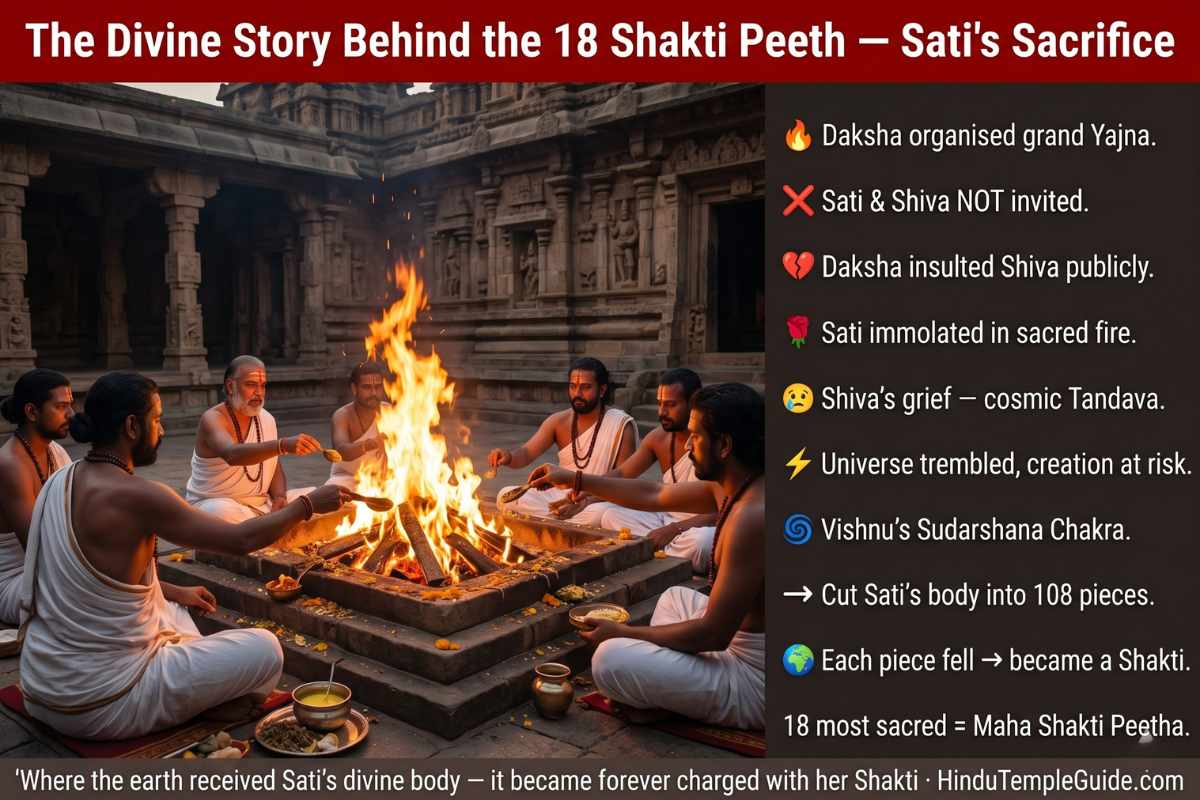
The origin of the 18 Shakti Peeth is one of the most heart-rending and devotionally significant stories in all of Hindu scripture — a story of a daughter’s love for her husband, a father’s arrogance, a wife’s ultimate sacrifice, and a universe saved from Shiva’s grief. In the beginning of this age, the beautiful and devoted Sati — daughter of King Daksha and first consort of Lord Shiva — defied her father to marry the ascetic Shiva, whom Daksha considered unsuitable. The marriage was a divine love story, but Daksha never forgave the insult.
When Daksha organised a grand Yajna (sacred fire ceremony) and deliberately did not invite Sati or Shiva — inviting every other god, king, and sage in creation — Sati went to the ceremony uninvited. There, before all assembled devas, Daksha publicly insulted Lord Shiva with the most degrading words. Sati, unable to bear this insult to her husband, immolated herself in the sacred Yajna fire. When the news reached Lord Shiva, his grief was beyond measure. He lifted Sati’s charred body from the fire and began his devastating Tandava — the cosmic dance of destruction. The entire universe trembled. Creation itself was at risk. The devas ran to Lord Vishnu in desperation.
Lord Vishnu, in his infinite compassion, launched his Sudarshana Chakra at Sati’s body as Shiva carried it — cutting it into pieces to separate Shiva from the object of his grief. The sacred pieces of Sati’s body fell at different locations across the Indian subcontinent — from Sri Lanka in the south to Kashmir in the north, from Assam in the east to Prayagraj in the west. At every spot where a piece of Sati’s divine body fell, the earth became charged with eternal Shakti — a temple arose, a presiding goddess manifested, and Lord Shiva appeared as Bhairava, the eternal guardian. These are the Shakti Peethas. Jai Mata Di!
Adi Shankaracharya’s Stotram — The Sacred Hymn of All 18 Shakti Peethas
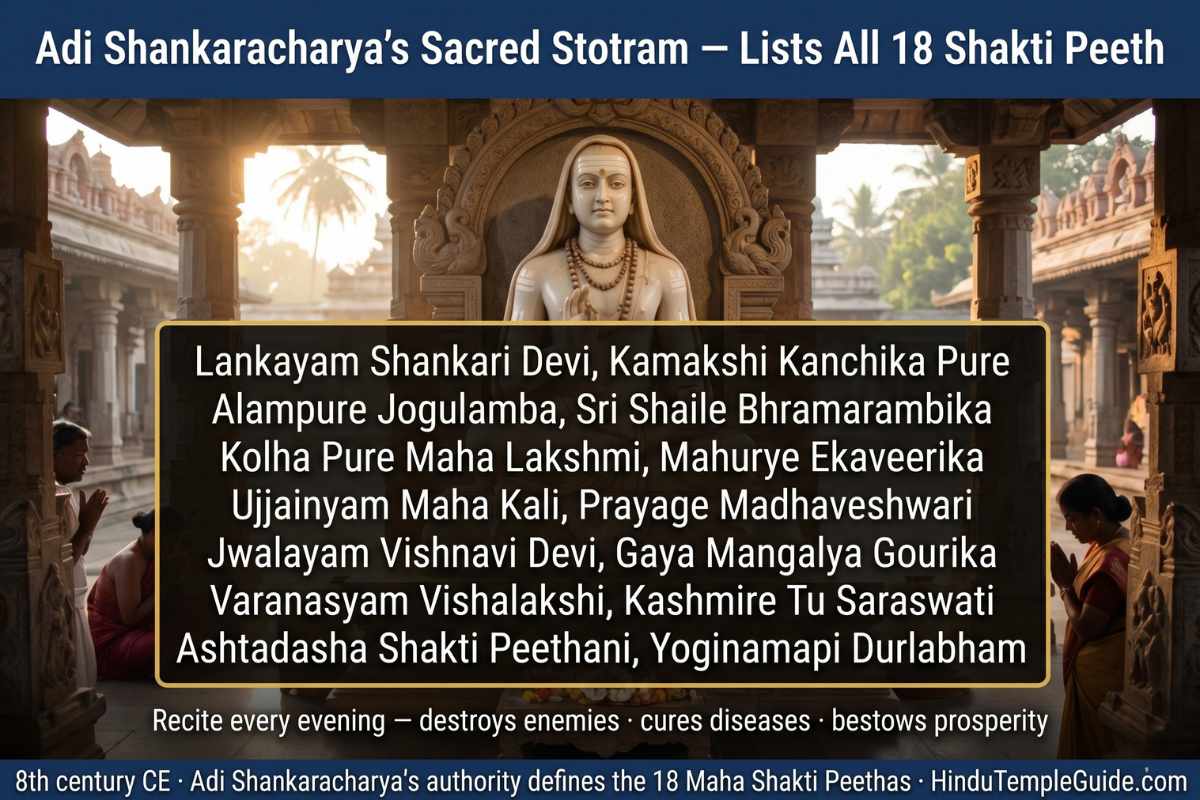
The 18 Shakti Peeth were defined for all posterity by Adi Shankaracharya (8th century CE) in his sacred Ashtadasha Shakti Pitha Stotram — a hymn of just four shlokas that names all 18 Peethas and their presiding goddesses. This hymn is said to:
Destroy all enemies
Cure all diseases
Bestow all prosperity
Grant liberation
Lankayam Shankari Devi, Kamakshi Kanchika Pure
Pradyumne Shrinkala Devi, Chamunda Krouncha Pattane
Alampure Jogulamba, Sri Shaile Bhramarambika
Kolha Pure Maha Lakshmi, Mahurye Ekaveerika
Ujjainyam Maha Kali, Peethikayam Puruhutika
Odhyane Girija Devi, Manikya Daksha Vatike
Hari Kshetre Kama Rupi, Prayage Madhaveshwari
Jwalayam Vishnavi Devi, Gaya Mangalya Gourika
Varanasyam Vishalakshi, Kashmire Tu Saraswati
Ashtadasha Shakti Peethani, Yoginamapi Durlabham
Sayamkale Pathennityam, Sarva Shatri Vinashanam
Sarva Roga Haram Divyam, Sarva Sampatkaram Shubham
Meaning: Goddess Shankari in Sri Lanka · Kamakshi in Kanchipuram · Shrinkala in Pradyumna · Chamunda in Mysore · Jogulamba in Alampur · Bhramaramba in Srisailam · Maha Lakshmi in Kolhapur · Ekaveerika in Mahur · Maha Kali in Ujjain · Puruhutika in Peethika · Girija in Odisha · Manikyamba in Daksha’s home · Kamarupa in Assam · Madhaveshwari in Prayag · Vishnavi in Jwalamukhi · Mangala Gauri in Gaya · Vishalakshi in Varanasi · Saraswati in Kashmir. These 18 abodes of Shakti are rare even to yogis.
Complete List of All 18 Shakti Peeth — Names, Locations & Sati’s Body Parts
The following authoritative table is based on Adi Shankaracharya’s Stotram and cross-referenced with the Devi Bhagavata Purana and Kalika Purana:
| # | Goddess (Shakti) | Location | State / Country | Sati’s Body Part | Bhairava (Shiva) |
|---|---|---|---|---|---|
| 1 | Shankari Devi | Trincomalee | Sri Lanka | Groin | Trikoneshwara |
| 2 | Kamakshi Devi | Kanchipuram | Tamil Nadu | Navel (back) | Ekambareshwara |
| 3 | Shrinkala Devi | Pandua / Hooghly | West Bengal | Stomach | Iswarayan |
| 4 | Chamundeshwari Devi | Mysuru (Chamundi Hill) | Karnataka | Head / scalp | Kapali/Krouncha |
| 5 | Jogulamba Devi | Alampur, Gadwal | Telangana | Upper teeth | Bala Brahma |
| 6 | Bhramaramba Devi Jyotirlinga | Srisailam | Andhra Pradesh | Neck | Mallikarjuna |
| 7 | Maha Lakshmi (Ambabai) | Kolhapur | Maharashtra | Eyes | Kapila |
| 8 | Ekaveerika / Renuka Devi | Mahur, Nanded | Maharashtra | Left hand | Chamara |
| 9 | Maha Kali Devi Jyotirlinga | Ujjain | Madhya Pradesh | Upper lip | Mahakal (Jyotirlinga) |
| 10 | Puruhutika Devi | Pithapuram, E. Godavari | Andhra Pradesh | Left hand (back) | Kukkuteswara |
| 11 | Girija Devi (Biraja) | Jajpur | Odisha | Navel | Jagannatha |
| 12 | Manikyamba Devi Jyotirlinga | Draksharamam, E. Godavari | Andhra Pradesh | Left cheek | Bhimeswara (Jyotirlinga) |
| 13 | Kamakhya Devi (Kamarupa) | Nilachal Hill, Guwahati | Assam | Womb / Yoni | Umananda |
| 14 | Madhaveshwari (Alopi Devi) | Prayagraj (Triveni Sangam) | Uttar Pradesh | Fingers | Someshwara |
| 15 | Jwalamukhi / Vaishnavi Devi | Jwalamukhi, Kangra | Himachal Pradesh | Tongue | Unmatta Bhairava |
| 16 | Mangala Gauri (Sarvamangala) | Gaya, Vishnupad complex | Bihar | Breasts | Hriyankar |
| 17 | Vishalakshi Devi | Meer Ghat, Varanasi | Uttar Pradesh | Earrings (Kundala) | Kala Bhairava |
| 18 | Sharada Devi (Saraswati) | Sharda, PoK Kashmir | Kashmir (PoK) | Right hand | Trayambaka |
Special Note — Where Jyotirlinga & Shakti Peeth Coincide (The Triple-Sacred Sites):
The 3 Most Sacred Shakti Peethas — Creation, Nourishment & Annihilation
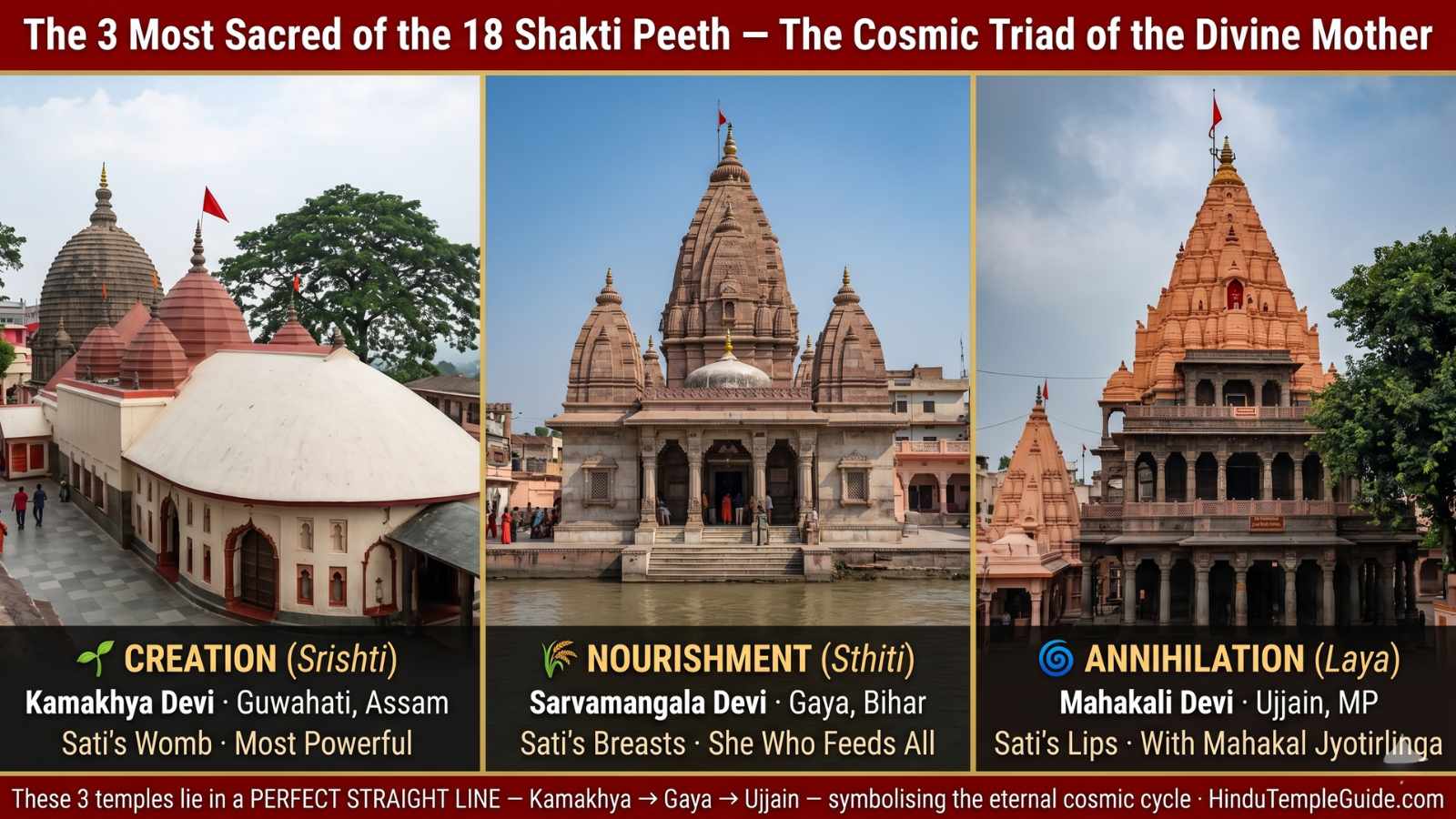
Sati’s womb and yoni (the creative organ of the universe) fell here. The sanctum has no idol — devotees worship a naturally formed yoni-shaped cleft in bedrock with an underground spring flowing through. Kamakhya represents Shakti in her most primal creative form.
Sati’s breasts — the symbol of nourishment, motherhood, and sustenance — fell here. Goddess Sarvamangala Devi — She Who Is Auspicious for All — is uniquely significant as Gaya is also sacred for pitru karma (ancestral rites).
Sati’s upper lip — the instrument of speech, mantra, and final dissolution — fell here, coinciding with the Mahakaleshwar Jyotirlinga. Mahakali embodies the annihilating aspect — the force that ends cycles, destroys evil, and grants liberation.
Six Most Visited 18 Shakti Peeth Temples — Complete Pilgrimage Guide
1. Kamakhya Temple, Guwahati, Assam
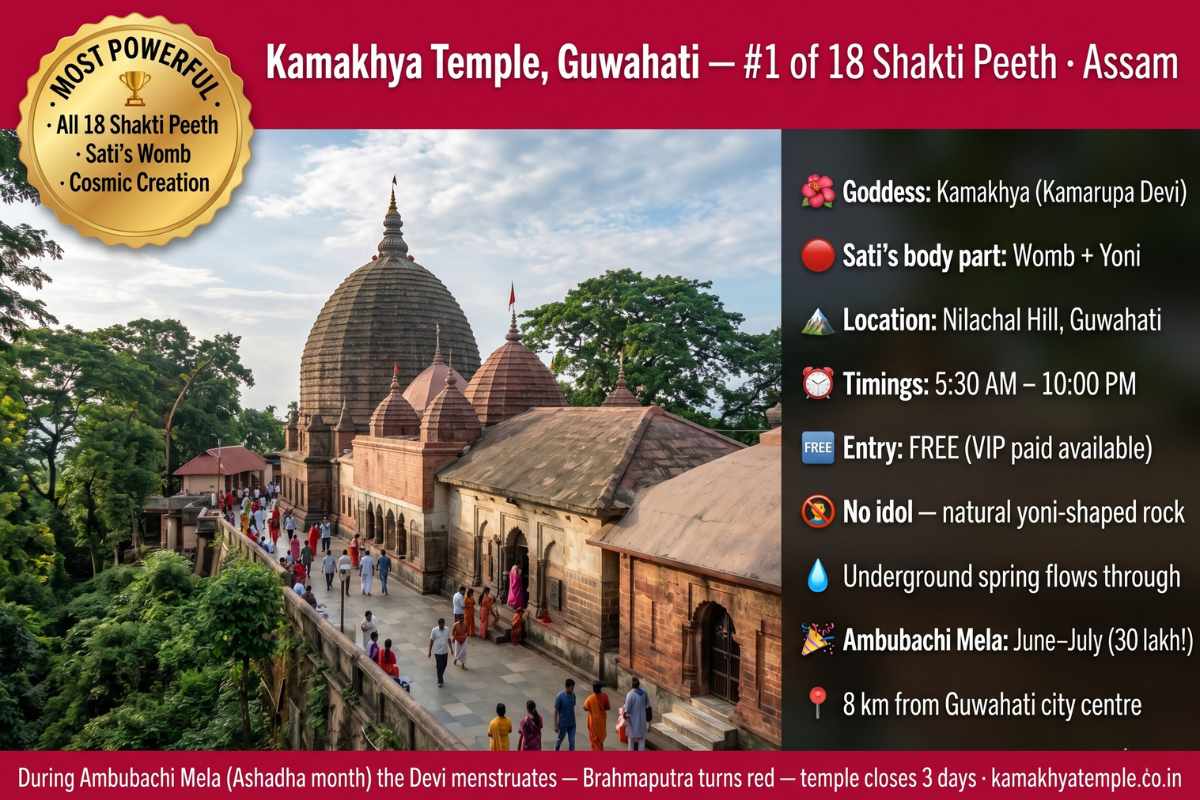
| Goddess | Kamakhya Devi (Kamarupa) — Divine creative energy |
| Sati’s Body Part | Womb and Yoni — most sacred of all Shakti Peethas |
| Timings | 5:30 AM – 10:00 PM daily (with afternoon break) |
| Entry | FREE general darshan · Paid VIP darshan available |
| Unique Feature | No idol — natural yoni-shaped cleft in rock · Underground spring flows through sanctum |
| Key Festival | Ambubachi Mela (June–July) — 30 lakh pilgrims · Temple closes 3 days · Brahmaputra said to turn red · Website: maakamakhya.org |
2. Jwalamukhi Temple, Kangra, Himachal Pradesh
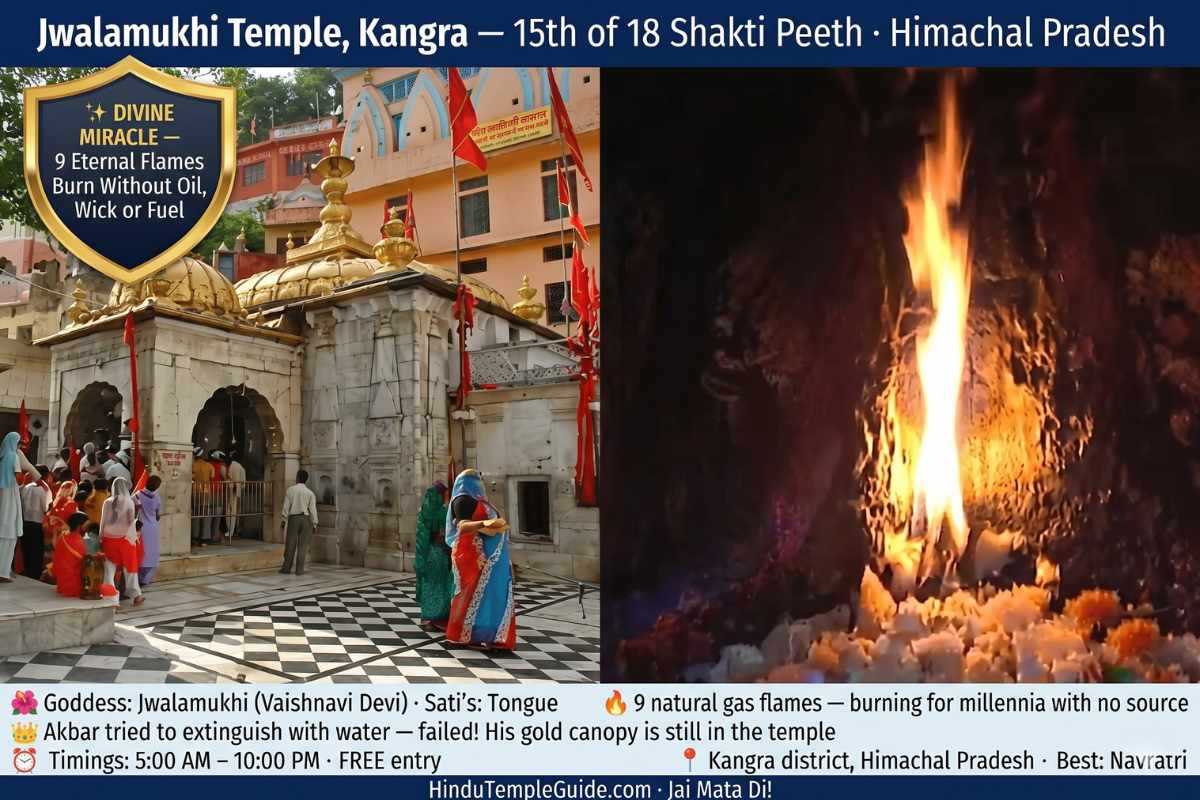
| Goddess | Jwalamukhi (Vaishnavi Devi) — manifest as eternal blue flames |
| Sati’s Body Part | Tongue — sacred seat of mantra, speech, and divine fire |
| Timings | 5:00 AM – 10:00 PM daily |
| Entry | FREE |
| Unique Feature | 9 eternal flames burning from underground — no idol, no oil, no wick. Natural gas flames. Akbar tried to extinguish with water and failed — his gold canopy gifted in awe is still in the temple |
| Best Time | Navratri (March–April and Sept–Oct) — spectacular crowds and energy |
3. Vishalakshi Temple, Varanasi, Uttar Pradesh
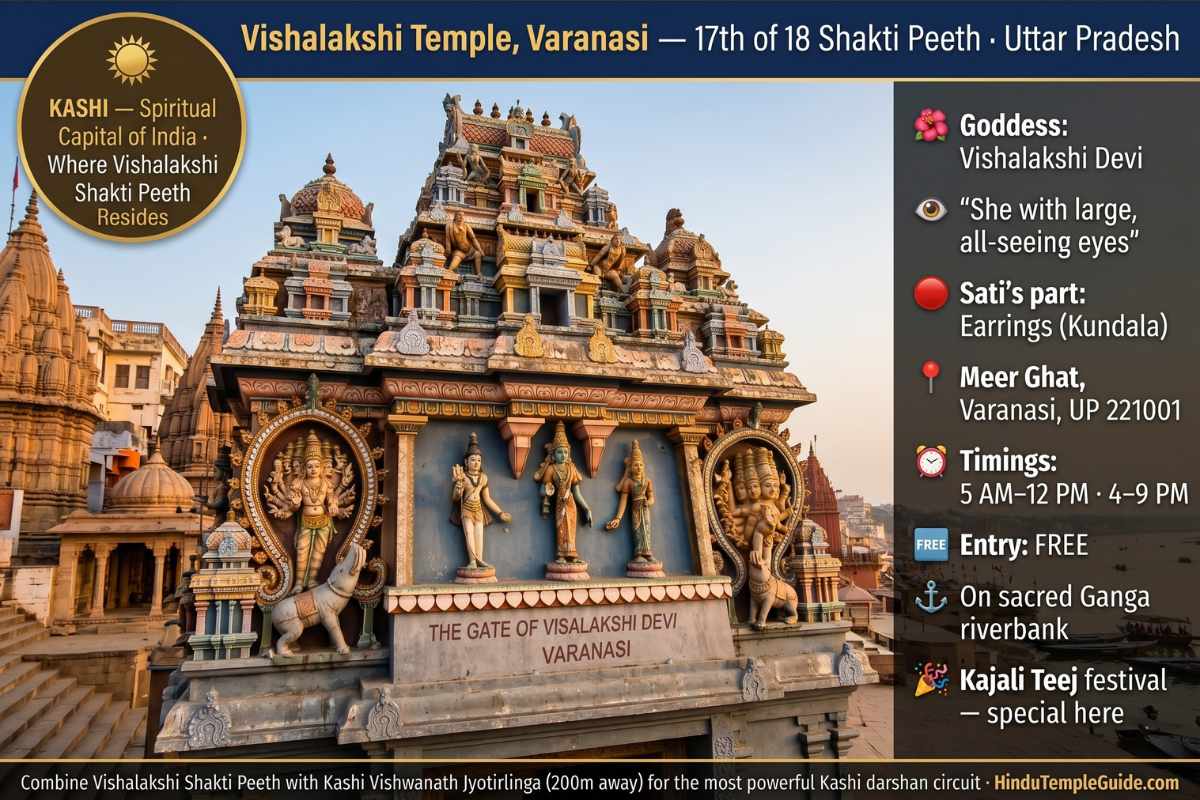
| Goddess | Vishalakshi Devi — ‘She with large eyes’ — divine all-seeing vision |
| Sati’s Body Part | Earrings (Kundala) |
| Timings | 5:00 AM–12:00 PM and 4:00–9:00 PM |
| Entry | FREE |
| Combine With | Located on sacred Ganges ghats at Meer Ghat · Kashi Vishwanath Jyotirlinga just 200m away — the ultimate Kashi Shakti-Shiva circuit |
4. Bhramaramba Devi, Srisailam, Andhra Pradesh
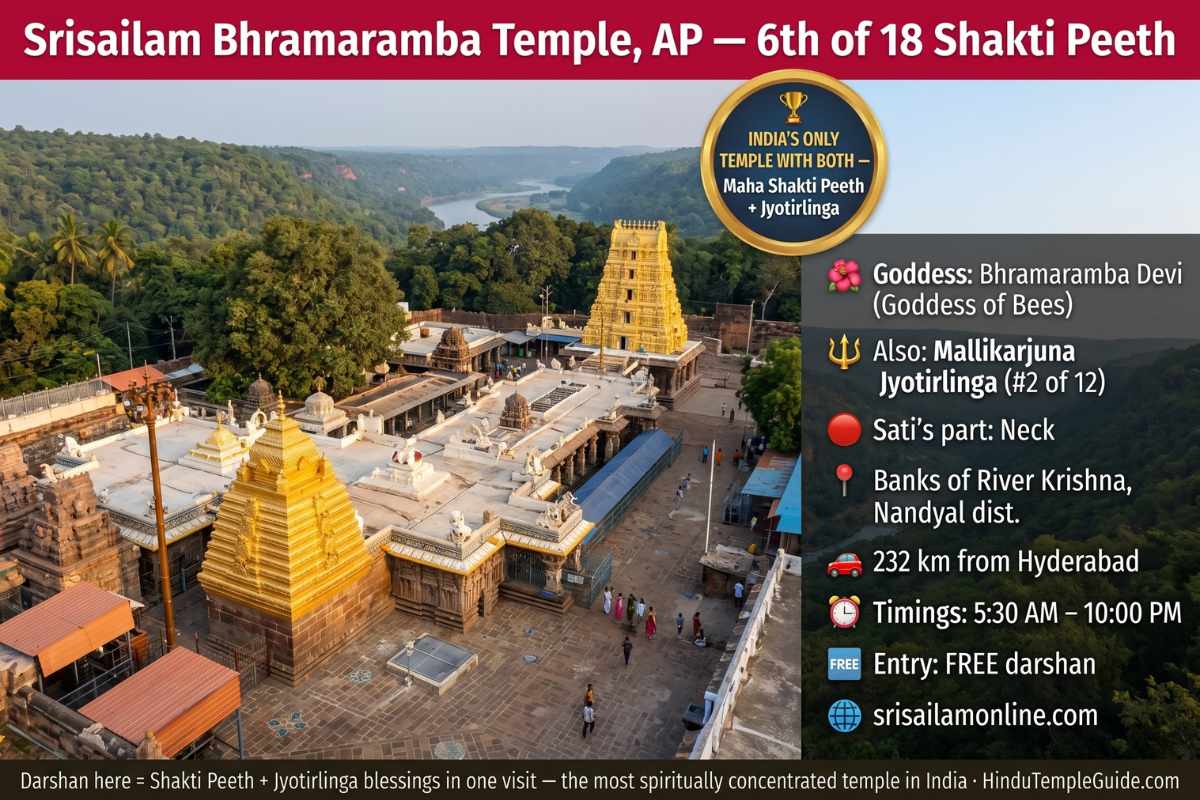
| Goddess | Bhramaramba Devi — ‘Goddess of Bees’ — primal energy |
| Sati’s Body Part | Neck |
| Unique Feature | The ONLY temple in India combining BOTH a Maha Shakti Peeth AND a Jyotirlinga (Mallikarjuna) |
| Entry | FREE darshan · Paid sevas available |
| Website | srisailadevasthanam.org · 232 km from Hyderabad |
5. Mahalakshmi Temple (Ambabai), Kolhapur, Maharashtra
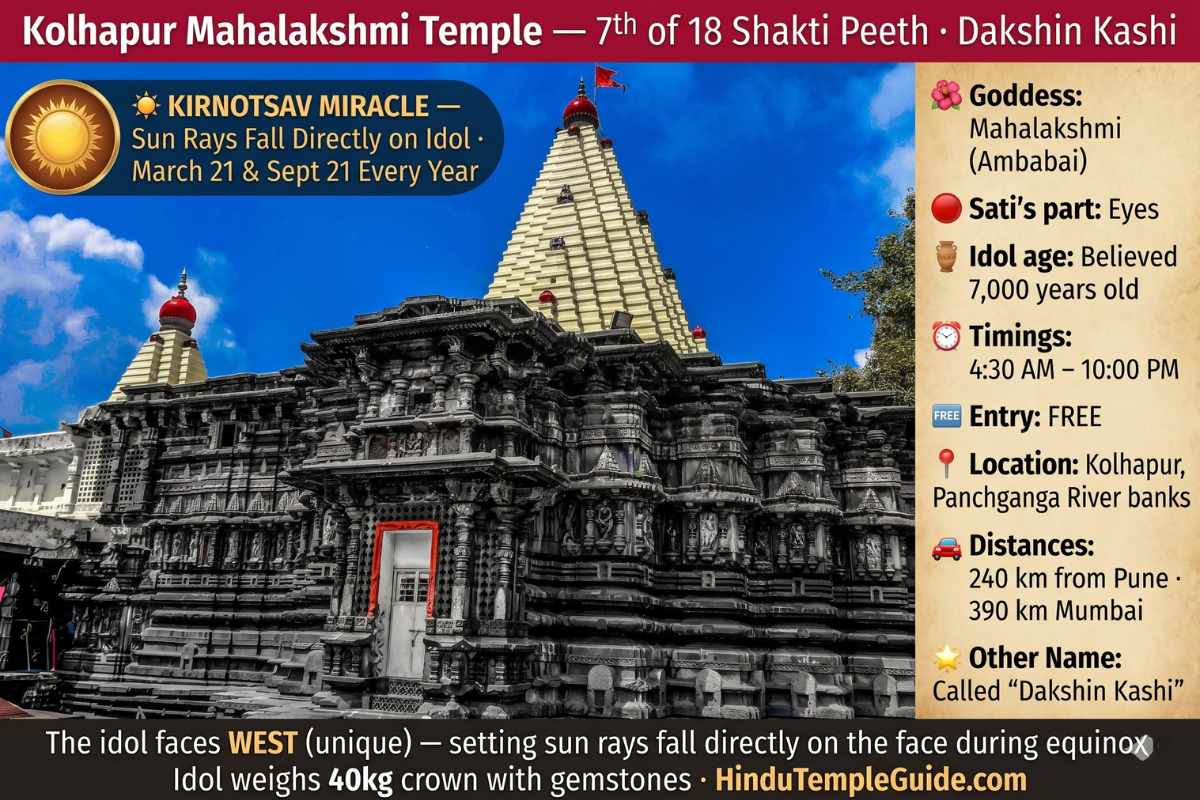
| Goddess | Mahalakshmi (Ambabai) — Goddess of wealth, prosperity and good fortune |
| Sati’s Body Part | Eyes |
| Timings | 4:30 AM – 10:00 PM (with breaks) |
| Unique Features | Idol believed to be 7,000 years old · Kirnotsav: direct sunrays fall on idol at equinox (March 21 & Sept 21) each year · Called ‘Dakshin Kashi’ · Idol faces west (unique in India) |
| Distance | 240 km from Pune · 390 km from Mumbai · On banks of Panchganga River |
6. Chamundeshwari Temple, Mysuru, Karnataka
| Goddess | Chamundeshwari (Durga Mahishasuramardini) — victorious warrior goddess |
| Sati’s Body Part | Head / scalp (Krouncha Pattane) |
| Timings | 7:30AM–2PM · 3:30–6PM · 7:30–9PM |
| Unique Feature | State deity of Karnataka · Presiding deity of Mysore Wadiyar Royal family · 1,008-step stone stairway from base |
| Best Festival | Mysore Dasara (Navratri) — world-famous golden procession witnessed by millions · 145 km from Bengaluru |
Shakti Peeth Pilgrimage Circuits — Planning Your 18 Shakti Peeth Yatra
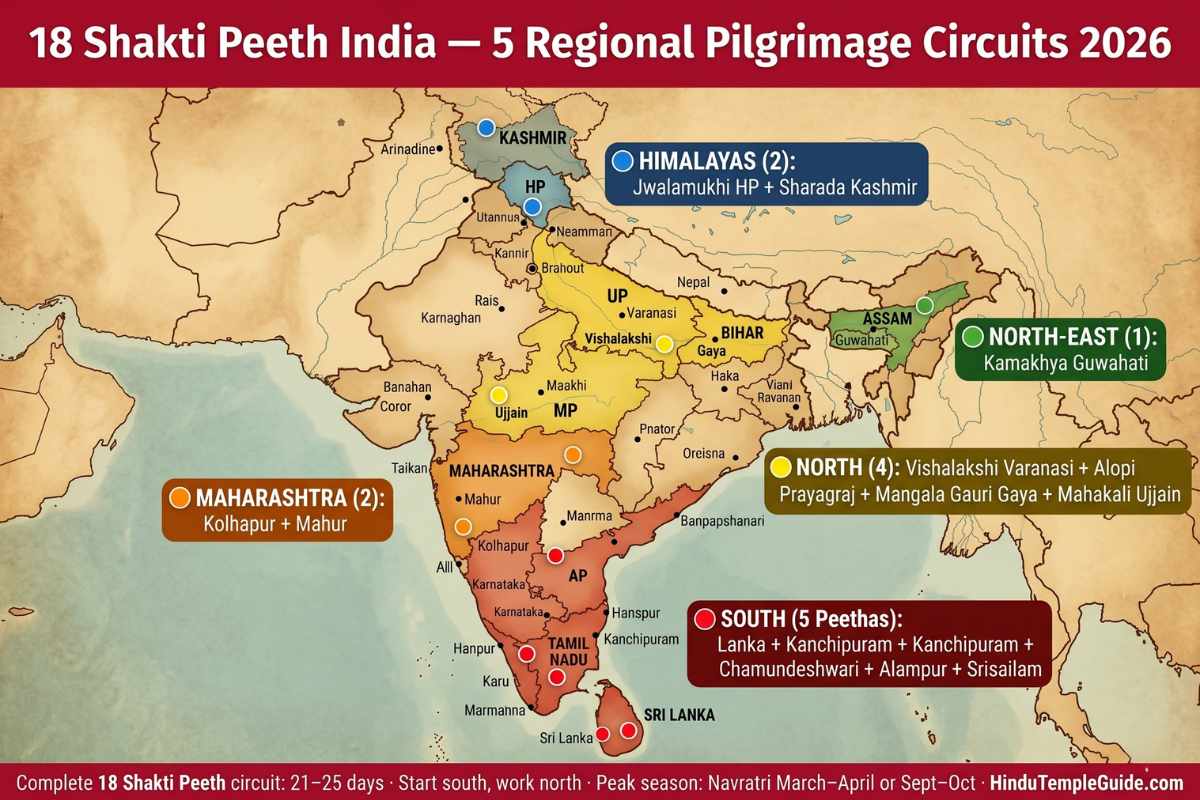
While completing all 18 Shakti Peethas in a single journey is a rare and extraordinary achievement, most devotees plan regional circuits across multiple trips. Here are the practical circuits:
| Circuit | Temples Included & Practical Details |
|---|---|
| South India (5 Peethas) | Shankari (Sri Lanka) + Kamakshi Kanchipuram + Chamundeshwari Mysore + Jogulamba Alampur + Bhramaramba Srisailam · 8–10 days from Chennai/Hyderabad |
| Maharashtra (2 Peethas) | Mahalakshmi Kolhapur + Renuka/Ekaveerika Mahur · 2 days from Pune/Mumbai |
| North India (4 Peethas) | Vishalakshi Varanasi + Madhaveshwari Prayagraj + Mangala Gauri Gaya + Mahakali Ujjain · 5–7 days from Delhi/Lucknow |
| Himachal + Assam (2 Peethas) | Jwalamukhi Kangra HP + Kamakhya Guwahati Assam · 5-day standalone or add to North India trip |
| Odisha + Andhra (3 Peethas) | Biraja/Girija Jajpur Odisha + Manikyamba Draksharamam + Puruhutika Pithapuram AP · 3–4 days from Bhubaneswar |
| Complete 18 Shakti Peeth Yatra | Minimum 21–25 days India travel + 2–3 days Sri Lanka · Start from South, work clockwise. Peak season: Navratri (March–April and September–October) |
Spiritual Significance — What Visiting a Shakti Peeth Bestows
The spiritual power of the 18 Shakti Peethas is described in the Devi Bhagavata Purana, Kalika Purana, and Tantrachudamani in terms that make these shrines absolutely unlike any ordinary temple. According to ancient scripture and the unbroken tradition of crores of devotees across millennia:
Pilgrimage Tips — Best Time, Dress Code & Practical Advice
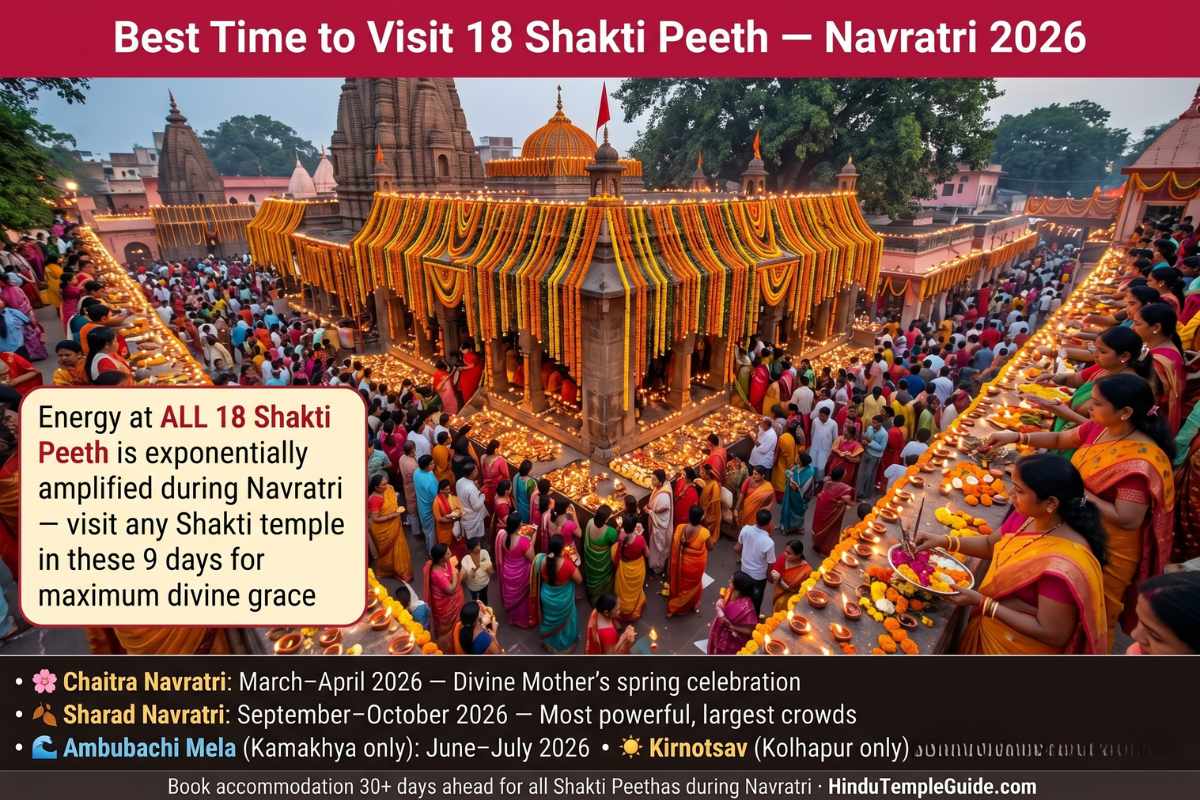
- Navratri (Chaitra & Sharad) — both Navratris are ideal for ALL 18 Shakti Peethas
- Ambubachi Mela (June–July) — specifically for Kamakhya, Guwahati
- Kirnotsav (March 21 & Sept 21) — specifically for Kolhapur Mahalakshmi
- Everyday — all 18 Peethas are perpetually charged with divine energy
- Women: Saree or salwar-kameez with dupatta — dress with reverence
- Men: Dhoti or full trousers with kurta — several South India temples require traditional dress
- No leather: Shoes, belts, wallets at entry counters — inauspicious at Shakti shrines
- Non-Hindus: Outer premises open at most; inner sanctum typically for Hindus — always inquire ahead
- Register VIP darshan early for Kamakhya, Srisailam, Kolhapur — 15–30 days ahead for Navratri
- Visit major temples before 9 AM — most peaceful, least crowded darshan
- Carry cash — smaller Peethas like Mahur, Pithapuram, Jajpur have limited digital payments
- Combine with Jyotirlingas — at Srisailam, Ujjain, Draksharamam you get BOTH in one visit
- Hire local guides at older, less-visited Peethas for ritual context and correct darshan procedure
FAQs — 18 Shakti Peeth Temples 2026
Navratri 2026 Complete Guide – Best Shakti Temples to Visit
12 Jyotirlinga in India 2026 – Complete Guide (3 overlap with Shakti Peethas)
Temples in Tamil Nadu 2026 – Top 15 including Kamakshi Kanchipuram
Kashi Vishwanath Temple Varanasi Guide 2026 – Near Vishalakshi Shakti Peeth
Bow Before the Divine Mother at All 18 Shakti Peethas
Start with the temple closest to you. Chant the Shankaracharya Stotram every evening. Let the Divine Mother find you. Jai Mata Di! Om Shakti!
Disclaimer: The list of 18 Shakti Peethas and their locations is based on Adi Shankaracharya’s Ashtadasha Shakti Pitha Stotram and cross-referenced with the Devi Bhagavata Purana and Kalika Purana. Temple timings, entry fees, and access rules are verified from official temple sources as of April 2026. Timings may change during festivals or government orders. Always verify with individual temple authorities before visiting. Jai Mata Di!
You May Also Like

[…] RouteDravidian vs Nagara Temple Architecture – Complete Comparison Guide with Examples 202618 Shakti Peeth Temples – Complete Guide with Names, Locations, Body Parts of Sati & Pilgrimag…Panch Kedar 2026 – Complete Guide to All 5 Sacred Himalayan Shiva Shrines: Kedarnath, Tungnath, […]