
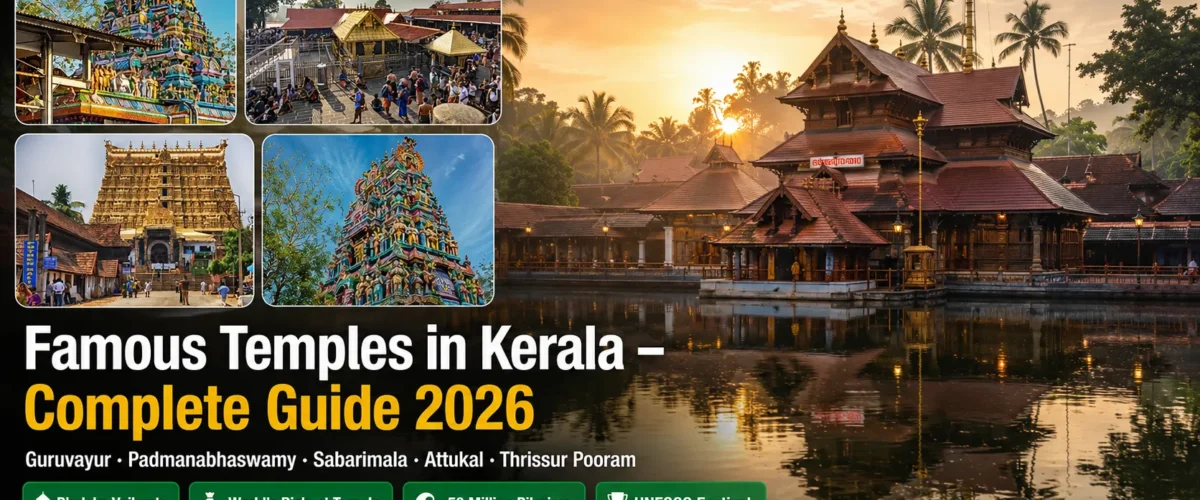
Famous Temples in Kerala 2026 – Guruvayur, Padmanabhaswamy, Sabarimala and Complete Devotee Guide
Which are the most famous temples in Kerala?
Kerala’s most famous temples are: (1) Guruvayur Sri Krishna Temple called ‘Bhuloka Vaikunta’ (Heaven on Earth), 4th most visited temple in India with 50,000+ daily visitors; (2) Sree Padmanabhaswamy Temple world’s wealthiest temple (over 22 billion USD in vaults, Vault B still unopened); (3) Sabarimala Sree Ayyappa Temple world’s 2nd most visited pilgrimage with 50 million pilgrims every Mandala season; (4) Attukal Bhagavathy Temple Guinness World Record, 3.7 million women at Pongala 2026; (5) Vadakkunnathan Temple, Thrissur venue of Thrissur Pooram which UNESCO calls the most spectacular festival on earth; (6) Aranmula Parthasarathy Temple home of the sacred Aranmula metal mirror. Entry at most major Kerala temples is restricted to Hindus only. Temple timings vary Guruvayur opens from 3 AM.
Famous temples in Kerala I have been going to temples across India for many years now, and I can tell you honestly: nothing prepared me for Kerala. Nothing. The first time I visited Guruvayur, I woke up at 2:30 in the morning in a small room near the temple. My phone screen was the only light. I could already hear bells thin, clear bells cutting through the darkness outside. I splashed water on my face, wrapped myself in clothes, and stepped out. The air was cool and smelled like wet earth and jasmine. The temple lane was already filling with people moving quietly in the dark. And I thought: this is what it must have always been like. For centuries. This exact scene. Nothing has changed.
Personally.. I have visited Kerala temples 8 times over the past several years Guruvayur three times, Padmanabhaswamy twice, one full day at Attukal during Pongala, Thrissur on Pooram day, Aranmula during Onam season, and a half-day at Chottanikkara outside Kochi. Every single visit has surprised me. This guide is everything I have personally learned the things nobody tells you in advance, the mistakes I made, and the moments that genuinely changed something in me.
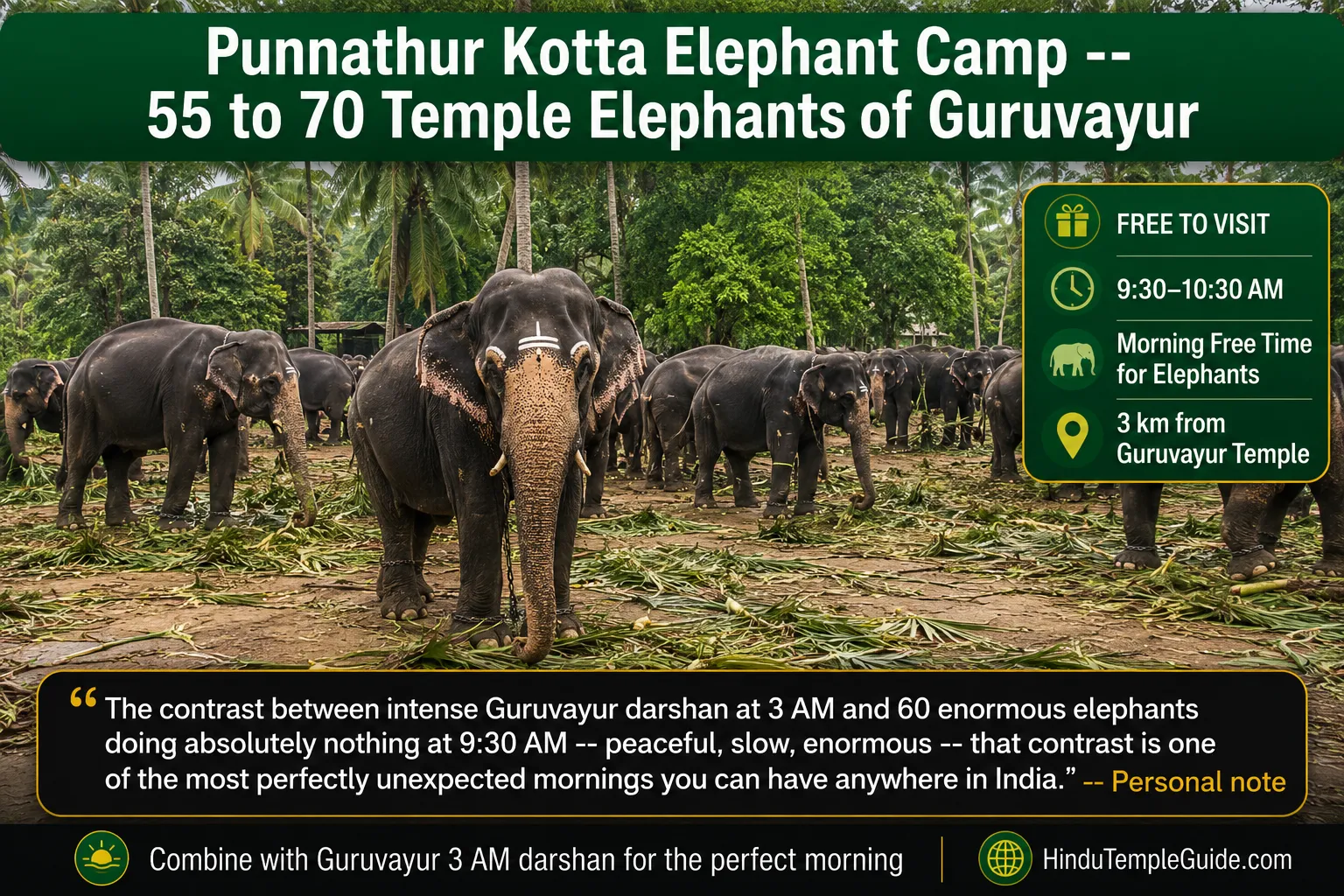
Kerala God’s Own Country is home to some of the most extraordinary temples in Kerala in all of India. I am not saying that as a tourism slogan. I am saying it because I have stood in Padmanabhaswamy’s sanctum and understood, in my bones, why the Travancore kings called themselves servants of the Lord. I have sat at the base of Punnathur Kotta at 9:30 in the morning watching 60 temple elephants do absolutely nothing just existing, enormous and calm and found it more peaceful than any meditation retreat. Kerala does things to you. This guide will help you experience them at their best. Jai Guruvayurappa! Swamiye Saranam Ayyappa!
Quick Navigation
Table of Contents
Why Kerala Is Genuinely God’s Own Country : My Honest Take
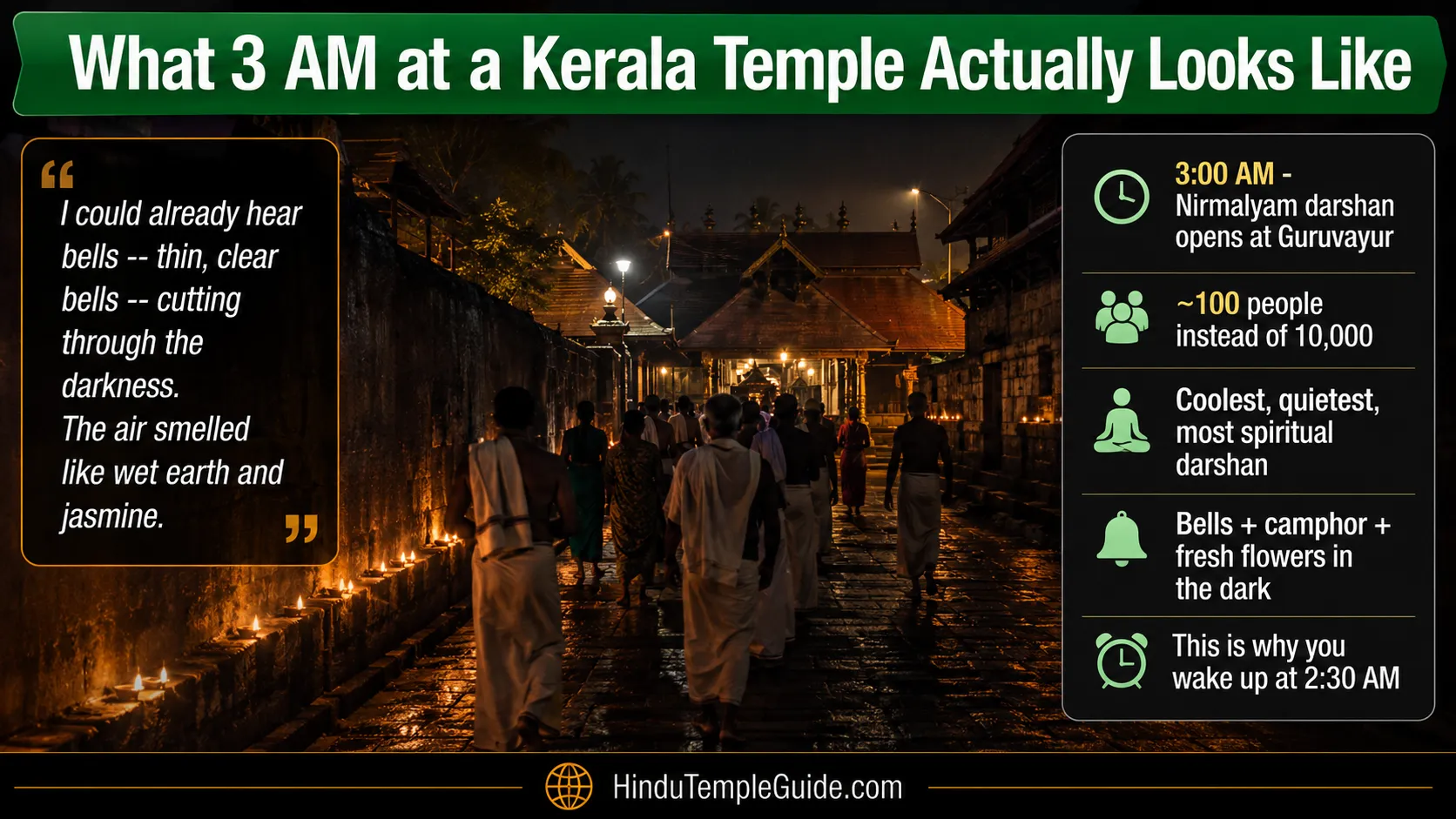
I want to be honest with you before we go any further. I have seen that phrase ‘God’s Own Country’ printed on every Kerala tourism poster since I was a child. And for a long time, I rolled my eyes at it. It sounded like marketing. Then I spent a week visiting the famous temples of Kerala and stopped rolling my eyes. Kerala has something I have not found at this density anywhere else in India. It is not just the number of ancient temples. It is the fact that they are all still completely, genuinely alive. The rituals have not been simplified for tourism. The priests are still following the same Tantric traditions their great-grandfathers followed. The elephants are still real. The percussion is still real. The flowers at 3 AM are still real.
Here is what makes the famous temples in Kerala unlike anywhere else in the country, in plain language:
- Two world records in one state. The world’s wealthiest temple (Padmanabhaswamy) and the world’s largest gathering of women for a religious event (Attukal Pongala). Both in Kerala. Both real. Both genuinely extraordinary when you stand in front of them.
- India’s strictest temple dress code. Guruvayur turns away men wearing shirts. Not sleeveless shirts. Any shirt. No shirt is allowed inside the sanctum. I was turned away. I changed. I went back in. And what happened after is the reason this article exists.
- The world’s second most visited pilgrimage. Sabarimala brings 50 million pilgrims per Mandala season. For context, the Hajj draws about 3 million. Sabarimala is a different scale entirely a river of black-clothed devotees flowing through a forest at 4 in the morning is something that rearranges your sense of what human devotion actually looks like.
- Temple architecture that is genuinely unique. Kerala’s sloping copper roofs, the intricate wood carvings, the narrow lamp-lit corridors, the sacred ponds these are not found anywhere else. Kerala developed its own school of temple architecture that looks nothing like the gopuram towers of Tamil Nadu or the spires of North India.
| Temple | What makes it special |
|---|---|
| Guruvayur | 4th most visited in India. 50,000+ daily. India’s strictest dress code. Open from 3 AM. |
| Padmanabhaswamy | World’s wealthiest temple. Over 22 billion USD in vaults. Vault B still not fully opened. |
| Sabarimala | 50 million pilgrims per season. World’s 2nd most visited pilgrimage. 41-day vow required. |
| Attukal Bhagavathy | Guinness Record: 3.7 million women cooked Pongala simultaneously on Feb 23, 2026. |
| Vadakkunnathan, Thrissur | Home of Thrissur Pooram UNESCO’s most spectacular festival on earth. |
| Aranmula Parthasarathy | One of 108 Divya Desams. Home of the sacred Aranmula metal mirror. Onam boat race. |
| Chottanikkara Bhagavathy | Three moods of the goddess across three daily darshan sessions. Famous for healing. |
Guruvayur Sri Krishna Temple : The Time I Was Turned Away (And What Happened After)
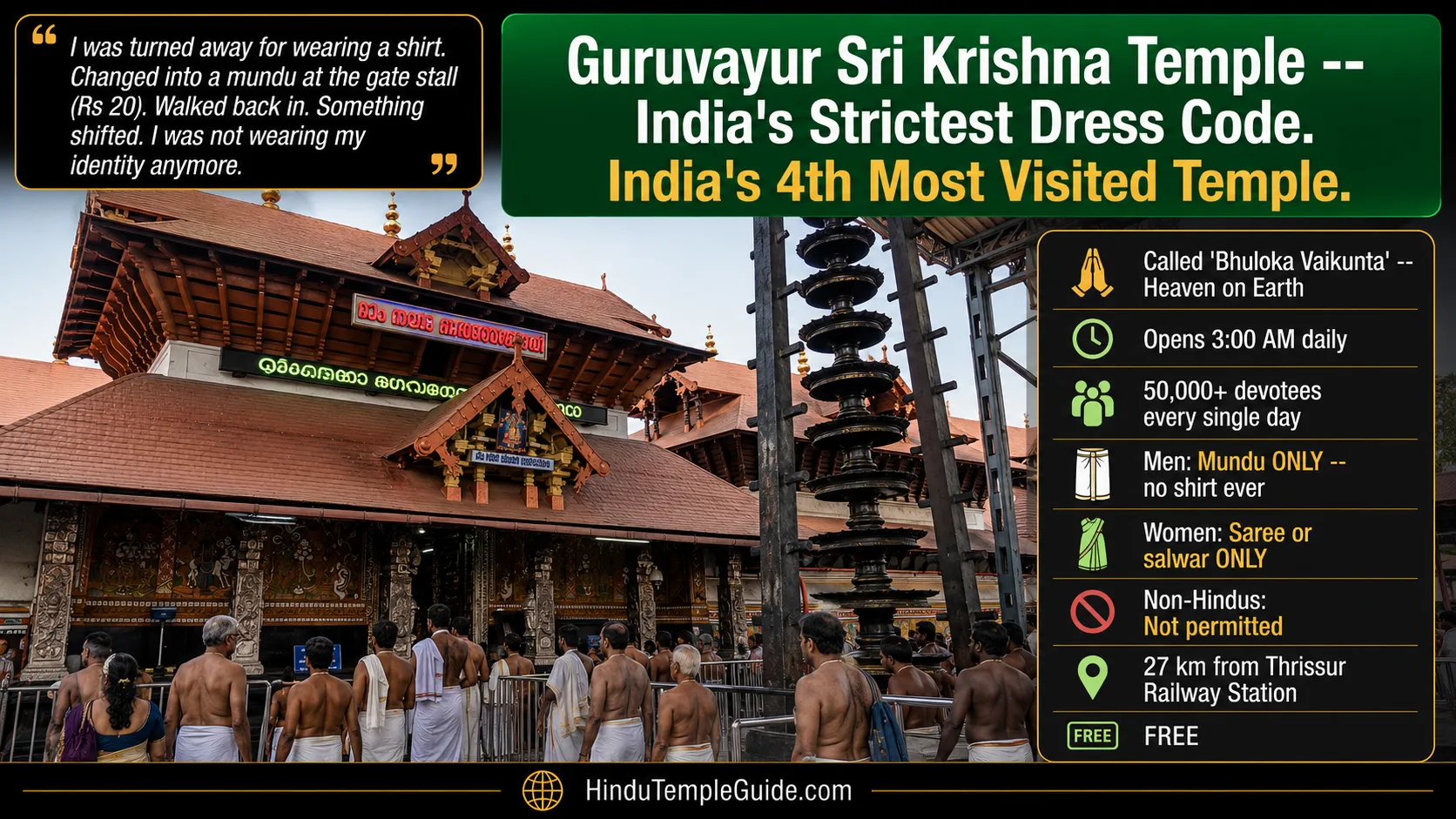
Let me tell you exactly what happened on my first visit to Guruvayur Temple. I arrived at around 7 in the morning, dressed in what I thought was perfectly respectful clothing a clean full-sleeve cotton shirt and trousers. I had done my research. I knew about the dress code. I thought I had followed it. The guard at the outer gate stopped me with absolute politeness and zero apology and said: shirt not allowed inside. Men must wear only mundu. No exceptions.
Personally.. I stood there for a moment feeling genuinely embarrassed. There was a small stall about 30 metres from the gate selling and renting mundus. The man there a cheerful elderly gentleman who had clearly helped hundreds of clueless visitors like me handed me a plain white cotton mundu, showed me roughly how to wrap it, accepted Rs 20, and sent me on my way. A kind local man standing nearby saw me struggling with the draping and fixed it properly in about 45 seconds. I walked back to the gate. The guard nodded me through. And then I am trying to find the right word for this something shifted. I was not wearing my identity anymore. I was not wearing my status or my city or my phone brand or anything that usually signals who I am. I was just a man in a piece of white cloth, joining hundreds of other men in white cloth, all of us moving toward the same dark doorway. That is what the Guruvayur dress code actually does. It makes everyone equal. And walking into that sanctum in that state of unexpected humility I was not prepared for how it would feel.
The idol of Guruvayurappan Lord Krishna in his four-armed cosmic form, dark as a monsoon cloud, holding conch, discus, mace and lotus is described in the Narayaneeyam (1586 CE, composed right here in this temple by Melpathur Narayana Bhattathiri while he was slowly being cured of paralysis) as having a smile that could cure a thousand illnesses. I do not know about that. But I can tell you that standing in front of that idol in the lamplight, surrounded by the smell of camphor and the sound of bells and the visible devotion of 200 people around me, I felt something I had not expected to feel. Something very quiet. Something that did not need explaining.
Guruvayur Temple has India’s strictest dress code. ONLY Hindus are permitted inside non-Hindus are not allowed and may be asked to declare their faith in writing. For men: plain white or cream mundu (dhoti) ONLY absolutely no shirt, T-shirt, vest, trousers or pants of any kind. An angavastram (small cloth) may be placed over the chest. Mundu available for rent near the temple gate (Rs 20–50). For women: saree or salwar kameez ONLY jeans are NOT allowed even with a long kurta. Temple timings: 3:00 AM (Nirmalyam) then 4:30–7:00 AM, 7:15–9:00 AM, 11:30 AM–12:30 PM, 5:00–7:00 PM, 7:15–9:30 PM. Official site: www.guruvayurdevaswom.in
| What you need to know | Details |
|---|---|
| Deity | Lord Krishna (Guruvayurappan) 4-armed standing form with conch, discus, mace and lotus |
| Why this temple is sacred | The idol is believed to have been worshipped by Lord Vishnu himself in the celestial realm before being brought to Kerala. Temple called ‘Bhuloka Vaikunta’ Heaven on Earth. |
| How busy it is | 50,000+ devotees every single day. 4th most visited temple in India. On festival days do not even think about it without arriving before 4 AM. |
| Timings | Opens at 3:00 AM for Nirmalyam darshan. Six sessions: 3 AM, 4:30–7 AM, 7:15–9 AM, 11:30 AM–12:30 PM, 5–7 PM, 7:15–9:30 PM. |
| Men’s dress code | Plain white/cream mundu ONLY. No shirt. No vest. No pyjama. No pants. Angavastram (cloth) over chest is allowed. |
| Women’s dress code | Saree or full salwar kameez ONLY. No jeans even with a long kurta. Non-negotiable. |
| Non-Hindus | Not permitted inside. Entry requires confirmation of Hindu faith. |
| Elephant camp | Punnathur Kotta 55–70 temple elephants. 3 km from temple. Morning free time 9:30–10:30 AM. Free to visit. |
| Best festival | Guruvayur Ekadashi (November/December) 10-day Utsavam with elephant processions |
| Official website | www.guruvayurdevaswom.in |
| How to reach | Cochin Airport (80 km). Thrissur Railway Station (27 km). Regular buses from Thrissur, Kochi, Kozhikode. |
Sree Padmanabhaswamy Temple : Standing Before the Door That Cannot Be Opened
I am going to tell you something about Sree Padmanabhaswamy Temple that I have been trying to put into words since my first visit. When you stand in front of the three doorways that let you see the reclining Lord Vishnu the face through one door, the torso through the second, the lotus-holding feet through the third, because the idol is simply too vast to be seen from any single vantage point you feel something that is not quite religious feeling and not quite awe and not quite smallness. It is something in between all three. Like standing at the edge of the ocean at night. The deity is too large for your eyes to hold all at once, so your mind has to give up trying and just be there with whatever part of it you can see.
Personally.. My second visit, I deliberately arrived for the 8:30 AM darshan window on a weekday. I got there at 8 in the morning, which meant 30 minutes of standing in the queue in the warm Thiruvananthapuram morning, in my dhoti and angavastram that I had brought from home this time (lesson learned from my first visit). The guard checked my dress with a brief nod. I removed my footwear. I walked through the outer corridor where the stone floor was already warm from the early light. And then the first doorway opened and I saw the face of Lord Padmanabha enormous, dark, utterly calm, the eyes slightly downcast as if the deity has been watching the entire world for centuries without needing to look up. I moved to the second doorway: the vast reclining torso, the four arms, the lotus growing from the navel with Brahma seated on it. Then the third: the feet, attended by two consorts. By the time I came back around, I sat on a stone bench in the outer corridor for about fifteen minutes. Not praying exactly. Just sitting. Thiruvananthapuram the entire city is named after this deity. Thiru-Anantha-puram. The holy abode of Anantha (the infinite serpent on which Vishnu rests). The city exists because the temple exists. Somehow that felt very real sitting there on that bench.
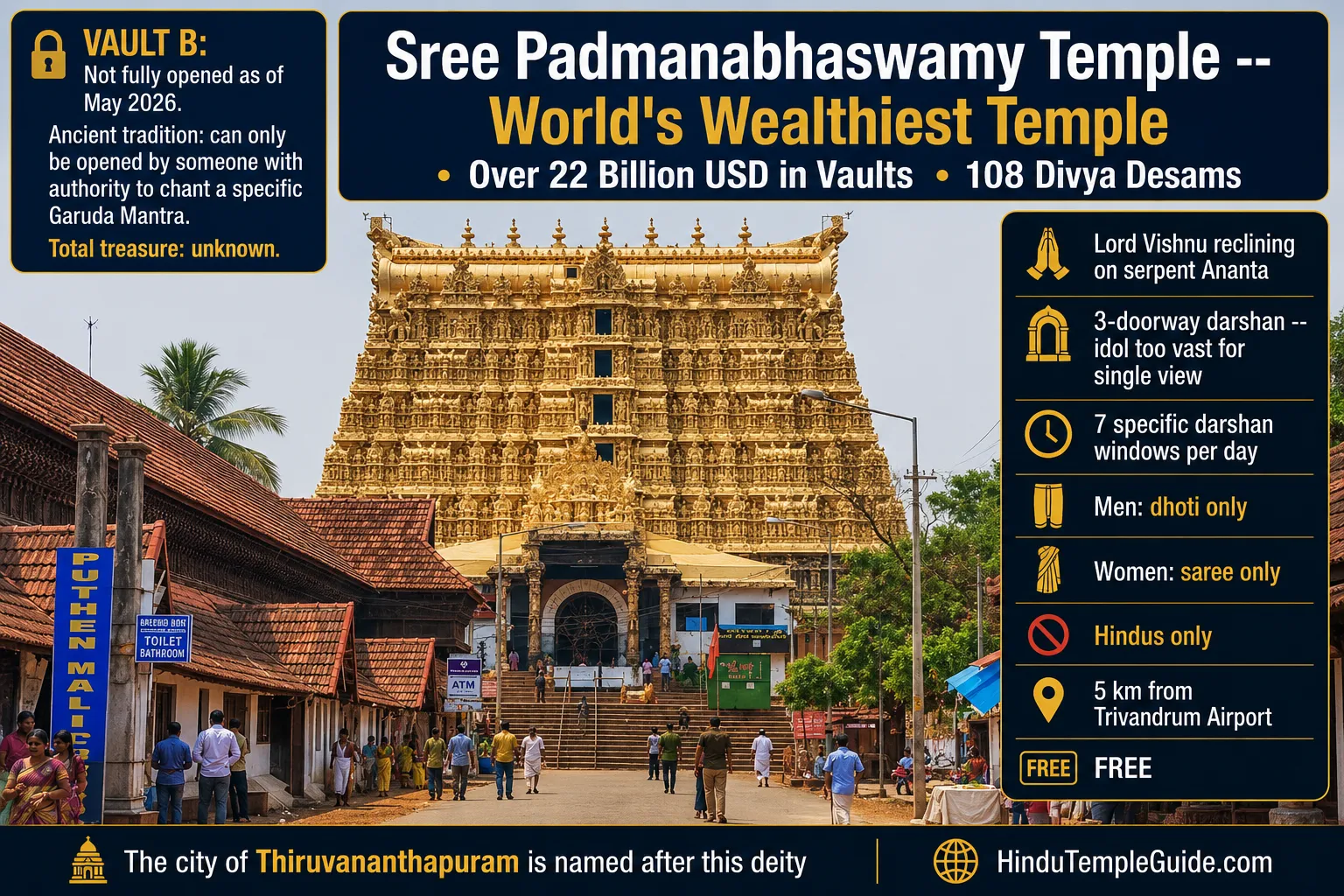
In 2011, five underground vaults at Sree Padmanabhaswamy Temple were opened by order of the Supreme Court of India and found to contain treasures valued at over 22 billion USD making it the world’s wealthiest place of worship. One vault, Vault B, has not been fully opened. According to ancient temple tradition, its innermost chamber can only be opened by a person with the spiritual authority to chant a specific Garuda Mantra. In 2020, the Supreme Court ruled that the Travancore Royal family continues to manage the temple as hereditary trustees. As of May 2026, Vault B and two additional newly discovered vaults (G and H) remain unopened. The full extent of the temple’s treasure is unknown.
| What you need to know | Details |
|---|---|
| Deity | Lord Anantha Padmanabhaswamy Vishnu reclining on 5-headed serpent Ananta/Shesha. Brahma grows from navel lotus. |
| Why extraordinary | World’s wealthiest temple. Over 22 billion USD found in vaults in 2011. Vault B still not fully opened as of May 2026. |
| The 3-doorway darshan | The idol is so vast it can only be seen through 3 separate doorways. Face through door 1, torso through door 2, feet through door 3. |
| Darshan timings | 7 specific windows per day: 3:30–4:45 AM, 6:30–7 AM, 8:30–10 AM, 10:30–11:10 AM, 11:45 AM–noon, 5–6:15 PM, 6:45–7:20 PM. |
| Dress code | Men: dhoti/mundu ONLY no shirt or pants. Women: saree or half-saree ONLY. Hindus only. |
| Entry fee | FREE for general darshan. Special pujas available at a fee. |
| Important note | Unlike most temples, darshan is ONLY during the 7 specific windows. Outside those times the sanctum is closed. Plan carefully. |
| How to reach | Thiruvananthapuram city centre. East Fort entrance. 5 km from Trivandrum Airport. 3 km from Central Railway Station. |
Sabarimala : The Pilgrimage I Witnessed at 4 AM and Will Never Forget
I have not done the full Sabarimala pilgrimage myself the 41-day Mandala Deeksham vow is a genuine commitment that I have not yet made and will not make until I am ready to make it properly. But I went to Pamba base camp during the Mandala season a few years ago, and what I saw there at 4 in the morning is something I find difficult to describe without making it sound like I am exaggerating.
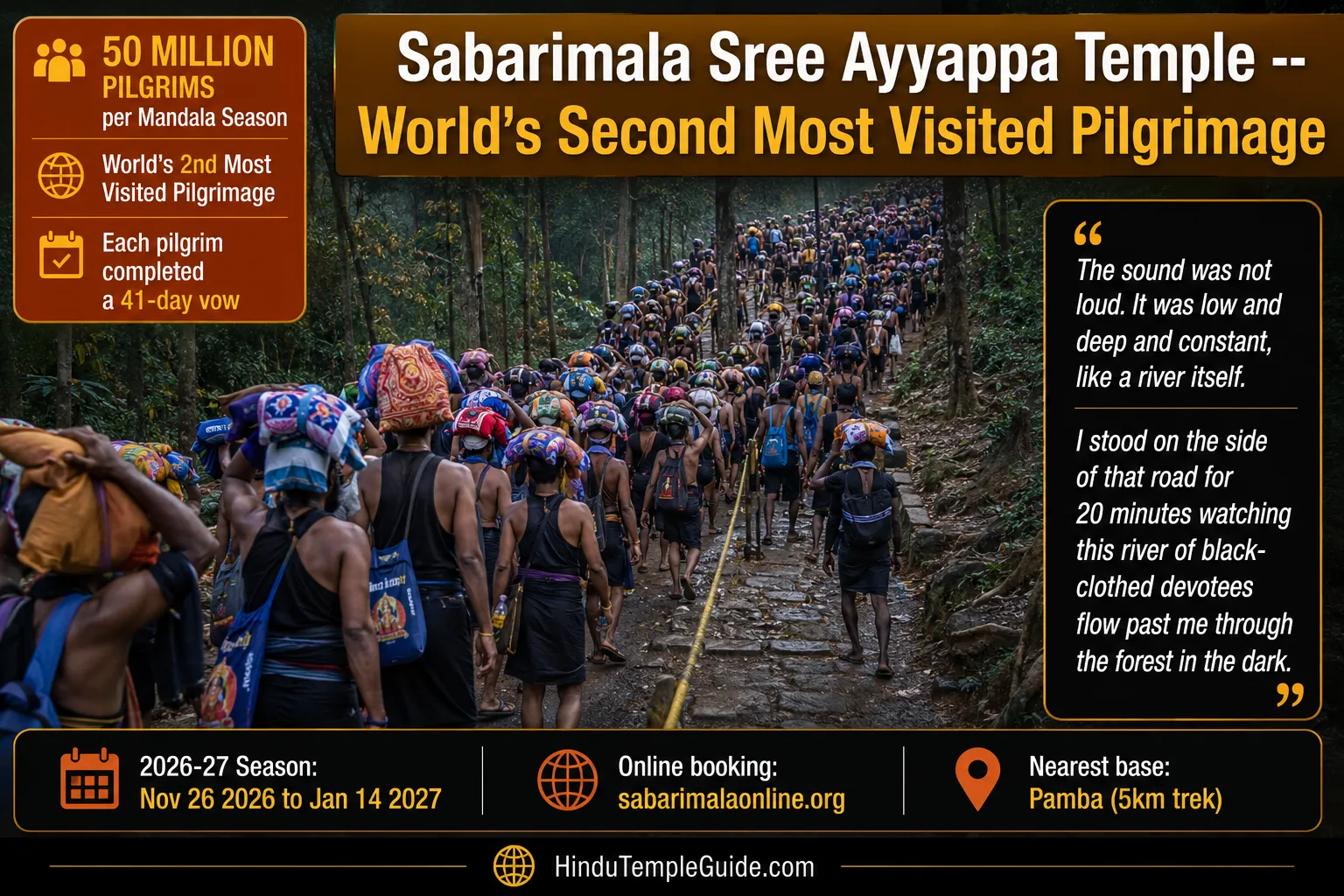
Personally.. Picture this: you are standing on a narrow road in a forest valley in the Western Ghats. It is completely dark except for the headlamps of vehicles and the small lights that pilgrims carry. And coming toward you as far as you can see in both directions, curving around the mountainside is a continuous river of human beings dressed in black and dark blue, each one carrying an Irumudi Kettu (the sacred two-part bag with coconut filled with ghee on one side and personal offerings on the other) balanced on their head, each one chanting ‘Swamiye Saranam Ayyappa’ in a low continuous rhythm. Fifty thousand people. The sound is not loud. It is low and deep and constant, like a river itself. I stood on the side of that road for probably 20 minutes, unable to move, watching this river of black-clothed devotees flow past me through the forest in the dark. I am not an especially emotional person at temples. I cried. I do not know exactly why. Something about the scale of it. Something about the simplicity of it everyone the same, everyone equal, everyone just walking toward the same thing.
Sabarimala opens during specific seasons only. The main 2026–27 Mandala-Makaravilakku season runs from November 26, 2026 to January 14, 2027. Other seasons: Vishu Kalam (April 2026), Onam season (August–September 2026), and the first day of each Malayalam month. The 41-day Mandala Deeksham vow requires: wearing only traditional black or dark blue lungi/mundu plus Tulasi or Rudraksha mala, complete abstinence from non-vegetarian food and alcohol, observing brahmacharya, daily prayer, and strict vegetarian diet throughout. Online booking at sabarimalaonline.org is mandatory during Mandala season. Nearest base camp: Pamba (5-km forest trek to Sannidhanam). Nearest railway: Chengannur (87 km).
| What you need to know | Details |
|---|---|
| Deity | Lord Ayyappa (Dharma Sastha) son of Shiva and Mohini (Vishnu in female form). Eternal celibate deity. |
| Scale | 50+ million pilgrims per Mandala season. World’s 2nd most visited pilgrimage after Hajj in sheer numbers. |
| 2026–27 main season | Mandala Pooja: November 26, 2026 to January 14, 2027. Makaravilakku on January 14. |
| The 41-day vow | Black/navy lungi + mala, no non-veg, no alcohol, no sexual activity, daily prayer, vegetarian only. |
| Online registration | sabarimalaonline.org virtual queue and darshan booking mandatory during peak season. |
| Getting there | Fly to Trivandrum (167 km) or Kochi (158 km). Train to Chengannur (87 km). Road to Pamba base camp. 5 km forest trek from Pamba. |
| The 18 steps | The Pathinettam Padi (18 sacred steps) at the sanctum entrance are climbed bare-chested with the Irumudi on the head. Each step represents one of the 18 hills of the surrounding Western Ghats. |
Attukal Bhagavathy Temple : The Day a Whole City Became One Temple
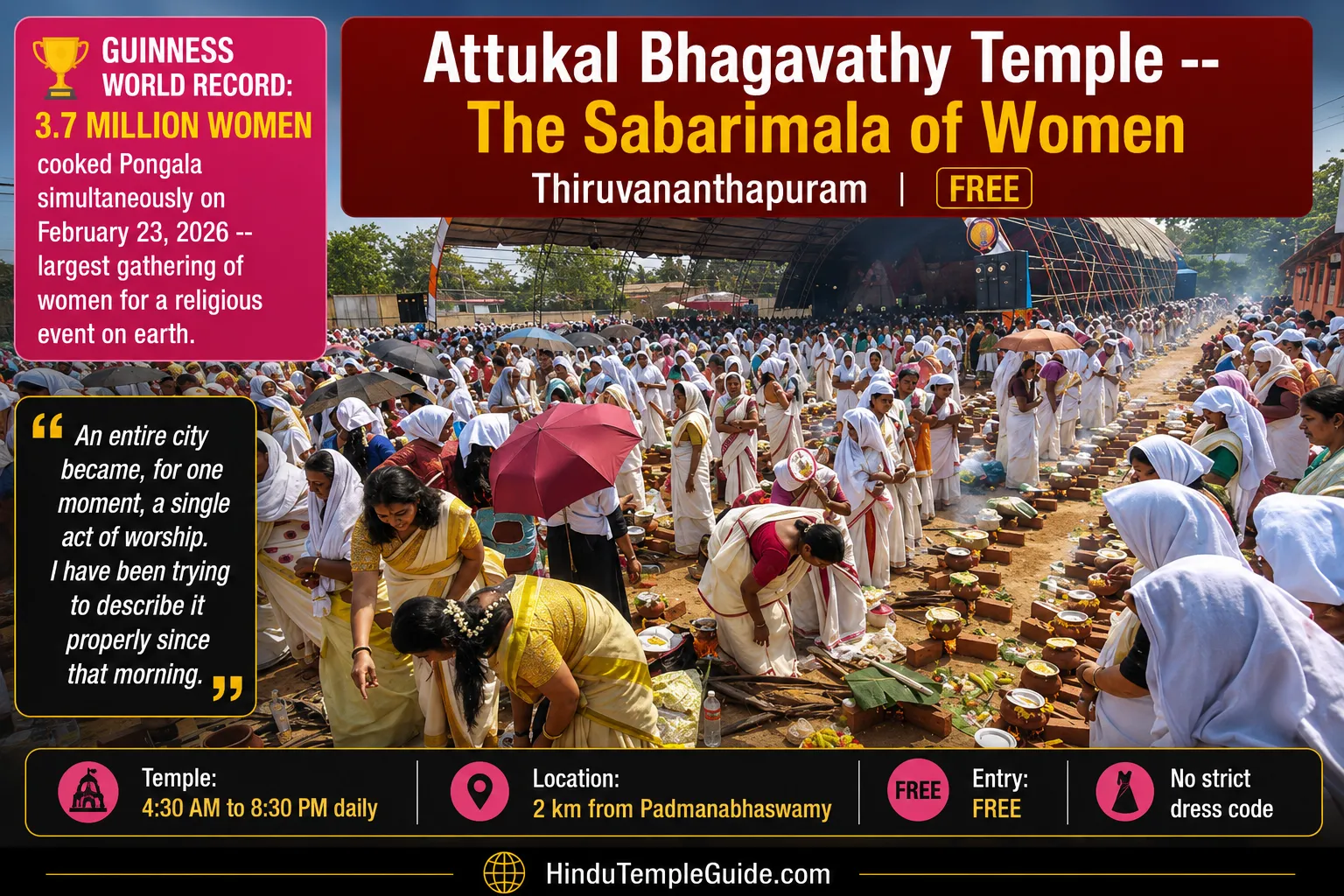
I want to tell you about February 23, 2026, specifically. I was in Thiruvananthapuram for Attukal Pongala, which I had read about but could not quite visualize from the descriptions. The Guinness World Record 3.7 million women cooking simultaneously sounded impressive in an abstract way. What I did not understand until I was standing there is what 3.7 million people actually looks and sounds and smells like.
Personally.. I woke up at 5:30 AM and walked out of my hotel and the city was already transformed. The streets every street, every lane, every footpath, every open space in the entire city had become a kitchen. Millions of small wood fires. Millions of small clay pots balanced on improvised stands made from bricks and stones. Millions of women in sarees in every colour, many of them having walked for days to get here, each one focused entirely on the pot in front of her. The smell was extraordinary wood smoke and coconut oil and jaggery and camphor, all of it rising together over the whole city. At the exact moment the temple priest inside Attukal Bhagavathy Temple lit the Pandara Aduppu (the sacred hearth), a wave passed through the city. That is the only word I have for it. A wave. Every fire brightened. Every woman’s face changed. I heard the sound a roar and a prayer and a release all at once go through three million throats. An entire city became, for one moment, a single act of worship. I have been trying to describe it properly since that morning and I am still not there.
| What you need to know | Details |
|---|---|
| Deity | Goddess Kannaki (Attukal Amma) worshipped as Saraswati, Lakshmi and Kali simultaneously. |
| Guinness Record | Largest gathering of women for a religious activity 3.7+ million women cooked Pongala on February 23, 2026. |
| Attukal Pongala | 10-day festival Feb–March. On the main Pongala day, millions of women cook sweet rice in clay pots across all of Thiruvananthapuram’s streets. |
| Timings | 4:30 AM to 8:30 PM daily. |
| Dress code and entry | FREE. No strict dress code. Generally open to all visitors. |
| Where it is | Attukal neighbourhood, Thiruvananthapuram. 2 km from Padmanabhaswamy Temple. 3 km from Central Railway Station. |
| Best days to visit | Pongala day (February/March) for the main event. Regular Fridays and Mondays for quieter darshan. |
Vadakkunnathan and Thrissur Pooram : The Greatest Festival I Have Ever Seen
I want to say something about Thrissur Pooram that most travel articles do not say: the day before Pooram is almost as moving as Pooram itself. The evening before during the Madathilvaravu procession when the temple deities are brought out for the first time the streets are quieter, the crowd is smaller, and you can actually feel the anticipation building. The city knows something extraordinary is coming. The temple town of Thrissur has this very particular feeling on that evening electric, concentrated, sacred.
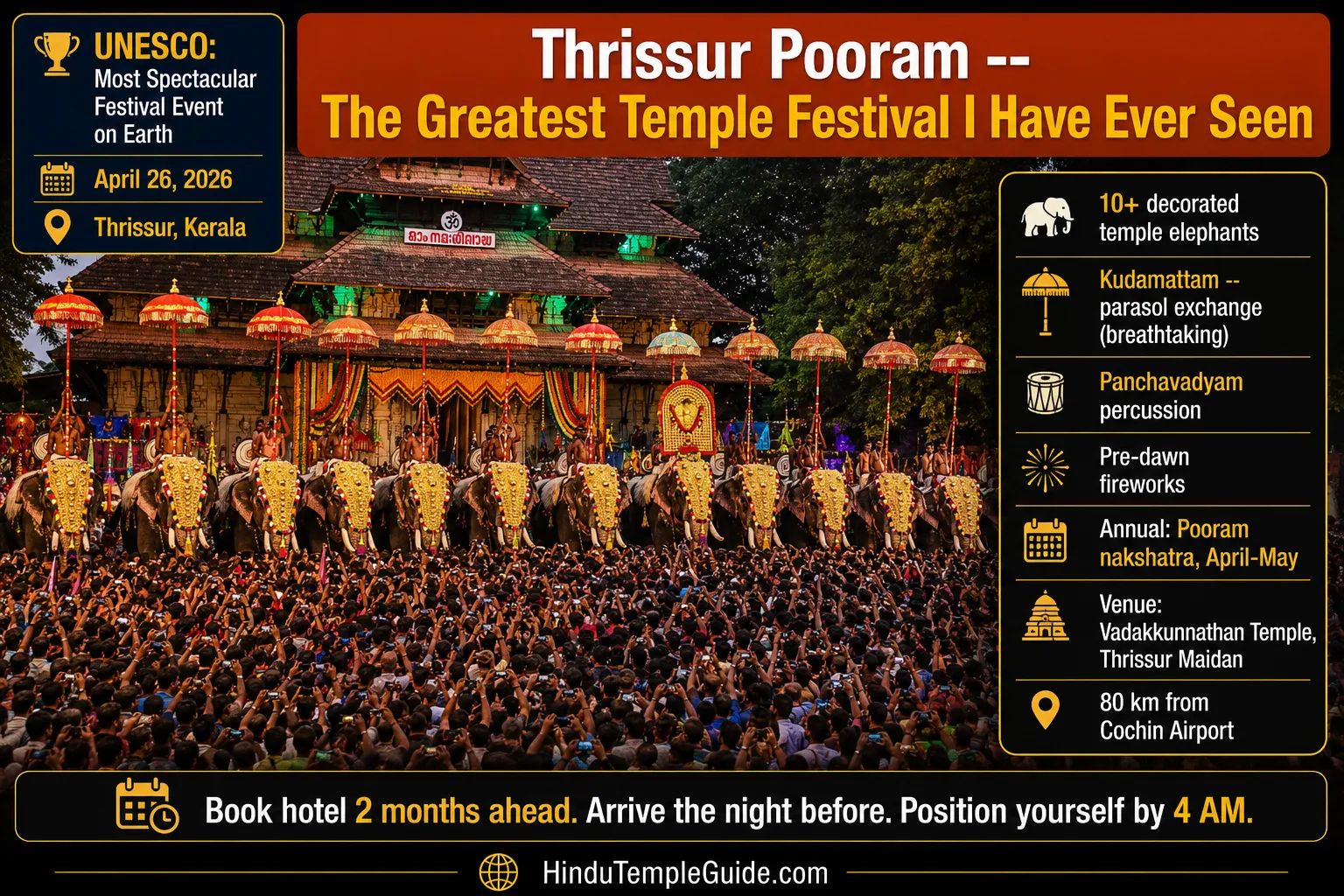
Personally.. I arrived in Thrissur the day before Pooram. Found a small hotel near the Maidan. Walked to Vadakkunnathan Temple in the evening for the Madathilvaravu. By 8 PM the streets were already crowded. By 10 PM I gave up trying to sleep and just sat at a tea stall near the temple listening to the distant sound of the Panchavadyam percussion building and ebbing. At 4 AM on Pooram day I was at my spot near the Maidan. By 6 AM there were more people than I have ever stood among in my life. The elephants 15 of them on each side, all standing in line, all decorated with golden caparisons that catch every lamp and camera flash faced each other across the Maidan. The drums started. And then the Kudamattam began the exchange of decorated parasols and I understood for the first time why UNESCO called this the most spectacular festival event on earth. There is no adequate photograph of it. The scale, the percussion, the light, the crowd, the devotion it has to be experienced.
| What you need to know | Details |
|---|---|
| Vadakkunnathan deity | Lord Shiva (Vadakkunathar). One of Kerala’s most ancient Shiva temples. |
| Thrissur Pooram 2026 | April 26, 2026. Annual falls on Pooram nakshatra in Malayalam month Medam (usually April or May). |
| What happens on Pooram day | 10 temple deities gathered. Decorated elephant processions. Kudamattam (parasol exchange). Panchavadyam percussion. Pre-dawn fireworks. |
| UNESCO recognition | Recognized as the most spectacular festival event on the planet. |
| Temple timings | 3:00 AM to 12:00 PM and 5:00 PM to 8:30 PM. |
| How to reach | Thrissur city centre. 80 km from Cochin International Airport. 27 km from Guruvayur. |
More Incredible Temples in Kerala : Aranmula, Ettumanoor, Chottanikkara
Aranmula Parthasarathy Temple On the Banks of the Pampa River
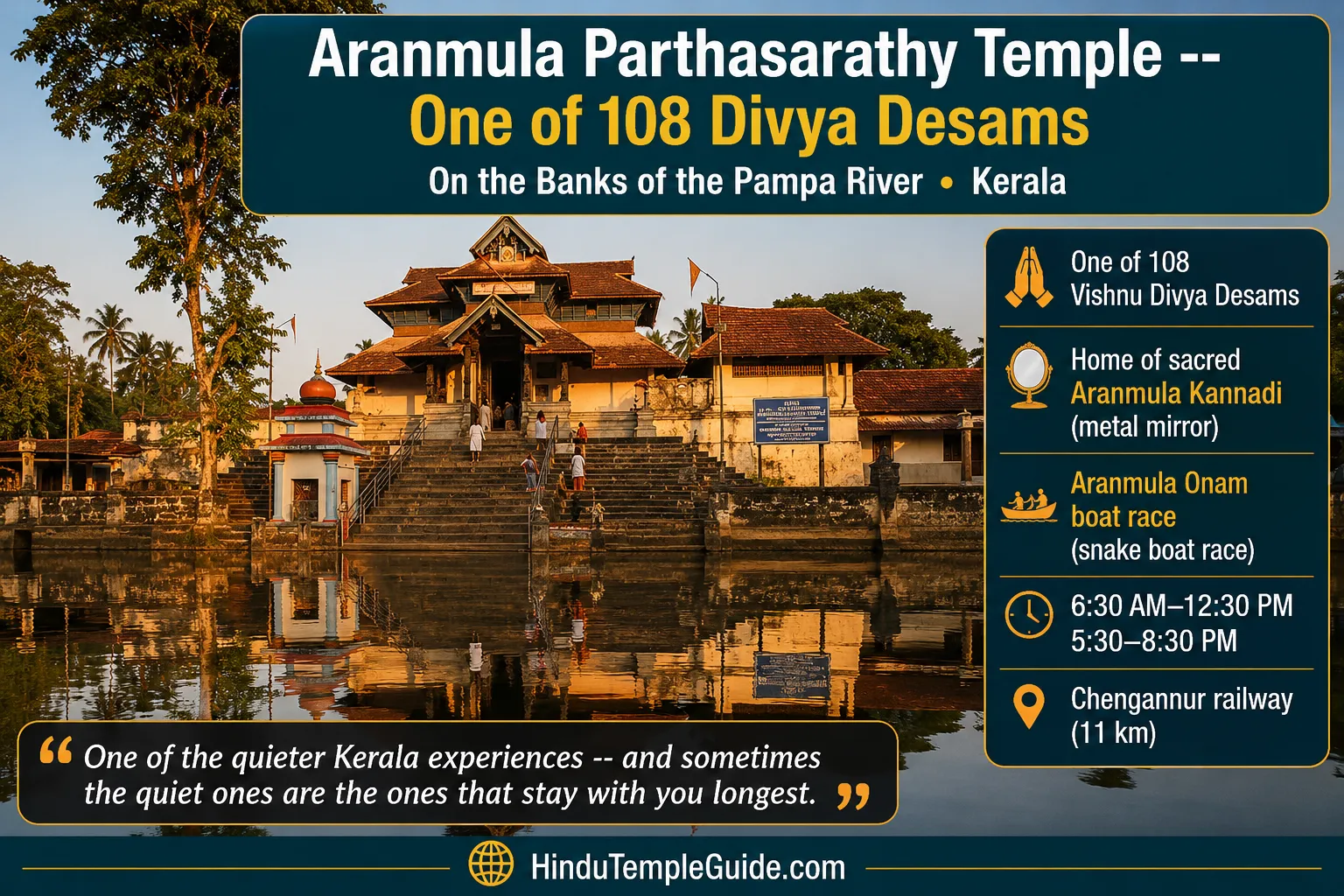
Aranmula was one of the quieter temple experiences I have had in Kerala and sometimes the quiet ones are the ones that stay with you longest. The Parthasarathy Temple sits directly on the Pampa River, surrounded by green Kerala countryside, and it has the particular quality of ancient Vishnu temples in Kerala: a deep stillness that feels less like absence of activity and more like a very long, very sustained presence. The temple is famous for the Aranmula Kannadi the sacred metal mirror made from a secret alloy that only a handful of families in the village know how to produce. These mirrors are considered sacred and auspicious. Timings: 6:30 AM to 12:30 PM and 5:30 PM to 8:30 PM. Nearest railway: Chengannur (11 km).
Ettumanoor Mahadeva Templ : The Best Temple Murals in Kerala
If you care about art at all traditional art, ancient art you need to visit Ettumanoor Mahadeva Temple in Kottayam district. The 16th-century Kerala mural paintings inside the sanctum are breathtaking. Painted in the traditional Kerala style using natural pigments on prepared plaster, they show scenes from the Ramayana, Mahabharata and Shiva Puranas with a vividness and emotional depth that genuinely rivals anything I have seen in Indian temple art. The temple is also famous for the Ezharaponnana festival (7.5 golden elephants procession). Timings: 3:30 AM to 12:00 PM and 5:00 PM to 8:30 PM. Nearest railway: Ettumanoor (1 km).
Chottanikkara Bhagavathy Temple : The Goddess in Three Moods
Chottanikkara is the temple I recommend to people who ask me which Kerala temple to visit if they can only visit one and they are not sure about strict dress codes. The Bhagavathy here is worshipped in three distinct forms across three daily darshan sessions: Saraswati in the morning (white, sattvic), Bhadrakali at noon (red, rajasic), Durga in the evening (dark, tamasic). The theological richness of that daily progression watching the goddess move through three aspects of existence across a single day is extraordinary. The temple is also known for its tradition of healing for mental conditions. Timings: 4:00 AM to 9:00 PM. Nearest railway: Tripunithura (8 km).
White form · Sattvic · Peaceful wisdom
Red form · Rajasic · Active power
Dark form · Tamasic · Transformative
Kerala Temple Dress Code : The Strictest in India (And Why That Is a Good Thing)
I want to address this directly because I have made the mistakes myself and I have watched many other visitors make them. Kerala temples have the strictest dress code in India. Stricter than Tirupati. Stricter than Varanasi. Stricter than anywhere. And I genuinely believe having experienced the difference between walking into Guruvayur in wrong clothes and being turned away, versus walking in wearing the correct mundu that the strictness is part of what makes these temples work. When everyone in the sanctum looks the same, when status and fashion and brand have been left at the gate, the temple becomes a different kind of space. More equal. More focused. More genuinely sacred.
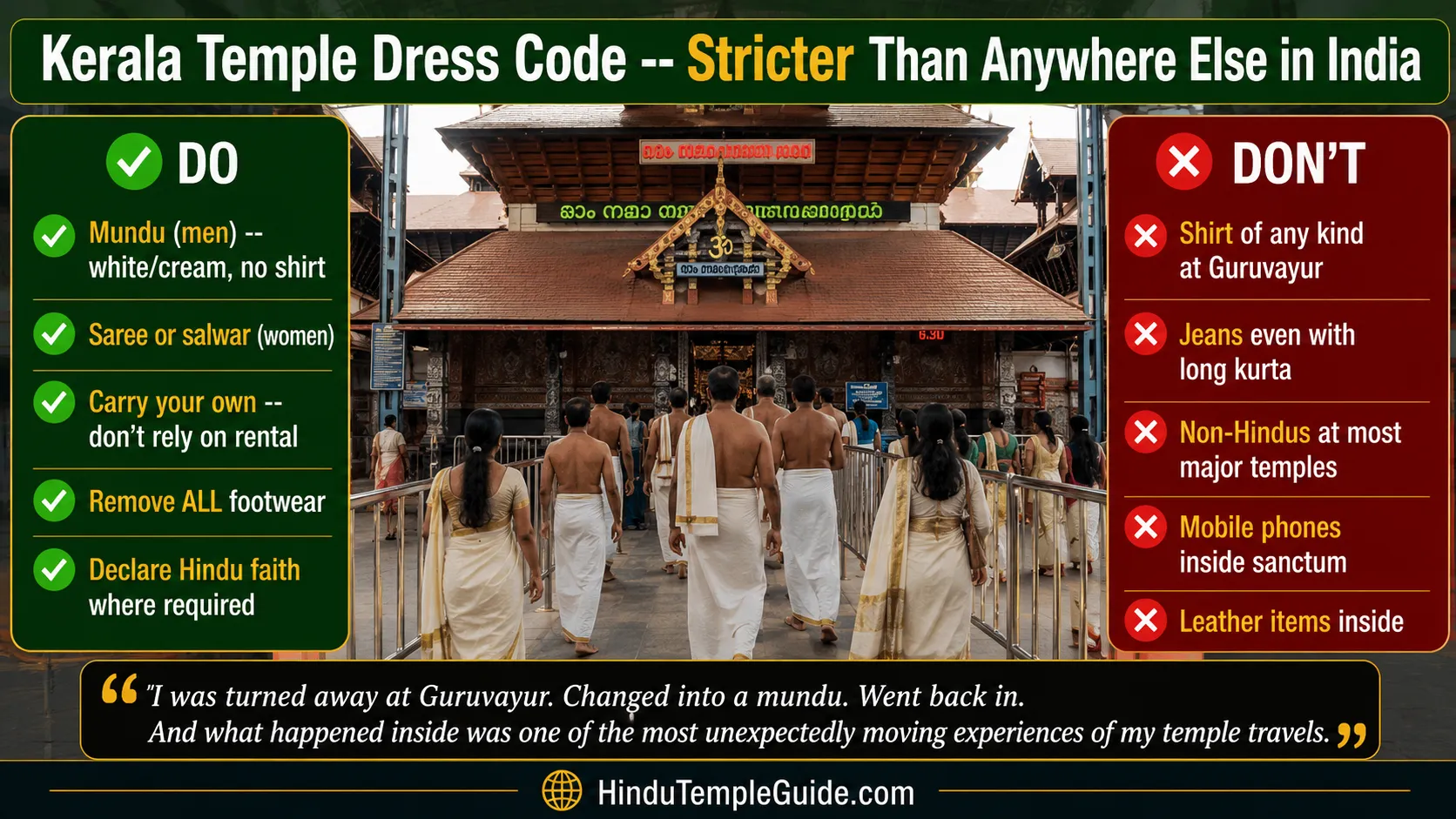
| Temple | Men | Women | Non-Hindus |
|---|---|---|---|
| Guruvayur | Mundu ONLY. No shirt at all. | Saree or salwar kameez. No jeans. | Not permitted. |
| Padmanabhaswamy | Dhoti/mundu ONLY. No shirt. | Saree or half-saree ONLY. | Not permitted. |
| Sabarimala | Traditional black/navy lungi + mala during vow period. | Traditional modest clothing. | All welcome. |
| Attukal Bhagavathy | Neat formal clothing. | No strict code. | Generally welcome. |
| Vadakkunnathan | Dhoti or full trousers + shirt. | Saree or salwar kameez. | Not permitted. |
| Aranmula | Dhoti or full trousers + shirt. | Saree or salwar kameez. | Not permitted. |
| Chottanikkara | Dhoti or full trousers + shirt. | Saree or salwar kameez. | Generally welcome. |
- Carry a dhoti and a saree in your bag. Not as a backup. As a plan A. Rental stalls exist near most Kerala temples but may be closed early in the morning when you most want to visit. Having your own removes all anxiety.
- Ask for help with the mundu. Every time I have needed help draping a mundu outside a Kerala temple, someone has stepped forward within 30 seconds. Kerala’s temple towns have a very specific culture of quiet helpfulness toward pilgrims. Do not be embarrassed to ask.
- For Padmanabhaswamy specifically. Arrive at East Fort. Give yourself 45 minutes before the darshan window. Dress check is thorough. No phones inside at all.
- What if you are not Hindu. Attukal Bhagavathy Temple is genuinely welcoming to everyone. Sabarimala is open to all faiths. Kerala also has extraordinary heritage churches (St. Francis Church in Kochi built 1503 CE is the oldest European church in India) and mosques. The state’s religious heritage is genuinely multi-faith and most of it is accessible.
Best Time to Visit Kerala Temples : What I Recommend From Experience
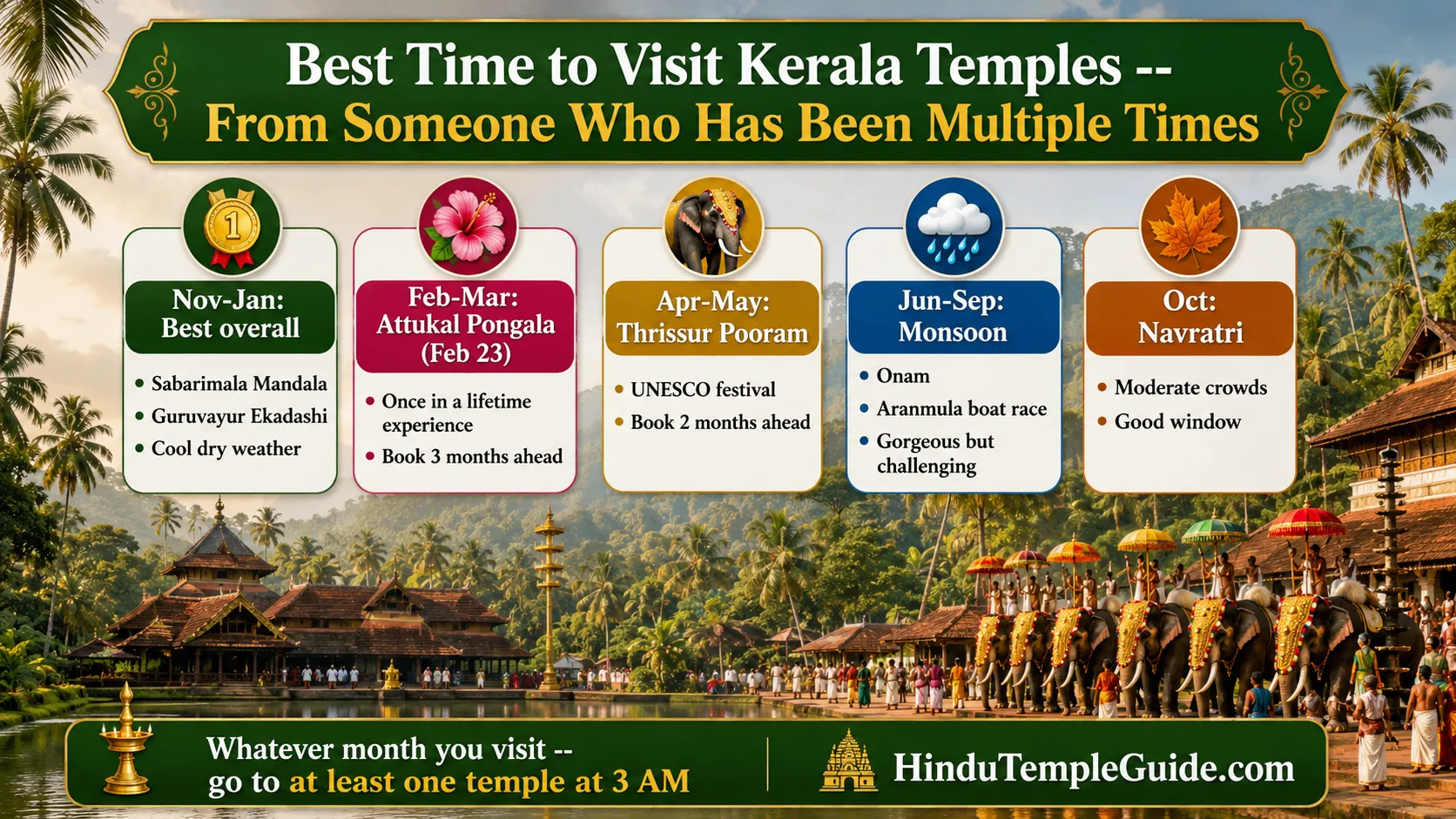
| When | What is happening | My honest recommendation |
|---|---|---|
| November to January | Sabarimala Mandala season. Guruvayur Ekadashi. Makaravilakku on Jan 14. | Best overall. Cool, dry weather (22–28 degrees). If you can only visit Kerala once, come in this window. Guruvayur Ekadashi is extraordinary. Makaravilakku at Sabarimala on January 14 is the peak of the entire pilgrimage year. |
| February to March | Attukal Pongala (Feb 23 in 2026). Maha Shivaratri. | Come for Pongala if you can only witness one religious event in India. Book hotels 3 months ahead. The whole experience is worth the planning. |
| April to May | Thrissur Pooram (April 26 in 2026). Vishu (Kerala New Year). | If you have any interest in temple festivals, Thrissur Pooram is non-negotiable. Book Thrissur hotels 2 months ahead. Arrive the night before. |
| June to September | Monsoon. Onam season. Aranmula boat race. | Gorgeous but challenging for hill temples. Aranmula Onam snake boat race is spectacular. Guruvayur and Padmanabhaswamy are accessible year-round. |
| October | Navratri. Pre-Mandala preparations. | Moderate crowds. Navratri at Padmanabhaswamy and Chottanikkara is special. Good window if you want to avoid peak-season crowds. |
How to Plan Your Kerala Temple Trip : My 5-Day Itinerary
This is the 5-day Kerala temple circuit I would recommend to someone visiting for the first time, based on what I have done across multiple trips:
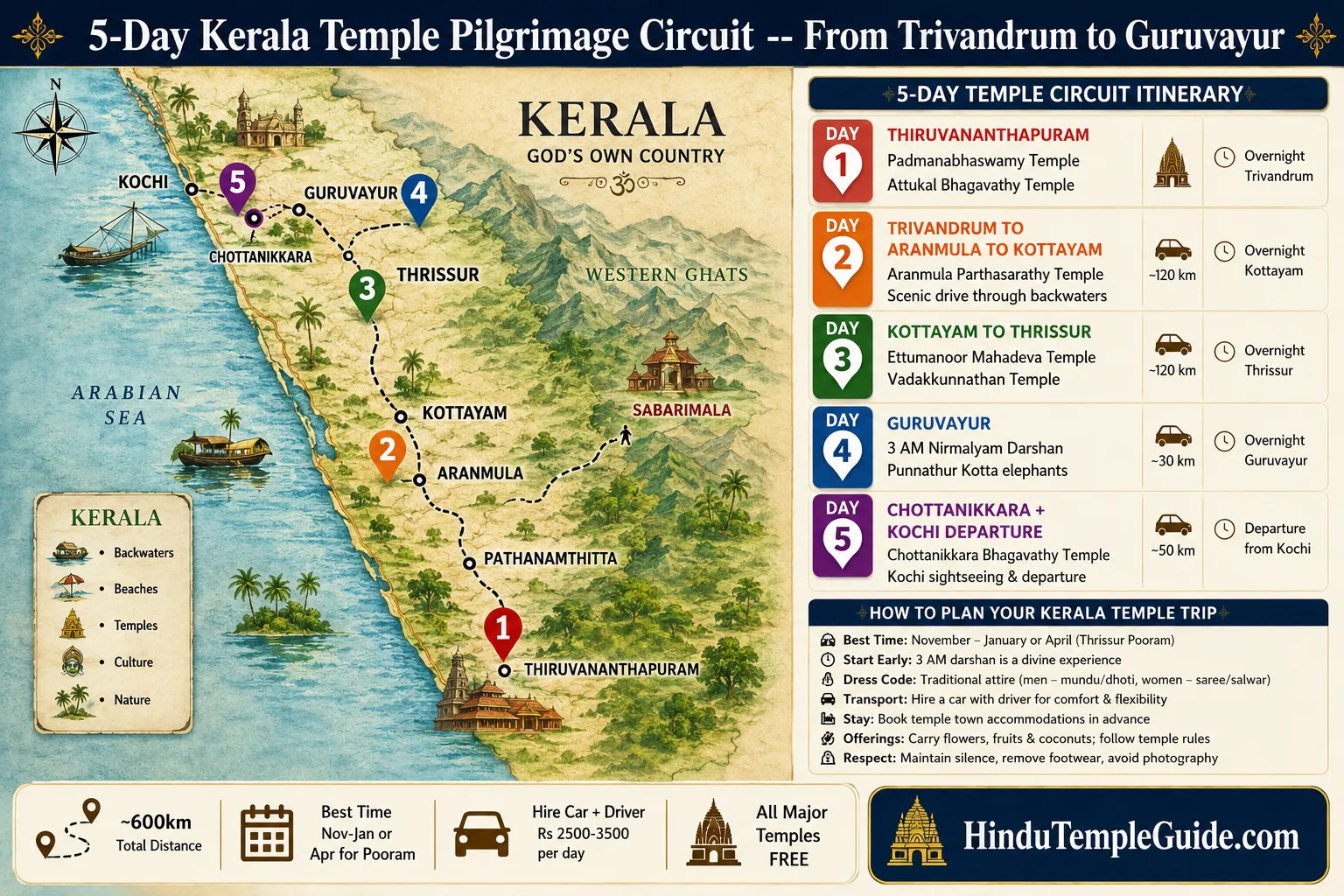
| Day | Where | What to do |
|---|---|---|
| Day 1 | Thiruvananthapuram | Arrive Trivandrum. Check in. 8:30 AM Padmanabhaswamy darshan. In the evening: Attukal Bhagavathy Temple (2 km walk). Night in Thiruvananthapuram. |
| Day 2 | Trivandrum → Aranmula → Kottayam | Optional 3:30 AM Padmanabhaswamy Nirmalyam if you can manage it. Drive to Aranmula via Chengannur (87 km). Parthasarathy Temple midday. Drive to Kottayam (2 hours). Night in Kottayam. |
| Day 3 | Kottayam → Thrissur | Ettumanoor Mahadeva Temple in the morning. Drive to Thrissur (3 hours). Vadakkunnathan Temple at the 5 PM session. Night in Thrissur. |
| Day 4 | Guruvayur | Wake up at 3 AM. Nirmalyam darshan at Guruvayur by 3:30 AM. Spend the morning at the temple. 9:30–10:30 AM: Punnathur Kotta elephant camp. Drive toward Kochi (80 km). Night in Kochi or Thrissur. |
| Day 5 | Chottanikkara → Kochi | Chottanikkara Bhagavathy Temple (25 km from Kochi). Or Kodungallur Bhagavathy Temple if you prefer. Return to Cochin Airport for departure. |
Practical Travel Tips for Kerala Temple Circuit
Cochin International Airport (Kochi) is the most convenient. Well connected to all major Indian cities. Thiruvananthapuram Airport serves the south circuit (Padmanabhaswamy, Attukal, Aranmula).
Hire a car and driver for the full circuit typically Rs 2,500 to 3,500 per day in Kerala, and the drivers near major temples know the darshan timings perfectly. KSRTC buses are reliable and cheap if you are travelling solo and light.
Thiruvananthapuram for the south circuit. Thrissur for the central circuit (Guruvayur is 27 km away). Kochi as a hub for the north and east. Book well in advance for November–January Mandala season.
Kerala temple towns take the feeding of pilgrims seriously. Most major temples have Annadanam (free food) at some point in the day. The food is simple rice, sambar, pickle and always good. Never leave a Kerala temple hungry.
FAQs : Famous Temples in Kerala 2026
Real questions that I get asked about famous temples in Kerala answered honestly from experience:
Famous Temples in Gujarat 2026 Somnath, Dwarkadheesh, Ambaji and Complete Guide
18 Shakti Peeth Complete Guide Includes South India Shakti Connections
Char Dham Yatra 2026 Complete Guide to India’s Four Sacred Cities
Panch Bhoota Sthalam 5 Elements Shiva Temples of South India
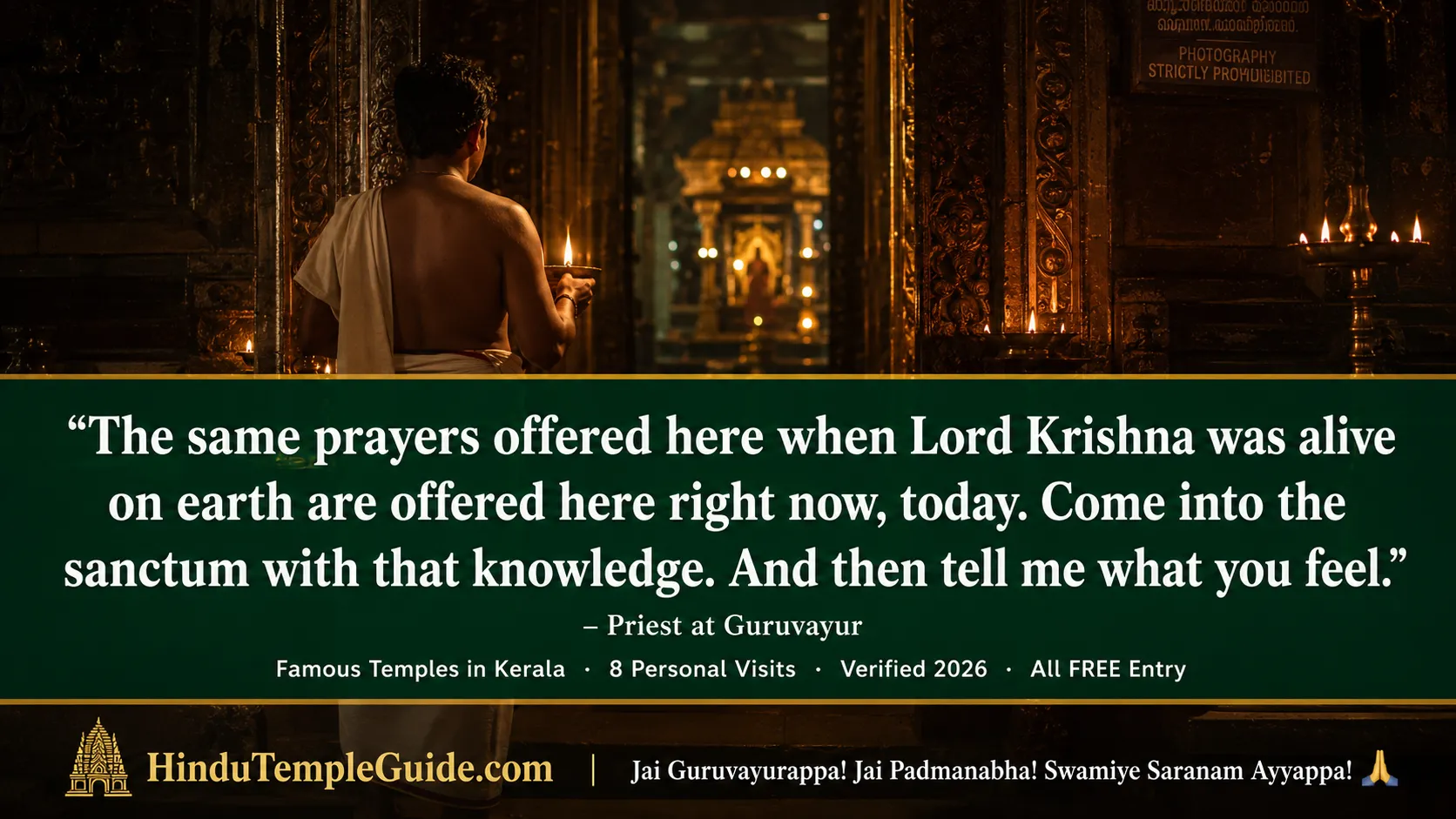
Come to Kerala. The Temples Are Waiting. || Jai Guruvayurappa!
Priest at Guruvayur Temple
I came in with that knowledge. I sat on the temple steps afterward for a long time, not wanting to move. That is what Kerala’s famous temples do to you when you let them. They are not tourist destinations. They are not heritage sites. They are places where something very old and very alive is still happening, quietly, every morning before the rest of the world wakes up.
Wake up at 3 AM. Wear your white mundu or your finest saree. Remove your footwear at the threshold. Let the stone corridors close around you in the dark. And wait for the lamp to be lit. What happens next you will have to find out for yourself.
Jai Guruvayurappa! Jai Padmanabha! Swamiye Saranam Ayyappa!
Sources & Disclaimer: Personal visits 2022–2026. Wikipedia. Britannica (Padmanabhaswamy). Guruvayur Devaswom official (guruvayurdevaswom.in). sabarimalaonline.org. Travancore Devaswom Board. All timings are approximate and may change during festivals always verify on official temple websites before travelling. HinduTempleGuide.com is an independent pilgrim guide. Jai Guruvayurappa!
You May Also Like

Leave a Comment
Your email will not be published. Required fields are marked *