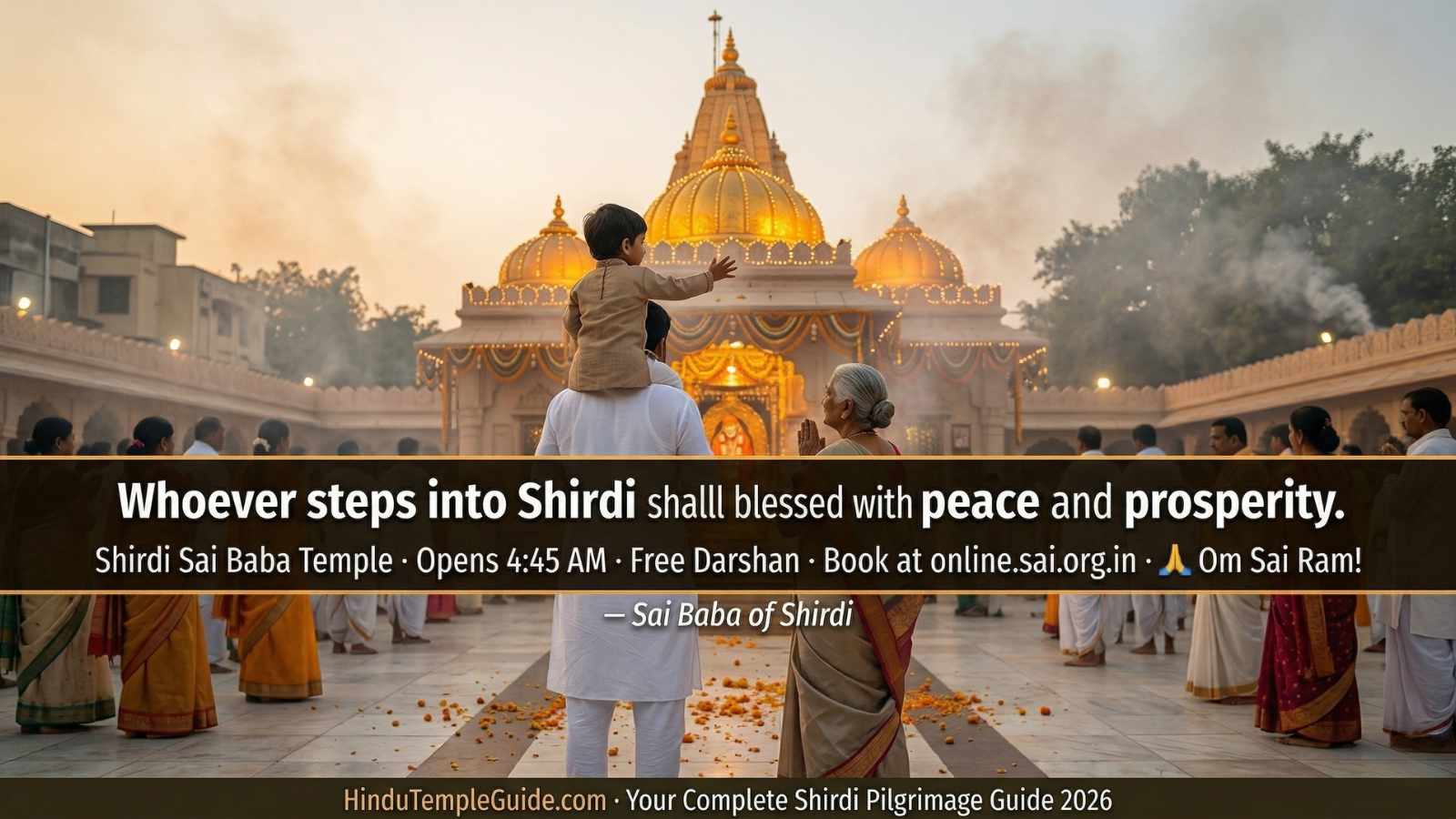
Opens 4:45 AM Daily General Darshan FREE VIP Pass ₹200 Kakad Aarti ₹600 60,000+ Pilgrims/Day All Religions Welcome
Living in Nagpur, Maharashtra, travelling to Shirdi has been an integral part of my spiritual journey for years-taking the Hindu Hrudaysamrat Balasaheb Thackeray Maharashtra Samruddhi Mahamarg across the Deccan plateau, stepping into the temple complex before dawn as the soothing notes of Bhupali fill the cool morning air, and standing before Baba's smiling Italian marble idol inside the Samadhi Mandir. Shirdi is not just a pilgrimage town; it is a living sanctuary of unconditional love and a breathing promise from Sai Baba himself: "Whoever steps onto the soil of Shirdi, their misery shall come to an end."
From a quiet, dilapidated village mosque where an ascetic fakir tended an eternal fire (Dhuni) for sixty years, Shirdi has blossomed into one of the most visited pilgrimage centres on Earth, welcoming over 60,000 to 80,000 devotees daily (and upwards of 1.5 lakh on Thursdays and festival weekends). In this complete 2026-2027 guide, I break down the verified 4-aarti daily schedule, free vs. ₹200 VIP darshan booking on online.sai.org.in, the complete 200-acre sacred complex (Dwarkamai, Chavadi, Gurusthan & Lendi Baug), sacred Udi prasad, free solar meals at Prasadalaya, and travel routes from Mumbai, Pune, Nashik, and Nagpur.
Sabka Malik Ek - There Is One God for All
Sai Baba welcomed people of every background-Hindus, Muslims, Zoroastrians, Christians, and seekers of all faiths. He lived in the mosque Dwarkamai, named it after Lord Krishna's capital, maintained the sacred Dhuni fire, and held Ram Navami and Urs simultaneously. Today, Shirdi represents the most inclusive and harmonious spiritual destination in India.
Shirdi Sai Baba Temple - Essential Information at a Glance (2026-2027)
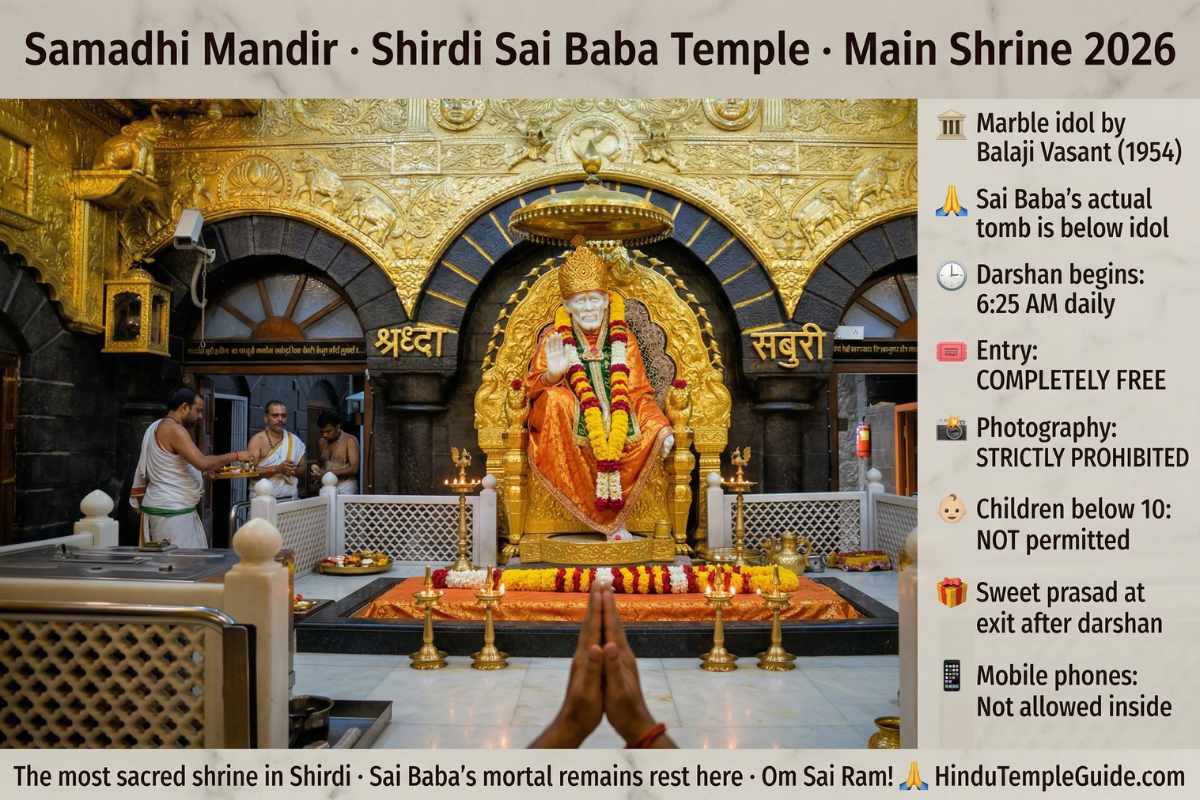
Shri Saibaba Samadhi Mandir - the life-size Italian marble idol (sculpted by Balaji Vasant Talim, 1954) seated above Sai Baba's actual Samadhi tomb. Free general darshan begins 6:25 AM. Photography inside is prohibited. Om Sai Ram!
Shirdi Sai Baba Temple Darshan Timings 2026 - Complete Daily Schedule
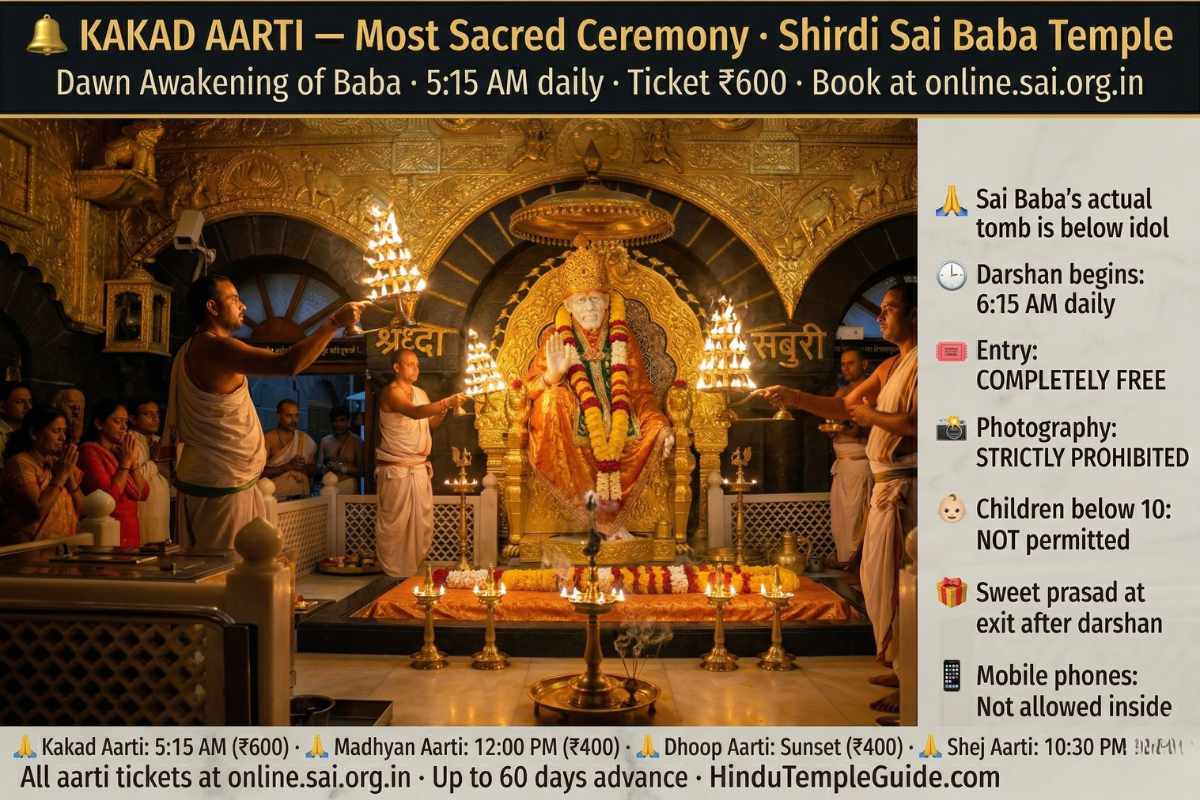
Kakad Aarti at Shirdi Sai Baba Temple - the most spiritually uplifting ceremony of the day at 5:15 AM. Sai Baba is ceremonially awakened with devotional songs and brass deepak flames. Ticket: ₹600/person booked at online.sai.org.in.
Best Daily Darshan Windows:Monday to Wednesday from 6:30 AM to 9:30 AM offers the shortest queues (45-75 mins) and the calmest atmosphere. Thursdays see up to 1.2 lakh devotees with lines extending 3 to 6 hours. Weekdays between 1:30 PM and 4:00 PM offer another calm window. Please note that darshan lines pause completely inside the Samadhi Mandir during all four daily Aarti sessions.
Time
Activity / Ritual
Devotee Notes & Entry Rules
4:45 AM
Temple Opens
Gate queues activated & morning security checks begin
5:00 AM
Bhupali
Sacred morning awakening songs sung to Baba; deeply peaceful
5:15 - 5:50 AM
1. KAKAD AARTI
Most sacred aarti · Ticket ₹600 · Book 30-60 days ahead at online.sai.org.in
5:50 AM
Mangal Snaan (Holy Bath)
Marble idol of Sai Baba is ceremonially bathed with rose water and milk
6:20 AM
Shirdi Majhe Pandharpur Aarti
Traditional hymn celebrating Shirdi as the Pandharpur of Kali Yuga
6:25 AM
General & VIP Darshan Begins
FREE General & ₹200 VIP Darshan · Best queue time: 6:25-9:30 AM
11:30 AM
Dhuni Pooja at Dwarkamai
Sacred wood, camphor & ghee offered to the eternal fire; must-witness
Night lullaby closing ritual · Baba prepared for rest · Ticket ₹400
~11:15 PM
Temple Closes for Night
Sanctum doors lock until 4:45 AM next morning
2
Who Was Sai Baba of Shirdi? The Saint Who Transcended All Boundaries
Quick Historical Summary: Sai Baba arrived in Shirdi around 1858 CE as a young ascetic of about sixteen years old, living beneath a sacred neem tree at Gurusthan and eventually making the dilapidated mosque Dwarkamai his permanent home for over sixty continuous years until his Mahasamadhi on Vijayadashami (October 15, 1918). Revered by Hindus as an avatar of Lord Dattatreya and Shiva and by Muslims as an enlightened Auliya / Sufi Pir, his entire life was anchored in two pillars: Shraddha (unwavering faith) and Saburi (patient endurance).
What makes Sai Baba unique in the entire panorama of Indian spirituality is his deliberate dismantling of religious barriers. He lived in a mosque, planted a Hindu tulsi vrindavan in its courtyard, named the mosque Dwarkamai (Mother Dwarka), celebrated Diwali with oil lamps and Eid with equal joy, and constantly recited both "Allah Malik" and the names of Rama and Krishna. When he took Mahasamadhi on October 15, 1918, his body was laid to rest inside the stone wada built by his wealthy Nagpur devotee Shrimant Gopalrao Buti (Buti Wada), which today forms the world-famous Samadhi Mandir.
Shraddha & Saburi
His two core teachings: Shraddha (total surrender of the heart) and Saburi (peaceful, enduring patience) remain the foundation of daily Sai devotion worldwide.
Dwarkamai & The Eternal Dhuni
He lived in this sacred mosque for over 60 continuous years, grinding wheat for the village, healing the sick, and feeding birds and dogs before taking a single bite himself.
Vijayadashami Mahasamadhi
Leaving his physical body on October 15, 1918, his funeral was attended by devotees of all communities-leaving behind eleven sacred promises that he would forever respond from his tomb.
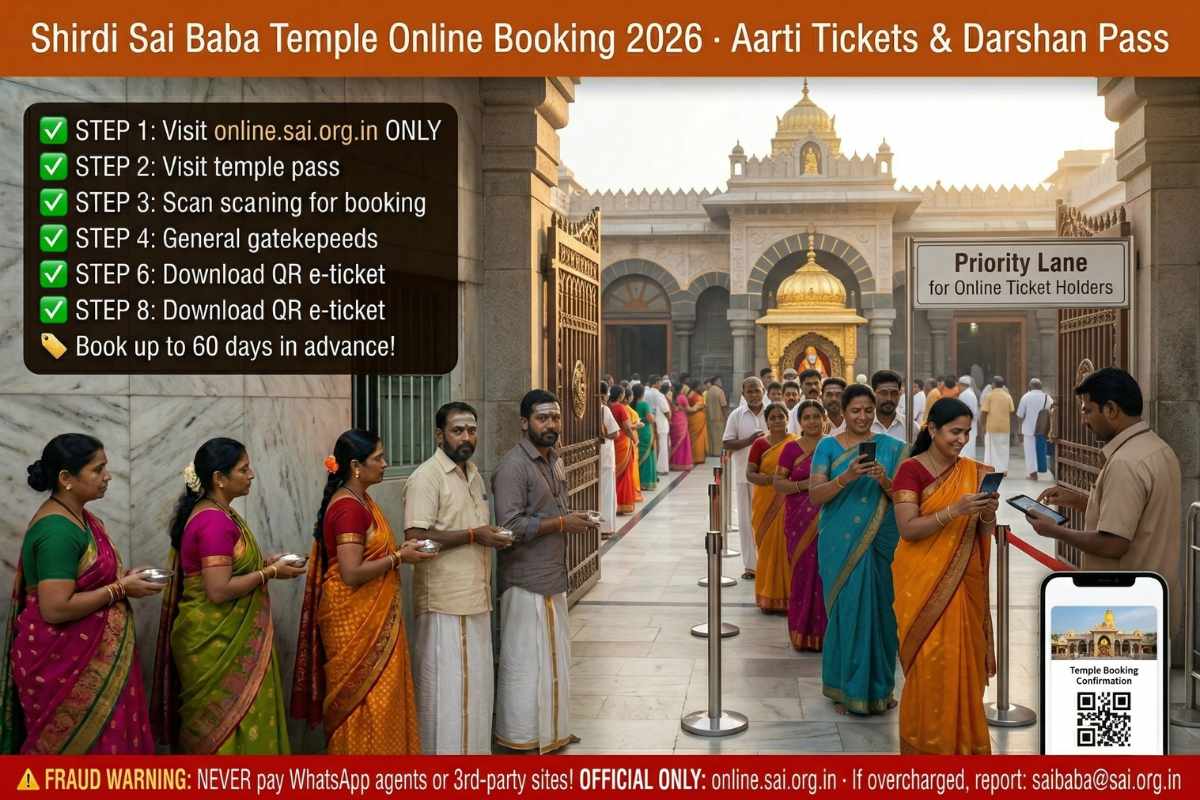
Official online booking for Shirdi Sai Baba Temple - book Aarti tickets (Kakad ₹600 / others ₹400), ₹200 VIP Darshan, and Sansthan accommodation exclusively at online.sai.org.in.
Quick Booking Summary: Go to online.sai.org.in → Sign in via Mobile OTP → Choose Free Slotted Darshan, Paid VIP Darshan (₹200), or Aarti Pass (₹400-₹600) → Enter Devotee Details & Photo ID → Pay online → Download QR E-Pass. Quotas open up to 60 days in advance.
Step-by-Step Booking Guide on online.sai.org.in
1
Visit the ONLY Official Booking Portal: Open online.sai.org.in (maintained directly by Shri Saibaba Sansthan Trust). Never book on third-party travel sites charging inflated fees.
2
Log In via Mobile Number & OTP: Enter your 10-digit mobile number, receive the OTP, and create or access your devotee profile. Keep a digital passport photo ready for profile completion.
3
Select Service (Free Darshan, ₹200 VIP Pass, or Aarti): Choose between Free Time-Slotted Darshan, Special / VIP Darshan (₹200/person), or a sitting pass for one of the four daily Aartis (Kakad: ₹600; Madhyan/Dhoop/Shej: ₹400). Note: Aarti passes include sitting during the aarti but are separate from general darshan lines.
4
Enter Devotee Details & Government ID: Enter full name, age, and ID number (Aadhaar, Voter ID, PAN, or Passport for foreign nationals) for each member. Children under 12 do not require a separate pass when accompanying parents for general darshan.
5
Pick Your Date and Time Slot: Thursday slots and major festival dates (Ram Navami, Guru Purnima, Vijayadashami) fill 20-30 days ahead. Pick morning slots (7:00-10:00 AM) or quiet afternoon slots (1:00-3:00 PM).
6
Pay & Download Printed E-Pass: Complete payment via UPI, debit/credit card, or net banking. Download and print the PDF ticket-carry the printed paper copy and original ID to the designated entry gate.
Service / Pass Type
Official Tariff & Inclusions
General Darshan (Dharma Darshan)
100% FREE · Open to all without any ticket (slotted free pass online recommended)
VIP / Special Darshan Pass
₹200 / person · Fast-track dedicated line (15-45 mins vs 2-4 hrs general)
₹400 / person · Midday, twilight, or closing bedtime aartis
Senior Citizens (65+) & Differently-Abled
Dedicated priority access via Gate No. 3 with original age/medical proof
FRAUD & TOUT ALERT: Beware of touts hanging around hotel lobbies and travel kiosks in Shirdi claiming to provide "instant VIP darshan for ₹1,000-₹2,500." The official Sansthan VIP pass costs exactly ₹200, and Aarti passes cost ₹400-₹600 ONLY. Never pay unofficial agents. Report fraud directly to Sansthan security or email saibaba@sai.org.in.
4
Inside the Sacred Temple Complex - The Complete Pilgrimage Circuit
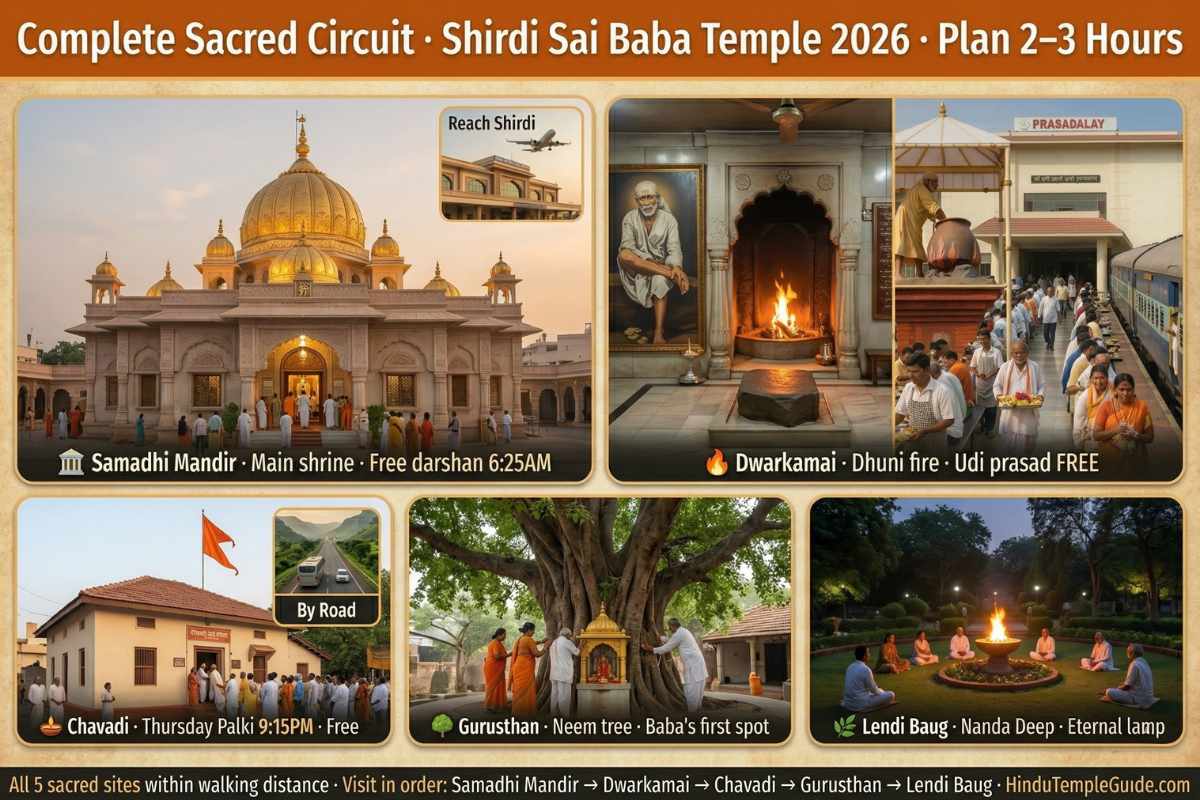
The complete Shirdi sacred circuit (plan 2.5-3 hours): Samadhi Mandir → Dwarkamai (Dhuni fire & free Udi) → Chavadi (Thursday Palkhi) → Gurusthan (neem tree) → Lendi Baug (Nanda Deep) → Dixit Wada Museum. All are within easy walking distance.
The Shri Saibaba Sansthan complex covers over 200 acres and comprises six sacred landmarks. Many hurried visitors only queue at the Samadhi Mandir and miss the deep emotional and spiritual intimacy of the full circuit. Plan 2 to 3 hours to visit all sites on foot:
1. Samadhi Mandir - The Sacred Tomb & Marble Sanctum
Originally built as a private rest house by Nagpur millionaire Shrimant Gopalrao Buti (Buti Wada), this grand stone building houses Sai Baba's physical resting place (Samadhi). Above the tomb rests the life-size Italian marble idol carved by Balaji Vasant Talim (1954), crowned in gold and wrapped in royal shawls. Sweet bundi prasad is distributed at the exit. Mobile phones and cameras are strictly banned inside.
2. Dwarkamai - The Sacred Mosque Where Baba Lived for 60 Years
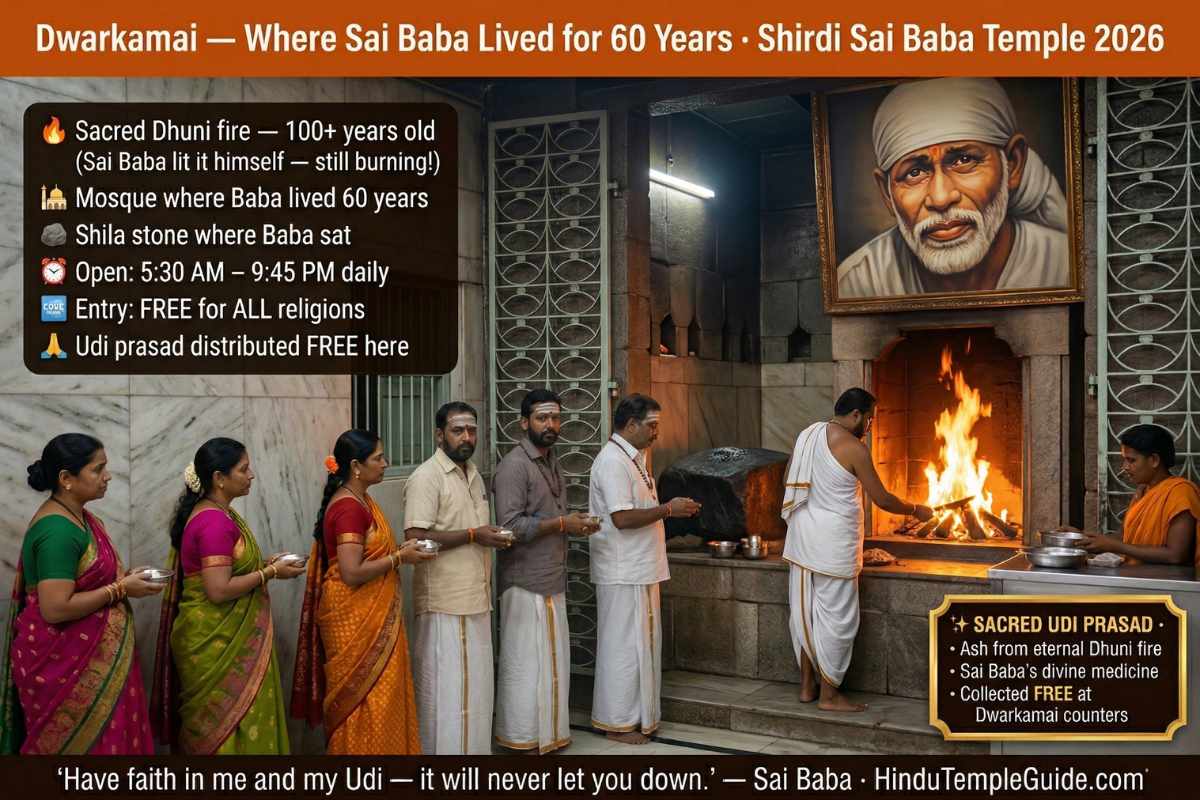
Just 100 metres from the Samadhi Mandir, Dwarkamai is the most spiritually charged site in Shirdi. Here Baba cooked meals for devotees, slept on a wooden plank, and lit the sacred Dhuni fire that has burned continuously for over 130 years. Free sacred ash (Udi) is distributed here. You can also see the stone slab (Shila) where Baba sat, his water pot (Tumrel), and the stone mortar (Kolamba). Timings: 5:30 AM-9:45 PM. Open to all faiths.
3. Chavadi - Where Baba Slept on Alternate Nights
Located directly opposite Dwarkamai, Chavadi is divided into two sections. From 1909 until 1918, Baba spent alternate nights sleeping here. This tradition lives on every Thursday night at ~9:15 PM in the famous Palkhi Procession, when Baba's photo and padukas are carried in a silver palanquin from the Samadhi Mandir to Chavadi accompanied by traditional bhajan mandalis, dhol-tasha, and thousands of singing devotees.
4. Gurusthan - Where Young Sai Baba First Appeared
Located under an ancient neem tree, this marks the spot where a sixteen-year-old Sai Baba was first seen meditating in yogic stillness. Baba pointed to this spot as the resting place of his own Guru. The neem tree's leaves are traditionally believed to be miraculously sweet. A small shrine housing a Shivalinga and Nandi stands beside the tree.
5. Lendi Baug - Sai Baba's Personal Garden & Nanda Deep
A peaceful green garden tended by Baba himself, who watered plants daily using earthen pots. Beneath a pipal tree sits the Nanda Deep-an eternal earthen lamp lit by Baba that has remained illuminated day and night between two trees for over a century. It is the most tranquil spot in the complex for quiet contemplation and meditation. Timings: 5:30 AM-9:30 PM.
6. Dixit Wada Museum - Rare Personal Articles of Sai Baba
Located right inside the complex near Gurusthan, this free museum houses authentic belongings used by Sai Baba-including his long robe (Kafni), leather sandals (Padukas), cooking pots, smoking pipe (Chillum), gramophone records, and black-and-white original photographs from the early 1900s. Takes 30-45 minutes. Free entry.
Sacred Spot
Walking Distance · Timings · Spiritual Focus
Samadhi Mandir
Main complex · 4:45 AM-11:15 PM · Marble idol, sacred tomb, prasad at exit
Dwarkamai
~100 m from Mandir · 5:30 AM-9:45 PM · Eternal Dhuni, free Udi counter, Shila
Chavadi
~100 m from Dwarkamai · 5:30 AM-9:00 PM · Thursday Palkhi Procession (9:15 PM)
Gurusthan
~50 m from Mandir · Open all day · Neem tree, Shivalinga, Baba's first appearance
Lendi Baug
~300 m east · 5:30 AM-9:30 PM · Perpetual Nanda Deep lamp, meditation garden
Sacred Udi, Sweet Prasad & Free Meals at Prasadalaya
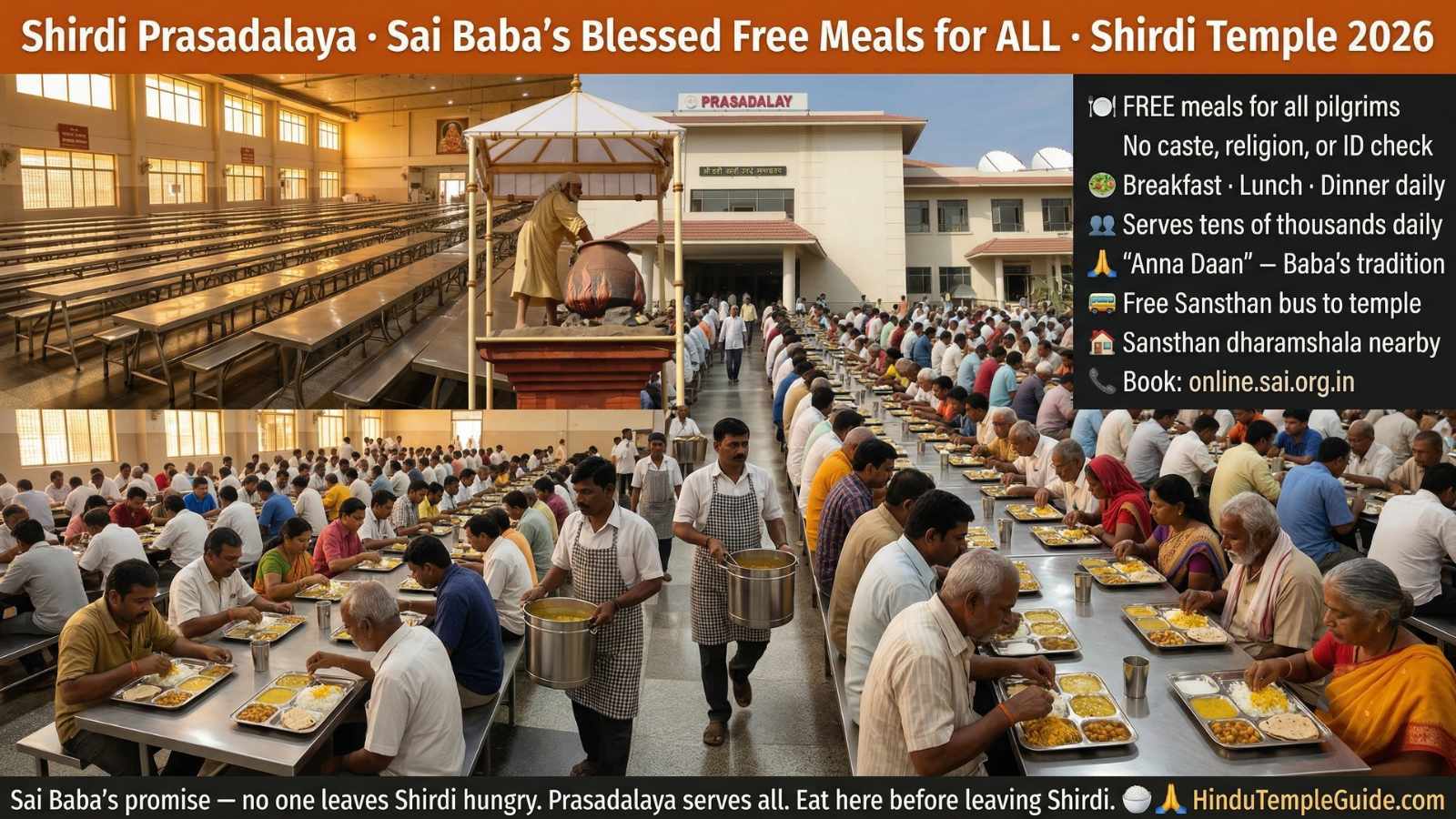
Dwarkamai - where Sai Baba lived for over 60 years. The sacred Dhuni fire he lit still burns continuously. Sacred Udi (ash) is distributed free at Dwarkamai counters as blessed divine medicine. Sabka Malik Ek!Shri Sai Prasadalaya - one of the largest solar-powered community kitchens in the world, serving freshly cooked, blessed satvik meals (dal, rice, chapati, vegetables, and sweet) to over 40,000 to 80,000 pilgrims every day.
Udi (Sacred Ash) - Distributed Free at Dwarkamai: Udi is the ash from the eternal Dhuni fire lit by Baba himself in Dwarkamai. Baba gave Udi to cure physical ailments and remove suffering, saying: "Trust in me and my Udi-it will never let you down." Packets are distributed completely FREE at designated counters inside and outside Dwarkamai. Apply a pinch to your forehead as a tilak or keep it in your home mandir as divine protection.
Sweet Bundi Prasad - Samadhi Mandir Exit: Right after having darshan of Baba's idol, every devotee receives a packet of sweet boondi prasad at the exit gate, received with both hands in traditional reverent fashion. Packets of dry laddoos are also available for purchase at subsidized Sansthan counters.
Free Anna Daan at Shri Sai Prasadalaya: Located about 1 km from the temple (connected by free Sansthan shuttle buses every 5 minutes), the massive solar-powered Prasadalaya can seat over 5,500 devotees simultaneously. Hot, nutritious vegetarian meals (dal, rice, sabzi, roti, and sweet halwa) are served from 10:00 AM to 10:00 PM daily with zero caste, religion, or background distinction. A visit to Shirdi is incomplete without partaking in Baba's Anna Daan!
Shawl & Chaddar Offering: Devotees can offer a new shawl or floral chadar at the Sansthan donation counter. It is ceremonially draped over Sai Baba's murti during the day and returned to the devotee as consecrated prasad. Bookings can be made online via online.sai.org.in.
6
How to Reach Shirdi Sai Baba Temple (2026-2027)
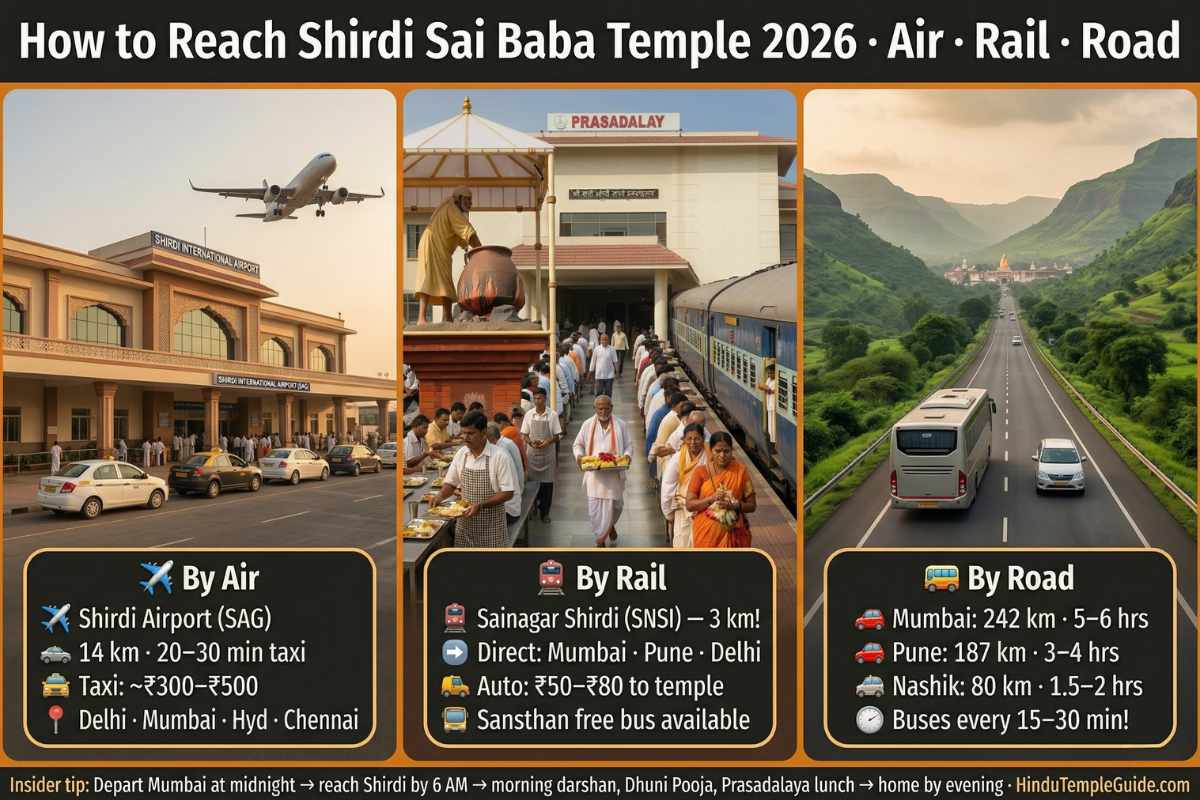
How to reach Shirdi - Flight: Shirdi International Airport (SAG - 14 km) · Train: Sainagar Shirdi (SNSI - 3 km) or Kopargaon (17 km) · Road: Fast access via Samruddhi Mahamarg from Mumbai, Pune, Nashik & Nagpur.
Quick Travel Summary:By Air: Shirdi International Airport (SAG) is 14 km away (taxi ₹350-₹500, 20 mins) with direct flights from Mumbai, Delhi, Bengaluru, Hyderabad, and Chennai. By Train: Sainagar Shirdi Station (SNSI) is just 3 km (auto ₹60-₹100) or Kopargaon (17 km). By Highway: Fast connectivity via the Samruddhi Mahamarg from Mumbai, Pune, and Nagpur!
By Rail - Nearest Stations to Shirdi
Railway Station
Distance
Last-Mile Transport & Notes
Sainagar Shirdi (SNSI)
3 km · 10 min
Direct Vande Bharat from Mumbai CSMT (5 hrs 20 min) · Shared auto ₹20/seat, full auto ₹80-₹100 · Free Sansthan bus
Kopargaon (KPG)
17 km · 25-30 min
Major stop on Mumbai-Bhusawal main rail line · Shared taxi/auto ₹50/seat, private cab ₹300-₹450
Manmad Junction (MMR)
60 km · 75-90 min
Major central railway junction connecting Delhi, Kolkata, Chennai & Nagpur · MSRTC bus ₹85, taxi ₹1,200-₹1,500
By Road & Samruddhi Mahamarg Routes
From City
Distance
Driving Time
Route & Travel Tip
Mumbai
242 km
4.5-5.5 hrs
Via Samruddhi Mahamarg (Igatpuri exit) or NH-160 via Nashik · Mumbai CSMT-Shirdi Vande Bharat is fastest
Pune
187 km
3.5-4 hrs
Via Pune-Nashik Highway (NH-60) via Sangamner · MSRTC Shivshahi AC buses depart Shivaji Nagar hourly
Nashik
85 km
1.5-2 hrs
Via NH-160 via Sinnar · Combine Shirdi with Trimbakeshwar Jyotirlinga and Panchavati
Nagpur
580 km
6.5-7.5 hrs
Direct access via Samruddhi Mahamarg expressway (smooth 120 km/h access from Vidarbha)
Chh. Sambhajinagar (Aurangabad)
110 km
2 hrs
Via Samruddhi Mahamarg · Easy 1-day link with Grishneshwar Jyotirlinga and Ellora Caves
First-Hand Road Timing Tip: If driving from Mumbai or Pune, depart between 1:00 AM and 2:30 AM to reach Shirdi by 6:00 AM. You will completely bypass city bottlenecks, catch the peaceful morning Bhupali and early morning darshan, and enjoy fresh breakfast at the Prasadalaya before temple crowds swell at 10:00 AM!
7
Where to Stay in Shirdi - Official Sansthan Bhaktniwas & Hotels (2026)
Accommodation Tier
Options, Tariffs & Booking Details
Sansthan Bhaktniwas (Best Value)
Sai Ashram Bhaktiniwas (over 1,500 AC/Non-AC rooms, ₹200-₹900/night) · Dwarawati Bhaktiniwas (right opposite temple) · Sai Baba Bhaktaniwas (500-Room) · Book at online.sai.org.in · Includes free round-the-clock Sansthan bus to temple
Budget & Mid-Range Hotels
₹1,000-₹2,800/night · Hundreds of private family hotels along Nagar-Manmad Road and Pimpalwadi Road within 500 m of temple gates
3-Star & Boutique Hotels
₹3,000-₹6,500/night · Sun-n-Sand Shirdi, St. Laurn, Marigold, Hotel Sai Jashan, and Keys Hotel Temple Tree with full family amenities and restaurants
Luxury & Resort Stays
₹6,500-₹12,000+/night · Heritage resorts 3-8 km outside town providing peaceful gardens, swimming pools, and dedicated temple VIP shuttle drops
Accommodation Booking Tip: For Thursdays, Ram Navami (March/April), Guru Purnima (July), and Vijayadashami (October), Sansthan Bhaktniwas rooms open 60 days ahead at online.sai.org.in and sell out in hours. The Sansthan's green shuttle buses run continuously every 5 to 10 minutes between Sai Ashram and the temple gates free of charge.
8
Dress Code, Security Rules & What to Know Before Visiting
Dress code at Shirdi Sai Baba Temple - Traditional Indian attire (kurta-pyjama, dhoti, saree, or salwar suit) is recommended. Mobile phones, cameras, and large luggage bags must be deposited at free Sansthan cloakroom counters.
Devotee Category
Sansthan Dress Code & Guidelines
Men
Kurta-pyjama, dhoti, or formal full-length trousers with shirt · Shorts, bermudas, and sleeveless vests are strictly barred
Women
Saree, salwar-kameez, or churidar with dupatta · Shoulders and knees must be respectfully covered · Shorts, mini-skirts, and sleeveless tops are not permitted
Footwear & Luggage
Leave shoes and large bags at the numbered Sansthan counters outside the gate before queue entry
DO
Carry original government photo ID (Aadhaar / Passport)
Carry a printed paper copy of your VIP or Aarti pass
Collect sacred Udi prasad from Dwarkamai
Eat a wholesome blessed meal at the Prasadalaya
Use the free Sansthan shuttle bus between Bhaktniwas & temple
Children of all ages are welcome (keep little ones accompanied)
DON'T
Take photos or shoot reels inside Samadhi Mandir or Dwarkamai
Use mobile phones inside the sanctum perimeter
Carry large backpacks or sharp objects into queues
Pay unauthorized touts outside for "quick darshan"
Carry cigarettes, bidi, gutkha, or alcohol
Leave without completing the peaceful Dwarkamai & Chavadi walk
9
Best Time to Visit Shirdi Sai Baba Temple & Key Festivals
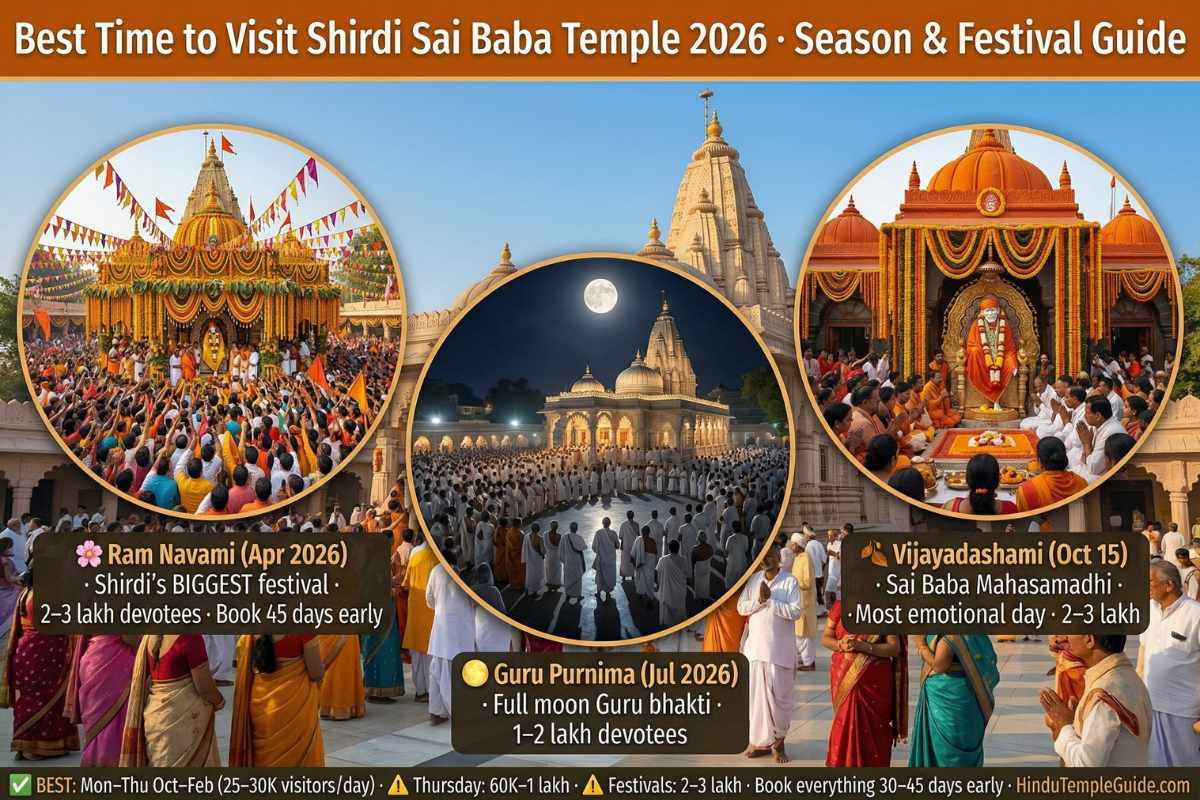
Best time to visit Shirdi: October to March on weekdays (Monday to Wednesday) for pleasant 18°C-28°C weather and shortest queues. Key festivals: Ram Navami (March/April), Guru Purnima (July), and Vijayadashami Mahasamadhi (October).
Most sacred weekly day · 80,000-1,20,000+ devotees · Book ₹200 VIP pass online · Thursday Night Palkhi Procession (9:15 PM) is unmissable
Weekends (Sat & Sun)
High footfall from Mumbai and Pune · 2 to 4 hour general queues · VIP Darshan pass strongly advised
Ram Navami (March/April)
Shirdi's biggest festival celebrated since 1897 · 2 to 3 lakh devotees · Simultaneous Urs celebrations · Book 45 days ahead
Guru Purnima (July)
The supreme festival for Guru Bhakti · 2 lakh devotees arrive to offer dakshina to Baba · All-night temple openings
Vijayadashami (October 15)
Sai Baba Mahasamadhi Day (1918) · The most emotionally moving 3-day festival of the year · Massive Brahman Bhojan
Oct-Feb (Pleasant Season)
Pleasant 15°C-28°C weather · Ideal for senior citizens and exploring nearby Nashik or Shani Shingnapur
10
Places to Visit Near Shirdi - Regional Temple Circuit
Shani Shingnapur (65 km · 1.5 hrs via Rahuri): World-famous Swayambhu Shani Dev temple where village houses have zero doors or locks because Lord Shani is believed to protect the entire town from theft. Most pilgrims combine Shirdi + Shani Shingnapur in a single day.
Nashik & Trimbakeshwar Jyotirlinga (85 km · 2 hrs): Home to Trimbakeshwar Jyotirlinga (source of the sacred Godavari River), Panchavati, Sita Gufa, Kalaram Mandir, and Ramkund. Perfect 1-night extension from Shirdi.
Ellora Caves & Grishneshwar Jyotirlinga (110 km · 2 hrs): UNESCO World Heritage Ellora Caves (including the monolithic Kailasa Temple Cave 16) paired with Grishneshwar, the 12th and final Jyotirlinga, easily reached via the Samruddhi Mahamarg.
Saptashrungi Devi Temple, Vani (140 km · 3 hrs): Revered as the Half-Peetha among Maharashtra's Saade Teen Shakti Peethas, perched on a mountain cliff with 510 steps (and a modern funicular ropeway).
Sai Heritage Village (2.5 km): A cultural theme park recreating Shirdi's rustic village life and Baba's miracles during the late 19th century-ideal for children and family storytelling.
❓
FAQs - Shirdi Sai Baba Temple (2026-2027)
Q1. Is darshan at Shirdi Sai Baba Temple completely free?
Yes, general darshan (Dharma Darshan) is 100% FREE for all visitors of every religion. No pass or fee is required to enter the regular queue. If you wish to fast-track your entry, you can purchase an optional Special / VIP Darshan Pass for ₹200 per person online at online.sai.org.in or at the Sansthan PR office counters.
Q2. Which is the most important aarti at Shirdi, and how much do aarti tickets cost?
Kakad Aarti at 5:15 AM is the most sacred and sought-after-the dawn ceremonial awakening of Sai Baba. Tickets for Kakad Aarti cost ₹600 per person. The other three aartis-Madhyan Aarti (12:00 PM), Dhoop Aarti (sunset), and Shej Aarti (10:30 PM)-cost ₹400 per person. All four must be booked in advance at online.sai.org.in.
Q3. Are children allowed for darshan at Shirdi Sai Baba Temple?
Yes, children of all ages are welcome at Shirdi! The restriction on children below 10 was a temporary COVID-19 measure from 2020-2021 that was completely lifted. Children below 12 years enter free with their parents for general darshan without needing a separate ticket (carry an Aadhaar card or birth certificate for age verification).
Q4. What is the Thursday Palkhi Procession at Shirdi?
Every Thursday at ~9:15 PM, Sai Baba's silver palanquin (Palkhi) carrying his photograph and sacred padukas is carried in a royal procession from the Samadhi Mandir through Dwarkamai to Chavadi, commemorating the nights Baba slept at Chavadi. Surrounded by dhol-tasha, fragrant flowers, and thousands of devotees chanting "Sai Nath Maharaj Ki Jai", it is completely free to witness and is one of the most moving weekly traditions in India.
Q5. What is Udi and where do I get it at Shirdi?
Udi is the sacred ash from the Dhuni fire at Dwarkamai lit by Sai Baba over 130 years ago. He used Udi to heal diseases and bestow spiritual peace. At Shirdi, packets of Udi are distributed completely FREE at designated counters inside and beside Dwarkamai. Devotees apply it to the forehead as a protective blessing and carry it home for family members.
Q6. Can people of any religion visit Shirdi Sai Baba Temple?
Absolutely. Devotees of all religions are warmly welcomed at Shirdi. Sai Baba lived in a mosque (Dwarkamai), celebrated Hindu and Islamic festivals together, and preached "Sabka Malik Ek". People of all faiths worship together inside the Samadhi Mandir and eat side-by-side at the free Prasadalaya.
"Whoever steps onto the soil of Shirdi, their misery shall come to an end." - Sai Baba. Om Sai Ram!
Begin Your Shirdi Pilgrimage 2026-2027 · Om Sai Ram!
Have questions about booking Kakad Aarti, staying at Sai Ashram Bhaktniwas, or driving via the Samruddhi Mahamarg? Send me a message here-as a fellow Maharashtra pilgrim from Nagpur, I read and reply to every message personally. - Devendra Khambalkar
Written by Devendra Khambalkar, Nagpur, Maharashtra | Last updated: October 2026. Shirdi Sai Baba Temple timings, Aarti rates, and booking procedures are verified from first-hand visits and official Shri Saibaba Sansthan Trust portals (sai.org.in and online.sai.org.in). Because schedules and VIP quotas may be adjusted during Ram Navami, Guru Purnima, and Vijayadashami, always confirm live slot availability on the official website before travelling. Om Sai Ram!
DK
Written by Devendra Khambalkar
Based in Nagpur, Maharashtra. Personally visited 50+ sacred shrines across India including Tirupati, Guruvayur, Vaishno Devi, Somnath, Mahakaleshwar Ujjain, and completed the Char Dham Yatra.