26-27 March 2026 · Madhyahna Moment 12:27 PM · Ayodhya Ram Mandir Surya Tilak
26-27 March 2026Madhyahna 12:27 PMFree Darshan GuideJai Shri Ram!
Quick Summary
In 2026, Chaitra Shukla Navami fell across Thursday, March 26 (Smarta Ram Navami) and Friday, March 27 (Vaishnava / Ayodhya Udaya Tithi Ram Navami), with the sacred Madhyahna birth moment at 12:27 PM and the 12:00 PM Surya Tilak illuminating the forehead of Bhagwan Shri Ram Lalla at the Ayodhya Ram Mandir. Looking ahead, Ram Navami 2027 falls on Thursday, April 15, 2027 (Madhyahna Muhurat: 11:04 AM - 1:38 PM). This complete guide covers exact Panchang timings, the opto-mechanical science of the Surya Tilak, Ayodhya darshan rules, famous Ram temples across India, home puja vidhi, and vrat rules.
Every year on the ninth day of Chaitra Shukla Paksha, streets and temple courtyards across India come alive with the sound of conch shells, dhol-tasha processions, and verses from the Ramcharitmanas. From historic shrines like Ramtek Gad Mandir near my hometown of Nagpur and Kalaram Mandir in Nashik to the banks of the Saryu in Ayodhya, millions of devotees gather at midday to celebrate the birth of Maryada Purushottam Bhagwan Shri Ram. And inside the newly constructed Shri Ram Janmabhoomi Mandir in Ayodhya, a focused beam of natural sunlight descends through brass optical tubes at noon to form a glowing 58 mm Surya Tilak right on the forehead of five-year-old Ram Lalla.
Whether you are planning an Ayodhya yatra for Ram Janmotsav, looking up the exact Madhyahna Muhurat timings for 2026 and 2027, or preparing for the Bal Swaroop Jhula puja and vrat at home, I have compiled every verified ritual and travel detail below.
SECTION 1
What Is Ram Navami and Why Is the Ayodhya Celebration So Special?
Ram Navami (Shri Ram Janmotsav) celebrates the birth anniversary of Bhagwan Shri Ram-the seventh avatar of Lord Vishnu-who manifested in Ayodhya during the Treta Yuga to King Dasharatha and Queen Kausalya following the sacred Putrakameshti Yagna conducted by Sage Rishyasringa and Maharishi Vashishtha. According to the Valmiki Ramayana (Bala Kanda, Sarga 18), Lord Ram was born on the ninth lunar day (Navami Tithi) of the bright fortnight of Chaitra under the Punarvasu Nakshatra and Karka Lagna at the auspicious midday hour (Abhijit / Madhyahna Muhurat). The festival also marks the grand culmination of the nine-day Chaitra Navratri fast.
Following the historic Pran Pratishtha of the Shri Ram Janmabhoomi Mandir on 22 January 2024, the 2026 Ram Navami celebration in Ayodhya stood out for two reasons:
1. Third Grand Ram Janmotsav Inside the Consecrated Ram Mandir (With Completed Shikhara & Ram Darbar)
Following the inaugural 2024 and 2025 celebrations, the 2026 festival marked the third Ram Janmotsav inside the new temple-and the first with the full 161-foot main Shikhara, the first-floor Shri Ram Darbar, and the 732-metre Parkota complex completed.
2. The Permanent 19-Year Opto-Mechanical Surya Tilak System
Engineered by scientists at CSIR-CBRI Roorkee and the Indian Institute of Astrophysics (IIA, Bengaluru), the permanent brass-and-lens mechanism tracks the 19-year Metonic lunar-solar cycle-channelling a 58 mm beam of natural midday sunlight straight onto Ram Lalla's forehead without electricity or batteries.
SECTION 2
Ram Navami 2026 & 2027 Dates and Exact Muhurat Timings
Because the Chaitra Shukla Navami Tithi in 2026 began at 11:48 AM on Thursday, March 26 and prevailed at sunrise (Udaya Tithi) on Friday, March 27 until 10:06 AM, household Smarta traditions observed Ram Navami on March 26 (when Navami overlapped the entire midday Madhyahna window), whereas Vaishnava sampradayas and the Shri Ram Janmabhoomi Mandir in Ayodhya celebrated Ram Janmotsav and performed the Surya Tilak on March 27, 2026:
Thursday, April 15, 2027 (Navami: 3:23 PM on Apr 14 to 1:20 PM on Apr 15)
Ram Navami 2027 Madhyahna Muhurat
11:04 AM - 1:38 PM on April 15, 2027 (Madhyahna Moment: 12:21 PM)
Puja Timing Guide: Begin your home Sankalp and Panchamrit Abhishekam at the start of the Madhyahna Muhurat (11:13 AM in 2026 / 11:04 AM in 2027), perform the Jhula Jhulana (cradle rocking ceremony) and birth aarti right at the midday moment (12:00-12:27 PM), and conclude with prasad distribution before 1:41 PM.
The Surya Tilak-a 58 mm beam of natural sunlight directed onto the forehead of Ram Lalla at noon on Ram Navami-was engineered by scientists from CSIR-CBRI Roorkee and the Indian Institute of Astrophysics (IIA), Bengaluru.
SECTION 3
What Is the Surya Tilak? The Science and Spirituality Behind It
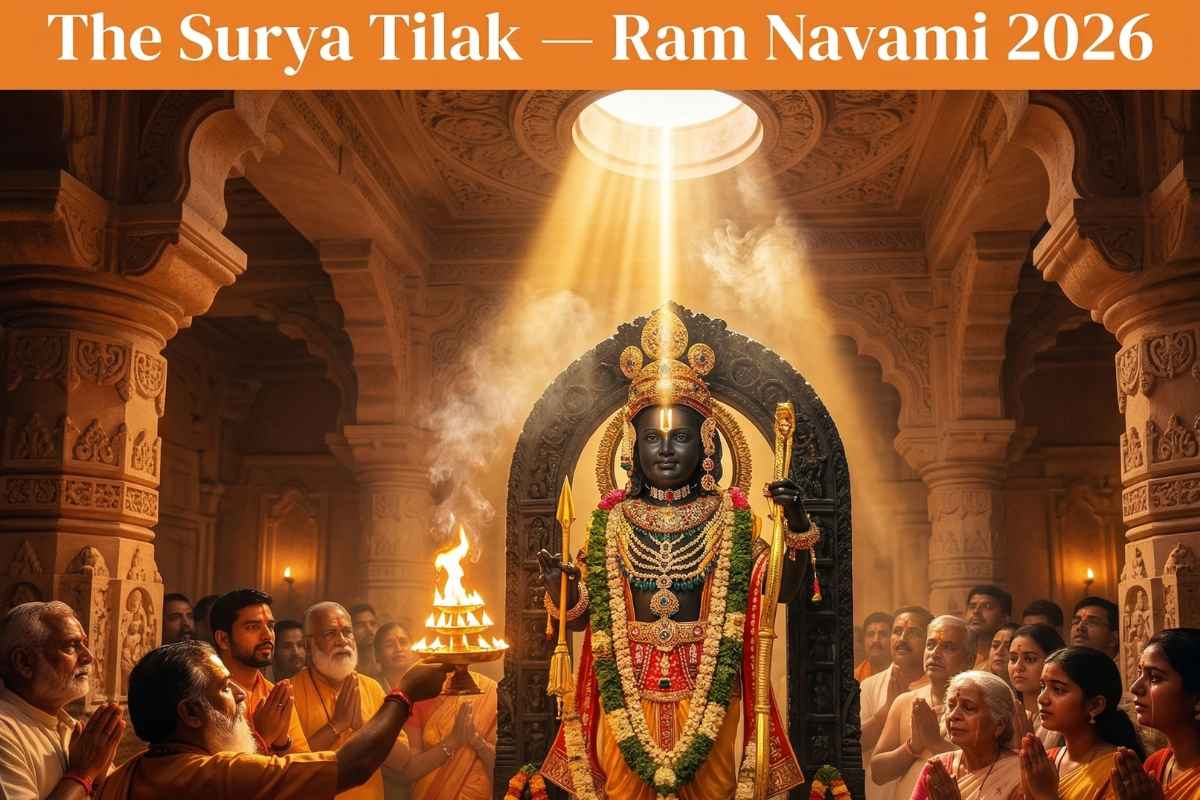
Surya Tilak at Ayodhya Ram Mandir - 12:00 PM Noon
A 58 mm circular beam of natural sunlight lands directly on Ram Lalla's forehead at the midday birth hour-where ancient astronomy and devotion meet.
Because Bhagwan Shri Ram was born in the Ikshvaku / Suryavamsha (Solar Dynasty), where Surya Deva is revered as the ancestral deity (Kuladevata), the Shri Ram Janmabhoomi Teerth Kshetra Trust commissioned a permanent optical system so that the Sun God himself anoints the child Lord's brow every Ram Navami. Engineered jointly by scientists at the Central Building Research Institute (CSIR-CBRI, Roorkee) and the Indian Institute of Astrophysics (IIA, Bengaluru) (and fabricated by Optica, Bengaluru), this system channels natural midday sunlight from the third-floor roof down into the dark stone Garbha Griha.
As the clock strikes 12:00 PM noon during the birth aarti on Ram Navami, sunlight enters an aperture near the third-floor shikhara, reflects through four precision lenses and four brass-mounted mirrors at 90-degree angles, and illuminates a 58 mm golden tilak of light on the centre of Ram Lalla's black-stone forehead for 4 to 5 minutes.
How the Opto-Mechanical Surya Tilak Works
4 Lenses & 4 Mirrors in Brass Tubes: High-grade optical lenses and mirrors are mounted inside corrosion-proof brass piping (with zero iron or steel) running vertically from the third floor to the ground-floor sanctum.
Zero Electricity or Batteries: The entire mechanism is 100% passive and mechanical, designed to function for centuries without motors, sensors, or electronic circuits.
19-Gear Metonic Cycle Adjuster: Because Ram Navami follows the Hindu lunar calendar while the sun's position follows the solar calendar, a precision 19-gear mechanical gearbox shifts the tilt of the top sun-receiving mirror each year across a 19-year astronomical cycle before repeating.
4 to 5 Minutes of Illumination: An infrared filter blocks heat from reaching the stone idol while projecting a bright 58 mm circular tilak onto Ram Lalla's brow for 4 to 5 minutes.
Live Broadcast Across Ayodhya: To prevent stampedes inside the sanctum, the Trust broadcasts the Surya Tilak live on over 100 giant LED screens installed along Ram Path, Janmabhoomi Path, and Ram Ki Paidi.
Ground Tip for Witnessing the Surya Tilak in Ayodhya: Because the inner Garbha Griha threshold moves in a continuous multi-lane flow during Ram Navami, entering Janmabhoomi Path between 10:30 AM and 11:30 AM or standing near the LED screens inside the Pilgrim Facilitation Centre / Ram Path gives you the clearest view of the noon ceremony.
Important Festival Rule: During the 3- to 4-day Ram Navami Mela peak, the Shri Ram Janmabhoomi Teerth Kshetra Trust temporarily suspends all pre-booked Sugam Darshan and Aarti E-Passes so that all 5 lakh+ daily devotees get equal, uninterrupted access through the 4-6 parallel lanes on Janmabhoomi Path. On peak Ram Navami day, temple doors open as early as 3:30 AM and remain open until 11:00 PM (19+ hours of darshan, pausing only 5 minutes during Bhog offerings). For non-festival visits, read our complete Ram Mandir Ayodhya Guide 2026.
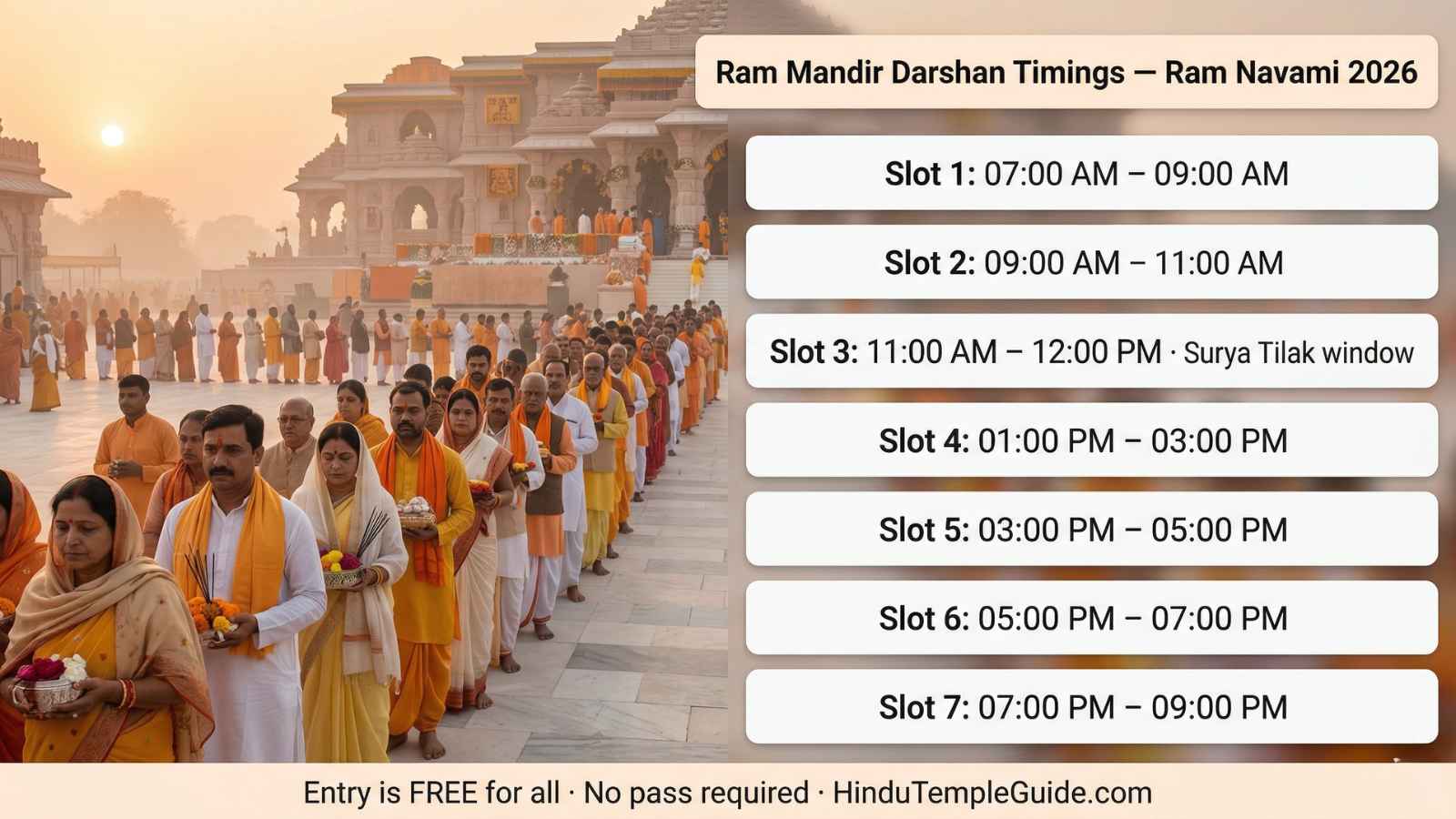
Best Entry Windows Across the Day (7 Darshan Time Windows)
Window
Timings
Crowd & Planning Note
Window 1 - Best
07:00 AM - 09:00 AM (Mela opens 3:30 AM)
Cool morning weather; best for senior citizens & children
Window 2
09:00 AM - 11:00 AM
Queue builds ahead of the midday Janmotsav rituals
Evening architectural illumination; combine with Saryu Aarti
Window 7
07:00 PM - 09:00 PM (Open till 11:00 PM on Mela days)
Cooler night breeze and faster-moving lanes
During Ram Navami in Ayodhya, darshan is 100% free and open to all without any pass requirement, with temple hours extended from 3:30 AM to 11:00 PM on peak festival days.
Daily Aarti Schedule at Ram Mandir
Aarti
Time
Mangala Aarti (Pre-dawn awakening)
04:00 AM - 04:30 AM (3:30 AM on Ram Navami)
Shringar Aarti (Morning adornment)
06:00 AM - 06:30 AM (5:00 AM on Ram Navami)
Rajbhog & Ram Janmotsav Midday Aarti
12:00 PM Noon (Simultaneous with Surya Tilak)
Sandhya Aarti (Evening lamp offering)
06:30 PM - 07:00 PM
Shayan Aarti (Night closing ritual)
09:30 PM - 10:00 PM (11:00 PM on Ram Navami)
Essential Security & Locker Rules on Janmabhoomi Path
Leave Mobile Phones, Bags & Belts at the Hotel (or Free PFC Lockers): Mobile phones, smartwatches, cameras, electronic car keys, leather belts, and bags of any size are strictly prohibited past the security frisking checkpoint. On Ram Navami, leaving your phone and bag locked in your hotel room saves you 45 minutes in the Pilgrim Facilitation Centre (PFC) cloakroom queue!
Free Drinking Water, ORS & Shade Canopies: The Trust provides overhead shade canopies, red jute floor carpets (so your bare feet do not burn in the March/April sun), and free RO drinking water stations along the entire Janmabhoomi Path queue.
Keep Original Aadhaar ID & Cash in Your Pocket: Only cash notes, spectacles, essential medicines, and your original government ID are permitted inside.
Ram Navami Celebrations in Ayodhya: Hour-by-Hour Experience
Ayodhya on Ram Navami is not just a temple visit-it is a city-wide festival. Over 50 quintals of marigolds, roses, and orchids deck the sandstone pillars of the Ram Mandir, and every intersection from Lata Mangeshkar Chowk to Hanuman Garhi resounds with "Bhaye Pragat Kripala Deen Dayala" at noon:
3:30 AM - 5:30 AM · Brahma Muhurat
Sacred Saryu Dip & Hanuman Garhi Darshan
Devotees begin with a holy dip in the Saryu River at Naya Ghat / Ram Ki Paidi before sunrise, followed by climbing the 76 steps of Shri Hanuman Garhi to seek Lord Hanuman's permission (Agya).
Bhagwan Shri Ram Lalla is bathed in milk, curd, ghee, honey, and Saryu jal, anointed with herbal Chandan, and dressed in bespoke yellow hand-woven silk (Pitambari) threaded with gold zari and gems.
12:00 PM - 12:27 PM · Abhijit / Madhyahna Muhurat
The Surya Tilak & 56-Bhog Janmotsav Aarti
At noon, the 58 mm beam of natural sunlight illuminates Ram Lalla's forehead for 4-5 minutes while priests offer Chhappan Bhog (56 delicacies) and Panjiri prasad, broadcast live across Ayodhya.
Afternoon · 4:00 PM Onwards
Sohar Badhai Geet at Kanak Bhawan & Dashrath Mahal
Traditional Awadhi Sohar (childbirth folk songs) and Badhai celebrations fill the courtyards of Kanak Bhawan and Dashrath Mahal, with saints dancing and distributing laddoos and panjiri.
Evening · 6:30 PM - 8:00 PM
Maha Saryu Aarti & Laser Show at Ram Ki Paidi
Thousands of brass lamps light up the banks of the Saryu at Naya Ghat, followed by the projection-mapping Ramayana light and sound show at Ram Ki Paidi.
SECTION 6
6 Famous Ram Temples to Visit on Ram Navami (Beyond Ayodhya)
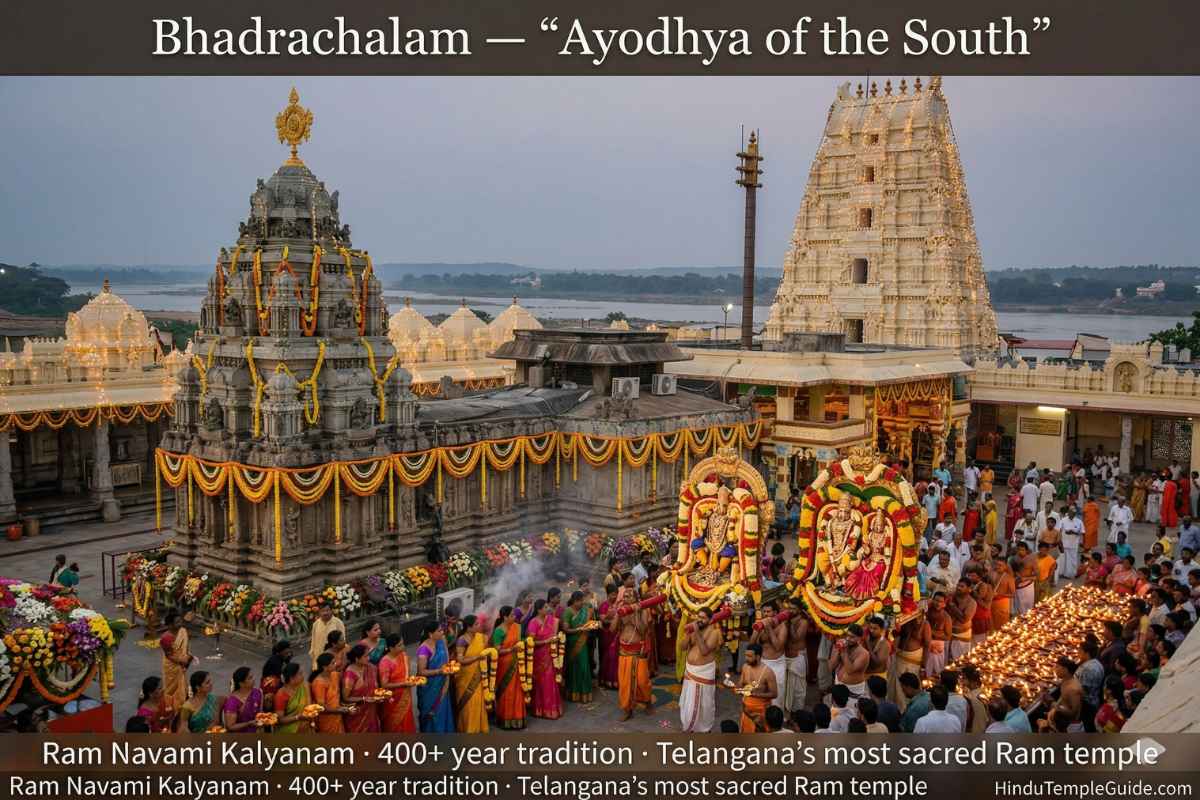
Bhadrachalam Temple in Telangana-revered as "Dakshina Ayodhya"-has celebrated the celestial Sri Sita Rama Kalyanam at the Mithila Stadium on Ram Navami for nearly 400 years since the time of Bhakta Ramadasu.
If you cannot travel to Ayodhya during the festival rush, these six historic shrines across India host unforgettable Ram Navami celebrations:
1. Sri Sita Ramachandra Swamy Temple, Bhadrachalam, Telangana ("Dakshina Ayodhya")
Perched on the banks of the Godavari River in Bhadradri Kothagudem district, Bhadrachalam was built in the 17th century by Kancharla Gopanna (Bhakta Ramadasu). Every Ram Navami at noon, the grand Sri Sita Rama Tirukalyana Mahotsavam (celestial wedding of Lord Ram and Goddess Sita) is performed at the open-air Mithila Stadium, where the Chief Minister of Telangana traditionally arrives in state procession carrying silk robes (Pattu Vastralu) and sacred pearls (Mutyala Talambralu) on behalf of the government.
2. Shri Ram Raja Mandir, Orchha, Madhya Pradesh (Where Ram Rules as King)
Located on the banks of the Betwa River 18 km from Jhansi, Orchha is the only shrine in India where Lord Ram is worshipped as a reigning monarch ("Ram Raja Sarkar") inside a royal palace rather than a temple spire. Brought on foot from Ayodhya in the 16th century by Bundela Queen Maharani Ganesh Kunwari, the Lord receives an official armed police guard of honour (Gun Salute) four times every day during each aarti.
Here in Maharashtra, two ancient Dandakaranya exile sites draw lakhs of devotees on Ram Navami: Shree Kalaram Mandir in Panchavati, Nashik (built in 1792 by Sardar Rangarao Odhekar with black-stone idols of Ram, Sita, and Lakshman, famous for its 15-day Chaitra Rathotsav) and Shree Ramtek Gad Mandir (50 km from my hometown of Nagpur), perched atop Ramgiri Hill where Lord Ram rested during his exile and took the vow (Tek) to rid the sages of demons, celebrated with the historic Ramtek Ramjanmotsav & Rath Yatra.
4. Arulmigu Ramanathaswamy Temple, Rameswaram, Tamil Nadu
On Pamban Island-where Lord Ram built the Rama Setu bridge to Lanka and established the Rameshwaram Jyotirlinga-Ram Navami is celebrated with a 10-day festival at both Ramanathaswamy Temple and the seaside Kothandaramaswamy Temple at Dhanushkodi (where Vibhishana surrendered to Lord Ram).
Overlooking the Chakratirtha bend of the Tungabhadra River in the UNESCO World Heritage site of Hampi (ancient Kishkindha), Kodandarama Temple marks the spot where Lord Ram crowned Sugriva, hosting a grand Chaitra Rathotsava. In the east, Punaura Dham & Janaki Mandir in Sitamarhi (Bihar)-the birthplace of Goddess Sita-celebrates Ram Navami with massive Mithila folk processions.
SECTION 7
Ram Navami Puja Vidhi: How to Perform Puja at Home
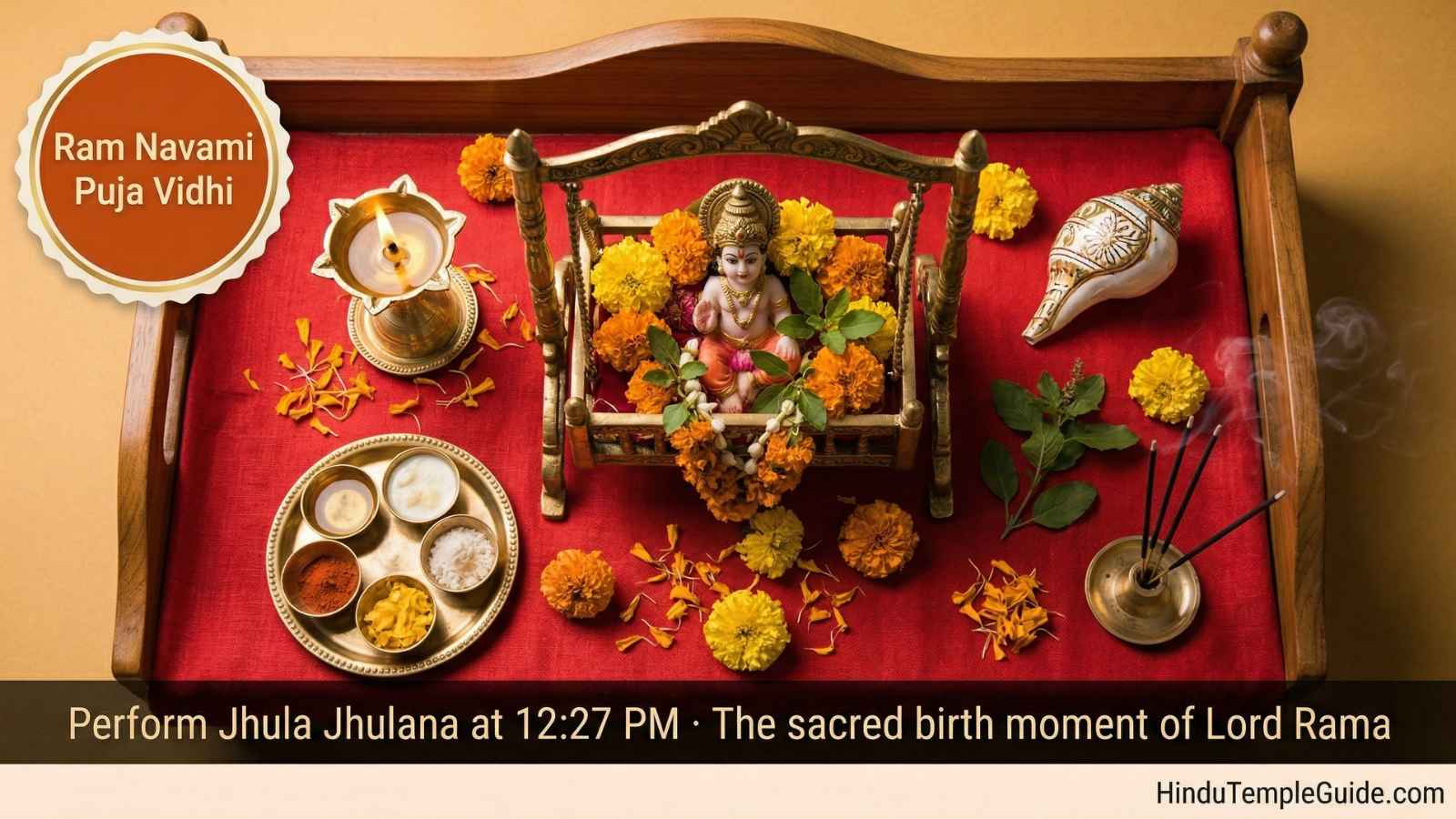
A traditional Ram Navami puja at home centres on the Bal Swaroop (infant Ram) placed in a decorated cradle (Palna), rocked gently at midday during the birth muhurat.
In Hindu homes, Ram Navami is celebrated by worshipping both the Ram Darbar (Lord Ram, Goddess Sita, Lakshman, and Hanuman) and the Bal Swaroop (infant Ram Lalla) placed inside a flower-decked cradle (Jhula / Palna):
Puja Samagri Checklist
Murti or framed picture of Ram Darbar and infant Ram Lalla + a small wooden/metal cradle (Palna)
Yellow silk cloth for the wooden chowki (Asana), Gangajal, and a copper Kalash with mango leaves & coconut
Panchamrit: Raw cow's milk, curd, desi ghee, honey, and sugar/jaggery
Yellow sandalwood paste (Pila Chandan), Roli, Akshata, yellow marigold flowers, and fresh Tulsi leaves (essential for Vishnu/Rama puja)
Dhaniya Panjiri (roasted coriander-seed powder with ghee and mishri), Kheer, and seasonal fruits for Naivedya/Prasad
Bathe before sunrise, wear clean yellow or saffron attire, clean the home temple with Gangajal, and if you observe the 9-day Chaitra Navratri fast, perform Havan and Kanya Pujan in the morning.
Step 2 - 11:13 AM · Begin Madhyahna Abhishekam
Invoke Lord Ganesha first, then bathe the metallic idol of Bal Ram with Panchamrit and pure Gangajal while chanting "Om Sri Ramaya Namah", wipe gently, apply a yellow Chandan tilak, and place the idol in the decorated cradle.
Step 3 - 11:30 AM to 12:00 PM · Stotra & Ramcharitmanas Path
Offer Tulsi leaves and yellow flowers, and recite the Sri Ram Raksha Stotra, the Bala Kanda birth verses of the Ramcharitmanas, and the Hanuman Chalisa.
At the exact midday birth moment, ring the puja bell, blow the conch shell, sing "Bhaye Pragat Kripala Deen Dayala, Kausalya Hitkari" and "Shri Ramachandra Kripalu Bhajman", and gently pull the cradle cord (Palna) to rock baby Ram.
Step 5 - Bhog Offering & Prasad Distribution
Offer Dhaniya Panjiri, Kheer, Panchamrit, and fruits with a Tulsi leaf placed on top, and distribute the consecrated prasad to your family and neighbours.
SECTION 8
Ram Navami Fasting (Vrat) Rules and What to Eat
Devotees observe the Ram Navami Vrat in one of two ways: either as the final day of the nine-day Chaitra Navratri fast or as a standalone Ram Janmotsav fast from sunrise until after the midday puja (or until Dashami sunrise the next morning, depending on family Kulachara):
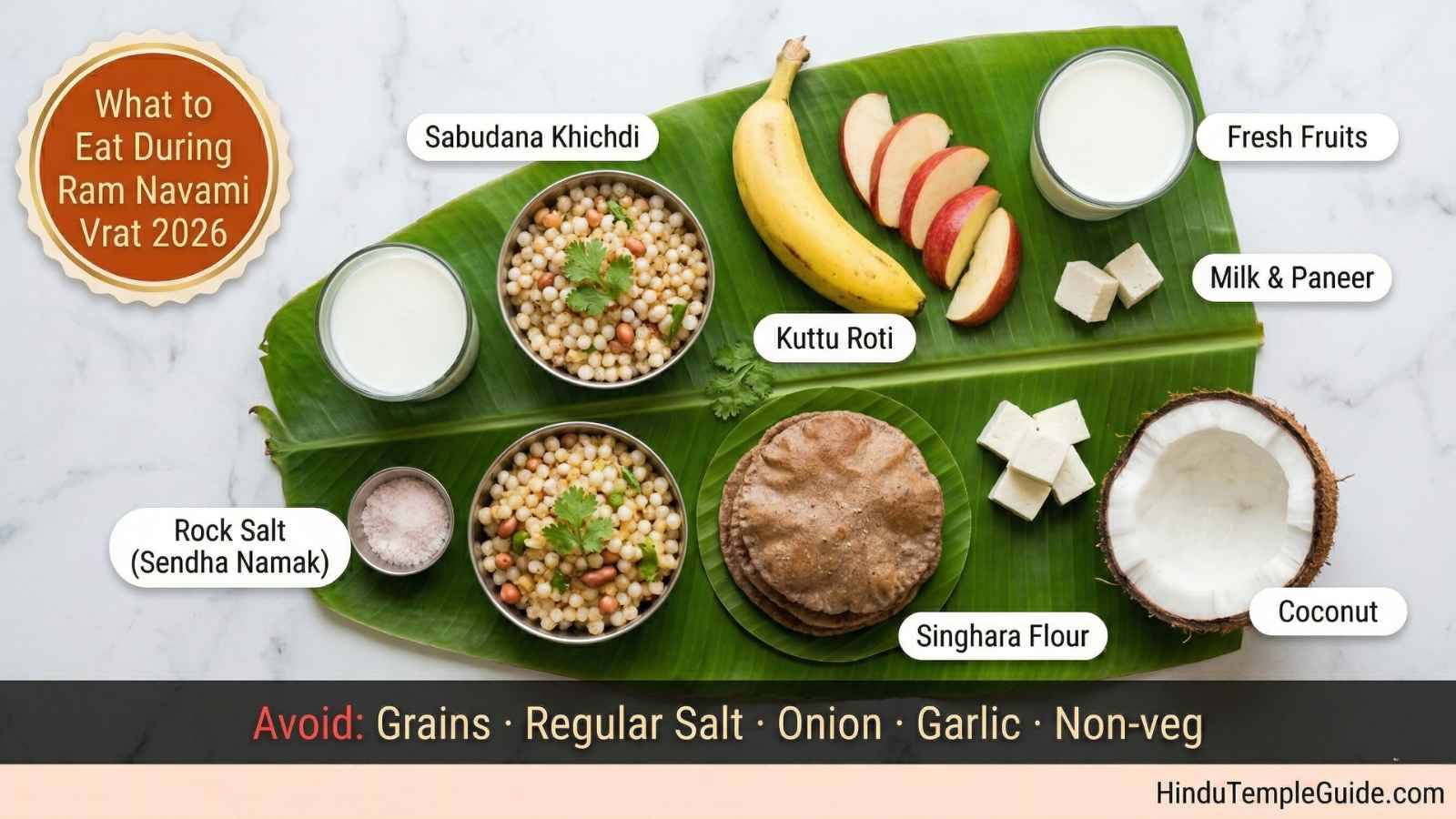
Satvik Phalahar items allowed during the Ram Navami fast: sabudana khichdi, kuttu/singhara flour preparations, fruits, milk, curd, and rock salt (sendha namak), along with South Indian Panakam and Neer Mor.
Fasting Rules - What to Avoid
Avoid regular cereal grains (wheat, rice, maida, suji, oats), pulses/lentils (dal), and regular iodised table salt during the vrat window.
Strictly avoid onion, garlic, non-vegetarian food, alcohol, and tamasic items across the household.
Avoid afternoon naps and angry speech while observing the fast, dedicating midday hours to kirtan or Ramayana reading.
Satvik Phalahar - What You Can Eat During the Fast
Traditional Naivedya & Cooling Drinks:Dhaniya Panjiri, Panchamrit, and in South India/Maharashtra, jaggery-pepper-cardamom Panakam, spiced buttermilk (Neer Mor / Taak), and soaked moong dal Kosambari / Vadapappu.
Vrat Flours & Meals: Sabudana (sago) khichdi or kheer, Kuttu (buckwheat) or Singhara (water chestnut) puris, Rajgira (amaranth) ladoos, and boiled potatoes/sweet potatoes seasoned with Sendha Namak (rock salt), cumin, and black pepper.
Fruits & Dairy: Fresh seasonal fruits, coconut water, milk, curd, paneer, and makhana (fox nuts) roasted in pure cow's ghee.
SECTION 9
How to Reach Ayodhya & Navigate Festival Traffic Controls
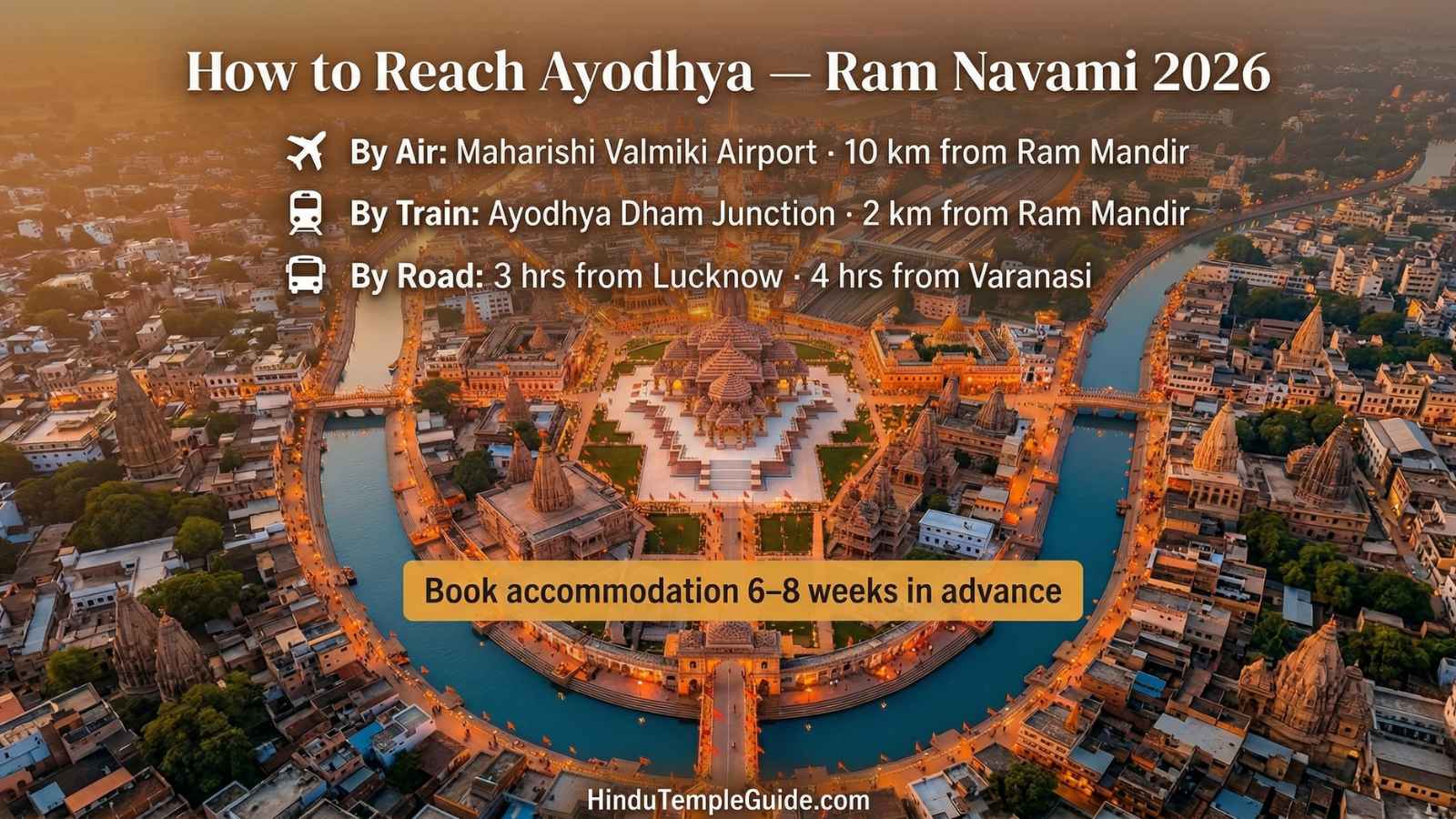
Ayodhya is served by Maharishi Valmiki International Airport (AYJ - 10 km), Ayodhya Dham Junction (AY - 1.5 km), and Ayodhya Cantt (AYC - 10 km).
Crucial Ram Navami Mela Traffic Rule: From 48 hours before Ram Navami until the day after, Uttar Pradesh Police convert the entire inner core of Ayodhya Dham (Ram Path, Bhakti Path, and Naya Ghat) into a 100% pedestrian-only zone. Outstation private cars and tourist buses are halted at peripheral parking lots along NH-27-making trains to Ayodhya Dham Junction (1.5 km walk from Janmabhoomi Path) by far the easiest way to arrive!
By Air - Ayodhya Airport (AYJ) & Lucknow Airport (LKO)
Maharishi Valmiki International Airport (AYJ) sits 10 km from the temple with direct flights from Delhi, Mumbai, Bengaluru, Ahmedabad, and Hyderabad. If festival airfares to AYJ spike, fly into Lucknow Airport (LKO - 135 km away) and take a 2-hour train or NH-27 highway bus to Ayodhya.
By Train - Best Choice During Ram Navami Mela
Ayodhya Dham Junction (AY) is just 1.5 km walking distance from Janmabhoomi Path, bypassing outer highway vehicle barriers completely, while Ayodhya Cantt (AYC) is 10 km away. Fast connections include the Vande Bharat Express and Amrit Bharat Express from Delhi (~8 hrs 20 mins), Lucknow (~2 hrs), and Varanasi (~3.5 hrs).
By Road & Where to Stay During the Festival Rush
Ayodhya is 135 km from Lucknow (2.5 hrs via NH-27), 165 km from Prayagraj (3.5 hrs), and 215 km from Varanasi (4 hrs). If Birla Dharamshala, UPSTDC Rahi Yatri Niwas, and homestays in Ayodhya town are sold out for Ram Navami, book a hotel in Faizabad / Ayodhya Cantt (8-10 km away) or Lucknow and take a morning train or electric shuttle bus in for darshan.
SECTION 10
Ram Navami Across India: Regional Traditions
Every region of India brings its own distinct devotional tradition to Ram Janmotsav:
Region
Signature Ram Navami Tradition
Maharashtra (Nagpur, Nashik & Sajjangad)
Nine-day Geet Ramayan and Grantha Parayana recitations culminating at 12:00 PM with flower petals showered on the cradle, Sunthavada (dry ginger-sugar prasad) distribution, the grand Poddareshwar Ram Mandir Shobha Yatra in Nagpur, Ramtek Rathotsav, and Samartha Ramdas Swami's historic Utsav at Sajjangad.
Telangana, Andhra Pradesh & Tamil Nadu
Observed as the wedding anniversary of Lord Ram and Sita (Sita Rama Kalyanam at Bhadrachalam & Ontimitta), accompanied by Carnatic concerts of Saint Tyagaraja's Pancharatna Kritis and street distribution of cooling Panakam and Neer Mor.
Uttar Pradesh, Bihar & North India
24-hour Akhand Ramcharitmanas Path, Chaitra Navratri Kanya Pujan (worshipping nine young girls as forms of Maa Durga), and massive Ram Lalla Janmotsav celebrations in Ayodhya, Kashi, and Sitamarhi.
Odisha & Eastern India
At Jagannath Puri, the 15-day Sahi Yatra folk theatre festival begins on Ram Navami, while temples across West Bengal and Jharkhand host grand Mahavir Jhanda and Ram Navami Shobha Yatras.
Q1. What was the exact date and muhurat of Ram Navami 2026, and when is Ram Navami 2027?
In 2026, the Chaitra Shukla Navami Tithi began at 11:48 AM on Thursday, March 26 and ended at 10:06 AM on Friday, March 27 (with Smarta households observing it on March 26 and Vaishnava/Ayodhya Ram Mandir Udaya Tithi celebrations on March 27; Madhyahna Muhurat: 11:13 AM - 1:41 PM; midday moment: 12:27 PM). Next year, Ram Navami 2027 falls on Thursday, April 15, 2027 (Madhyahna Muhurat: 11:04 AM to 1:38 PM; Madhyahna Moment: 12:21 PM).
Q2. What is the Surya Tilak at Ayodhya Ram Mandir and how long does it last?
The Surya Tilak is a yearly opto-mechanical ritual at the Shri Ram Janmabhoomi Mandir in Ayodhya where natural midday sunlight is directed through four lenses and four brass-mounted mirrors onto the forehead of the 51-inch Ram Lalla idol at 12:00 PM noon on Ram Navami. Engineered by CSIR-CBRI Roorkee and IIA Bengaluru with a 19-gear mechanical lunar-solar calendar mechanism, the 58 mm tilak illuminates the deity's brow for 4 to 5 minutes.
Q3. Are Sugam Darshan or Aarti passes available on Ram Navami at Ayodhya Ram Mandir?
No. Pre-booked Sugam Darshan and Aarti E-Passes are suspended during the 3-4 day Ram Navami Mela so that all devotees can walk continuously through the free general darshan lanes from 3:30 AM to 11:00 PM. For non-festival dates, free passes can be booked 15 days ahead at online.srjbtkshetra.org.
Q4. What foods are offered as prasad and eaten during the Ram Navami fast?
In North and Central India, Dhaniya Panjiri (coriander-seed powder roasted in ghee with sugar/mishri), Panchamrit, and Sunthavada (dry ginger and sugar) are the traditional birth offerings, while South Indian homes and temples prepare Panakam (jaggery-pepper-cardamom drink), Neer Mor (spiced buttermilk), and Vadapappu / Kosambari. Fasting devotees eat fruits, dairy, sabudana, kuttu/singhara rotis, and sendha namak.
Q5. Which are the best temples in India to experience Ram Navami outside Ayodhya?
The top destinations outside Ayodhya are Bhadrachalam Sri Sita Ramachandra Swamy Temple (Telangana) for the grand state-sponsored Kalyanam, Orchha Ram Raja Mandir (Madhya Pradesh) for the police guard of honour to King Ram, Kalaram Mandir in Nashik & Ramtek Gad Mandir near Nagpur (Maharashtra), Rameswaram (Tamil Nadu), and Kodandarama Temple in Hampi (Karnataka).
Final Thoughts - Celebrating the Ideals of Maryada Purushottam
Whether you witness the noon Surya Tilak in Ayodhya, attend the Kalyanam in Bhadrachalam, walk in the Ram Navami Shobha Yatra in Nagpur or Nashik, or rock the cradle of Bal Ram at home with your family, Ram Navami reminds us of the timeless values Lord Ram lived by-truth, Steadfast Dharma, humility, and compassion. Have a question about planning your Ayodhya trip? Send me a message here-I reply to every reader personally. - Devendra Khambalkar, Nagpur
Jai Siya Ram!
Read More Pilgrimage & Temple Guides on HinduTempleGuide.com
Written by Devendra Khambalkar, Nagpur, Maharashtra | Last updated: October 2026. Panchang tithi timings and Ayodhya darshan arrangements in this guide are cross-checked against Drik Panchang and official announcements by the Shri Ram Janmabhoomi Teerth Kshetra Trust (srjbtkshetra.org). Always verify official passes at online.srjbtkshetra.org before travelling.
DK
Written by Devendra Khambalkar
Based in Nagpur, Maharashtra. Personally visited 50+ sacred shrines across India including Tirupati, Guruvayur, Vaishno Devi, Somnath, Mahakaleshwar Ujjain, and completed the Char Dham Yatra.